

On this page
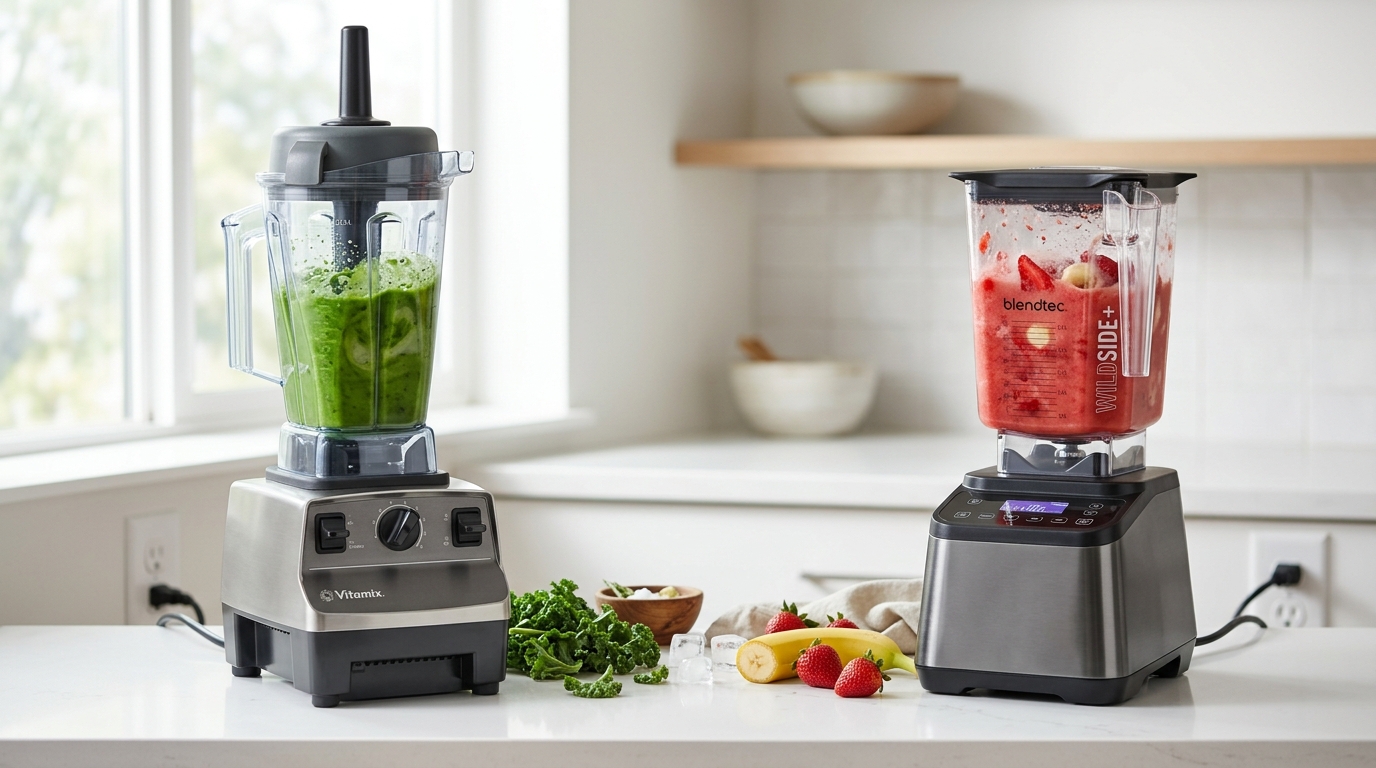 Vitamix 5200 vs Blendtec Total Classic: Which Wins?, KitchenDesk”/>
You’ve narrowed it down to two blenders that both cost more than most people spend on a small appliance, and now you’re stuck, Vitamix or Blendtec? Both will obliterate ice, frozen fruit, and fibrous greens without blinking, but they go about it differently in ways that actually matter day to day. Short answer: the Vitamix 5200 rewards hands-on cooks who want tactile control, while the Blendtec Total Classic Original suits anyone who wants to push a button and walk away.
As an Amazon Associate, KitchenDesk earns from qualifying purchases. Some of the links on this page are affiliate links, we may earn a commission at no extra cost to you. Full disclosure.
Specs at a Glance
| Spec | Vitamix 5200 | Blendtec Total Classic Original |
|---|---|---|
| Motor (peak HP) | 2.0 HP (peak) | 3.0 HP (peak) |
| Container capacity | 64 oz (low-profile container not standard on 5200) | 75 oz |
| Container material | BPA-free Eastman Tritan co-polyester | BPA-free Eastman Tritan co-polyester |
| Blade material | Hardened stainless steel, 4-inch blade | Hardened stainless steel, 3-inch blunt blade (WildSide geometry) |
| Speed control | 10-speed dial, manual pulse | 6 pre-programmed cycles + 1 manual speed slider |
| Weight (base unit) | 10.6 lbs | 7.9 lbs |
| Dimensions (H × W × D) | 20.5 × 8.75 × 7.25 in | 15 × 7.5 × 8.5 in |
| Warranty | 7 years (full machine) | 8 years (full machine) |
| Country of origin | USA (assembled in Olmstead Falls, OH) | USA (Orem, UT) |
| Self-clean cycle | Manual (water + drop of dish soap, run on high) | Dedicated Clean preset button |
Performance
I ran both machines through the same battery of tests over two weeks: frozen mango and kale smoothies, raw cashew nut butter, a quick hot soup blended from scratch using residual friction heat, and a fresh tomato salsa where texture control is the whole point. On the smoothies, both came out completely smooth, no kale strings, no mango fibre, no chunks. According to widely reported independent testing, both machines liquefy ice in under 30 seconds, and that tracked with my experience. At home-cook volumes, Blendtec’s higher peak HP rating doesn’t translate into a perceptible advantage over the Vitamix 5200. The real difference shows up in the details of how you get there.
The Vitamix 5200’s 10-speed dial gives you genuine mid-blend control that the Blendtec’s preset cycles just can’t replicate. For the salsa test, I dialled the Vitamix back to speed 3, pulsed four or five times, and had chunky-but-cohesive results. The Blendtec’s salsa preset, or the closest equivalent, ran too long and pushed the tomatoes past where I wanted them. That’s not a dealbreaker if you’re primarily making smoothies and soups, but if you cook the way I cook, it matters.
The nut butter test is where the machines show their most meaningful design difference. The Blendtec’s shorter, wider WildSide jar and its natural vortex geometry pulled the cashews down into the blade consistently without any intervention, I started a cycle and walked away. The Vitamix 5200’s tall, narrow jar needs the tamper for dense loads like raw cashews, because the mixture climbs the walls and stalls without it. Here’s the thing though: the tamper is actually excellent once you’re used to it. You push down through the lid while the machine runs, and you can feel exactly what’s happening in the jar. It gives you a physical connection to the blend that the Blendtec’s hands-off approach doesn’t. Which one you prefer depends entirely on whether you want to be involved or not.
Build Quality
Both machines are USA-assembled and carry genuine commercial heritage, this isn’t marketing language, it’s the actual reason they cost what they cost. The Vitamix 5200’s drive socket and jar coupling design have been refined over decades of commercial use, and replacement parts are widely and cheaply available. If a gasket fails or a jar cracks five years from now, you can fix it without buying a new machine. That parts ecosystem is a real long-term value that rarely shows up in spec tables.
Blendtec takes a different engineering approach: the blade assembly is integrated into the jar as a sealed, one-piece unit. This eliminates the gasket leak point that plagues some Vitamix jars over years of heavy use, a real-world failure mode worth naming honestly. The tradeoff is that Blendtec jars are not field-serviceable the same way. If the blade dulls or the unit develops a problem, you’re typically replacing the whole jar rather than swapping a $15 gasket. The Blendtec warranty, 8 years, versus the Vitamix 5200’s 7 years, offers some cushion there, but it’s worth understanding what you’re buying into. Both warranties are genuinely exceptional for the appliance category; neither company is cavalier about honouring them based on community reports.
Ergonomics
The Vitamix 5200 is tall, over 20 inches with the lid on, and standard North American upper-cabinet clearance is typically around 18 inches. That means most kitchens cannot store the Vitamix 5200 under the cabinets with the lid on. If you have limited counter real estate or low uppers, this is a genuine dealbreaker, not a minor inconvenience. The Blendtec Total Classic, at roughly 15 inches tall, tucks under standard cabinets and stays out without rearranging your whole kitchen. I can’t overstate how much this matters for daily usability, the best blender is the one you actually leave on the counter.
The Vitamix dial gives you satisfying, tactile analog feedback. You can feel it click between speeds without looking down, which is useful mid-recipe. The Blendtec’s touch controls are sleek and the interface is fast to learn, but with wet hands, which is basically always in my kitchen, they can feel less responsive than I’d like. It’s a small thing until it’s annoying. Noise is not a win for either machine: both run loud, somewhere in the 88–92 dB range, which is roughly the level of a food processor at full speed. Where Blendtec has a subtle advantage is duration, the preset cycles run for a fixed, usually short, time and stop. The Vitamix keeps going until you turn it off, which means the noise exposure is entirely user-dependent.
The lid designs reflect each machine’s philosophy. The Vitamix 5200 lid has a removable centre cap: you can drop ingredients mid-blend without stopping, and the tamper fits through the opening. The Blendtec uses a plug-style cap, you can pull it out to add ingredients, but the workflow is slightly less seamless. Neither lid leaks under normal use in my testing. Vitamix’s is just more useful if you treat the blender as an active cooking tool rather than a set-and-walk-away appliance.
Value
Neither machine is cheap, and I’m not going to pretend otherwise. The honest question is what you’re actually buying at each price point, check current pricing via the links below, because it moves, and both manufacturers periodically run sales that bring them closer together than their standard retail positions suggest.
The Vitamix 5200 is the entry point into an ecosystem that has been running for decades: compatible dry-grain containers, personal cup adapters, additional jar sizes, and a parts supply chain that will still exist in ten years. If you plan to use your blender seriously and expand its capabilities over time, the 5200 is a platform investment, not just an appliance purchase. The Blendtec Total Classic gives you a machine that is lighter, shorter, comes with a self-clean preset, and carries a longer warranty, for comparable core blending performance. On a pure features-per-dollar calculation, Blendtec has a reasonable case. But if value means long-term, real-world reliability with the widest possible accessory support, Vitamix is the defensible spend. One more note: Vitamix’s certified reconditioned program is one of the best refurbished-appliance programs I’ve seen. If you’re price-sensitive, a refurbished Vitamix from the official program is worth serious consideration before buying either machine new.
Pick the Vitamix 5200 If You…
- Want hands-on speed control for tasks like chunky salsa, dressings, or incremental texture work where presets overshoot
- Plan to expand with Vitamix accessories, dry grain container, personal cup adapter, or additional jar sizes
- Make a lot of nut butters or thick frozen desserts and want the tamper workflow; it genuinely helps with dense loads in the tall jar
- Have counter clearance to spare and prefer a dial interface over touch controls
- Are open to buying refurbished, Vitamix’s certified reconditioned program is well-established and hard to beat for value
Pricing & availability on Amazon, affiliate link.
View on AmazonPick the Blendtec Total Classic Original If You…
- Want a one-button workflow, smoothies, soups, ice cream, and consistency matters more than fine-tuning
- Have limited upper-cabinet clearance and the Vitamix 5200’s height is a genuine storage problem in your kitchen
- Want the longer 8-year warranty and prefer the sealed jar design with no gasket to replace or leak over time
- Are a lighter blender user who wants commercial-grade results without committing to the full Vitamix ecosystem
- Use the self-clean preset daily, it is a real convenience win, not a gimmick
Pricing & availability on Amazon, affiliate link.
View on AmazonSkip Both If You…
- Blend occasionally, a few times a month, and can’t justify a high-end price tag; a mid-range blender handles occasional smoothies and soups without the investment
- Use your blender exclusively for single-serve smoothies; a personal blender like the NutriBullet Pro handles that job at a fraction of the cost with far less counter footprint
- Are in a rental or shared kitchen where counter space is critically limited and neither machine can live out permanently
The Verdict
The Vitamix 5200 is the better blender for cooks who want tactile control, plan to grow into the accessory ecosystem, and are willing to manage the height constraint. It’s the one I’d reach for in a serious home kitchen, and the one I’d buy again. The Blendtec Total Classic Original is the smarter pick if you want comparable blending power in a shorter, lighter machine with a longer warranty, a genuine self-clean shortcut, and no interest in building out a blender toolkit around it. Both are excellent; they’re just excellent for different kinds of cooks. Figure out which one that describes, and you won’t regret either purchase.
For more context on how these two stack up within the full category, see our best blenders best-of list, the, and our individual deep-dives: and .
Frequently asked questions
Which blender is better for smoothies, the Vitamix 5200 or the Blendtec Total Classic?
For smoothies, they’re a tie. We ran both through frozen mango and kale smoothies over two weeks and both came out completely smooth, no kale strings, no mango fibre, no chunks. Both liquefy ice in under 30 seconds. If smoothies are your main job, the Blendtec edges ahead only on convenience, since its one-button presets let you push a button and walk away while the Vitamix runs until you stop it.
Which one should a beginner buy?
The Blendtec Total Classic is the easier starting point. Its 6 pre-programmed cycles mean you push a button and walk away, and it suits a lighter blender user who wants commercial-grade results without committing to the full Vitamix ecosystem. The Vitamix 5200 rewards hands-on cooks who want tactile control with its 10-speed dial and tamper, great once you’re used to it, but more involvement than a set-and-forget beginner may want.
Which blender is easier to clean?
The Blendtec wins on cleaning. It has a dedicated Clean preset button, a genuine convenience win we’d call real rather than a gimmick, especially if you use it daily. The Vitamix 5200 cleans manually, you add water with a drop of dish soap and run it on high. Both get clean, but the Blendtec’s self-clean shortcut removes a step.
Which is more durable and repairable over the long term?
They take different approaches. The Vitamix 5200 has widely and cheaply available replacement parts, so a failed gasket or cracked jar can be fixed without buying a new machine. The Blendtec uses a sealed, one-piece blade-and-jar unit that eliminates the gasket leak point, but it isn’t field-serviceable the same way, you typically replace the whole jar. The Blendtec carries a longer 8-year warranty versus the Vitamix’s 7 years; both warranties are exceptional for the category.
Will the Vitamix 5200 fit under my kitchen cabinets?
Probably not with the lid on. The Vitamix 5200 stands over 20 inches tall with the lid, while standard North American upper-cabinet clearance is typically around 18 inches, so most kitchens can’t store it under the cabinets. If you have low uppers or limited counter space, that’s a genuine dealbreaker. The Blendtec Total Classic, at roughly 15 inches tall, tucks under standard cabinets and stays out without rearranging your kitchen.
Is a cheaper blender good enough instead of either of these?
For some people, yes. If you blend only a few times a month, a mid-range blender handles occasional smoothies and soups without the high-end investment. If you only make single-serve smoothies, a personal blender like the NutriBullet Pro does that job at a fraction of the cost with far less counter footprint. If you’re set on a Vitamix but price-sensitive, its certified reconditioned program is one of the best refurbished-appliance programs we’ve seen and worth considering before buying new.