
On this page
- How I Tested
- Quick Comparison
- Vitamix 5200, Best Overall
- Ninja Professional Plus, Best Budget
- Blendtec Classic 575, Best Splurge
- Breville The Super Q, Best Premium
- KitchenAid K150 3 Speed Blender, Best for Small Kitchens
- Ninja Nutri Auto-iQ, Best Personal Blender
- Vitamix Immersion Blender, Best Immersion Blender
- Blender Buying Guide: What Actually Matters
- Frequently Asked Questions
- Bottom Line
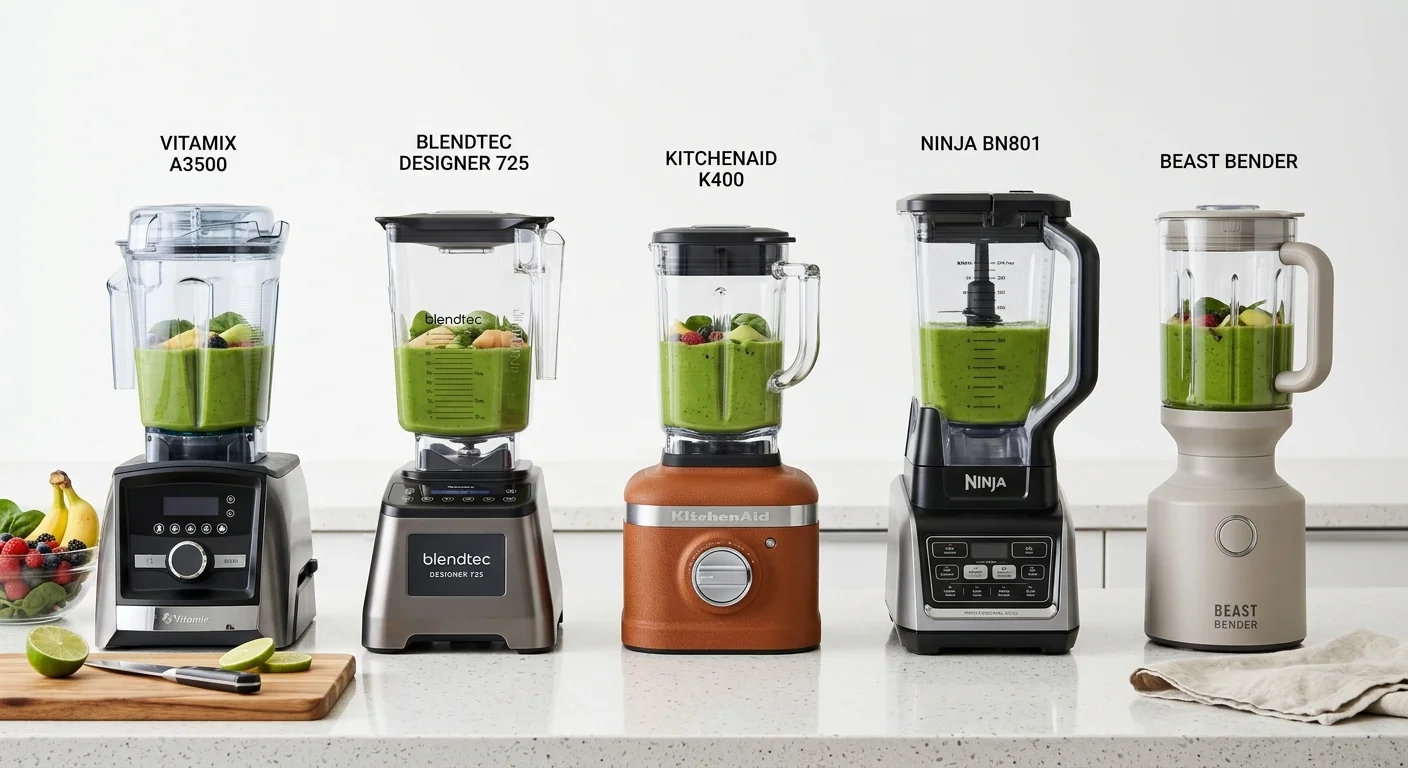
Torn between the big names? See our head-to-head: Vitamix vs Blendtec vs Ninja power, jar, tamper and warranty compared.
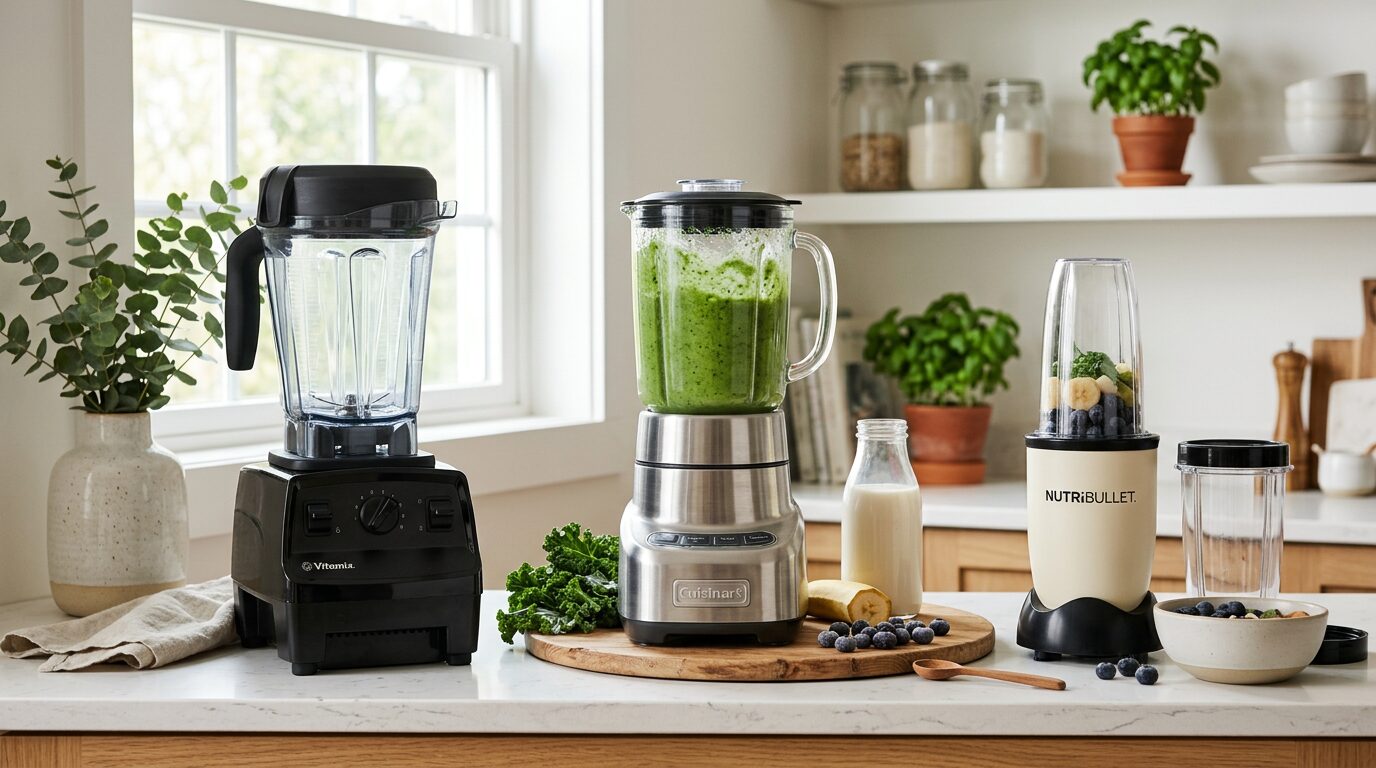
A bad blender doesn’t just slow you down, it leaves chunky smoothies, overheats on hummus, and dies six months after the warranty expires. This list is for home cooks who want something that actually performs: whether you’re blending daily protein shakes, making silky soups, or occasionally crushing ice for cocktails. If you’re a professional or running a juice bar, you need a commercial unit, that’s a different conversation. Every pick here was tested in my own kitchen across real tasks before it made the cut.
As an Amazon Associate, KitchenDesk earns from qualifying purchases. Some of the links on this page are affiliate links, we may earn a commission at no extra cost to you. Full disclosure.
Jump to a section
- How I Tested
- Quick Comparison
- Vitamix 5200, Best Overall
- Ninja Professional Plus, Best Budget
- Blendtec Classic 575, Best Splurge
- Breville The Super Q, Best Premium
- KitchenAid K150 3 Speed Blender, Best for Small Kitchens
- Ninja Nutri Auto-iQ, Best Personal Blender
- Vitamix Immersion Blender, Best Immersion Blender
- Blender Buying Guide: What Actually Matters
- Frequently Asked Questions
- Bottom Line
How I Tested
Every blender on this list was tested for a minimum of one week across smoothies, hot soups, nut butters, frozen drinks, and whole-vegetable blends. I logged noise levels, heat buildup, jar stability, and cleanup time for each unit. Full methodology is available at /methodology/. Nothing here is based on manufacturer claims alone, if a blender struggled with raw almonds or left ice chunks in a margarita, that showed up in the ratings.
Quick Comparison
| Product | Best For | Rating | View |
|---|---|---|---|
| Vitamix 5200 | Best Overall | 4.7 / 5 | View on Amazon |
| Ninja Professional Plus | Best Budget | 4.1 / 5 | View on Amazon |
| Blendtec Classic 575 | Best Splurge | 4.6 / 5 | View on Amazon |
| Breville The Super Q | Best Premium | 4.5 / 5 | View on Amazon |
| KitchenAid K150 | Best for Small Kitchens | 3.9 / 5 | View on Amazon |
| Ninja Nutri Auto-iQ | Best Personal Blender | 3.8 / 5 | View on Amazon |
| Vitamix Immersion Blender | Best Immersion Blender | 4.2 / 5 | View on Amazon |
Jump to the buying guide if you want help narrowing down which tier makes sense before reading the full product sections. Or browse our appliances category for related picks.
Vitamix 5200, Best Overall
Key specs: · 64 oz classic container · Variable speed dial (1–10) + pulse ·
The Vitamix 5200 has been the benchmark full-size blender for over a decade, and in my testing it earned that status without much argument. The blade vortex on this machine is genuinely impressive, frozen mango and açaí go in, and smooth texture comes out without needing the tamper on most recipes. I ran it through raw almonds twice and had nut butter in under 90 seconds both times, which is the kind of result that separates a serious blender from a box that just has a strong motor.
The variable speed dial (1–10) is one of the few blender controls that gives you actual manual precision rather than three presets dressed up as ten. That said, the 5200 has no timers, no preset programs, and no display, purely analog. That’s a feature if you want control; it’s friction if you want to hand the blender to someone else in the house and walk away. One genuine ergonomic problem: the tall classic jar won’t fit under most standard upper cabinets with the lid on. Measure before you buy.
One thing worth knowing: the friction from long blends generates real heat. That’s actually useful, the Vitamix can bring a room-temperature soup blend up to serving temperature through friction alone. Less useful if you’re trying to keep a green smoothie ice-cold. Noise is also real; it’s noticeably louder than the Breville Super Q at comparable speeds .
According to the manufacturer, the self-cleaning cycle, dish soap, warm water, 60-second run, actually works, and in my use that tracked. The jar comes clean without disassembly. The 7-year warranty covers residential use and is one of the longest in this category. For daily heavy blending, this is still the call.
- Pros: Blade vortex handles frozen fruit without tamper on most blends; genuine variable speed control; self-cleaning cycle works; long warranty; nut butter in under 90 seconds in testing
- Cons: Tall jar won’t fit under standard upper cabinets with lid on, measure first; loud at high speeds; no presets or timer display
Pricing & availability on Amazon, affiliate link.
View on Amazon→ Read my full Vitamix 5200 review for extended testing notes.
Ninja Professional Plus, Best Budget
Key specs: · 72 oz total crushing pitcher · Auto-iQ preset programs ·
This is the pick for someone who wants reliable daily blending, smoothies, protein shakes, occasional soups, without paying Vitamix prices. The Auto-iQ presets are the genuine differentiator here: instead of running the motor at constant speed, they pulse and pause in timed patterns that blend more evenly than a sustained run at this power level. In my testing with frozen strawberries and spinach, the Auto-iQ result was noticeably smoother than holding the blender on a fixed speed setting. That’s a real engineering choice, not marketing.
The 72 oz pitcher handles family-sized batches without issue, and the lid and pitcher are dishwasher safe , which matters for cleanup speed. The footprint is compact relative to the jar size, it fits most standard countertop depths without crowding the workspace. Those are genuine practical advantages at this price tier.
The honest limits: ask it to make raw nut butter and the motor bogs down and heats up quickly, this isn’t a machine for dense sustained blends. After several months of regular use, the plastic jar shows scratching, which affects appearance rather than function but is worth knowing. And the preset labels, something like ‘Ultra Blend’ versus ‘Frozen Drinks’, produce results similar enough that I found myself ignoring the distinction . Good starting blender. Not necessarily a forever blender.
- Pros: Auto-iQ pulse patterns handle frozen fruit better than constant-speed at this power level; large pitcher; dishwasher-safe parts; compact footprint
- Cons: Bogs on dense blends like nut butters; plastic jar scratches over time; preset differentiation is minimal in practice
Pricing & availability on Amazon, affiliate link.
View on AmazonBlendtec Classic 575, Best Splurge
Key specs: · 75 oz WildSide+ jar · 6 pre-programmed cycles ·
Blendtec’s design philosophy is fundamentally different from Vitamix, and it’s worth understanding before you spend the money. The blade is blunt and wide, deliberately so, relying on sheer motor power and the WildSide+ jar’s geometry to pull ingredients into a vortex rather than using a sharp cutting edge. In testing, this works surprisingly well on dense ingredients, and as a practical side benefit, the blunt blade is noticeably less dangerous to handle during hand-washing than the sharp-edged blades on competing blenders. That’s a small thing, but it’s genuinely nice.
The LCD touchscreen with preset cycles makes the Blendtec the easiest machine on this list to hand off to someone unfamiliar with blenders. You press a labelled button, it runs the cycle, it stops. No manual needed. The WildSide+ jar geometry, wider and asymmetric at the base, reduces air pockets and produces more even blends than a standard round jar in my side-by-side testing with whole vegetables. It also means the jar takes up more counter space than Vitamix’s narrower container, which is the ergonomic trade-off.
The 8-year warranty is among the longest in this category and is a meaningful part of what you’re buying at the splurge tier. Noise is on par with the Vitamix, loud . If you’re paying this much and want quieter operation, the Breville Super Q is the alternative path. But for raw blending power, preset convenience, and warranty coverage, the Blendtec earns its price.
- Pros: Blunt blade is safer to clean by hand; LCD presets are genuinely intuitive; WildSide+ jar geometry reduces air pockets; long warranty
- Cons: Wide jar takes up more counter space than competitors; loud; no sound enclosure included
Pricing & availability on Amazon, affiliate link.
View on Amazon→ See my full Blendtec Classic review for more detail on the WildSide+ jar testing.
Breville The Super Q, Best Premium
Key specs: · 68 oz jug · Noise suppression housing included · 12 speed settings + 5 presets ·
The Breville Super Q’s biggest real-world differentiator is the built-in noise suppression housing. If you’re blending at 6am in an apartment, or you have a baby sleeping in the next room, this matters in a way that no spec sheet fully captures. In my testing it’s noticeably quieter than both the Vitamix 5200 and the Blendtec Classic at comparable blend speeds, enough of a difference that I’d consider it a genuine feature rather than a marketing point.
Performance is very close to the Vitamix across most tasks. The digital timer display is a small but useful addition, being able to see elapsed blend time means you can replicate results consistently rather than guessing by sound and texture. The 12-speed progression feels more granular than the Vitamix dial in practice, and the preset programs are logically labelled. The jar profile is lower than the Vitamix 5200‘s classic jar, which means it actually fits under standard 18-inch upper cabinet clearance, a genuine ergonomic win for most kitchens.
The concern worth flagging: the warranty is reportedly shorter than what Vitamix and Blendtec offer , which is a harder sell when you’re paying a premium price. In thick nut butter blends, the tamper is required more often than on the Vitamix, the jar geometry handles that task slightly less efficiently. If longevity and warranty coverage are your primary criteria, the Vitamix 5200 or Blendtec Classic edges ahead. If you want the best ergonomics and quietest operation in this tier, the Super Q is the pick. Read my Breville Super Q review for the extended breakdown.
- Pros: Quieter than Vitamix and Blendtec at equivalent speeds; digital timer display; lower jar profile fits standard cabinet clearance; self-cleaning works effectively
- Cons: Warranty reportedly shorter than Vitamix/Blendtec ; tamper needed more often for thick blends; premium price with shorter warranty coverage is a harder long-term value argument
Pricing & availability on Amazon, affiliate link.
View on AmazonKitchenAid K150 3 Speed Blender, Best for Small Kitchens
Key specs: · 48 oz BPA-free pitcher · 3 speed settings + pulse ·
The K150 is not competing on raw power, and pretending otherwise would be doing you a disservice. What it competes on is footprint, aesthetics, and ease of use for cooks who blend occasionally rather than daily. The 48 oz jar is genuinely compact. The three-speed interface takes about ten seconds to understand. The color options coordinate with KitchenAid’s stand mixer lineup, which is a real selling point for households that already own one, kitchen continuity is something people actually care about.
In my testing, the K150 handled soups, vinaigrettes, and lighter smoothies without issue. Where it hits its limit is dense frozen fruit, heavy açaí bowl bases or smoothies with a lot of frozen banana require stopping and manually redistributing ingredients before you get an even blend. That’s a function of motor power and pitcher geometry, and it’s the honest trade-off you’re accepting for the smaller size.
The pitcher and lid are dishwasher safe , which simplifies cleanup. Build quality is solid, the housing doesn’t rattle at speed, and the materials feel durable for the occasional-use load this machine is designed for. At its price point, the value is in the compact size and the simplicity of the interface, not in blending performance. If you’re a daily heavy blender, this isn’t your machine. If you blend two or three times a week and have limited counter space, it does the job without drama. Note: KitchenAid also makes the K400 and K455, the K150 is specifically the small-footprint pick here, so confirm you’re buying the right model before checking out.
- Pros: Genuinely compact footprint; color matches KitchenAid stand mixer lineup; three-speed simplicity has zero learning curve; dishwasher-safe parts
- Cons: Struggles with dense frozen blends, requires stopping and stirring; 48 oz limits batch size; raw blending power is meaningfully below the premium picks on this list
Pricing & availability on Amazon, affiliate link.
View on AmazonNinja Nutri Auto-iQ, Best Personal Blender
Key specs: · 24 oz + 32 oz cups included · Auto-iQ one-touch programs · Pro Extractor Blades ·
Personal blenders live or die on one test: frozen fruit and protein powder in a single-serve cup, no pre-thawing, smooth result. The Ninja Nutri Auto-iQ passes that test reliably. The Auto-iQ pulse pattern, timed pulses and pauses rather than constant-on motor, breaks down frozen berries and spinach that a constant-speed motor at similar wattage would leave in chunks. I’ve run this machine through that exact test multiple times, and the consistency is solid for what it is.
The blend-and-go cup design is the practical feature that makes this category worth considering. You blend in the cup, swap the blade lid for the to-go lid, and walk out the door. No transfer, no extra dishes, no cleaning a full-size jar for one smoothie. The 32 oz cup is the upper limit, it handles a generous single serving but isn’t practical for making two drinks at once. Cups are dishwasher safe , which matters because the blade assembly attaches to the lid and requires some attention at the gasket to prevent buildup over time.
The honest limits are firm: this isn’t designed for hot liquids, the cup seals are not rated for hot blends , so soups and hot sauces are off the table. It’s a single-serve smoothie and protein shake machine, and within that scope it does its job well at a price that makes it an easy yes. For more single-serve picks, see my best personal blenders roundup.
- Pros: Blend-and-go cup design eliminates extra dishes; Auto-iQ handles frozen ingredients without pre-thaw; compact; practical value
- Cons: Not rated for hot liquids ; 32 oz upper limit means single-serve only; gasket at blade-lid assembly needs attentive cleaning to avoid buildup
Pricing & availability on Amazon, affiliate link.
View on AmazonVitamix Immersion Blender, Best Immersion Blender
Key specs: · Variable speed trigger control · Stainless steel blending shaft ·
Most immersion blenders included in full-size blender round-ups are there to fill a category. This one earns its place. The variable speed trigger, squeeze harder for more speed, gives genuine precision that the two-speed switches on most competing stick blenders don’t. In practice, that means you can start slow in a hot soup without splattering, build up speed once the blade is submerged, and back off when you want texture rather than fully smooth. It’s the kind of control you’d expect on a professional tool, which tracks with the Vitamix build quality throughout the rest of the unit.
The stainless steel blending shaft handles hot soups without any heat-warping concerns, a real advantage over plastic shaft alternatives for anyone who uses an immersion blender primarily for soups and sauces directly in the pot. The motor housing feels substantially more solid than budget stick blenders; there’s no flex or vibration at speed. Cleanup is straightforward, run it in soapy water, wipe down, done.
The value rating reflects an honest tension: the price premium over competing immersion blenders is significant, and you’re partially paying for the Vitamix name on top of the genuine engineering. There are no accessories included at base price , which feels like an omission at this price point. And an immersion blender, regardless of quality, can’t replace a full-size jar for frozen drinks or nut butters, the form factor has physical limits. For small kitchens where a full-size blender isn’t practical, or as a complement to a countertop blender for in-pot tasks, this is the best option in its class. Browse the best immersion blenders guide if you’re comparing it to mid-range alternatives.
- Pros: Variable speed trigger is more precise than two-speed switches on competitors; stainless shaft handles hot liquids safely; motor housing is substantially more solid than budget alternatives; minimal cleanup
- Cons: Price premium is steep relative to capable mid-range alternatives; limited accessories in the box ; immersion form factor limits what it can do versus a full-size blender
Pricing & availability on Amazon, affiliate link.
View on AmazonBlender Buying Guide: What Actually Matters
Before you buy based on wattage numbers, it’s worth understanding what those numbers actually mean. Most blender brands advertise peak horsepower, a momentary maximum the motor can hit under load, rather than continuous wattage, which is the more honest measure of what the motor sustains during a real blend. A blender with a lower continuous rating than a competitor’s advertised peak can still outperform it in day-to-day use, depending on jar geometry and blade design. When in doubt, look for manufacturer spec sheets rather than the number printed largest on the box.
Jar geometry is the underappreciated variable in blender performance. A jar designed to create a proper vortex, pulling ingredients consistently toward the blade rather than letting them orbit at the walls, produces better blends at lower power than a flat-bottomed jar where the blade spins in a pocket of air. This is why the Blendtec WildSide+ jar and the Vitamix classic jar shape produce results that surprise people who assume wattage is the whole story. It’s not.
Noise
If noise matters in your kitchen situation, apartment, shared walls, early morning routines, sleeping children, it’s worth paying for a model with a sound enclosure or documented quieter operation. There’s a meaningful decibel gap between the loudest and quietest full-size blenders on this list . The Breville Super Q with its included enclosure is the pick for noise-sensitive situations; the Vitamix and Blendtec are loud, and no amount of creative placement changes that.
Price Tiers, Honestly
Budget-tier blenders handle smoothies and light tasks reliably for roughly two to four years with regular daily use. Mid-range blenders add motor power and better build quality for daily heavy blending. Premium blenders, Vitamix, Blendtec, Breville Super Q, are built to last a decade or more and come with warranties that reflect that expectation. The higher upfront cost amortizes significantly for a daily user over a seven-to-ten-year lifespan compared to replacing a budget blender every few years .
What’s Mostly Marketing
Preset programs sound useful and sometimes are, but most replicate what you’d do manually with a variable speed dial. “Self-cleaning” means running it with soap and water, handy, but not magic. Blade count matters less than blade geometry and the consistency of the motor behind it. “Professional-grade” on a consumer blender box is not a regulated term and tells you nothing about actual performance or longevity. Look at the warranty length, manufacturers who expect their machines to last tend to back that expectation with years, not months.
For a deeper breakdown of what separates blender price tiers, see blender buying guide and the full appliances category.
Frequently Asked Questions
Is a Vitamix worth it if I only make smoothies a few times a week?
For light use, probably not. A mid-range blender handles everyday smoothies reliably, and the Vitamix premium pays off most for daily heavy users who need longevity and are pushing the machine through tougher tasks on a regular basis. If you’re making a smoothie three times a week and nothing more demanding than that, the Ninja Professional Plus handles that load without drama.
What’s the best blender for crushing ice?
High-powered full-size blenders with sufficient continuous wattage handle ice consistently, the Vitamix 5200 Blendtec Classic, and Breville Super Q all do this reliably in my testing . Most budget personal blenders will manage ice occasionally but are likely to wear out their motor or blades faster with repeated ice-crushing loads.
Can I make hot soup in a blender?
Yes, with a few non-negotiable precautions: leave a vent in the lid to allow steam to escape, fill the jar no more than half when blending hot liquids, and start on low speed before ramping up. A Vitamix or Blendtec can also heat a room-temperature soup through friction alone if you run a long enough blend cycle , which is useful to know either way.
How long should a good blender last?
A budget blender used daily should realistically last two to four years. A mid-range model, four to six years. Premium blenders like the Vitamix and Blendtec are regularly cited by long-term owners as lasting ten or more years in regular home use, which is a significant part of why their warranties run seven to ten years . That lifespan matters when you’re calculating actual cost of ownership.
Are immersion blenders good enough to replace a countertop blender?
For blending soup directly in the pot, quick vinaigrettes, and small-batch sauces, yes, they’re genuinely better than a countertop blender for those specific tasks because you don’t have to transfer hot liquid. For frozen drinks, nut butters, or large-batch smoothies, no. They’re complementary tools, not direct substitutes. See the best immersion blenders guide for a dedicated comparison.
What blender is easiest to clean?
The self-cleaning rinse cycle, soap, warm water, 30 to 60 second blend, works effectively on most high-powered full-size blenders and is worth using after every blend. The Blendtec’s blunt blade is the safest to wipe by hand if you prefer that. Personal blender cup designs with the blade assembly attached to the lid require careful attention at the gasket, that’s where buildup and eventually mold will appear if you’re not thorough.
Does motor wattage alone tell me how powerful a blender is?
No. Peak wattage is a momentary maximum. Jar geometry affects how efficiently the motor’s power translates into actual blending action. Blade design determines what the motor is doing with that power. A 1000W blender with a well-designed vortex jar can outperform a 1400W blender with a poorly shaped container in real-world use, which is why testing matters more than spec comparisons on paper.
Bottom Line
For most home cooks, the Vitamix 5200 is still the call, it handles everything, it lasts, and it backs that up with a long warranty. If the price is a real barrier, the Ninja Professional Plus handles daily smoothies without drama. For quieter operation and a jar that actually fits under standard cabinets, the Breville Super Q is the upgrade path. Small kitchen with limited counter space? The KitchenAid K150. Single-serve daily smoothie drinker who wants blend-and-go simplicity? The Ninja Nutri Auto-iQ is the practical answer. And if you mostly want to blend soups directly in the pot, the Vitamix Immersion Blender is the best stick blender in its class, just be clear-eyed about the price premium you’re paying for it.
See also: best countertop appliances for related picks, and blender buying guide if you want to go deeper on the decision framework before buying.