
On this page
- Quick Comparison
- Nordic Ware Natural Aluminum Commercial Baker’s Half Sheet, Best Overall
- USA Pan Bakeware Half Sheet Pan, Best for Everyday Baking
- Vollrath Wear-Ever Half-Size Sheet Pan, Best Commercial-Grade
- Cuisinart Chef’s Classic Nonstick Half Sheet Pan, Best Budget
- Made In Blue Carbon Steel Sheet Pan, Best Premium
- Wilton Easy Layers Sheet Cake Pan Set, Best for Sheet Cakes
- OXO Good Grips Non-Stick Pro Half Sheet Pan, Best for Beginners
- How to Choose a Sheet Pan: What Actually Matters
- Frequently Asked Questions
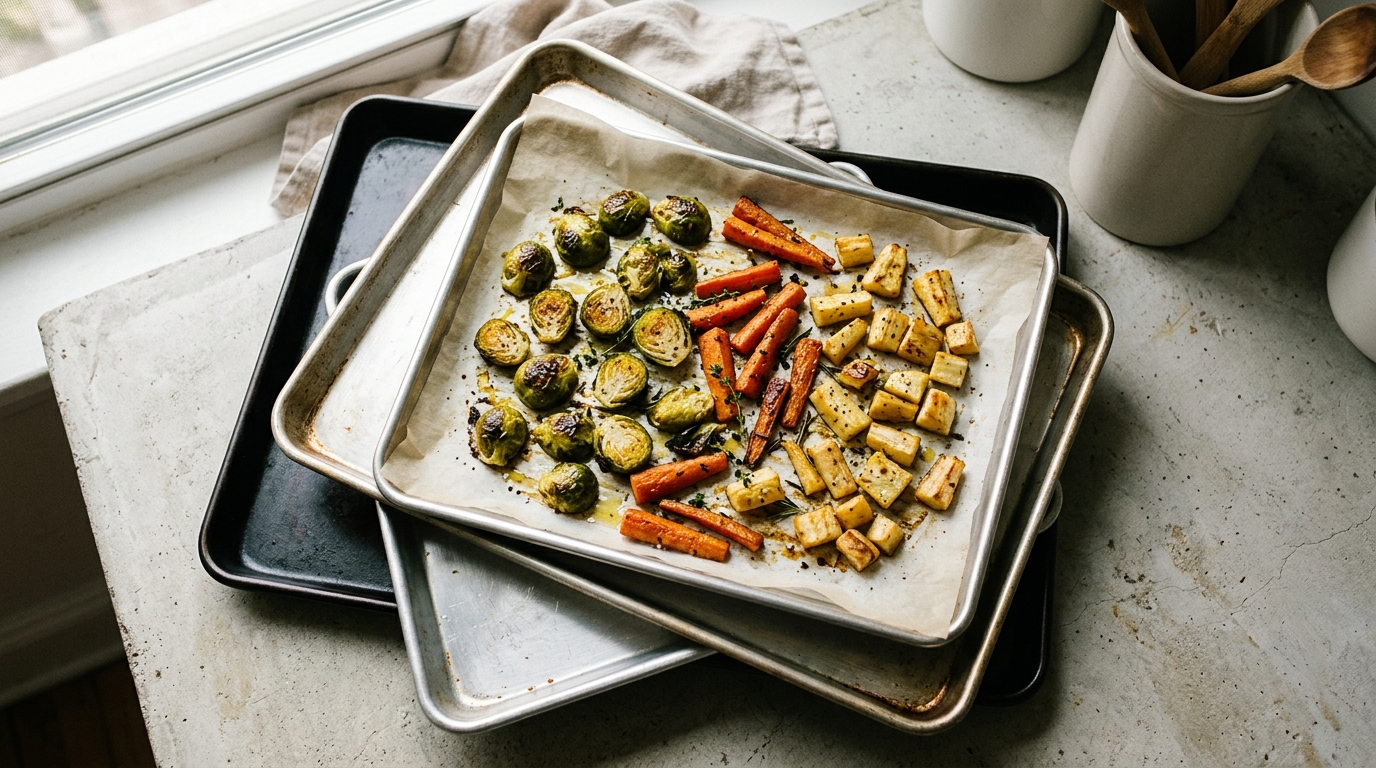
A warped sheet pan is the kind of kitchen problem that sneaks up on you, one loud bang in a 425°F oven and suddenly your cookies are sliding to one side and your roasted vegetables are steaming instead of caramelizing. This list is for home cooks who roast, bake, and broil regularly and want a pan that stays flat, browns evenly, and doesn’t shed a nonstick coating into their dinner. If you only bake once a year, the cheapest pan at the grocery store will do fine, this guide is not for you.
As an Amazon Associate, KitchenDesk earns from qualifying purchases. Some of the links on this page are affiliate links, we may earn a commission at no extra cost to you. Full disclosure.
Each pan was tested for a minimum of one week across gas, induction (with a flat-bottom baking steel adapter), and electric ovens at temperatures ranging from 350°F to 500°F. Tests included roasting vegetables, baking cookies, broiling salmon, and freezer-to-oven cycles. Full methodology here.
Jump to a section
- Quick Comparison
- Nordic Ware Natural Aluminum Commercial Baker’s Half Sheet, Best Overall
- USA Pan Bakeware Half Sheet Pan, Best for Everyday Baking
- Vollrath Wear-Ever Half-Size Sheet Pan, Best Commercial-Grade
- Cuisinart Chef’s Classic Nonstick Half Sheet Pan, Best Budget
- Made In Blue Carbon Steel Sheet Pan, Best Premium
- Wilton Easy Layers Sheet Cake Pan Set, Best for Sheet Cakes
- OXO Good Grips Non-Stick Pro Half Sheet Pan, Best for Beginners
- How to Choose a Sheet Pan: What Actually Matters
- Frequently Asked Questions
Quick Comparison
| Pan | Badge | Material | Coating | Made in USA | Overall Rating |
|---|---|---|---|---|---|
| Nordic Ware Natural Aluminum Commercial Baker’s Half Sheet | Best Overall | Pure aluminum | Uncoated | Yes | 4.8/5 |
| USA Pan Bakeware Half Sheet Pan | Best for Everyday Baking | Aluminized steel | AMERICOAT (PTFE-free) | Yes | 4.6/5 |
| Vollrath Wear-Ever Half-Size Sheet Pan | Best Commercial-Grade | 18-gauge aluminum | Uncoated | 4.7/5 | |
| Cuisinart Chef’s Classic Nonstick Half Sheet Pan | Best Budget | Heavy-gauge steel | Nonstick | 3.8/5 | |
| Made In Blue Carbon Steel Sheet Pan | Best Premium | Blue carbon steel [[VERIFY gauge]] | Seasons naturally | 4.5/5 | |
| Wilton Easy Layers Sheet Cake Pan Set | Best for Sheet Cakes | Steel | Nonstick | 4.2/5 | |
| OXO Good Grips Non-Stick Pro Half Sheet Pan | Best for Beginners | Aluminized steel | Three-layer nonstick | 4.4/5 |
Nordic Ware Natural Aluminum Commercial Baker’s Half Sheet, Best Overall
The Nordic Ware half sheet is the pan that professional pastry cooks reach for without thinking about it, and after testing it alongside everything else on this list, I understand why. Pure aluminum heats fast and distributes that heat remarkably evenly, in my cookie tests, the difference in browning between the center and the edges was negligible, which is exactly what you want. The reinforced rolled rim is the structural reason this pan resists the dramatic warp-and-bang you get from thinner consumer pans; thermal stress finds nowhere to buckle. After repeated cycles from 350°F to 500°F, mine still sits flat on a countertop without rocking.
The trade-off is real and worth stating plainly: uncoated aluminum means food will stick without parchment, a silicone mat, or enough fat. That’s not a dealbreaker, parchment is cheap, but if you expect to roast vegetables directly on the pan surface with minimal oil and zero liner, you’ll be disappointed. Acidic foods like tomatoes or citrus left sitting on bare aluminum for extended periods can react with the surface and impart a metallic note; use parchment or foil for anything in that category. Dishwasher use will cause discolouration over time, hand washing keeps it looking and performing better for longer.
This is not a complicated pan and that’s the point. There are no coatings to baby, no seasoning protocol to follow, and no question about what it’s made of.
Pricing & availability on Amazon, affiliate link.
View on AmazonRead single review, Nordic Ware Natural Aluminum Commercial Baker’s Half Sheet for the full breakdown.
USA Pan Bakeware Half Sheet Pan, Best for Everyday Baking
Where the Nordic Ware is a purist’s tool, the USA Pan is built for the cook who wants a bit more forgiveness without sacrificing structural integrity. Aluminized steel gives it more rigidity than pure aluminum of the same gauge, and the AMERICOAT silicone-based coating, listed by the manufacturer as PTFE-free and PFOA-free, releases cookies and roasted vegetables cleanly in most cases without a liner. In my testing, even a full sheet of brown butter chocolate chip cookies came off without tearing or sticking to the surface.
The corrugated bottom surface is worth a moment’s explanation because it looks like a quirk and is actually a structural feature. Those ridges increase the pan’s rigidity under thermal stress, which directly reduces warping, and they promote airflow underneath food, which can help with browning on the underside of things like fish fillets or thick vegetable cuts. The downside is that the grooves are slightly tedious to scrub thoroughly if something caramelizes or burns into them; a narrow bottle brush or a firm nylon scrubber handles it, but it’s a step the flat-bottomed pans don’t require.
The coating will eventually show wear with heavy use, particularly if metal utensils get involved, stick to silicone or wood when handling food on this surface. It’s slightly heavier than bare aluminum, which some bakers notice when moving a full, hot pan.
Pricing & availability on Amazon, affiliate link.
View on AmazonSee single review, USA Pan Bakeware Half Sheet Pan for extended testing notes.
Vollrath Wear-Ever Half-Size Sheet Pan, Best Commercial-Grade
Vollrath makes pans for professional kitchens, which means the Wear-Ever half sheet is built to a standard that consumer marketing materials rarely have to meet. The gauge is heavier than most pans you’ll find on a retail shelf , and the NSF certification means it has been independently assessed for food safety under commercial conditions, not just evaluated in-house. That’s meaningful if you take food safety credentials seriously, and most professional cooks do.
In my kitchen, the heavier gauge translated to noticeably more thermal mass. The pan takes slightly longer to heat up than the Nordic Ware, but once it’s hot, it holds that temperature steadily, which showed up in more consistent browning on roasted cauliflower and carrots, particularly when I was working at 450°F with a full sheet. The flat surface is true and stayed true across every high-heat cycle I ran it through, including a direct-from-freezer-to-500°F test that warped a budget steel pan in the same session.
The practical consideration for most home cooks is availability: Vollrath is less commonly found in retail stores than Nordic Ware and is usually an online purchase. That’s a minor friction point but worth noting if you want to inspect something in person before buying. Like all uncoated aluminum, parchment or oil is non-negotiable for anything that will stick.
Pricing & availability on Amazon, affiliate link.
View on AmazonCuisinart Chef’s Classic Nonstick Half Sheet Pan, Best Budget
Not everyone needs a pan that lasts a decade. If you bake a few times a month and want something that works reliably without a significant upfront investment, the Cuisinart Chef’s Classic is a reasonable starting point. The nonstick coating releases cookies, sheet dinners, and roasted vegetables cleanly through the short-to-medium term, and the lighter weight makes it easy to handle for anyone who finds heavier commercial-grade pans awkward when full. At this price tier, owning two or three pans for simultaneous oven loads is realistic without budget stress.
The honest trade-offs are worth spelling out. In my testing, this pan warped noticeably at temperatures above 425°F, I heard the bang during a high-heat roasting session, and the pan came out with a visible bow that was enough to cause liquid to pool on one side. For cookie baking at 350–375°F it performed well enough, but serious high-heat roasting or broiling is where the thinner steel construction shows its limits. The nonstick coating also showed early wear signs within my one-week testing window under heavy use, which suggests a shorter practical lifespan than mid-range competitors.
Steel conducts heat less evenly than aluminum, which means edge browning tends to run ahead of the center, this showed up most clearly in a batch of roasted broccoli, where the florets along the pan edges were deeply caramelized while the center pieces were still finishing. It’s manageable with a mid-cook rotation, but it’s worth knowing going in.
Pricing & availability on Amazon, affiliate link.
View on AmazonMade In Blue Carbon Steel Sheet Pan, Best Premium
Carbon steel occupies an interesting position between cast iron’s mass and aluminum’s speed, it builds a natural nonstick patina with use, handles temperatures north of 500°F without concern, and has a weight that feels substantial without being punishing to move around. Made In’s version is the pick for cooks who want to make a single long-term investment and build up a cooking surface over time. The pan arrives unseasoned and requires a seasoning step before first use, similar to a carbon steel skillet.
In my testing, conducted with the caveat that carbon steel requires a seasoning-in period to perform at its best, the browning on roasted vegetables and salmon was excellent once the surface had a few sessions of use behind it. The heat retention is meaningfully better than aluminum, which helps when you’re loading a cold, crowded pan: the temperature doesn’t drop as sharply, and you get more consistent caramelization across a full sheet. For broiling at high heat, there are no coating concerns whatsoever.
The honest barrier is maintenance. Carbon steel will rust if left wet, stored improperly, or put through a dishwasher. If that kind of upkeep doesn’t appeal to you, the Nordic Ware or USA Pan will serve you better without the requirements. This pan is for cooks who enjoy that relationship with their cookware.
Pricing & availability on Amazon, affiliate link.
Check Made In Blue Carbon Steel Dutch Oven on AmazonWilton Easy Layers Sheet Cake Pan Set, Best for Sheet Cakes
This is a niche pick and it’s worth being direct about that upfront: the Wilton Easy Layers set is purpose-built for bakers who want even, thin cake layers without the work of splitting or torting a single taller cake. The shallow, uniform depth is the whole point, each pan in the set produces a consistent layer that stacks evenly, which is meaningfully useful if you bake celebration cakes or layer cakes regularly. For that specific application, it does its job well.
The nonstick surface releases sponge cakes and sheet cakes cleanly in my testing, and the consistency across multiple pans from the same set meant my layers were uniform enough that I didn’t need to level any of them before assembling. That’s the win. What this pan cannot do is equally clear: the shallow depth makes it useless for anything that produces liquid, roasted vegetables, sheet dinners, anything with a marinade or sauce will run straight over the edge. It is also not a high-heat workhorse; like most steel-and-nonstick constructions, warping risk increases significantly above 350°F, and the nonstick coating requires careful handling. No metal utensils, and hand washing is the right call.
If you bake layer cakes regularly, this set solves a genuine problem elegantly. If you want a general-purpose baking sheet, look at the Nordic Ware or OXO picks instead.
Pricing & availability on Amazon, affiliate link.
View on AmazonOXO Good Grips Non-Stick Pro Half Sheet Pan, Best for Beginners
The OXO Good Grips Pro sits at a genuinely useful middle ground: it’s more capable than a department-store basic and less demanding than an uncoated aluminum or carbon steel pan. For a cook who is upgrading their bakeware for the first time and wants a noticeable improvement without a learning curve, this is a strong starting point. The aluminized steel base heats more evenly than plain steel, and the three-layer nonstick coating is meaningfully more durable than what you’ll find on single-coat budget alternatives, it held up well across my full week of testing without visible wear.
The micro-textured surface does two things: it improves airflow under food, which helped with browning on the underside of salmon fillets in my broiler test, and it adds structural rigidity that helps the pan resist warping. The wide handles on the short ends are a practical ergonomic detail, a full sheet of roasted vegetables is heavy and awkward to move with narrow tabs, and the OXO handles give you a secure, confident grip. Cleanup was genuinely easy; food released without soaking and wiped away with a soft cloth and warm soapy water.
The ceiling on this pan is the nonstick coating itself. It will wear eventually, particularly with high-heat broiling, and when it does the pan needs replacing rather than reseasoning. It also costs more than bare aluminum pans that will outlast it, that’s the honest math. But for a beginner who wants reliability and easy cleanup without managing a bare metal surface, the OXO Pro earns its place.
Pricing & availability on Amazon, affiliate link.
View on AmazonSee single review, OXO Good Grips Non-Stick Pro Half Sheet Pan for full testing notes.
How to Choose a Sheet Pan: What Actually Matters
Material is the most important decision
Pure aluminum heats fast and evenly and won’t rust, but it reacts with acidic foods and needs parchment to prevent sticking. Aluminized steel is more rigid and rust-resistant, which makes it a good everyday option. Carbon steel builds a natural nonstick surface over time but requires seasoning and ongoing maintenance. Coated steel is the most forgiving for beginners, but the coating is the first component to fail, every nonstick surface degrades, and the question is just how quickly. For high-heat roasting and broiling, uncoated aluminum and carbon steel are the more durable long-term choices.
Gauge determines warp resistance, not brand marketing
Thicker metal holds its shape better under thermal shock. Manufacturers use the term “heavy gauge” loosely, so it’s worth looking for a reinforced or rolled rim as a secondary indicator of structural quality, that feature adds rigidity at the point where warping typically starts. A pan that warps in the oven isn’t just annoying; it means uneven contact with the rack, uneven heat distribution, and food that moves to one side. The investment in a thicker pan is an investment in flat, consistent results.
Size in practical terms
The standard half-sheet (18 x 13 inches) is the workhorse that fits most home ovens and most baking recipes. Quarter sheets (13 x 9 inches) are useful for smaller batches and toaster ovens. Full sheets typically don’t fit home ovens, measure your oven’s interior dimensions before buying, because a pan that doesn’t fit the oven is useless regardless of its other qualities. This sounds obvious and gets overlooked constantly.
What looks important but is mostly marketing
“Ceramic-infused” nonstick coatings are not inherently more durable than standard nonstick, durability depends on coating thickness and substrate quality, not the marketing term. “Professional-grade” on a consumer product is not a regulated claim. The colour of the pan does matter: darker pans absorb more radiant heat from the oven and can over-brown the bottoms of cookies and delicate baked goods. Lighter-coloured aluminum pans are more versatile across baking and roasting tasks for exactly this reason.
On dishwasher-safe claims
Even pans marketed as dishwasher-safe will degrade faster with regular dishwasher use. The combination of high heat and harsh detergents strips nonstick coatings and oxidizes aluminum. Hand washing is almost always the better call for any pan you want to last more than a year or two of regular use.
For a broader look at what to look for when building out your bakeware set, see our how to choose bakeware guide. You might also want to browse our cookware reviews and the full best bakeware round-up.
Frequently Asked Questions
What is the best material for a sheet pan?
Pure aluminum and aluminized steel are the most practical choices for most home cooks, they heat evenly, resist warping, and last well without demanding much maintenance. Carbon steel is excellent but requires seasoning and consistent upkeep. Coated steel is the easiest to use out of the box but the least durable long-term, since every nonstick coating will eventually wear.
How do I stop my sheet pan from warping in the oven?
Warping happens when thin metal heats unevenly or too fast. Choose a heavier-gauge pan with a reinforced rim, avoid putting a cold pan directly into a very hot oven, and never run a hot pan under cold water immediately after use, that thermal shock is one of the fastest ways to permanently warp a pan that was otherwise in good shape.
Can I use a sheet pan on an induction cooktop?
Most sheet pans aren’t designed for stovetop use in any form. Aluminum is not induction-compatible, and flat sheet pans don’t sit securely on a burner regardless of material. Carbon steel sheet pans are theoretically induction-compatible, but they’re not built for the purpose, I wouldn’t recommend it.
Do I need to use parchment paper on a sheet pan?
On uncoated aluminum and carbon steel pans, parchment or a silicone mat prevents sticking and makes cleanup significantly faster. On nonstick-coated pans, parchment is optional, but using it still extends the life of the coating by reducing abrasion and making it easier to lift food without dragging across the surface.
How do I clean a sheet pan with baked-on grease?
For uncoated aluminum, a paste of baking soda and dish soap left to sit for 30 minutes removes most baked-on residue without scratching the surface. For nonstick pans avoid abrasive scrubbers entirely, hot soapy water and a soft cloth is the right tool. Bar Keepers Friend works well on aluminized steel surfaces and won’t scratch if you use it with a non-abrasive pad.
What size sheet pan should I buy?
The half-sheet (18 x 13 inches) is the standard workhorse that fits most home ovens and is the size referenced in most baking recipes. Measure your oven’s interior width and depth before buying, this step gets skipped more often than it should, and a pan that doesn’t fit is useless at any price point.
Are dark sheet pans worse than light-coloured ones?
Dark pans absorb more radiant heat from the oven, which can over-brown the bottoms of cookies and delicate baked goods before the tops are finished. For roasting vegetables and proteins at high heat, the difference is less significant. Lighter-coloured aluminum pans are more versatile across both baking and roasting tasks, which is part of why bare aluminum remains the professional default.
Also worth reading: our rimmed baking sheet comparison article puts the top performers head-to-head with side-by-side browning results.