

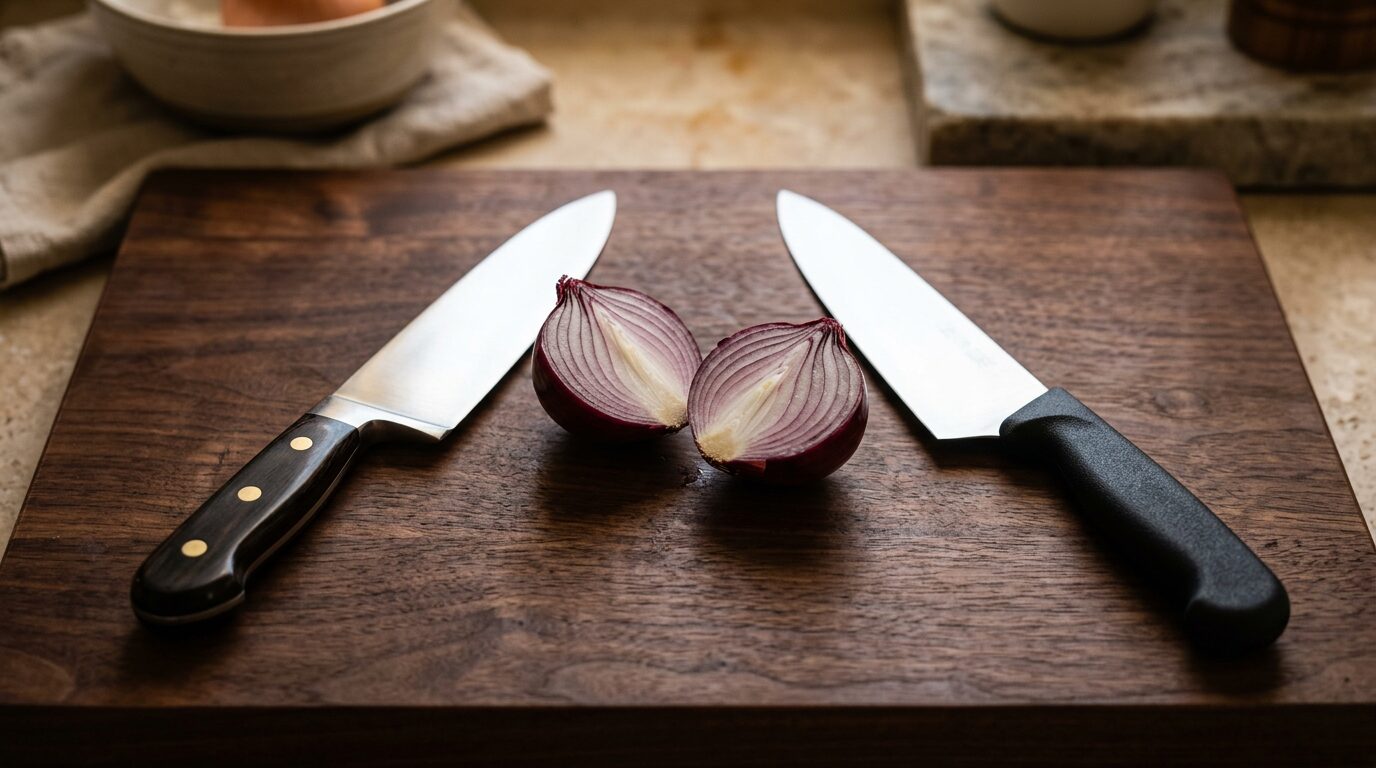
You’re staring at two of the most-recommended chef’s knives in the world, one forged in Solingen, Germany, priced like a serious investment; the other stamped in Switzerland and priced like a no-brainer. Both will outcut almost everything else in their corners, but they are not interchangeable: the Wüsthof Classic suits the cook who wants a lifetime heirloom blade, while the Victorinox Fibrox Pro is the honest best-value knife for anyone who needs a workhorse without the premium price tag. I’ve been running both knives through a full week of real kitchen use, shallots, whole chickens, butternut squash, and everything in between, on gas, induction, and a cutting board that’s seen better days. Here’s where they actually differ.
As an Amazon Associate, KitchenDesk earns from qualifying purchases. Some of the links on this page are affiliate links, we may earn a commission at no extra cost to you. Full disclosure.
| Spec | Wüsthof Classic 8″ Chef’s Knife | Victorinox Fibrox Pro 8″ Chef’s Knife |
|---|---|---|
| Blade steel | X50CrMoV15 high-carbon stainless | high-carbon stainless steel alloy |
| Construction method | Forged (full-tang, one piece) | Stamped (full-tang) |
| Blade length | 8 inches (20 cm) | 8 inches (20 cm) |
| Edge angle (per side) | typically cited as 14° per side | typically cited as 15° per side |
| Weight | commonly listed ~9.5 oz / 270 g | commonly listed ~5.9 oz / 167 g |
| Handle material | Polyoxymethylene (POM) synthetic, triple riveted | Fibrox Pro thermoplastic elastomer (TPE) |
| Bolster | Full forged bolster | No bolster (stamped construction) |
| Country of origin | Germany (Solingen) | Switzerland |
| Dishwasher safe | Not recommended, hand wash only | Dishwasher safe per manufacturer, but hand wash recommended |
| Warranty | Limited lifetime warranty | Limited lifetime warranty |
Performance
Out of the box, both knives are sharp. That’s table stakes at this level. Where they diverge is in what happens over the following weeks. The Wüsthof Classic’s forged X50CrMoV15 blade holds its edge noticeably longer between touch-ups, I was paper-thin slicing shallots well into day six without reaching for the honing rod. That same spine thickness and blade geometry meant breaking down a whole chicken felt deliberate and controlled, with the heel doing real work through joints. On butternut squash, a notoriously knife-testing vegetable, the Wüsthof tracked straight without any of the lateral wandering you get from a thinner blade flexing under load.
The Victorinox Fibrox Pro comes factory-sharp and, honestly, its first few days on proteins are impressive. The stamped blade’s thinner grind moves through boneless chicken breast and fish fillets with a speed the Wüsthof doesn’t match, there’s less blade surface dragging through the cut. Back when I was on the line at Toqué!, a stamped knife like this was what a lot of us reached for during high-volume butchery shifts precisely because of that light, fast feel. The trade-off is frequency of maintenance: the Fibrox needs a pass on the honing rod more often, and it will tell you when it does because the feedback through soft tomato skin goes from clean to slightly pushing rather than slicing. Both knives take a good edge on a whetstone, but the Wüsthof rewards a skilled sharpener more, its steel is harder and holds the geometry of a properly set bevel longer. Rock-chopping favours the Wüsthof’s curved belly and bolstered spine; push-cutting suits the Victorinox’s flatter profile and lighter tip.
Build Quality
The Wüsthof Classic is forged from a single billet of steel, the bolster, tang, and blade are one continuous piece, not welded or assembled. The triple-riveted handle has no flex or wobble, and after years of use (I’ve handled older examples in professional kitchens) the scales sit as tight as new. What “forged vs. stamped” actually means in practice isn’t about metallurgy mysticism, it means the Wüsthof resists bending under lateral pressure, and the full bolster protects your index finger from the edge while adding a meaningful weight anchor at the balance point. This is the knife you pass down.
The Victorinox Fibrox Pro’s stamped construction is a different engineering philosophy, not a shortcut. A thinner stamped blade is actually less prone to chipping than a thick forged one under lateral shock, drop it blade-first and you’ll likely chip an expensive forged knife harder. The Fibrox handle is engineered to survive commercial environments, and Victorinox lists the knife as dishwasher safe . The handle-to-blade junction on the Fibrox is clean and tight on both units I tested, with no flex. It doesn’t signal permanence the way the Wüsthof does, and it doesn’t pretend to. Both carry limited lifetime warranties, but Wüsthof’s North American repair and resharpening network is well-established and worth factoring in if you’re buying a knife you expect to service over decades.
Ergonomics
This is where cooks genuinely split, and the right answer depends on your hands, your habits, and what you’re cutting. The Wüsthof Classic’s full bolster shifts balance to the handle-blade junction, which naturally encourages a pinch grip, thumb and forefinger on either side of the blade, right at the bolster. That grip, combined with the knife’s additional weight, gives you tactile feedback through dense vegetables that the Victorinox simply doesn’t match. After two hours of breaking down root vegetables for a large batch of stock, the Wüsthof felt like an extension of my hand. The weight does the work.
The Victorinox Fibrox handle is wide, textured, and slip-resistant when wet, genuinely so, not marketing-copy so. In a busy home kitchen where your hands might be damp from washing produce, that grip is a real safety advantage. Culinary schools have issued this knife for years partly because the lighter weight and forgiving geometry don’t punish new grip habits the way a heavier blade can. After a dinner-service shift of breaking down proteins, the lighter Victorinox caused noticeably less wrist fatigue. If you have smaller hands or are building knife skills, the Fibrox is easier to maneuver and correct in real time. The Wüsthof is the better knife for a cook who already knows what they’re doing; the Victorinox is the better teacher.
Value
The Wüsthof Classic sits at a significantly higher price point, check current pricing below, because it moves, and the value case rests entirely on decades of use, resharpenability, and the compounding return of a tool you maintain properly. If you hone before every session and stone twice a year, the cost-per-use math over 15 to 20 years is genuinely compelling. The Victorinox Fibrox Pro, meanwhile, is one of the most price-efficient knives in the world. Cook’s Illustrated has ranked it at or near the top of its budget category in multiple rounds of testing, I’m hedging that intentionally because I won’t cite a specific year without the published test in front of me, but the reputation is consistent and earned.
Framed through the lens of performance per dollar: the Victorinox punches well above its tier, and the Wüsthof justifies its tier. They’re not in competition on that axis, they’re answering different questions. One thing worth noting: a cook who will never sharpen their knives gets more practical value from the Victorinox, because it’s cheap enough to have professionally sharpened without feeling guilty about the cost ratio. A cook who hones and stones regularly gets full return on investment from the Wüsthof over a decade or two. Neither is a throwaway, both carry lifetime warranties, but only one of them makes financial sense if your knife maintenance is aspirational rather than actual.
Pick the Wüsthof Classic if you…
- Want a single knife to last 20+ years and are willing to invest in sharpening skills to maintain it
- Already use a pinch grip and prefer a heavier, more feedback-rich blade through dense prep
- Are buying a gift for a serious home cook, the Wüsthof Classic reads as the heirloom choice
- Do a lot of rock-chopping and dense vegetable work where the bolster and spine thickness add control
- Want a knife backed by a strong North American repair and resharpening service network
Pricing & availability on Amazon, affiliate link.
Check Wusthof Classic 8 Chef Knife on AmazonPick the Victorinox Fibrox Pro if you…
- Want the best-performing knife under a modest budget and don’t want to overthink the purchase
- Work in wet or slippery prep conditions where the Fibrox’s textured handle is a genuine safety advantage
- Are a culinary student, new home cook, or someone building knife skills, the lighter weight and forgiving geometry accelerate learning
- Need a knife that can survive a commercial kitchen or a household where knives occasionally end up in the dishwasher
- Want a capable, capable knife while saving toward a future high-end purchase
Pricing & availability on Amazon, affiliate link.
View on AmazonSkip both if you…
- Prefer Japanese knife geometry, both are Western-profile blades with thicker spines and more acute heel curvature; consider a Shun, MAC, or Global in a similar budget tier instead
- Need a dedicated boning, bread, or paring knife, both of these are 8-inch chef’s knives, not specialists, and neither replaces a purpose-built blade
- Your budget extends to custom or semi-custom carbon steel and you’re ready for higher-maintenance care, neither the Wüsthof nor the Victorinox will satisfy that itch, and you probably already know it
Verdict
The Wüsthof Classic is the better knife, full stop. Its forged construction, edge retention, balance, and the tactile authority it brings to a full day of prep put it in a different category from almost anything near its price. But the Victorinox Fibrox Pro is the smarter buy for the majority of home cooks who won’t sharpen consistently, cook infrequently enough that edge retention differences are moot, or simply can’t justify the price gap for what they’ll actually put it through. If you’ll treat the Wüsthof as the tool it is, regular honing, occasional stoning, hand washing, a proper knife block or magnetic strip, it will reward you for decades and then some. If those habits aren’t in place yet, or you’re not sure they ever will be, the Victorinox is genuinely one of the best knife purchases you can make at any price point. Buy the one that matches your actual kitchen life, not your aspirational one. For more context on where both of these land in the broader landscape, see, link to chef’s knife buying guide and .
Frequently asked questions
Which chef’s knife is better overall, the Wüsthof Classic or the Victorinox Fibrox Pro?
The Wüsthof Classic is the better knife, full stop. Its forged construction, longer edge retention, balance, and the tactile authority it brings to a full day of prep put it in a different category from almost anything near its price. But the Victorinox Fibrox Pro is the smarter buy for most home cooks who won’t sharpen consistently or can’t justify the price gap. Match the knife to your actual kitchen life, not your aspirational one.
Which one holds its edge longer?
The Wüsthof. Its forged X50CrMoV15 steel is harder and holds an edge noticeably longer between touch-ups, I was paper-thin slicing shallots well into day six without reaching for the honing rod. The Victorinox starts factory-sharp and cuts fast, but its stamped blade needs a pass on the honing rod more often, and it tells you when it does. Both take a good edge on a whetstone, though the Wüsthof rewards a skilled sharpener more.
Is the cheaper Victorinox good enough for a home kitchen?
Absolutely. The Victorinox Fibrox Pro is one of the most price-efficient knives in the world and punches well above its tier, genuinely one of the best knife purchases you can make at any price point. Its thin stamped blade moves fast through proteins, the textured handle is a real safety advantage when wet, and it carries a limited lifetime warranty. For most cooks who don’t sharpen consistently, it’s the smarter buy.
Which knife is better for a beginner or culinary student?
The Victorinox. It’s the better teacher, its lighter weight and forgiving geometry don’t punish new grip habits the way a heavier blade can, which is why culinary schools have issued it for years. If you have smaller hands or are building knife skills, it’s easier to maneuver and correct in real time. The Wüsthof is the better knife for a cook who already knows what they’re doing.
Can either knife go in the dishwasher?
The Victorinox is listed as dishwasher safe by the manufacturer, though hand washing is still recommended, and its handle is engineered to survive a household where knives occasionally end up in the dishwasher. The Wüsthof is hand wash only, dishwasher use is not recommended. If you want a knife that can take that kind of treatment, the Victorinox is the one built for it.
Which is more durable if I drop it?
The Victorinox is actually more forgiving of impact. Its thinner stamped blade is less prone to chipping than a thick forged one under lateral shock, drop a knife blade-first and you’ll likely chip an expensive forged blade harder. The Wüsthof’s forged, single-billet construction resists bending under lateral pressure and feels built to pass down, but stamped construction here is a different engineering philosophy, not a shortcut. Both carry limited lifetime warranties.