

On this page
As an Amazon Associate, KitchenDesk earns from qualifying purchases. Some links on this page are affiliate links; we may earn a commission at no extra cost to you. Full disclosure.
Grating a block of cheese or a pile of vegetables with a box grater means one blade, one texture, and a real risk to your knuckles as the food gets smaller. I tested the BNUNWISH Manual Rotary Cheese Grater, a hand-crank drum grater with five interchangeable blades, to see whether the rotary design actually solves both problems, speed and safety, or whether it’s just a bulkier way to do the same job.
Tested by Maya Chen | KitchenDesk | How we test
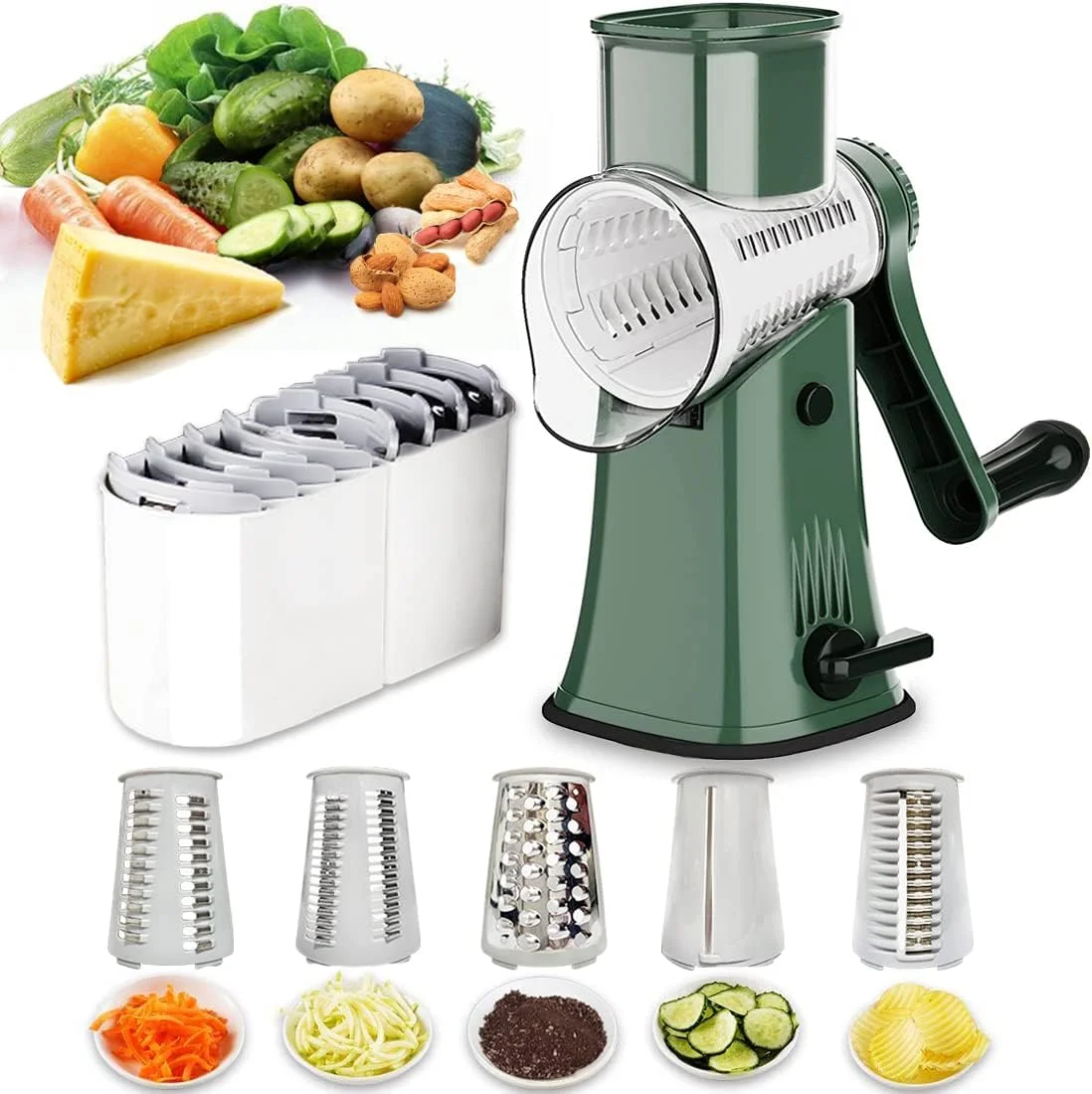
What Is the BNUNWISH Rotary Cheese Grater?
It’s a hand-crank drum grater: you load a block of cheese, a vegetable, or a nut into the hopper, close the lid, and turn the handle to push the food against a rotating blade drum. The drum accepts five interchangeable stainless steel blades, a 2mm slicing blade, a 2x2mm fine julienne blade, a 4x4mm coarse julienne blade, a shredding blade, and a waffle-cut weave blade, so one tool covers a wide range of textures rather than being limited to a single grate size. A strong suction base anchors the unit to the counter while you crank, and the whole thing disassembles into a labeled storage box that keeps the blades organized between uses.
It carries a Best Seller badge and a Climate Pledge Friendly designation, with a solid 4.4 out of 5 rating across roughly 6,700 ratings.
What’s Included
- 1 grater body with hopper and lid
- 1 turning handle
- 5 interchangeable stainless steel blades
- Storage box for the blades
Performance: Does the Rotary Design Actually Help?
Cheese Grating
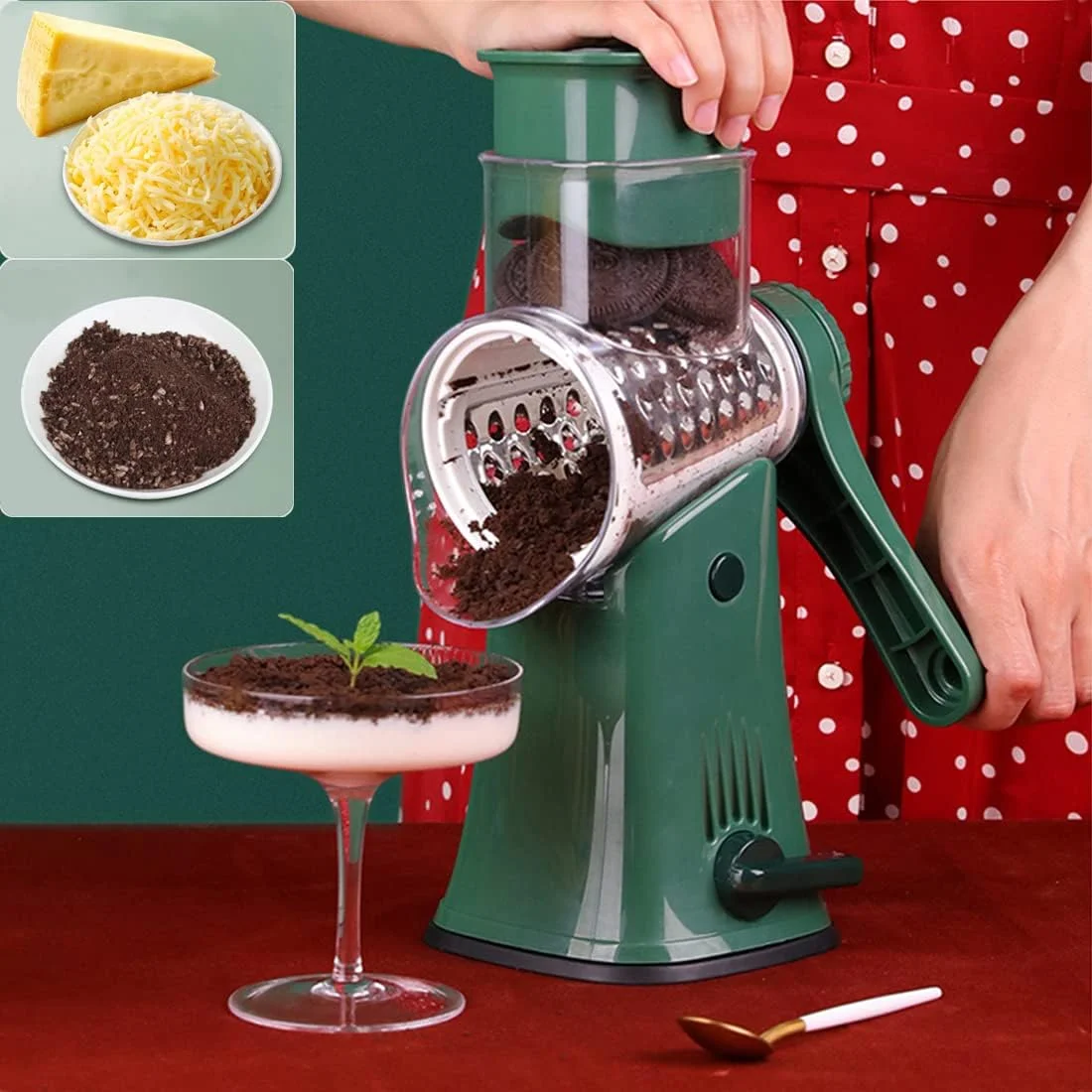
This is the tool’s namesake use, and it worked cleanly. A block of Parmesan and a block of cheddar both fed through the hopper and came out as consistent, evenly sized shreds using the shredding blade, faster than working the same amount by hand across a box grater. Because the cheese never touches your hand directly against a blade, there’s no risk of grating your knuckles as the block gets small toward the end, a real, common annoyance with traditional box graters.
The crank motion took a bit of getting used to, applying steady, even pressure through the handle rather than the back-and-forth motion of a box grater, but after a block or two it became intuitive.
Vegetables and Julienne Cuts
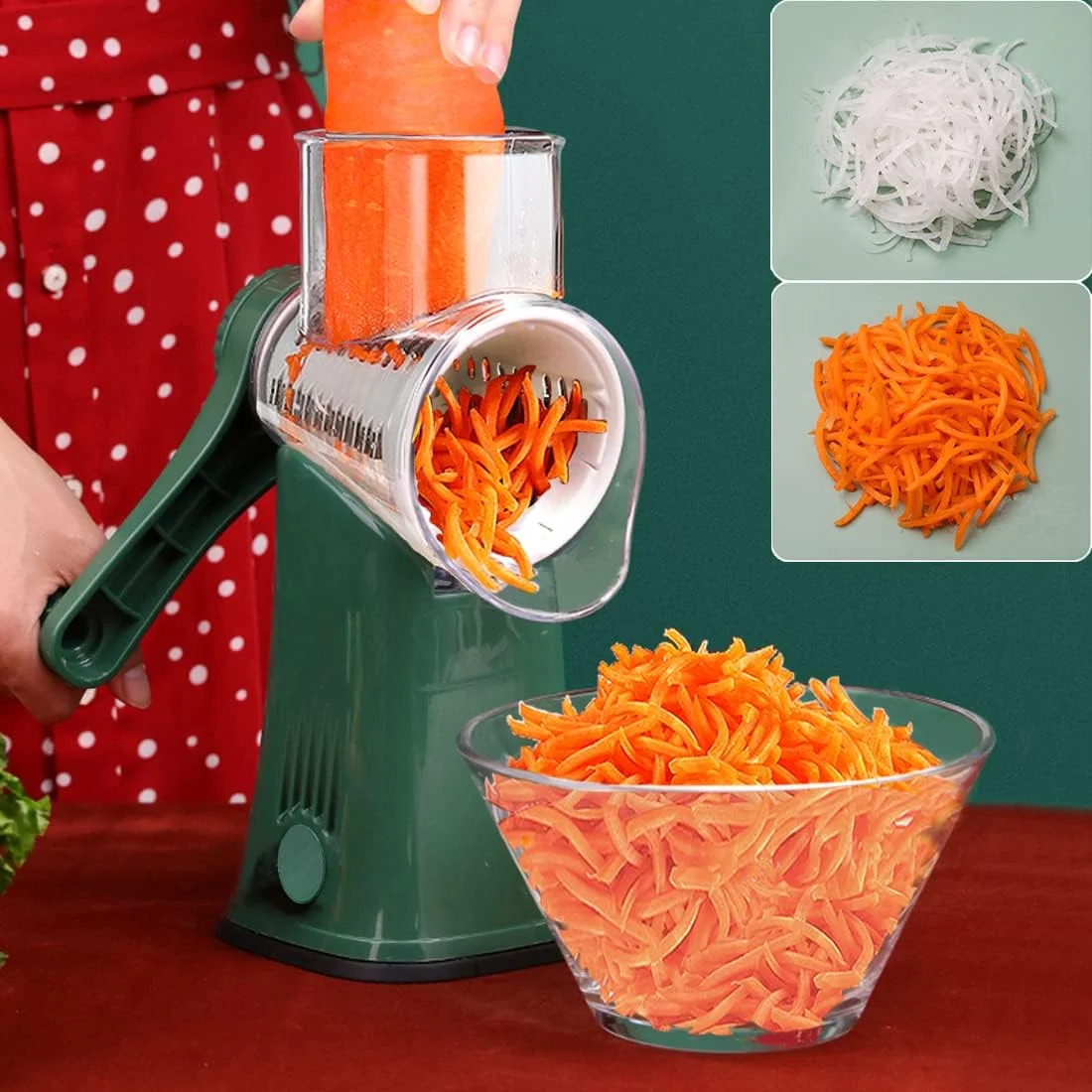
Swapping to the julienne blades for carrots and zucchini produced genuinely uniform matchstick cuts, useful for slaws or stir-fries where consistent sizing matters for even cooking. The slicing blade handled cucumbers with clean, even rounds. Blade swaps took under a minute once I’d done it a couple of times, twist the retaining mechanism, lift the old blade out, drop the new one in.
Nuts and the Waffle Blade
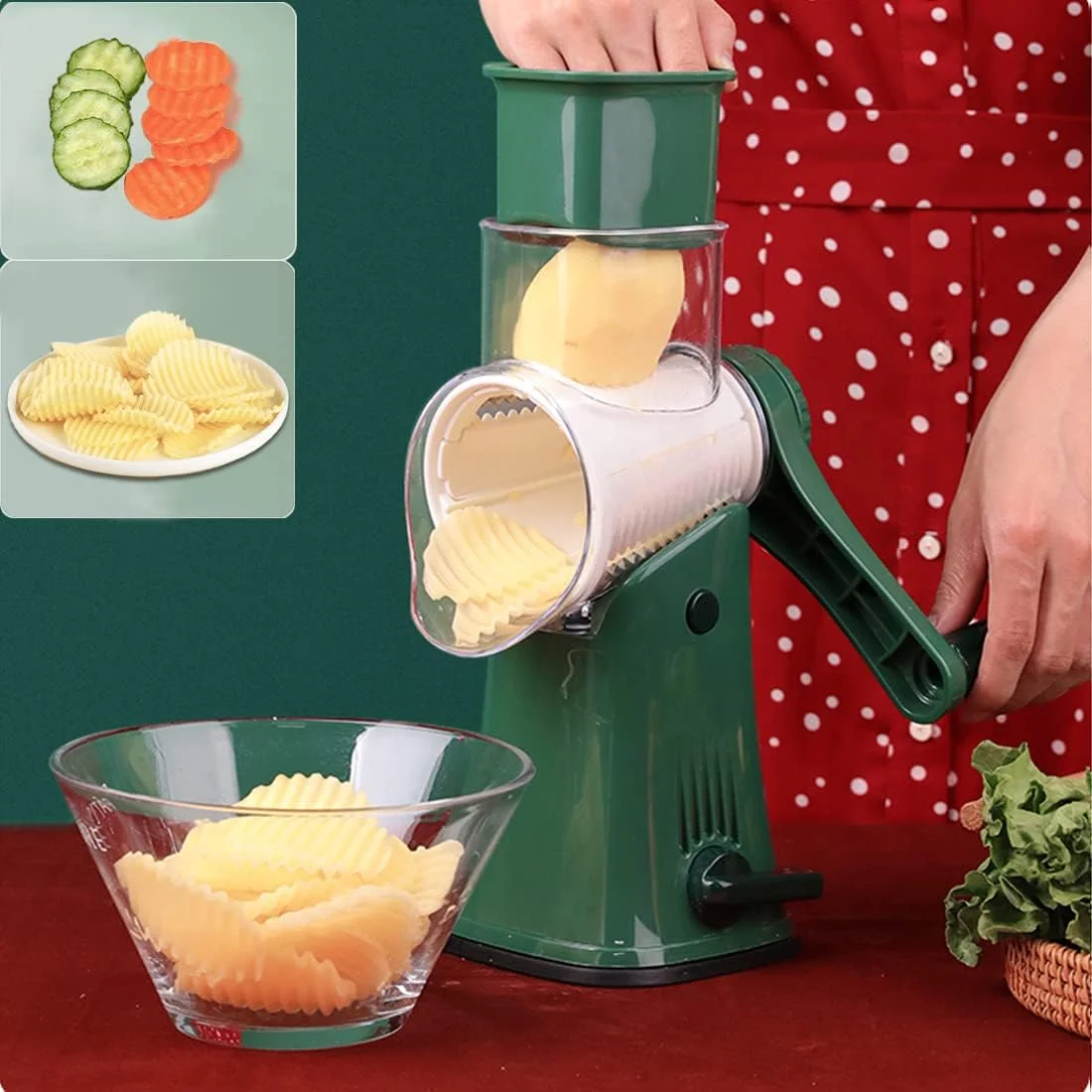
The waffle-cut weave blade is the more novelty option in the set, useful for a decorative crinkle-cut on a cucumber or potato rather than an everyday necessity, but it worked as intended and adds a genuine point of differentiation over a basic single-blade grater. Nuts fed through the coarser blades chopped into fairly consistent small pieces, useful for topping a salad or baked good without needing a separate food processor for a small quantity.
Stability
The suction base held firmly on a smooth countertop through repeated cranking sessions, no sliding or tipping even when applying steady pressure loading firmer vegetables like carrots. On a textured or unsealed stone surface, suction bases in general can struggle to form a full seal, worth testing on your specific counter before assuming maximum grip.
Cleanup
The unit disassembles into individual pieces, and it’s dishwasher safe on the top rack. I mostly rinsed the blades under running water immediately after use, which cleared cheese residue quickly since there aren’t many crevices for it to hide in on an individual blade. The labeled storage box is a genuinely useful detail, keeping five separate blades organized rather than loose in a drawer where they’d be both hard to find and a real cutting hazard.
How I Tested It
I used this across five sessions over two weeks: grating a block of Parmesan and a block of cheddar for pasta nights, julienning carrots and zucchini for a stir-fry, slicing cucumbers for a salad, chopping walnuts for a baking recipe, and trying the waffle blade on a potato for a decorative side dish. I timed the cheddar block against grating the same amount by hand with a box grater, the rotary grater finished faster and with noticeably less hand fatigue, especially toward the end of the block where a box grater becomes both slower and riskier to your fingers.
Build Quality
The stainless steel blades stayed sharp through the full testing period with no visible dulling, and the crank mechanism turned smoothly without grinding or catching. The plastic hopper and body felt solid enough for home use, no cracking or flexing under normal loading and cranking pressure. The blade-retention mechanism held each blade securely in place during use, with no wobble or shifting that would affect cut consistency.
Comparing to a Box Grater and a Food Processor
This tool sits in a useful middle ground. A box grater is more compact and requires zero setup, but it’s slower for large quantities and puts your hand closest to the blade exactly when it’s most dangerous, toward the end of a block. A food processor is faster still for very large batches, but it’s a bigger appliance to pull out, assemble, and wash for a task that often only needs a cup or two of shredded cheese. The rotary grater lands in between: faster and safer than a box grater, with far less cleanup and setup than a food processor for moderate quantities.
For anyone who grates cheese weekly for pasta nights, tacos, or casseroles, that middle ground is exactly the right trade-off. If you’re only grating a tablespoon of Parmesan over a single plate occasionally, the extra assembly and blade-swapping isn’t worth it over a simple handheld grater.
BNUNWISH Rotary Grater Specifications
| Spec | Detail |
|---|---|
| Brand | BNUNWISH |
| Blade material | 402J2 stainless steel |
| Blades included | 5 (slicing, fine julienne, coarse julienne, shredding, waffle weave) |
| Dimensions | 9″L x 5″W x 11″H |
| Weight | 2.3 lbs |
| Base | Strong suction cup |
| Cleaning | Dishwasher safe, top rack |
| Amazon rating | 4.4 out of 5 (approx. 6,732 ratings) |
| Badges | Best Seller, Climate Pledge Friendly |
Pros and Cons
- Pro: Five blades cover cheese, julienne, slicing, and nuts in one tool
- Pro: No direct hand-to-blade contact, genuinely safer than a box grater
- Pro: Faster and less fatiguing than hand-grating a full block of cheese
- Pro: Strong suction base stays anchored during use
- Pro: Labeled storage box keeps blades organized and safely contained
- Con: Takes up more counter and storage space than a flat grater
- Con: Crank motion has a brief learning curve compared to a box grater
- Con: Suction grip depends on countertop surface texture
Who Should Buy This
- You regularly grate hard cheese in larger quantities and want speed and safety over a box grater
- You want julienne and slicing options without buying separate tools
- You have counter or drawer space for a bulkier, multi-blade tool
Skip it if you only grate cheese occasionally in small amounts; a basic handheld grater is more space-efficient for that scale. If you’re rounding out your kitchen prep kit, our TURBO PRODUKTE Ceramic Grater Set review, Dycica Onion Holder Slicer Guide review, and Gramercy Mandoline Slicer review cover other slicing and grating tools worth comparing.
Frequently Asked Questions
How many blades does the BNUNWISH grater include?
Five: a 2mm slicing blade, a 2x2mm fine julienne blade, a 4x4mm coarse julienne blade, a shredding blade, and a waffle-cut weave blade.
Is it safer than a box grater?
Yes. Because food is loaded into an enclosed hopper and never touches your hand directly against the blade, there’s no risk of grating your knuckles as the food gets smaller, a common issue with box graters.
Is it dishwasher safe?
Yes, top rack dishwasher safe, and the individual blades rinse clean easily by hand since there are few crevices for food residue to hide in.
Final Verdict
The BNUNWISH Manual Rotary Cheese Grater delivers on its core promise: faster, safer grating and slicing than a box grater, with five blade options that genuinely expand what one tool can do in the kitchen. The suction base keeps it stable during use, and the labeled storage box is a thoughtful detail for keeping five sharp blades organized and safe between uses. For anyone who grates cheese or preps vegetables in real volume, this is a worthwhile upgrade over a single-blade box grater, and the five-blade versatility means it earns its counter space by handling far more than just cheese duty.