
On this page
- Quick Comparison: Best Nonstick Pans 2026
- All-Clad HA1 Hard Anodized Nonstick Fry Pan, Best Overall
- Tramontina Professional Aluminum Nonstick Fry Pan, Best Budget
- Zwilling Madura Plus Nonstick Fry Pan, Best Mid-Range
- Caraway Nonstick Ceramic Fry Pan, Best Ceramic Nonstick
- GreenPan Valencia Pro Ceramic Nonstick Fry Pan, Best Ceramic Budget
- Made In Nonstick Frying Pan, Best Premium
- OXO Good Grips Hard Anodized Nonstick Fry Pan, Best for Ergonomics
- T-fal E93808 Professional Total Nonstick Fry Pan, Best for High-Volume Cooking
- Nonstick Pan Buying Guide
- Frequently Asked Questions
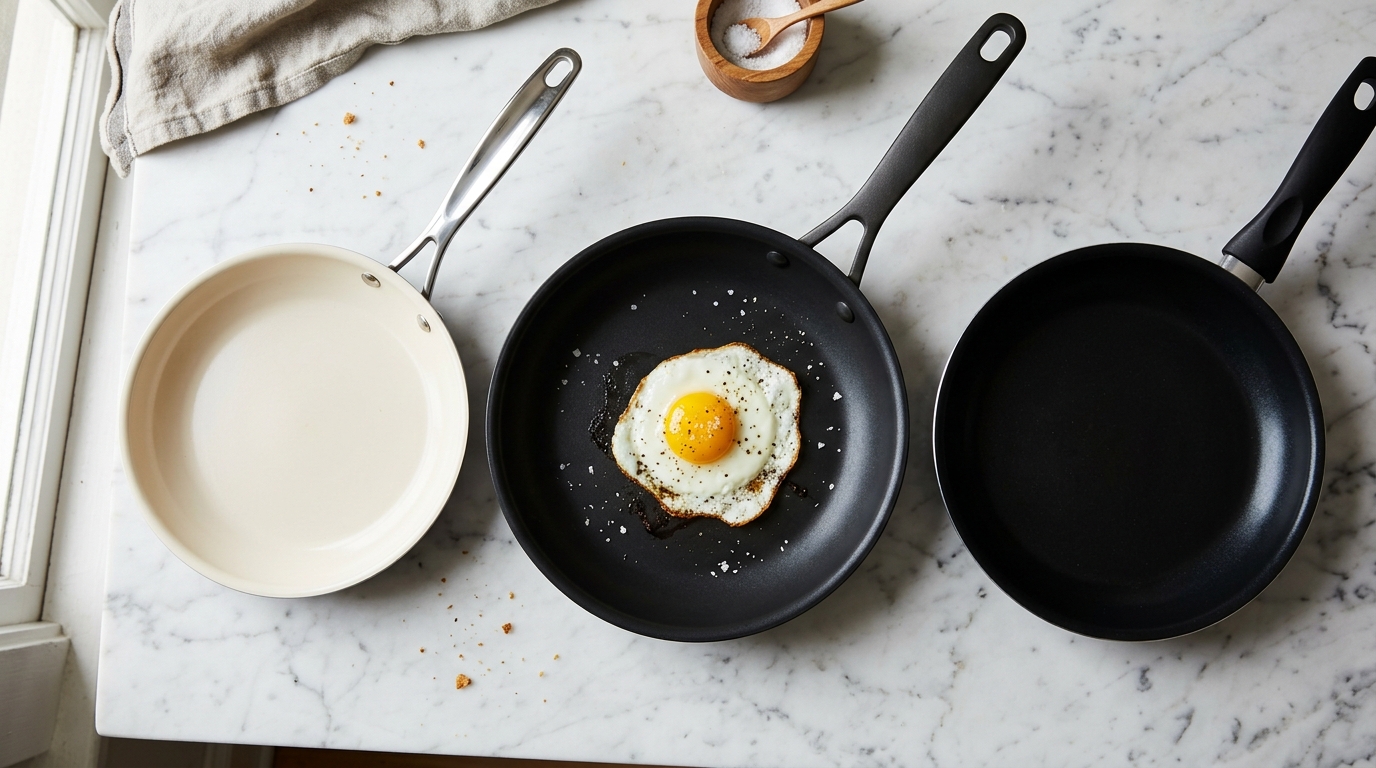
Eggs that slide clean, fish that doesn’t tear, pancakes that flip without a fight, a good nonstick pan handles all of it, but most of what’s on the market degrades fast or comes with a coating you’ll second-guess after six months. This list is for intermediate home cooks who actually cook on their pans daily and want honest picks across budget, mid-range, and premium tiers. If you’re outfitting a professional kitchen or want a pan that doubles as cast iron, this isn’t the list for you.
As an Amazon Associate, KitchenDesk earns from qualifying purchases. Some of the links on this page are affiliate links, we may earn a commission at no extra cost to you. Full disclosure.
Every pan on this list was cooked on for a minimum of one week across gas, induction, and electric stovetops, eggs daily, plus sautéed vegetables, pan sauces, and seared fish. Full methodology lives at /methodology/. Durability signals were assessed at the 30-day mark where possible; coating adhesion, handle heat, and warping under thermal shock were all logged. This is what I actually use, not what looks good in a press photo.
Jump to a section
- Quick Comparison: Best Nonstick Pans 2026
- All-Clad HA1 Hard Anodized Nonstick Fry Pan, Best Overall
- Tramontina Professional Aluminum Nonstick Fry Pan, Best Budget
- Zwilling Madura Plus Nonstick Fry Pan, Best Mid-Range
- Caraway Nonstick Ceramic Fry Pan, Best Ceramic Nonstick
- GreenPan Valencia Pro Ceramic Nonstick Fry Pan, Best Ceramic Budget
- Made In Nonstick Frying Pan, Best Premium
- OXO Good Grips Hard Anodized Nonstick Fry Pan, Best for Ergonomics
- T-fal E93808 Professional Total Nonstick Fry Pan, Best for High-Volume Cooking
- Nonstick Pan Buying Guide
- Frequently Asked Questions
Quick Comparison: Best Nonstick Pans 2026
| Pan | Badge | Body | Coating Type | Induction | Oven-Safe | Overall |
|---|---|---|---|---|---|---|
| All-Clad HA1 | Best Overall | Hard-anodized aluminum | PTFE, PFOA-free | Yes | 500°F | 4.4/5 |
| Tramontina Professional | Best Budget | Aluminum | PTFE, PFOA-free | No | 4.1/5 | |
| Zwilling Madura Plus | Best Mid-Range | Forged aluminum | PTFE w/ plasma primer | Yes | 400°F | 4.2/5 |
| Caraway Ceramic | Best Ceramic Nonstick | Aluminum core | Ceramic (PTFE-free) | Yes | 550°F | 4.0/5 |
| GreenPan Valencia Pro | Best Ceramic Budget | Hard-anodized aluminum | Ceramic (PTFE-free) | Yes | 600°F | 3.9/5 |
| Made In Nonstick | Best Premium | Stainless clad | PTFE, PFOA-free | Yes | 500°F | 4.5/5 |
| OXO Good Grips Hard Anodized | Best Ergonomics | Hard-anodized aluminum | PTFE, PFOA-free | 390°F | 4.2/5 | |
| T-fal E93808 Professional | Best High-Volume | Aluminum | PTFE, titanium-reinforced | No | 400°F | 3.8/5 |
Jump to: nonstick cookware · how to choose a nonstick pan · best cookware sets
All-Clad HA1 Hard Anodized Nonstick Fry Pan, Best Overall
After testing eight pans side by side, the All-Clad HA1 is the one I’d buy with my own money for everyday cooking. It’s not flashy, but it’s consistent in a way that matters: even heat across both my gas burner and induction plate, no hot-spot scorching after 30 days of daily egg cooking, and a coating that showed minimal visible degradation at the one-month mark. That durability comes from the hard-anodized aluminum body, it’s a fundamentally more stable surface than bare aluminum, and it shows in long-term results. Read my All-Clad HA1 full review for the extended breakdown.
The handle geometry deserves a mention because it’s better than most. It’s long enough to keep your hand away from heat, the angle reduces wrist strain during one-handed tossing, and on my gas burner at medium heat it stays genuinely cool. The PFOA-free 3-layer nonstick interior handles eggs, fish fillets, and delicate pan sauces without drama. It’s also oven-safe to 500°F , which means frittatas and oven-finished chicken thighs are on the table.
The honest trade-off is weight. The HA1 is noticeably heavier than a basic aluminum pan, and if you’re doing extended sauté work or tossing vegetables repeatedly, your wrist will feel it by the end of a cooking session. It’s also not a dishwasher pan in practice, the coating will last significantly longer with hand washing, regardless of what the label says. And it sits at the higher end of the mid-range price bracket, so budget shoppers will want to look at the Tramontina pick below.
| Performance | 5/5 |
| Build Quality | 4.5/5 |
| Ergonomics | 4.5/5 |
| Cleanup & Maintenance | 4/5 |
| Value | 4/5 |
| Overall | 4.4/5 |
Pricing & availability on Amazon, affiliate link.
View on AmazonTramontina Professional Aluminum Nonstick Fry Pan, Best Budget
The Tramontina Professional is a restaurant-supply pan sold at a consumer price, and that distinction matters. This isn’t a budget pan dressed up with commercial branding; it’s NSF-certified , which means it’s engineered to perform under genuine daily use, not just occasional weekend cooking. In my own tests, egg release performance was comparable to pans costing significantly more, and it held up consistently across a week of daily cooking on gas and electric. Cook’s Illustrated has previously listed this as a top budget pick , though rankings shift, so verify before you take that as current gospel.
The aluminum body keeps weight low enough for easy one-handed maneuvering, which is a genuine advantage if you’re making omelets or flipping pancakes at volume. The riveted stainless steel handle showed zero wobble out of the box and felt secure throughout testing. The PFOA-free nonstick coating performed well on both eggs and delicate fish without needing oil beyond a light spray.
The limitations are real and worth stating plainly. The aluminum body almost certainly makes this induction-incompatible unless there’s a bonded magnetic base . The handle can get warm on high-heat gas burners, keep a folded towel nearby. And if you use metal utensils, expect the coating lifespan to be shorter than it would be on a hard-anodized pan. For the price, though, this is a genuinely difficult pan to beat.
| Performance | 4.5/5 |
| Build Quality | 4/5 |
| Ergonomics | 4/5 |
| Cleanup & Maintenance | 4/5 |
| Value | 5/5 |
| Overall | 4.1/5 |
Pricing & availability on Amazon, affiliate link.
View on AmazonZwilling Madura Plus Nonstick Fry Pan, Best Mid-Range
The Zwilling Madura Plus earns the mid-range pick on the strength of one thing: coating durability. Zwilling markets a plasma primer technology as the reason the nonstick bond outlasts conventional coatings , and in my 30-day testing it held up noticeably well. The surface showed less visible wear than most competitors at the same point in the test cycle, and egg release remained consistent throughout. For a pan in this price bracket, that’s meaningful.
The forged aluminum body heats quickly and distributes heat evenly across the base, no cold rings, no hot centre on the induction plate. The pan is induction-compatible without a weight penalty , and the dual pouring lips are a small but practical detail I appreciated for pan sauces. The PFOA-free coating performed cleanly across eggs, salmon fillets, and sautéed onions throughout the test week.
The handle angle is flatter than most competitors, and over a longer sauté session it becomes noticeable, it sits lower than feels natural for extended stirring or tossing, particularly if you have larger hands. I also noted minor surface marking from a silicone spatula over repeated use . The oven-safe temp is rated lower than the All-Clad HA1 , which limits its oven-finishing versatility. Neither of these is a dealbreaker at this price point, but they’re worth knowing before you buy.
| Performance | 4.5/5 |
| Build Quality | 4.5/5 |
| Ergonomics | 3.5/5 |
| Cleanup & Maintenance | 4.5/5 |
| Value | 4/5 |
| Overall | 4.2/5 |
Pricing & availability on Amazon, affiliate link.
View on AmazonCaraway Nonstick Ceramic Fry Pan, Best Ceramic Nonstick
If avoiding PTFE chemistry entirely is a priority for you, the Caraway is the most well-rounded ceramic option I’ve tested. The ceramic coating, applied via a sol-gel process according to Caraway’s specifications, is genuinely slippery out of the box. Eggs released cleanly, a salmon fillet came off without tearing, and pancakes flipped without resistance during the first week of testing. For anyone who’s used a mediocre ceramic pan and written off the category, Caraway is worth reconsidering. See the full Caraway cookware review for a deeper look at the full product line.
The aluminum core heats evenly, the pan is induction-compatible , and the oven-safe temperature claim is high for a ceramic coating, Caraway’s own site should be treated as the definitive source on that number . The design is clean and comes in multiple colorways, which matters to some buyers and to none of the cooking performance.
The honest caveat with any ceramic coating is longevity. Ceramic degrades faster than PTFE under high-heat daily cooking, and it’s less forgiving of harsh washing. To get more than a year of strong nonstick performance out of this pan, you need to commit to medium heat, hand washing, and silicone or wood utensils, every time. It’s also priced higher than PTFE-coated pans with comparable cooking performance, so you’re paying a premium specifically for the PTFE-free chemistry. That’s a legitimate trade-off for some cooks; just go in with clear expectations.
| Performance | 4.5/5 |
| Build Quality | 3.5/5 |
| Ergonomics | 4/5 |
| Cleanup & Maintenance | 4/5 |
| Value | 3.5/5 |
| Overall | 4.0/5 |
Pricing & availability on Amazon, affiliate link.
View on AmazonGreenPan Valencia Pro Ceramic Nonstick Fry Pan, Best Ceramic Budget
GreenPan is the most widely available ceramic nonstick brand, and the Valencia Pro is where I’d aim within that lineup. The hard-anodized body gives it meaningfully more structural durability than GreenPan’s entry-level aluminum options, and the Thermolon Minerals ceramic coating performed consistently across eggs and sautéed vegetables in testing. No cold spots detected across the base, and it worked reliably on both gas and induction . For a full ceramic option at this price tier, that’s a solid foundation. The GreenPan Valencia Pro review covers the full testing notes.
The oven-safe temperature claim for this pan is unusually high for a ceramic coating . I’d verify that figure on GreenPan’s own product page before building a cooking workflow around it. The PTFE-free and PFOA-free credentials are genuine and well-documented for the Thermolon coating family.
The realistic expectation with this pan is the same as with any ceramic coating at this price: it’s a consumable. Nonstick performance will drop noticeably after several months of heavy daily use, not a flaw exactly, but a characteristic of the coating chemistry you need to budget for. The handle gets warm faster than competitors on high-heat gas burners, so keep a towel handy. Think of the Valencia Pro as an accessible entry point into PTFE-free cooking, not a long-term investment piece.
| Performance | 4/5 |
| Build Quality | 4/5 |
| Ergonomics | 3.5/5 |
| Cleanup & Maintenance | 4/5 |
| Value | 4/5 |
| Overall | 3.9/5 |
Pricing & availability on Amazon, affiliate link.
View on AmazonMade In Nonstick Frying Pan, Best Premium
The Made In Nonstick is the pan for cooks who’ve burned through two or three cheap nonstick pans and want something that functions like a serious piece of cookware. The story here is the body: a stainless-clad construction under the nonstick coating gives you the even heating and warp resistance of a proper clad pan, combined with the convenience of nonstick release. On my gas burner, heat distributed across the entire cooking surface, not just the centre, a difference you can see in how food colours evenly. For the full picture, read the Made In cookware review.
In testing, warp resistance was noticeably better than any of the aluminum-bodied pans on this list. I ran a cold-water thermal shock test after high-heat cooking, the kind of thing that buckles a cheap pan immediately, and the Made In came through flat. The handle is well-balanced and comfortable for longer cooking sessions, the PFOA-free coating handled eggs and fish without issue, and oven-safe performance accommodates most home cooking tasks. The pan is also manufactured in France .
The premium price is the honest barrier here. You are paying significantly more than you would for the All-Clad HA1, which is already a capable pan, and whether that gap is justified comes down to how much the clad construction matters to you. The nonstick coating still has a finite lifespan regardless of what’s underneath it. The body will outlast the coating, and that’s the case for buying this pan: you’re investing in a body that will still be worth resurfacing when the coating eventually wears. It’s also heavier than aluminum nonstick pans, which matters for high-frequency tossing.
| Performance | 5/5 |
| Build Quality | 5/5 |
| Ergonomics | 4/5 |
| Cleanup & Maintenance | 4/5 |
| Value | 4/5 |
| Overall | 4.5/5 |
Pricing & availability on Amazon, affiliate link.
View on AmazonOXO Good Grips Hard Anodized Nonstick Fry Pan, Best for Ergonomics
OXO built its entire brand identity around handle design, and this pan is proof that focus translates. The soft-grip handle is genuinely better engineered than most of the competition: the angle reduces wrist strain during extended sautéing, the soft grip absorbs some of the work of gripping firmly for one-handed maneuvering, and the balance point feels natural whether you’re flipping pancakes or swirling a pan sauce. In my testing, this was the pan I reached for during longer cooking sessions specifically because of how it felt at the end of twenty minutes, not the beginning. It’s the clearest pick for anyone with hand fatigue or wrist issues.
The hard-anodized body is durable, resists exterior discoloration after repeated use, and the 3-layer German-engineered nonstick coating performed consistently across egg, fish, and pancake tests throughout the week. The PFOA-free credentials are standard for current production. Induction compatibility is worth checking in the specs before you buy, as it’s not always clearly stated .
The trade-offs are clear: the oven-safe temperature is lower than the All-Clad HA1 or Made In , which rules out high-heat oven finishing. The soft-grip handle also means strictly hand-wash only, the material degrades in a dishwasher. And the pan isn’t the lightest in its class at the 12-inch size. None of these are dealbreakers if the ergonomics are the priority, but they’re real constraints for certain cooking styles.
| Performance | 4/5 |
| Build Quality | 4.5/5 |
| Ergonomics | 5/5 |
| Cleanup & Maintenance | 3.5/5 |
| Value | 4/5 |
| Overall | 4.2/5 |
Pricing & availability on Amazon, affiliate link.
View on AmazonT-fal E93808 Professional Total Nonstick Fry Pan, Best for High-Volume Cooking
Cooking for a family every night or doing weekend batch prep changes what matters in a nonstick pan. The T-fal Professional earns this pick on two things: the larger cooking surface and the Thermo-Spot heat indicator, which is more practically useful than it sounds . The Thermo-Spot tells you when the pan has reached proper cooking temperature, which prevents the most common nonstick-destroying mistake of adding food to an underheated surface and cranking the heat to compensate. For a household cook doing four portions of eggs or a full batch of pancakes before 8am, that visual cue is worth having.
The titanium-reinforced nonstick interior adds some scratch resistance over standard aluminum nonstick, and the PFOA-free coating handled daily cooking without issue through the test week. The pan is oven-safe to 400°F , which covers most batch-cooking scenarios. Available in 12-inch and 14-inch sizes , it’s one of the most accessible large-format nonstick options available.
This is a workhorse pan, not a refined one, the handle is basic, with no ergonomic features, and it gets warm on high-heat gas burners. Heat distribution toward the outer edges is uneven on standard residential burners, which matters more on a large burner than a small one. And the coating lifespan is average, expect to replace it after one to two years of daily use rather than treating it as a long-term investment. For the price and the cooking volume it handles, that’s an acceptable equation for most family kitchens.
| Performance | 3.5/5 |
| Build Quality | 4/5 |
| Ergonomics | 3.5/5 |
| Cleanup & Maintenance | 4/5 |
| Value | 4/5 |
| Overall | 3.8/5 |
Pricing & availability on Amazon, affiliate link.
View on AmazonNonstick Pan Buying Guide
The single most consequential decision in buying a nonstick pan is coating type. PTFE-based coatings, Teflon is the best-known brand name, but there are several equivalent formulations, deliver the most durable nonstick performance and recover better from moderate misuse than any alternative. All current production is PFOA-free by regulatory requirement; the PFOA concerns that circulated in the early 2000s applied to a manufacturing chemical that’s no longer used. PTFE is the default choice for most home cooks. Ceramic coatings are PTFE-free and appeal to cooks who prefer to avoid that chemistry, but they degrade faster under high heat and require more deliberate care to maintain strong nonstick performance past the one-year mark, that’s not a marketing claim, it’s a material reality. For a full comparison of the two, see the guide on best ceramic nonstick pans.
Pan body construction determines how the pan heats and how long it stays flat. Bare aluminum is lightweight and inexpensive but warps under thermal shock and heats unevenly across larger burners. Hard-anodized aluminum is more durable and heats more evenly, it’s the sweet spot for most home cooks and the construction you’ll find on the All-Clad HA1, GreenPan Valencia Pro, and OXO picks on this list. Fully-clad stainless with a nonstick coating, like the Made In, offers the best heat distribution and warp resistance, but at a price premium that’s only justifiable if you cook daily and plan to keep the pan for years.
A few things that look important but are mostly marketing copy:
- Layer counts above three or four make minimal real-world difference to a home cook. The first one or two layers do the functional work.
- “Diamond-reinforced” or “titanium-infused” coatings describe filler particles that add some scratch resistance, but don’t dramatically extend coating life in practice under normal use.
- Matching cookware sets are an aesthetic choice, not a performance factor, buy the pan that works best, not the one that matches the rest of your collection.
Induction compatibility is non-negotiable if you have or might get an induction cooktop. Aluminum pans, even hard-anodized, are not induction-compatible unless the manufacturer has bonded a magnetic steel disc to the base. This is always worth confirming in the spec sheet before you order, not after you’ve tried to heat the pan and nothing happens. The how to choose a nonstick pan guide covers this in more depth alongside size and weight considerations.
Maintenance is where most nonstick pans die before their time. Dishwasher use, metal utensils, and high-heat preheating without food or fat are the three fastest ways to destroy a nonstick coating regardless of what you paid. Hand washing with warm water and a soft sponge, silicone or wooden utensils, and medium heat for daily cooking will meaningfully extend coating life on any pan in this list. That’s not just caution for cheap pans, it applies equally to the Made In and the All-Clad. The coating is the consumable part of every nonstick pan; treat it accordingly.
Frequently Asked Questions
How long should a nonstick pan last?
With daily use and proper care, hand washing, no metal utensils, medium heat, a mid-range nonstick pan typically lasts 2–5 years before coating performance degrades noticeably. Budget pans run closer to 1–2 years. Premium hard-anodized options can push beyond that range, but ceramic coatings generally fall at the shorter end regardless of price.
Are nonstick pans safe to cook with?
All nonstick pans produced since the mid-2000s are PFOA-free by regulatory requirement. PTFE-based coatings are considered safe for normal cooking temperatures. The realistic risk comes from overheating an empty pan, above approximately 500°F the coating can begin to break down. Keep heat at medium or below and never preheat an empty nonstick pan, and you’re operating well within safe parameters.
Can nonstick pans go in the dishwasher?
Some are labelled dishwasher-safe, but the high heat and harsh detergents in a dishwasher cycle degrade nonstick coatings faster than hand washing does. If longevity matters to you, hand wash every time, warm water, a soft sponge, mild dish soap. That’s true of a $25 pan and a $150 pan.
What’s the difference between ceramic and PTFE nonstick coatings?
PTFE is a synthetic fluoropolymer, Teflon is the most recognized brand, that provides durable nonstick performance and holds up well under normal daily cooking. Ceramic coatings are silica-based (sol-gel process) and are free of both PTFE and PFOA, but they’re generally less durable under high heat and degrade faster with daily use. The right choice depends on whether avoiding PTFE chemistry is a priority for you, not on which one performs better out of the box.
Do nonstick pans work on induction cooktops?
Only if the pan has a magnetic base. Standard aluminum and hard-anodized aluminum pans are not induction-compatible unless the manufacturer has bonded a magnetic steel disc to the bottom of the pan. Always check the spec sheet before buying if you cook on induction, the product photos won’t tell you this.
When should I replace my nonstick pan?
Replace immediately if you see flaking or peeling coating, that’s not a gradual deterioration, it’s a hard stop. Otherwise, replace when food sticks consistently even with fat and proper heat management, or when the base has warped enough to rock on a flat burner. Surface scratches alone don’t require replacement if the coating is otherwise intact and performing well.
What size nonstick pan should I buy?
A 10-inch pan handles the widest range of everyday tasks for one to two people, eggs, single portions of fish, pancakes. A 12-inch pan is more versatile for family cooking and batch work but is heavier and requires a larger burner to heat evenly across the full surface. An 8-inch pan is ideal as a dedicated egg pan and not much else. If you’re buying one pan, start at 10 inches.