

On this page
- Quick Comparison
- 1. GIR Ultimate Spatula, Best Overall
- 2. OXO Good Grips Silicone Flexible Turner, Best for Nonstick Pans
- 3. Di Oro Seamless Series Large Silicone Spatula, Best Budget
- 4. Zwilling Silicone Flexible Spatula, Best Premium
- 5. Rubbermaid High Heat Scraper Spatula, Best for Scraping
- 6. Ateco Offset Silicone Spatula, Best for Baking
- 7. Joseph Joseph Elevate Silicone Spatula, Best for Hygiene-Conscious Cooks
- Silicone Spatula Buying Guide
- FAQs
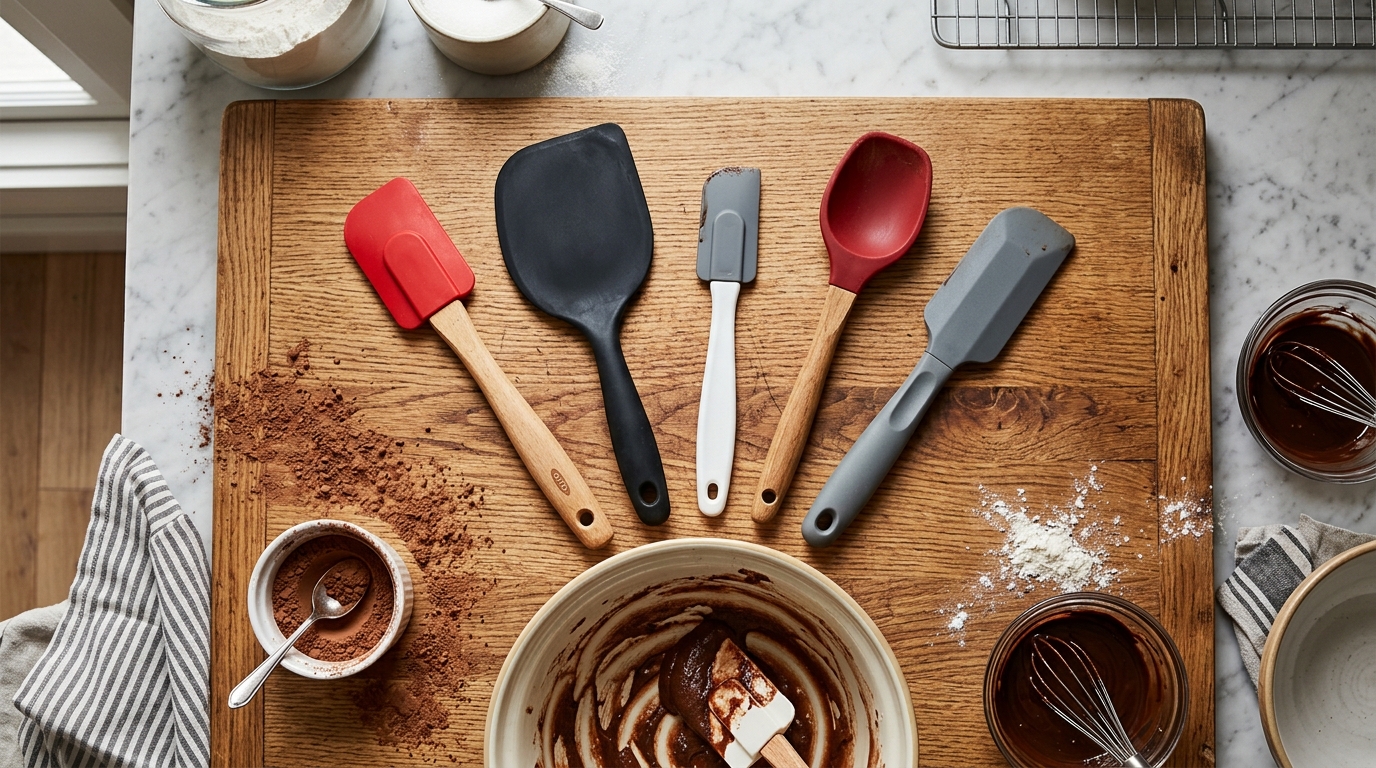
A bad spatula is the kind of thing you don’t notice until it melts into your scrambled eggs or folds under a stubborn fond scrape, then you notice it a lot. This list is for home cooks who want a spatula that handles everything from folding delicate mousse to scraping a screaming-hot carbon steel pan, without babying it. If you’re happy with whatever came in a utensil set five years ago, this probably isn’t for you, but if you’ve ever had a handle separate mid-stir, keep reading.
As an Amazon Associate, KitchenDesk earns from qualifying purchases. Some of the links on this page are affiliate links, we may earn a commission at no extra cost to you. Full disclosure.
Before we get into the picks, a quick note on methodology. Each spatula was tested for a minimum of one week across gas, induction, and electric cooktops, full methodology here. For this category specifically, tests included high-heat sautéing on cast iron at 450°F+, silicone-flex stress under thick cookie dough, dishwasher cycling, and a tomato-sauce stain check after 72 hours. These aren’t controlled lab conditions, but they’re the conditions that actually break spatulas. You can also find more context in my kitchen tools hub and the broader .
Jump to a section
- Quick Comparison
- 1. GIR Ultimate Spatula, Best Overall
- 2. OXO Good Grips Silicone Flexible Turner, Best for Nonstick Pans
- 3. Di Oro Seamless Series Large Silicone Spatula, Best Budget
- 4. Zwilling Silicone Flexible Spatula, Best Premium
- 5. Rubbermaid High Heat Scraper Spatula, Best for Scraping
- 6. Ateco Offset Silicone Spatula, Best for Baking
- 7. Joseph Joseph Elevate Silicone Spatula, Best for Hygiene-Conscious Cooks
- Silicone Spatula Buying Guide
- FAQs
Quick Comparison
| Spatula | Badge | Construction | Heat Rating | Best For |
|---|---|---|---|---|
| GIR Ultimate Spatula | Best Overall | Seamless one-piece | 550°F | All-round daily use |
| OXO Good Grips Flexible Turner | Best for Nonstick | Two-piece | 600°F | Flipping fish, eggs, pancakes |
| Di Oro Seamless Series | Best Budget | Seamless one-piece | 600°F | Everyday cooking, tight budgets |
| Zwilling Silicone Spatula | Best Premium | Stainless core + silicone | Heavy-duty scraping, longevity | |
| Rubbermaid High Heat Scraper | Best for Scraping | Two-piece | 500°F | Pan fond, bowl cleanup |
| Ateco Offset Silicone Spatula | Best for Baking | stainless blade + silicone coating | Frosting, spreading, baking | |
| Joseph Joseph Elevate Spatula | Best for Hygiene | Seamless one-piece | Clean-workflow kitchens |
Jump to the buying guide if you want the framework before the picks. Otherwise, let’s get into the spatulas.
1. GIR Ultimate Spatula, Best Overall
The GIR Ultimate is the spatula I reach for first, and after a week of testing it alongside everything else on this list, I understand why it’s become a reference point in this category. The defining feature is the seamless one-piece construction, there is no joint between the head and handle. That matters because the neck joint is where virtually every other spatula eventually fails: it loosens, it traps grease, it splits. GIR eliminates that failure point entirely.
In testing, the standard size scraped fond off a cast iron skillet without folding, which is the key ask for a stiff-enough head, and then released cleanly from a nonstick omelette pan without any drag. That balance is harder to get right than it sounds. The handle is thick enough to grip with a wet hand, and it didn’t slip once during a full week of active cooking. Heat resistance is claimed at 550°F per manufacturer, more than enough headroom for most home-cook scenarios including cast iron and carbon steel.
Stain resistance was a genuine differentiator. After repeated tomato-based cooking, we’re talking bolognese, shakshuka, a Sunday gravy, the GIR came out of the dishwasher noticeably cleaner than the budget picks. The lighter color options did show faint discoloration after high-heat cast-iron use, so if that bothers you, go dark.
The cons are real but manageable. The price is noticeably higher than budget options, which makes buying multiples feel like a commitment. The standard size head is also slightly wide for smaller saucepans, GIR’s mini size solves this, but that’s an additional purchase. Still, if I could own only one spatula, this is the one.
- Pros: Seamless one-piece silicone; rigid enough for fond scraping, flexible enough for nonstick; grippy handle with wet hands; excellent stain resistance after dishwasher cycling
- Cons: Higher price makes buying multiples expensive; standard head slightly wide for small pans; light colors show discoloration after cast-iron use
Read the full for detailed test notes.
Pricing & availability on Amazon, affiliate link.
View on Amazon2. OXO Good Grips Silicone Flexible Turner, Best for Nonstick Pans
Worth being upfront about what this tool is: a turner first, not a multi-purpose spatula. If you’re expecting a scraper or a folder, look at the GIR or Di Oro instead. But for flipping fish fillets, sliding under a frittata, or handling pancakes on a nonstick surface, the OXO Good Grips Flexible Turner is the most capable tool I tested in that specific lane.
The thin, beveled leading edge is the key detail. It gets under a fragile fish fillet without tearing, something a thicker-edged spatula will destroy. The slotted head lets excess butter or oil drain back into the pan rather than pooling on top of whatever you’re lifting, which is a small but genuinely useful design choice. Heat resistance is claimed at 600°F per manufacturer, I didn’t push it that hard, but at normal nonstick-safe temperatures it performed without any softening or deformation.
The OXO grip handle is the most comfortable I tested in this category. After a longer cooking session, think weekend brunch for six, the soft non-slip grip made a noticeable difference versus the stiffer handles on the budget picks. If you have any hand fatigue issues, this is the ergonomic choice. My one concern for long-term durability is the two-piece construction: the head-to-handle junction is a potential weak point that seamless designs avoid entirely.
The slotted design is also worth flagging as a limitation: sauces, small capers, minced herbs, anything small falls straight through. That’s fine for proteins, not ideal for anything else. This is genuinely a purpose-built tool, and it’s excellent at its purpose.
- Pros: Thin beveled edge slides under delicate foods without tearing; slotted head drains oil effectively; best-in-class ergonomic handle; widely available
- Cons: Not a multi-tasker, turner only; two-piece construction is a durability trade-off; slotted head loses sauces and small ingredients
More detail in the .
Pricing & availability on Amazon, affiliate link.
View on Amazon3. Di Oro Seamless Series Large Silicone Spatula, Best Budget
Seamless one-piece construction at a budget price is not something you should expect to find, and yet the Di Oro delivers exactly that. Most spatulas in this price range cut corners by using a two-piece build, which means you get a joint that traps food and eventually fails. The Di Oro Seamless Series skips that compromise, which is the primary reason it earns a spot on this list over a half-dozen similarly priced competitors I’ve used.
In testing it held its shape under thick brownie batter, the kind of load that makes cheaper spatulas bow sideways, and stayed flexible at cast-iron temperatures without any detectable softening. The stiffness-to-flex ratio is well calibrated for bowl scraping and pan work alike. Heat resistance is claimed at 600°F per manufacturer, I’d treat that as a ceiling, not a target, but for everyday cooking it has more than enough headroom. The BPA-free claim is .
The trade-offs are real but appropriate for the price tier. The silicone compound feels slightly stiffer than GIR or Zwilling, particularly in cold conditions, where it takes a moment to loosen up. The lighter color versions picked up faint staining after a week of heavy tomato-sauce use, which the darker colors avoid. The handle is on the thinner side compared to the premium picks, and during extended mixing tasks that thinness becomes noticeable.
Di Oro has historically offered a strong warranty on this line. If that holds, this is an easy recommendation for any cook who doesn’t want to spend premium money on a spatula they’ll use daily and eventually lose to a dog or a move.
- Pros: Seamless build at a budget price; handles high heat without deformation; good all-around flex for bowls and pans; backed by a warranty (verify current terms)
- Cons: Silicone feels stiffer and slightly lower-grade than premium picks; light colors stain with tomato use; thinner handle less comfortable for extended mixing
See the for week-long test notes.
Pricing & availability on Amazon, affiliate link.
View on Amazon4. Zwilling Silicone Flexible Spatula, Best Premium
Pick up the Zwilling next to any all-silicone spatula and you’ll feel the difference immediately. The stainless steel core inside the handle eliminates flex entirely, there’s no give, no wobble, no vague sense that the tool might eventually bend in a direction you didn’t intend. The silicone head remains appropriately pliable, which means you still get the controlled flex you need for scraping a Dutch oven or folding bread dough, but the handle itself is a fixed, rigid extension of your hand.
That rigidity is the main reason this earns the premium pick. When I was scraping a full batch of sticky caramel off the sides of a saucepan, the Zwilling didn’t ask me to compensate for handle flex the way even the GIR occasionally does under serious load. The silicone head quality is also categorically better than the budget picks, it’s noticeably more supple and responsive without feeling flimsy. Heat rating and dishwasher compatibility are . Stainless core construction .
The cons are straightforward. The price is the highest on this list, full stop, and for a cook who uses a spatula occasionally for light tasks, the premium is genuinely hard to justify. The stainless core also adds weight, after twenty minutes of continuous mixing, that weight is noticeable in a way that all-silicone handles aren’t. And if you’re used to the natural give of a fully silicone handle when scraping curved bowls, the rigidity can feel slightly less intuitive at first.
This is the pick for someone who replaces kitchen tools rarely, cooks on cast iron and carbon steel regularly, and wants to buy once. If that’s not you, the GIR does 90% of the job at a lower price point.
- Pros: Stainless core handle gives unmatched rigidity; premium silicone head, supple and durable; inspires confidence under heavy loads; matches Zwilling cookware aesthetically
- Cons: Highest price on this list; heavier than all-silicone picks; rigid handle less intuitive for bowl-scraping curves
Pricing & availability on Amazon, affiliate link.
View on Amazon5. Rubbermaid High Heat Scraper Spatula, Best for Scraping
There’s a reason this spatula has been in commercial prep kitchens for years, and it’s not brand loyalty, it’s that the wide, relatively stiff head is genuinely excellent at the one thing it’s built for. Scraping. Pan corners. Bowl edges. The last stubborn half-cup of brownie batter. In that specific task category, the Rubbermaid High Heat Scraper outperformed every other spatula on this list during testing, and it wasn’t particularly close.
The head geometry is the difference: wider than most, stiffer than most, with an edge profile designed to get into corners that curved or smaller-headed spatulas miss. The handle length gives you real leverage for scraping tasks, on my gas burner with a cast iron skillet, I was moving more fond with less effort than with any other pick here. Heat resistance is claimed at . That’s lower than several competitors, so this is not the tool to leave resting across a screaming-hot pan.
The construction trade-off is real and worth naming clearly: the two-piece design, head inserts into handle, creates a joint that can trap food over time, even with regular dishwasher cycling. I noticed some residue accumulation at that joint after a week of heavy use. Reports of the head loosening after repeated dishwasher cycles are . The two-piece construction .
At its price point, replacing it every few years is a reasonable trade rather than a problem, this is a tool you buy for performance in a specific job, not for heirloom longevity. If you need a dedicated scraper and don’t want to spend premium money, this is the honest answer.
- Pros: Best scraping performance tested; wide head cleans pan corners and bowl edges completely; comfortable handle length for leverage; price makes replacement painless
- Cons: Two-piece joint traps food over time; head may loosen after heavy dishwasher use (verify); lower heat rating than seamless picks, don’t leave it in a hot pan
Pricing & availability on Amazon, affiliate link.
View on Amazon6. Ateco Offset Silicone Spatula, Best for Baking
Ateco has been supplying professional bakeries for decades, and this offset spatula reflects that lineage. The angled blade solves a problem that every baker has run into: trying to frost a cake or spread batter in a pan while your knuckles drag through the surface you’re trying to smooth. The offset geometry keeps your hand elevated and clear, which gives you actual control over pressure and direction rather than fighting your own hand position.
In my own tests, this was the go-to tool for spreading ganache on a layer cake, leveling batter in a square baking pan, and getting cleanly under cookies on a parchment-lined sheet. The silicone coating means it won’t scratch nonstick bakeware. The thin, flexible blade gives you tactile feedback during detailed work in a way that thicker spatulas don’t. Heat rating .
The limitations are clear and not a criticism of the tool, they’re just a function of what it is. This is a baking-specific implement with limited stovetop utility. If you already own a plain stainless offset, the silicone-coated version is an upgrade for nonstick bakeware but not a radical change. And the offset angle that makes it excellent for spreading works against you when you try to scrape a mixing bowl, the blade catches on the curve rather than following it. .
If baking is a regular part of your kitchen routine and you’re working with nonstick pans or delicate cake layers, this earns a permanent spot in the drawer. If your cooking skews savory and stovetop-heavy, it’s a lower priority.
- Pros: Offset blade keeps hand clear of surface, essential for frosting and spreading; silicone coating protects nonstick bakeware; thin flexible blade gives excellent control; professional-grade build from an established bakery supplier
- Cons: Limited stovetop utility, purpose-specific tool; offset angle is counterproductive for bowl scraping; long-term durability of silicone coating on blade edge is an open question
Pricing & availability on Amazon, affiliate link.
View on Amazon7. Joseph Joseph Elevate Silicone Spatula, Best for Hygiene-Conscious Cooks
The first time someone described the Joseph Joseph Elevate’s integrated rest feature to me, I mentally filed it under “design gimmick.” After a week of using it, I’ve revised that. The small angled foot built into the handle keeps the spatula head lifted off the counter whenever you set it down, no silicone head resting in a puddle of oil or raw egg residue, no transferring counter bacteria into whatever you’re cooking next. The head stayed reliably off the surface across different counter heights and materials throughout testing.
The practical payoff goes beyond hygiene. In multi-step recipes, a braise where you’re moving between browning and braising liquid, or a cake with several components, not having to grab a spoon rest or wipe the counter every time you set the spatula down genuinely speeds up your workflow. It’s a small thing that compounds across a full cooking session. Heat resistance is . Construction is claimed as seamless .
The trade-offs are honest. The resting foot adds bulk to the handle, which makes it feel chunkier than the GIR or Zwilling, not uncomfortable, but less refined in the hand. Performance alone doesn’t distinguish it from comparably priced competitors; the integrated rest is the differentiating feature, and if that doesn’t solve a problem you actually have, there are better pure-performance picks at similar prices. The foot also catches on the walls of a crowded utensil crock, which is a minor but genuinely recurring annoyance.
This is the right pick for cooks who meal-prep heavily, cook for people with compromised immune systems, or simply want a cleaner kitchen workflow without adding another gadget to the counter. It earns its badge because the design innovation is practical and the seamless build keeps cleanup straightforward.
- Pros: Integrated rest keeps head off counter, genuinely useful in practice; reduces cross-contamination risk; seamless build is easy to clean; distinctive enough not to get confused in a utensil crock
- Cons: Thicker handle feel due to the rest foot; performance alone doesn’t justify the price without valuing the hygiene feature; rest foot can catch on utensil crock walls
Pricing & availability on Amazon, affiliate link.
View on AmazonSilicone Spatula Buying Guide
Most spatula marketing is noise. Here’s the framework I actually use when evaluating a new one, and what I’d tell a friend standing in front of a shelf of options. For a deeper look, check out the and the .
Seamless vs. Two-Piece Construction
This is the single most important durability signal. A seamless spatula is one continuous piece of silicone, no joint between head and handle. A two-piece spatula has a head that attaches to (or inserts into) a separate handle. That joint is where food traps, bacteria hide, and failures eventually happen. The GIR and Di Oro picks on this list are seamless, and that’s a primary reason they’re on this list. Two-piece spatulas aren’t automatically bad, the Rubbermaid scraper is worth owning despite the joint, but go in knowing the trade-off. If longevity and hygiene are priorities, seamless wins every time.
Heat Resistance Ratings, What They Actually Mean
Most quality silicone spatulas are rated between 400°F and 600°F, and most home cooks will never approach those limits under normal stovetop use. The real-world concern is cast iron and carbon steel, where pan temperatures can exceed 450°F. If you cook on those surfaces regularly, look for a rating above 500°F, and more importantly, check whether the rating applies to the full spatula or just the silicone head. A silicone head on an unrated plastic handle is a false promise. The handle is usually the weak point, not the head.
Flexibility vs. Rigidity, Match the Tool to the Task
A spatula that folds egg whites beautifully is probably not the best tool for scraping stuck-on fond. Flexible heads win for delicate tasks, omelettes, fish, mousse, anything where you’re following a curve or need tactile feedback. Stiffer heads win for scraping and moving dense ingredients. In my experience, most home cooks benefit from owning two spatulas: one flexible head for the stovetop and a stiffer scraper for bowls and heavy pan work. Buying a single “versatile” spatula is a real compromise in both directions, not a free upgrade in both.
What Looks Important But Mostly Isn’t
Antibacterial silicone claims are largely unverified and not meaningfully different from standard food-grade silicone in real kitchen conditions, I wouldn’t pay a premium for them. “Commercial grade” is not a regulated term; any brand can use it. BPA-free is table stakes for any reputable manufacturer in 2026 and shouldn’t be treated as a differentiator. Bright color variety is genuinely fun but has no bearing on performance. Fancy packaging predicts nothing about how the spatula performs once you’ve had it for three months.
Price Tiers, Where the Money Actually Goes
Budget picks, the Di Oro and Rubbermaid tier, deliver solid everyday performance and are easy to replace when they eventually fail. Mid-range (OXO, Joseph Joseph territory) adds ergonomic refinement and more consistent build quality across production runs. Premium (GIR, Zwilling) means you’re paying for construction precision, material quality, and long-term durability, the picks for someone who wants to buy once and not revisit the decision. The jump from budget to mid-range is usually worth it. The jump from mid-range to premium is worthwhile mainly if you cook frequently at high heat or under heavy loads.
FAQs
Is silicone really safe to cook with at high heat?
Food-grade silicone is FDA-approved for cooking use and doesn’t leach harmful compounds at typical cooking temperatures. The risk comes from very low-quality silicone or filler materials in cheap off-brand spatulas, which is why sticking to established brands matters more in this category than in some others. If your spatula smells strongly of chemicals when heated, that’s a red flag worth taking seriously.
What temperature can silicone spatulas handle?
Most quality silicone spatulas are rated between 400°F and 600°F, but the actual weak point is usually the handle construction or any adhesive at a joint, always check whether the manufacturer’s heat rating applies to the full spatula or just the silicone head. If only the head is rated, that number is effectively meaningless for whole-tool durability.
Can I use a silicone spatula on cast iron?
Yes, as long as the spatula is rated above the cooking temperature you’re using. Cast iron can exceed 450°F in normal use, so a spatula rated to 500°F or higher, with a seamless or metal-core handle that’s also rated, is the safer choice. Don’t leave any spatula resting across a pan that’s actively on a high flame; no rating is a substitute for basic care.
How do I get stains out of a silicone spatula?
A paste of baking soda and dish soap, left for 30 minutes before scrubbing, handles most tomato and turmeric staining. For persistent staining, a short soak in diluted white vinegar followed by a hot dishwasher cycle usually finishes the job. Some discoloration on lighter-colored silicone is cosmetic and doesn’t affect safety or performance, it’s annoying but not a reason to replace the spatula.
Are seamless silicone spatulas actually more hygienic?
In practice, yes. The joint between head and handle in a two-piece spatula can trap food and moisture even after thorough washing, which over time creates a spot that’s genuinely difficult to sanitize. Seamless spatulas eliminate that specific failure point. It’s not a theoretical concern, after a week of heavy use, the difference in residue accumulation at that joint versus a seamless design is visible.
How many silicone spatulas does a home cook actually need?
Realistically, two covers most kitchens: one flexible-head spatula for stovetop tasks (flipping, folding, sautéing) and one stiffer scraper-style for bowl work and sticky pan cleanup. Anything beyond that is category-specific, an offset for baking, a mini for small saucepans. Don’t let a utensil set talk you into owning six of essentially the same tool.
What’s the difference between a silicone spatula and a silicone turner?
A spatula traditionally refers to a tool with a flexible head used for mixing, folding, and scraping. A turner (sometimes also called a spatula, which is where the confusion lives) has a wider, flatter head designed specifically for flipping. On this list, the OXO pick is a turner, it’s built for flipping, not folding. The others are spatulas in the traditional sense, with varying degrees of flex and stiffness depending on their primary job.
For more on outfitting a functional kitchen drawer, see my guides to and, or browse the full kitchen tools category.