

On this page
We may earn a commission from links on this page. Specs are verified from manufacturer/retailer listings (June 2026). This is a spec comparison and buying framework, not a hands-on lab test, and we say so plainly. Prices change, so we link to live listings.
A mandoline is the fastest way to get even, professional slices at home, and the most common way to get a trip to urgent care. Picking the right one is less about brand and more about matching the blade, the safety system and the thickness control to what you actually slice. Here’s how the seven best-known mandolines compare, and how to choose between them.
What actually matters in a mandoline (the framework)
Most “best mandoline” lists just rank products. The decision really comes down to six trade-offs. Understand these and you can choose for your kitchen instead of someone else’s:
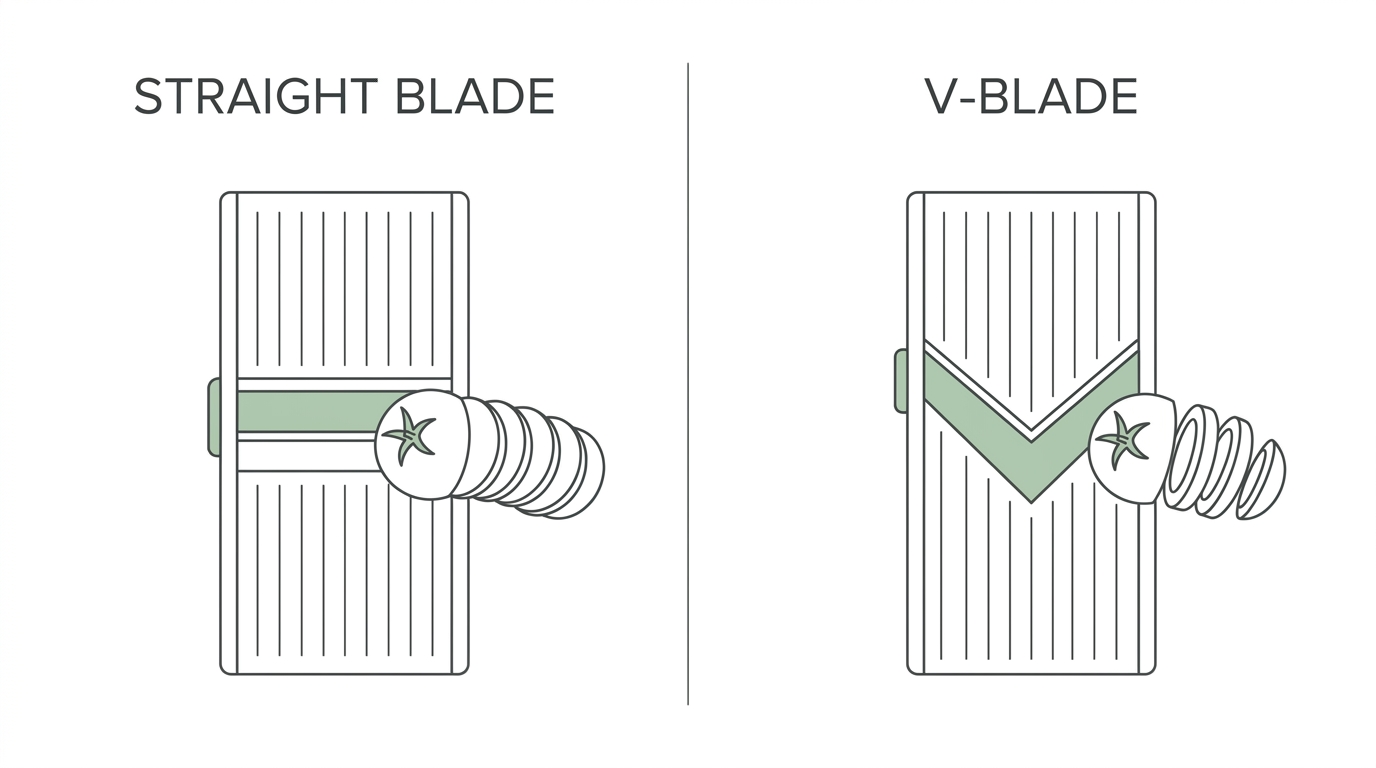
- Blade geometry: straight vs V. A straight blade (OXO, Benriner, Bron) is forgiving and great for clean rounds. A V-blade (de Buyer, Swissmar, Mueller) needs less downward force and grips firm produce better, but can tear soft items if it dulls. It’s a pressure-versus-precision trade, not a better-or-worse.
- Blade material: steel vs ceramic. Steel takes a finer edge and handles everything. Ceramic (Kyocera) never rusts and holds its edge far longer, but it can chip and is hard to re-sharpen. Heavy users lean steel; low-maintenance users lean ceramic.
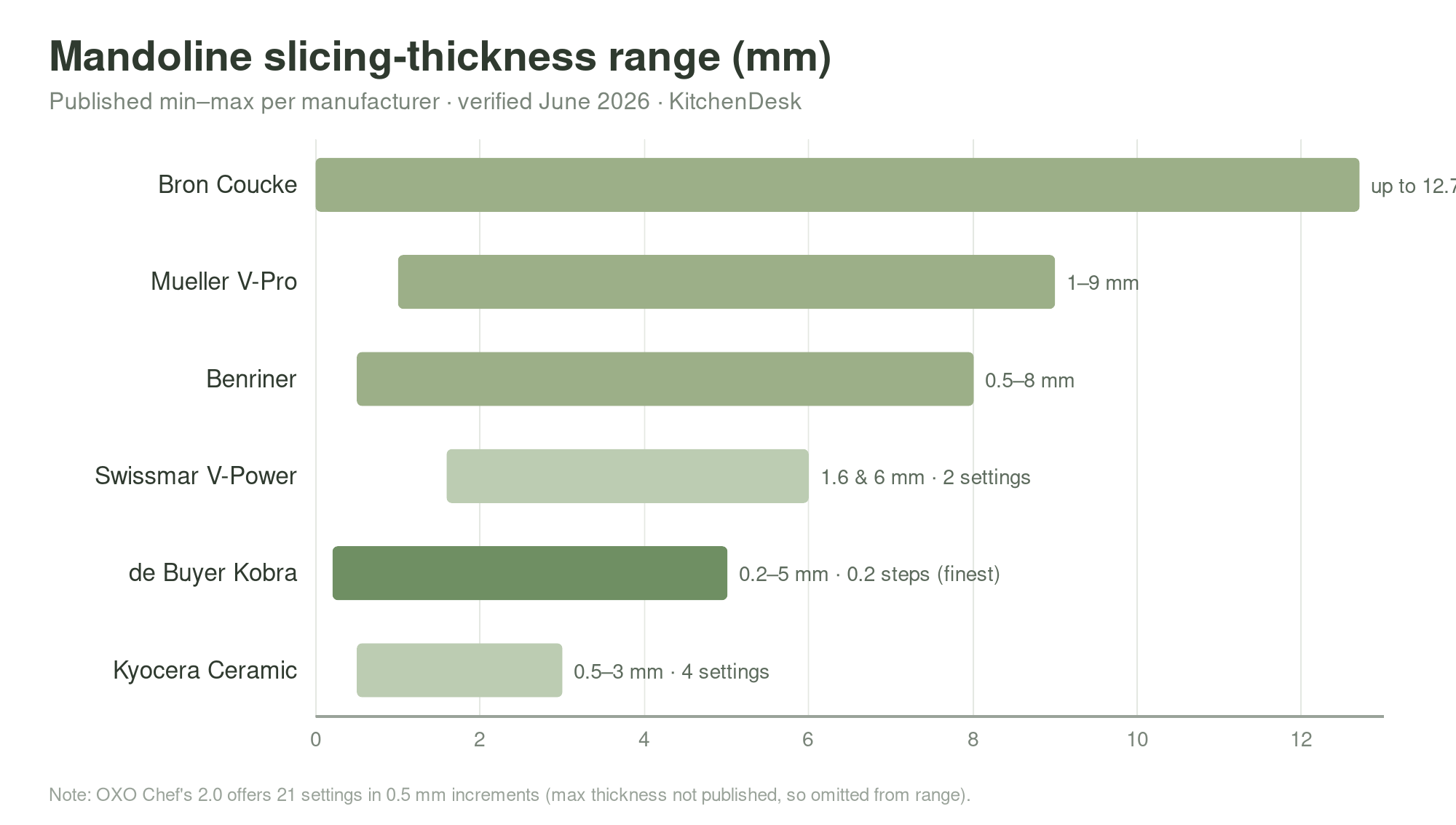
- Thickness adjustability: range and granularity. A wide range with fine steps (de Buyer: 0.2 to 5 mm in 0.2 mm increments) is a different tool than a two-setting reversible blade. Match it to whether you do delicate carpaccio or just weeknight veg.
- Hand-guard and safety system. The mandoline is the kitchen’s number-one ER-visit gadget. A secure, ambidextrous food holder is the spec that decides whether you’ll actually keep using it. A cut-resistant glove is cheap insurance on any model.
- Build and origin. A full stainless body (Bron) lasts longer and feels stable. ABS-framed units (Mueller, Swissmar, Benriner) are lighter and cheaper. French, German and Japanese manufacture each carry different edge-finishing traditions.
- Cleanup and storage. Dishwasher-safe versus hand-wash-only decides whether it lives on the counter or dies in a drawer. Folding or flat storage matters in small kitchens.
Spec comparison: 7 mandolines (verified June 2026)
| Model | Blade type | Material | Thickness range | Hand guard | Dishwasher | Origin |
|---|---|---|---|---|---|---|
| OXO Good Grips Chef’s 2.0 | Straight + wavy | Japanese stainless | 21 settings, 0.5 mm steps | Yes (spring food holder) | Hand-wash only | n/s |
| Benriner (Classic) | Straight + 3 julienne | Japanese stainless | 0.5 to 8 mm (dial) | n/s (use a cut glove) | n/s | Japan |
| de Buyer Kobra | V-blade (19.3°) | Stainless (France) | 0.2 to 5 mm, 0.2 mm steps | Yes (pusher) | n/s | France |
| Mueller Austria V-Pro | V + wavy + shredder | 420 surgical stainless | 1 to 9 mm | Yes (food holder) | Top-rack | n/s |
| Swissmar Börner V-Power | V-blade | German surgical stainless | ~1.6 & 6 mm (2 settings) | Yes (ambidextrous) | n/s | n/s |
| Kyocera Advanced Ceramic | Straight | Ceramic (zirconia) | 4 settings: 0.5 / 1.3 / 2.0 / 3.0 mm | Yes (handguard) | n/s | n/s |
| Bron Coucke (Original) | Straight + waffle | All stainless steel | Up to ~12.7 mm | Yes (safety carriage) | 100% safe | France |
“n/s” = not stated in the manufacturer/retailer listing we checked (not “absent”; just unconfirmed, and we don’t guess).
What the specs reveal
- Finest control: the de Buyer Kobra (0.2 to 5 mm in 0.2 mm steps) is the only one with true sub-millimetre control for carpaccio and truffle work. The OXO is the everyday-granularity champ (21 settings).
- Lowest maintenance: the Kyocera ceramic blade resists rust and (per Kyocera) holds its edge far longer than steel, at the cost of chip risk and no easy resharpening.
- Easiest cleanup: Bron Coucke (100% dishwasher-safe, all-stainless) and Mueller (top-rack). The popular OXO 2.0 is hand-wash only, a detail buyers often miss.
- Two-setting limit: the Swissmar V-Power’s reversible blade is essentially two slice thicknesses, fast but limiting for precision.
- Build longevity: only the Bron Coucke is full stainless; the rest are ABS or plastic framed (lighter and cheaper, less heirloom-durable).
Match the mandoline to how you cook
- Safety-first everyday cook: the OXO (sprung food holder, 21 thickness settings) or Mueller (food holder, top-rack dishwasher) are the most forgiving to live with. Add a cut-resistant glove regardless.
- Precision slicing (carpaccio, gratin, truffles): the de Buyer Kobra. Nothing else here gets to 0.2 mm in fine steps.
- Low-maintenance, rarely sharpened: the Kyocera ceramic. No rust, holds an edge for years, just keep it away from bones and pits.
- Heavy or near-daily use: the Bron Coucke. All-stainless and fully dishwasher-safe, it’s built to outlast plastic-framed rivals.
- Thin Japanese-style slicing on a budget: the Benriner, the chef’s-kitchen classic, with three julienne blades. Just supply your own hand protection.
- Firm produce (hard squash, potatoes): a V-blade (Swissmar V-Power or Mueller) bites with less downward force.
What each one is bad at (the honest limits)
- OXO 2.0: hand-wash only, and bulkier to store than a flat slicer.
- Benriner (Classic): the classic model isn’t sold with a hand guard, so a cut glove is essentially mandatory; the body is plastic.
- de Buyer Kobra: premium price, and like any V-blade it can tear very ripe produce once the edge dulls.
- Mueller V-Pro: ABS body is less durable than metal, and there are several loose blades to store and keep track of.
- Swissmar V-Power: only two slice thicknesses, so it’s a speed tool more than a precision one.
- Kyocera Ceramic: the ceramic edge can chip on hard items or pits, isn’t easily resharpened at home, and offers only four thickness settings.
- Bron Coucke: heavy and expensive, genuine overkill for occasional slicing.
Using a mandoline safely
However good the blade, a mandoline only earns its place if you respect it. A few rules cover almost every injury:
- Always use the food holder or a cut-resistant glove. Most cuts happen on the last few slices, when fingers get close to the blade. The guard exists for exactly that moment.
- Set it on a stable, dry surface. A mandoline that slides mid-stroke is dangerous. Use the folding legs on a board, or the bowl-edge hooks where fitted.
- Slow down at the end. Stop slicing while there is still a safe nub of vegetable left, and finish that last piece by hand.
- Store it blade-guarded. Reaching into a drawer for an unguarded mandoline is its own hazard, so fold or cover the blade.
FAQ
Straight blade or V-blade, which is safer? Neither is inherently safer; both demand the food holder or a cut glove. A V-blade needs less downward force, which some cooks find more controlled on hard produce; a straight blade gives cleaner full rounds.
Are ceramic mandoline blades worth it? If you hate maintenance, yes. Ceramic won’t rust and holds its edge far longer than steel. The trade-off is that it can chip on something hard and you can’t easily resharpen it.
Can you sharpen a mandoline blade? Most consumer mandoline blades aren’t designed for home sharpening; you replace blades rather than hone them, and ceramic can’t be sharpened conventionally. Buy quality steel up front so the factory edge lasts.
Which is easiest to clean? The Bron Coucke is fully dishwasher-safe and the Mueller is top-rack safe. The OXO 2.0, despite its popularity, is hand-wash only.
Do I really need the hand guard? Yes. The guard (or a cut-resistant glove) is the single most important safety feature on a mandoline; skipping it is how people get hurt. The Benriner classic notably doesn’t include one.
Once you know which trade-offs matter most for your kitchen, our tested Best Mandolines 2026 guide matches each pick to a use case.
Sources (verified June 2026)
OXO · oxo.com, webstaurantstore.com, amazon.com (B0716HGWWK). Benriner · amazon.com (B01CZXJJBU), mtckitchen.com. de Buyer Kobra · debuyer.com, webstaurantstore.com (2011.01). Mueller Austria · amazon.com (B01CT63964), walmart.com. Swissmar Börner V-Power · amazon.com (B078XJ7YDS), kitchenkapers.com. Kyocera · cutlery.kyocera.com, amazon.com (B000KKNQZ6). Bron Coucke · amazon.com (B0001BMZ38), walmart.com (20638CHB).