
On this page
- TL;DR, What to Know Before You Scroll
- What an Air Fryer Actually Is (and Isn’t)
- What Actually Matters When Buying an Air Fryer
- What’s Marketing Fluff (Features That Sound Good, Aren’t)
- Common Mistakes First-Time Buyers Make
- Price Tiers: Where to Spend and Where to Save
- Frequently Asked Questions
- The Bottom Line
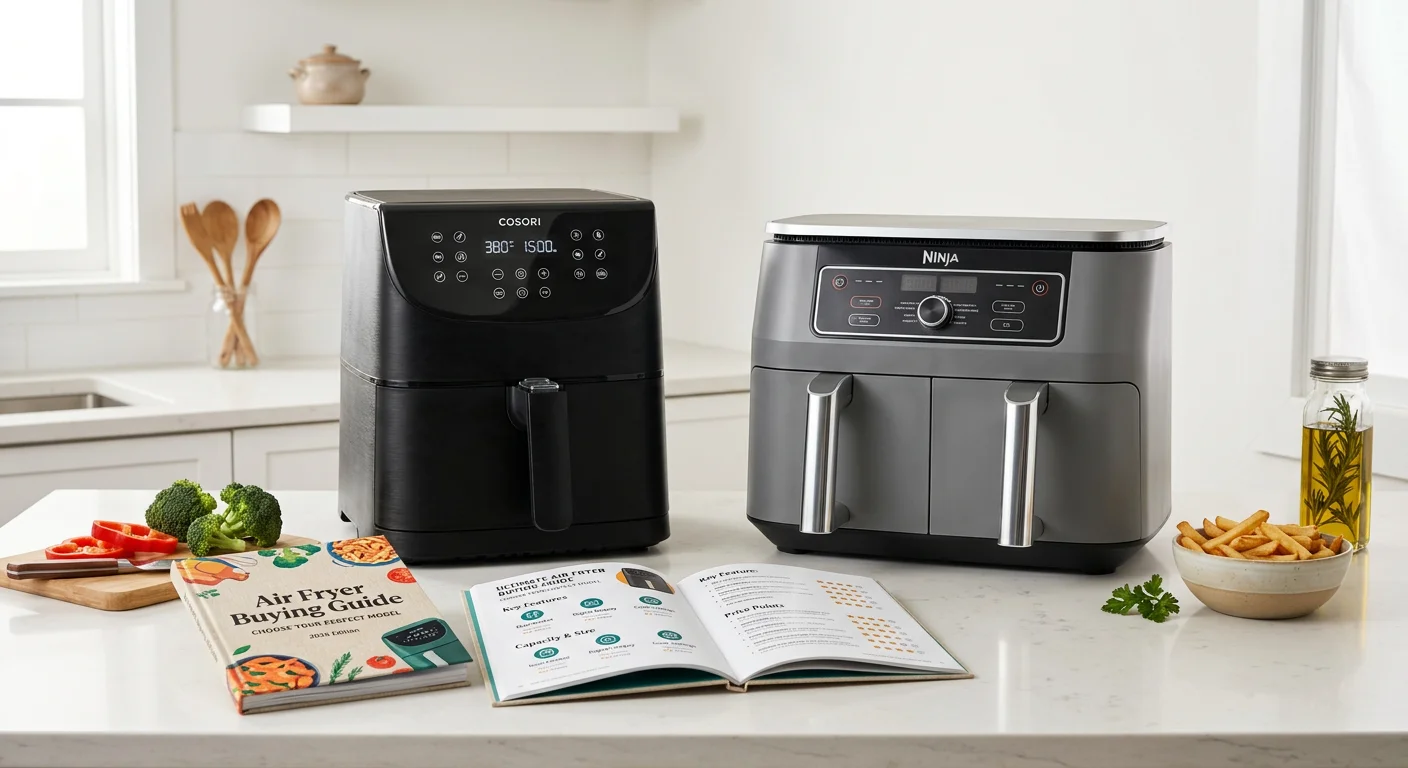
Picking an air fryer sounds simple until you’re staring at 40 models on Amazon ranging from $30 to $350, with spec sheets full of wattages and quart sizes that don’t tell you whether the fries will actually be crispy. This guide cuts through that noise. By the end, you’ll know exactly which size fits your household, which features are worth paying for, and which marketing claims you can safely ignore, so you can buy once and be done with it.
As an Amazon Associate, KitchenDesk earns from qualifying purchases. Some of the links on this page are affiliate links, we may earn a commission at no extra cost to you. Full disclosure.
Jump to a section
- TL;DR, What to Know Before You Scroll
- What an Air Fryer Actually Is (and Isn’t)
- What Actually Matters When Buying an Air Fryer
- What’s Marketing Fluff (Features That Sound Good, Aren’t)
- Common Mistakes First-Time Buyers Make
- Price Tiers: Where to Spend and Where to Save
- Frequently Asked Questions
- The Bottom Line
TL;DR, What to Know Before You Scroll
- Capacity is the most important spec: plan for 1–1.5 qt per person for main-dish cooking; basket-style models suit 1–3 people, oven-style suits 3+.
- Wattage (typically 1400–1800W) affects preheat time and recovery speed, look for at least 1500W for a basket model if you cook proteins regularly.
- Preset buttons are mostly convenience theater; what matters is whether the machine holds a consistent temperature across a full cook cycle.
- Non-stick coatings vary widely in durability, PTFE-coated baskets are fine for most cooks if you skip metal utensils; ceramic-coated baskets tend to degrade faster under daily use .
- Dual-zone / dual-basket models genuinely save time if you cook proteins and vegetables simultaneously; the added bulk is a real trade-off for smaller kitchens.
- The oven-style form factor is slower to preheat but handles larger cuts, dehydration, and toast, worth it only if you’d also replace a countertop oven.
- Budget models are fine for frozen foods and reheating; for raw proteins more than twice a week, mid-range build quality pays off quickly.
- Cleanup ease tracks almost entirely with basket material and how well the drawer seals, confirm dishwasher-safe status from the manufacturer before buying.
What an Air Fryer Actually Is (and Isn’t)
Air fryers reached mass-market shelves around 2017, but the technology traces back to Philips’s 2010 Airfryer patent, which adapted rapid hot-air circulation, a technique long used in professional convection ovens, into a compact countertop drawer format. The core mechanism is a high-speed heating element paired with a fan that forces hot air around food at velocities high enough to produce the Maillard browning you’d get from shallow frying, without submerging food in oil.
Understanding that an air fryer is essentially a small, aggressive convection oven explains both what it does well and where it has limits. It excels at fast browning, crisping, and reheating. It struggles with large roasts, wet batters that need oil submersion to set, and anything that benefits from steam or braising liquid. That’s not a knock, it’s just knowing what tool you’re actually buying.
What Actually Matters When Buying an Air Fryer
Capacity and Footprint
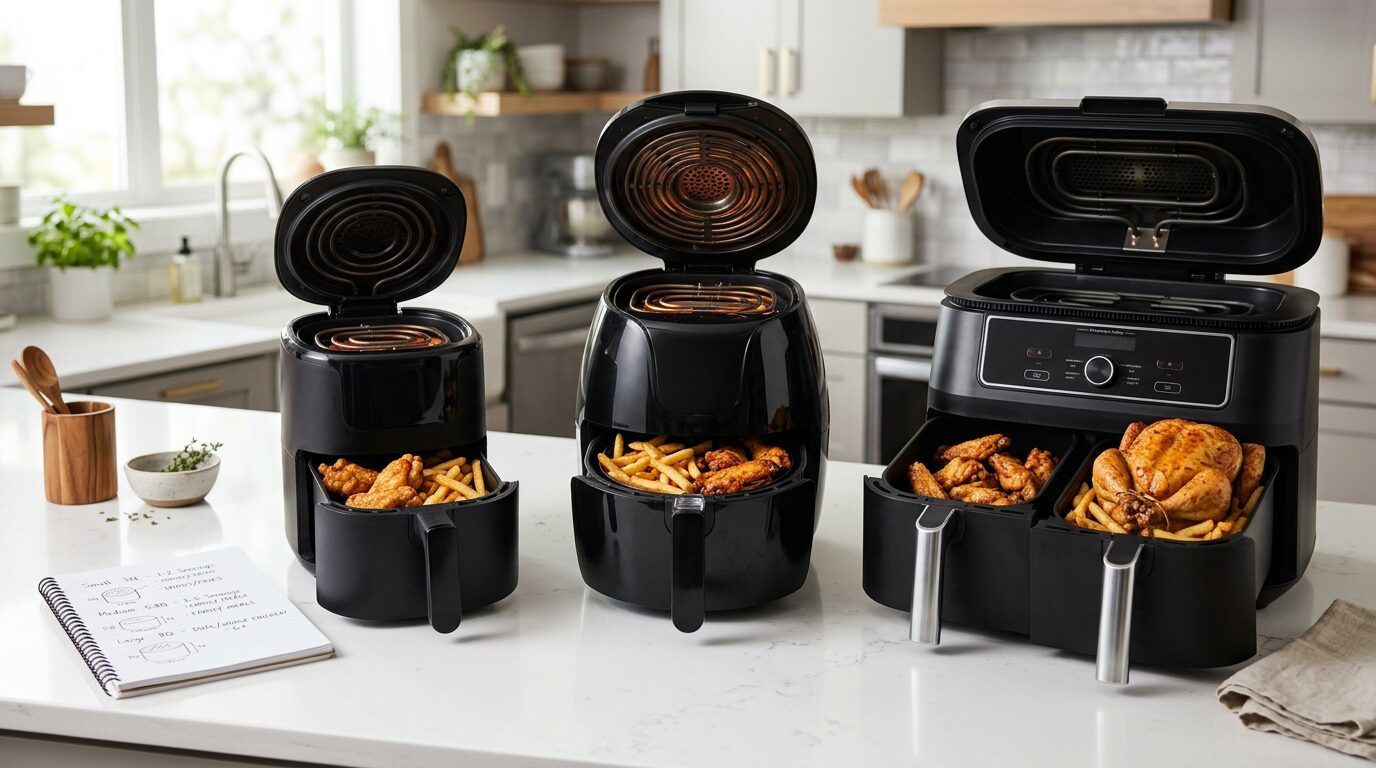
Basket volume in quarts is the single most consequential spec on the box. A 4-qt basket feeds two people a reasonable portion of fries or chicken thighs in one batch; jumping to 5.5–6 qt lets you cook for three to four without running a second round. Oven-style models advertise larger internal volumes, but they have narrower effective cooking zones due to shelf placement, always check usable shelf dimensions against what you’re actually planning to cook, not just the total cubic-volume number the manufacturer leads with.
Wattage and Heating Consistency
Higher wattage shortens preheat time and helps the unit recover temperature faster after you open the drawer to shake or flip. Most competent basket models land between 1500W and 1800W. Below 1400W, you’ll notice uneven browning on thicker cuts, the element simply can’t keep up with heat loss. That said, peak wattage is only part of the picture. How evenly the unit distributes heat across a full cook cycle matters just as much, and that’s something only hands-on testing reveals. According to, internal temperature swings of ±15–25°F during a cycle are common across consumer-grade models, which is why you should always use an instant-read thermometer to verify doneness on proteins rather than trusting the display alone.
Basket Material and Coating
The basket is what you’re touching, washing, and relying on every single cook. PTFE (Teflon-family) coatings on quality baskets hold up well with silicone or wooden utensils and are considered safe at normal cooking temperatures, PTFE doesn’t begin to break down until well above 500°F . The practical concern is mechanical wear: cheap PTFE on thin stamped steel shows visible degradation within months of daily use. Ceramic coatings are frequently marketed as a “healthier” alternative, but suggests they lose their non-stick release properties faster than quality PTFE under repeated high-heat use. Look for a basket where the coating comes with a confirmed dishwasher-safe rating from the manufacturer, “hand wash recommended” is often corporate hedging, not a coating that will hold up.
Controls and Temperature Range
A clear, accurate temperature readout matters more than a touchscreen aesthetic. Dial-and-LED setups are often faster to adjust mid-cook than capacitive touch panels, which require clean, dry fingers at the exact moment you’re handling raw chicken or greasy vegetables. A temperature range of 180°F–400°F covers nearly all standard use cases. If dehydration is on your list, check that the unit can go down to 130–150°F, not every model does, and the spec is sometimes buried in the manual rather than listed on the product page.
Ease of Cleaning
Three things determine how much you’ll dread cleanup: whether the drawer and basket separate for independent washing, whether the heating element is accessible for wiping down, and how well the drawer seals to prevent grease from dripping into the base unit. A model that scores well on all three will stay functional and sanitary over years of regular use. One that doesn’t seal properly will have you scrubbing the interior cavity with a damp cloth after every fatty cook, which gets old fast.
What’s Marketing Fluff (Features That Sound Good, Aren’t)
Preset programs. “12 preset cooking modes” means the manufacturer pre-entered a time/temp combination for pizza, fries, steak, and so on. These are starting points at best, a frozen pizza preset can’t account for your specific brand’s thickness, your unit’s actual calibration, or whether you want it crispier. Experienced cooks ignore presets after the first week. Beginners find them useful as a training-wheels baseline, but they don’t justify a price premium over a model with manual controls you trust more.
Digital display precision. A display reading “385°F” implies more accuracy than most air fryer thermostats can actually maintain, given the ±15–25°F swings common in consumer models. A bright, readable display is a real usability win; treating the exact number as a precise scientific measurement is not. Always verify protein doneness with a thermometer.
Advertised extra-large capacity. Manufacturers measure total interior volume. The usable cooking space, where food actually gets airflow and browning, is always smaller. A “7-qt basket” with a shallow, wide profile may cook less food evenly per batch than a tighter 5.5-qt basket with better fan placement. Where possible, check third-party test results that measure actual usable batch capacity rather than relying on the number printed on the box.
Wi-Fi and app connectivity. App connectivity exists on a handful of models and solves a problem very few people actually have, air fryer cooks are standing at the counter watching a 12-minute cook cycle. The added complexity of firmware updates and the real risk of app deprecation over a product’s lifetime rarely pays back. Skip it unless a specific feature genuinely fits your workflow.
Front viewing windows. A viewing port sounds practical but tends to collect grease vapor and turn opaque within a few weeks of regular use. It also doesn’t replace opening the drawer to check and flip, which you should be doing anyway on anything that cooks unevenly if left alone.
Common Mistakes First-Time Buyers Make
Buying for a household size they don’t have yet. A solo cook who buys a compact 3-qt model and then moves in with a partner, or starts cooking for guests, will be running two batches every dinner. If you’re on the fence between sizes, go up one tier. The footprint difference between a 4-qt and a 5.8-qt basket model is modest; the batch capacity difference is not.
Confusing basket air fryers with air fryer ovens. Basket air fryers preheat in 2–3 minutes and brown food quickly at close range to the element. Oven-style air fryers, which also toast, bake, and sometimes rotisserie, take 5–8 minutes to preheat and cook more slowly overall. If your main use case is weeknight speed (frozen foods, chicken thighs, reheating pizza), get the basket. If you want to replace a toaster oven and can accept slower air frying, get the oven style. Trying to get the best of both in one appliance often means compromising on both. For more detail on that decision, see our, Best air fryer ovens if you want to replace your toaster oven too.
Overcrowding the basket on day one and deciding the unit doesn’t work. Air frying requires airflow around each piece of food. Piling chicken wings three layers deep will steam the bottom layer and crisp only the top. Single-layer cooking, or at most a loose arrangement with mid-cook shaking, is what produces the results you see in review photos. This is operator error, not a product flaw, but buyers who don’t know it return perfectly functional units every day.
Ignoring the total ownership cost. A cheap basket with a thin non-stick coating may need replacing within 12–18 months under daily use. Replacement baskets, when available, often cost $15–30, and some manufacturers quietly discontinue them. Spending a bit more upfront on a unit with a robust basket and documented available spare parts is frequently cheaper over three years than cycling through budget models.
Not verifying dishwasher safety before buying. “Easy clean” in ad copy is not the same as “top-rack dishwasher safe” in the manual. Check the manufacturer’s product page for the specific model number you’re ordering, not the general category listing, which may cover multiple SKUs with different specs and different basket materials.
Price Tiers: Where to Spend and Where to Save
Budget
Entry-level basket models in this tier typically offer 3–4 qt capacity, manual or basic digital controls, and adequate, not impressive, build quality. The heating element and fan usually get the job done for frozen foods, reheating leftovers, and occasional vegetable roasting. Basket coatings and drawer mechanisms are where corners get cut most visibly; you’ll likely be hand-washing carefully and replacing the unit sooner than you’d want. This tier makes sense for college students, infrequent users who want to test whether they’ll actually use an air fryer before committing, or households that have a backup countertop oven for anything serious. Expect to verify cooking temperatures manually and to treat the basket gently. For the best-tested options at this price point, see our, Best budget air fryers we’ve tested.
Mid-Range
This is where most regular home cooks should land. Mid-range models typically offer 5–6 qt baskets, 1500–1700W heating elements with better calibration, more durable coatings on thicker-gauge steel, and cleaner drawer mechanisms that are easier to degrease. Some include a second rack or divider for layered cooking. Build quality is noticeably better, drawer slides feel solid, baskets don’t warp after six months of regular 400°F sessions. If you cook proteins from raw multiple times a week and care about consistent results, the price delta over budget is justified within the first few months of use. Our full tested picks are in the, See our picks for the best air fryers this year.
Premium
Premium air fryers split into two sub-categories: high-end basket models with superior temperature consistency and durable finishes, and full air fryer ovens that replace multiple countertop appliances. The first type is worth it for cooks who want best-in-class results from a single-function unit and plan to use it daily for years. The second type pays back only if you’re genuinely replacing a toaster oven convection oven and dehydrator and have the counter space to accommodate something that’s meaningfully larger than a basket model. Premium also buys you better customer support, longer warranties, and (usually) available replacement parts. If your use case is occasional or limited to simple tasks, the performance ceiling of a solid mid-range model is already more than adequate for most households.
Frequently Asked Questions
How much capacity do I actually need?
Plan roughly 1–1.5 qt of basket space per person for a main dish. A 4-qt basket comfortably feeds two; 5.5–6 qt handles three to four. If you regularly cook for five or more, an oven-style air fryer or cooking in two batches is more realistic than any single basket model on the market.
Is an air fryer the same as a convection oven?
Mechanically similar, both use a fan to circulate hot air, but an air fryer moves air much faster at closer range to the food, which accelerates browning significantly. A convection oven has more space and more even heat distribution for larger items but crisps more slowly. They’re not interchangeable for all tasks, and knowing the difference helps you set realistic expectations for each.
Are air fryers actually healthier than deep frying?
For most recipes, yes, air frying achieves crispy texture with far less added oil than submerged frying, which meaningfully reduces total fat if that’s a health priority. The Maillard browning reaction that creates flavor still happens. That said, “healthier than deep frying” is a fairly low bar; an air fryer doesn’t transform a sodium-heavy frozen food into a health food, and it’s worth keeping that in perspective.
Can I use parchment paper or foil in an air fryer?
Yes, with caveats. Pre-cut perforated parchment liners sized for air fryers work well and make cleanup easier without blocking airflow. Flat foil or parchment covering the entire basket bottom restricts airflow and defeats the purpose of the appliance. Critically: never preheat the unit with bare parchment sitting in the basket, the fan can blow it up into the heating element.
How long does an air fryer take to preheat?
Basket models typically reach 400°F in 2–4 minutes at 1500W or above. Oven-style models take 5–10 minutes depending on size and wattage. Some manufacturers say preheating isn’t necessary for shorter cook times, but for proteins and anything where initial crust formation matters, preheating consistently improves results.
Are non-stick air fryer baskets safe?
PTFE-coated baskets are considered safe for normal cooking temperatures, according to, PTFE does not begin to break down until temperatures well above 500°F, which is beyond what any standard air fryer recipe calls for. The practical concern is mechanical wear from metal utensils or abrasive scrubbing, which degrades the coating over time and can introduce flaking. Use silicone or wooden utensils and avoid steel wool.
What foods don’t work well in an air fryer?
Wet batters (like beer batter) drip through the basket and don’t set properly without oil submersion. Very large roasts exceed most basket capacities. Delicate leafy greens blow around from the fan and burn unevenly. Foods that benefit from steaming, braising, or liquid, braises, soups, custards, are simply the wrong tool match. None of that is a flaw; it’s just knowing what the appliance was designed to do.
How do I keep my air fryer from smoking?
Smoke almost always comes from fat dripping onto the heating element. Adding a small amount of water to the drawer below the basket reduces smoke during fatty cooks like bacon, sausage, or duck. Keeping the basket and drawer clean between uses is the most effective long-term prevention, built-up grease in the base is the main culprit in units that smoke regularly even with lean proteins. Using high-smoke-point oils sparingly on food surfaces also helps.
Should I buy a dual-basket / dual-zone air fryer?
Dual-zone models let you run two different foods at different temperatures and finish them at the same time, genuinely useful for weeknight cooking where you’re doing chicken thighs at 400°F alongside vegetables at 375°F. The trade-off is a larger countertop footprint and a higher price point. For a single cook or anyone who meal-preps one item at a time, it’s more machine than the use case warrants.
Do air fryers use a lot of electricity?
A 1700W air fryer running for 15 minutes uses approximately 0.43 kWh. For comparison, a full-size oven preheating and running for 30–45 minutes uses considerably more energy for the same small batch of food. For small-batch cooking, air fryers are among the more energy-efficient countertop appliances you can own. Exact costs depend on your local electricity rate.
The Bottom Line
If you’re buying your first air fryer, start with a 5–6 qt basket model from a brand with documented replacement parts and a confirmed dishwasher-safe basket. That covers most households and most use cases without overcomplicating the decision. Only move to an oven-style model if countertop oven replacement is genuinely your goal, not just because the larger capacity sounds appealing in theory. For specific model recommendations across all three price tiers, see our, each pick links through to a full single-unit review with hands-on test notes, so you can read the details before committing.
Tested and written by Maya Chen KitchenDesk. Maya is a Toronto-based home cook and former line cook (Toqué!, 2014–2017). She tests every product on gas, induction, and electric for a minimum of one week before any recommendation goes out.