

On this page
We may earn a commission from links on this page. This is an explainer and buying guide; where we mention specific models, see our tested picks linked below.
Air fryer, convection oven, toaster oven, deep fryer: people use the names interchangeably, but they cook differently, take up different space, and suit different jobs. Here’s what actually separates them, and which one (or which combination) you really need.
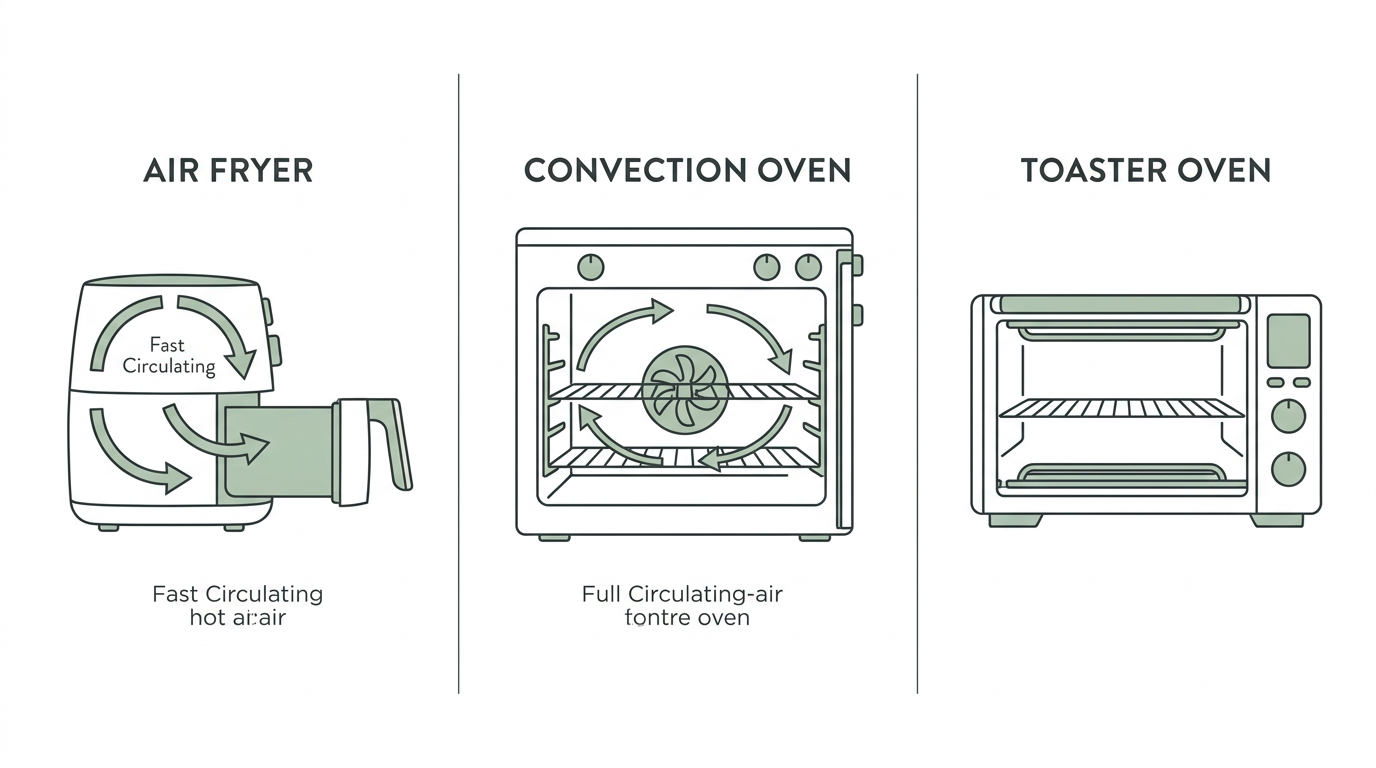
How each one actually works
- Air fryer. It’s a small, sealed chamber with a powerful fan that blasts hot air at high velocity around food in a basket. The compact space and strong airflow are why it crisps fast and preheats in a couple of minutes. It is, essentially, a tiny, turbocharged convection oven.
- Convection oven. A full-size oven with a fan that circulates the heat. The airflow is gentler than an air fryer’s and the cavity is far larger, so it browns more evenly across multiple trays but takes longer to come up to temperature and doesn’t crisp small batches as hard.
- Toaster oven. A small countertop box oven heated by elements top and bottom. Basic models rely on radiant heat with little air movement; many newer ones add a convection fan or a dedicated air-fry mode, which blurs the line with an air fryer.
- Deep fryer. The outlier: it cooks by submerging food in hot oil, not hot air. That’s what gives true deep-fried texture, at the cost of a vat of oil, the mess, and the calories.
Side-by-side comparison
| Air fryer | Convection oven | Toaster oven | Deep fryer | |
|---|---|---|---|---|
| How it cooks | High-velocity hot air | Fan-circulated hot air | Radiant heat (+ optional fan) | Hot oil immersion |
| Crisping | Excellent, fast | Good, even | Moderate (better with air-fry mode) | Best (true fried) |
| Capacity | Small (1 to 6 qt) | Large (full oven) | Medium | Small to medium |
| Preheat / speed | Fastest | Slowest | Fast | Fast (once oil heats) |
| Cleanup | Easy (basket) | Whole oven | Tray | Messy (oil disposal) |
| Best at | Fries, wings, reheating crisp | Batch roasting, baking trays | Toast, small bakes, reheats | Battered foods, doughnuts |
Air fryer vs convection oven: which do you need?
If you already own a convection oven, an air fryer isn’t strictly necessary, but it earns its place for two reasons: it preheats in a fraction of the time, and its tighter, faster airflow crisps small batches harder than a big oven cavity can. For a weeknight tray of fries or wings, the air fryer is quicker and crispier. For a Sunday roast, a sheet of cookies, or anything that needs room, the convection oven wins on capacity. Many people keep both for exactly that reason: the oven for volume, the air fryer for fast and crisp.
Air fryer vs toaster oven
This is the closest call, because modern toaster ovens increasingly include a convection fan and an air-fry setting. A toaster oven is more versatile (it toasts, bakes and broils) and usually holds more, while a dedicated air fryer crisps a little harder and is simpler to clean. If counter space allows only one and you want a do-everything box, an air-fry toaster oven is the smarter buy; if you mostly want fast, crispy results and easy cleanup, a basket air fryer is better.
Air fryer vs deep fryer
A deep fryer still makes the crispiest, most authentic fried food, because nothing fully replicates oil immersion. But an air fryer gets surprisingly close on things like fries and wings using a fraction of the oil, with far less mess and no oil to store or dispose of. For everyday cooking and lighter results, the air fryer wins on convenience and health; for true battered fish, doughnuts or restaurant-style fries, the deep fryer is still king.
Do you need both an air fryer and an oven?
Not necessarily. If your oven has a convection setting, it can do most of what an air fryer does, just slower and less crisp on small portions. The honest case for owning both is convenience: the air fryer saves preheat time and crisps weeknight portions, while the oven handles capacity. If your kitchen is small, an air-fry toaster oven is the one-box compromise that covers the most ground.
Which should you buy?
- You have a full oven and want fast, crispy small meals: add a basket air fryer. See our air fryer comparison and best air fryers guide.
- Tight counter, want one versatile box: an air-fry toaster oven (toasts, bakes, air-fries).
- You batch-cook or bake a lot: lean on a convection oven; an air fryer is a nice-to-have, not essential.
- You want genuine deep-fried texture often: a dedicated deep fryer, accepting the oil and mess.
FAQ
Is an air fryer just a small convection oven? Essentially yes, mechanically: both cook with fan-circulated hot air. The air fryer’s smaller chamber and faster, more aggressive airflow are what make it preheat quicker and crisp harder than a full oven.
Can a convection oven replace an air fryer? For most foods, yes, just slower and slightly less crisp on small batches. Use a low rack, a perforated tray, and a slightly higher temperature to get closer to air-fryer results.
Toaster oven or air fryer for a small kitchen? If you want one appliance that does the most, an air-fry toaster oven. If you mostly want crispy food fast with the easiest cleanup, a basket air fryer.
Is an air fryer healthier than a deep fryer? For the same foods, yes, because it uses far less oil. It won’t perfectly match deep-fried texture, but it’s a meaningful cut in oil and mess.
Do air fryers use a lot of electricity? Less than heating a full oven for a small meal, because the chamber is tiny and preheats fast. For big batches, a full oven is more efficient per portion.
The bottom line
They overlap, but they’re not the same. An air fryer is a fast, crisp, small-batch specialist; a convection oven is the capacity workhorse; a toaster oven is the versatile middle ground (especially with an air-fry mode); and a deep fryer is the only one that truly deep-fries. Pick by your most common job and your counter space, not by the buzzword on the box.