

On this page
- How I Tested
- Quick Comparison
- Boos Block Walnut Cutting Board (End-Grain), Best Overall
- OXO Good Grips Carving and Cutting Board, Best Budget
- Teakhaus Edge Grain Teak Cutting Board, Best Wood for Easy Maintenance
- Epicurean Gourmet Series Cutting Board, Best Lightweight
- Boardsmith Maple End-Grain Cutting Board, Best Splurge
- Dexas Polysafe Cutting Board, Best for Food Safety
- Misen Walnut Cutting Board, Best Mid-Range
- Joseph Joseph Index Chopping Board Set, Best Set
- Buying Guide: How to Choose a Cutting Board
- Frequently Asked Questions
- Related Reading
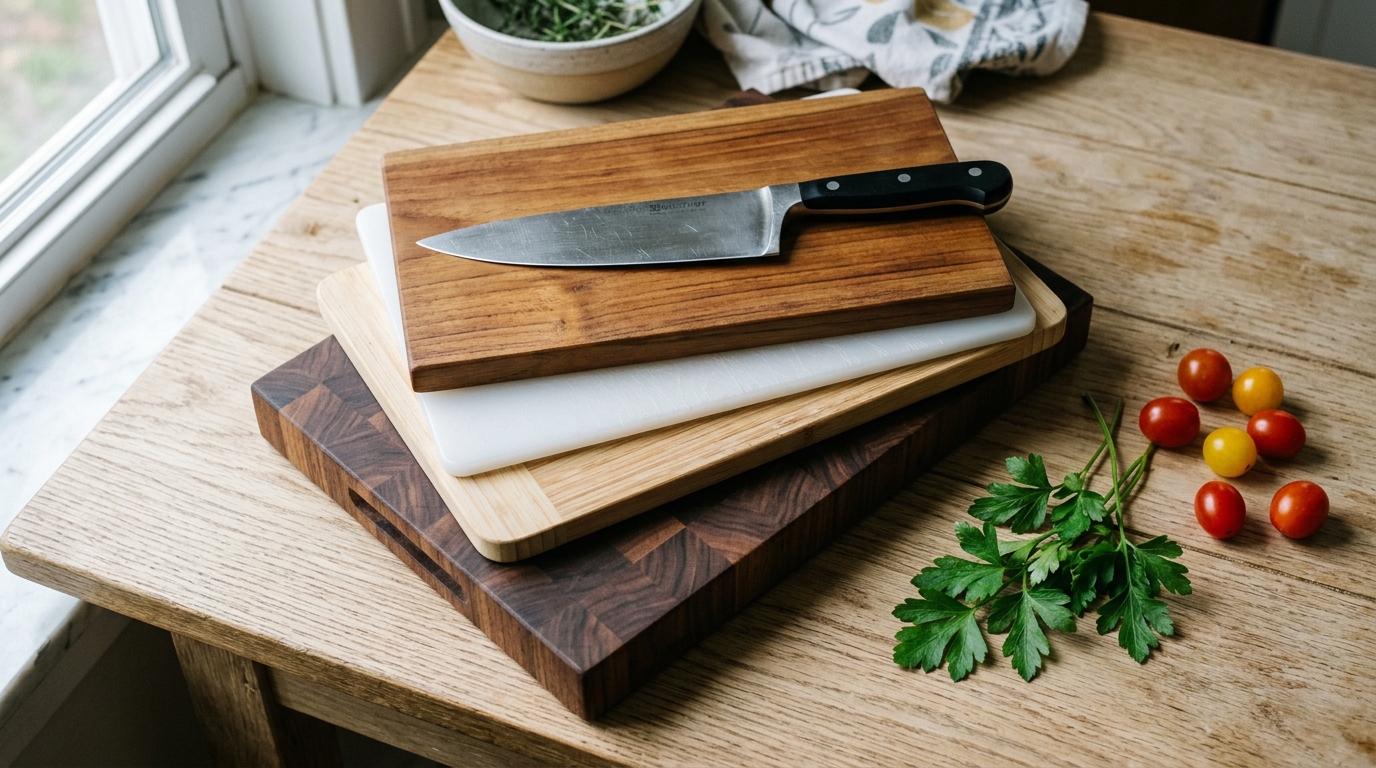
A cutting board sounds like the simplest thing in the kitchen until yours warps after six months, traps onion smell forever, or sends a chef’s knife sliding across a slick surface mid-prep. This list is for home cooks who prep daily meals and want a board that earns its counter space, not collectors chasing aesthetics. If you do a quick chop twice a week and don’t care about longevity, any cheap plastic board will do; this guide is probably overkill for you.
As an Amazon Associate, KitchenDesk earns from qualifying purchases. Some of the links on this page are affiliate links, we may earn a commission at no extra cost to you. Full disclosure.
Jump to a section
- How I Tested
- Quick Comparison
- Boos Block Walnut Cutting Board (End-Grain), Best Overall
- OXO Good Grips Carving and Cutting Board, Best Budget
- Teakhaus Edge Grain Teak Cutting Board, Best Wood for Easy Maintenance
- Epicurean Gourmet Series Cutting Board, Best Lightweight
- Boardsmith Maple End-Grain Cutting Board, Best Splurge
- Dexas Polysafe Cutting Board, Best for Food Safety
- Misen Walnut Cutting Board, Best Mid-Range
- Joseph Joseph Index Chopping Board Set, Best Set
- Buying Guide: How to Choose a Cutting Board
- Frequently Asked Questions
- Related Reading
How I Tested
Each board was used for a minimum of one week of daily prep, proteins, aromatics, bread, citrus, across both gas and induction cooktop contexts where knife work mattered most. Full methodology lives at /methodology/; for this category, specific tests included knife-drag scoring, warping checks after repeated hand-washing, odor retention after raw garlic and fish, and stability on both wet-towel and bare countertop surfaces. If a board couldn’t handle a bone-in chicken thigh and a pound of onions in the same session without moving or smelling like a fish market the next morning, it dropped in the rankings.
Quick Comparison
| Board | Badge | Material | Dishwasher Safe | Maintenance | Overall Rating |
|---|---|---|---|---|---|
| Boos Block Walnut (end-grain) | Best Overall | American black walnut end-grain | No | High (regular oiling) | 4.6/5 |
| OXO Good Grips Carving & Cutting Board | Best Budget | Polypropylene | Yes | Low | 4.2/5 |
| Teakhaus Edge Grain Teak | Best Wood for Easy Maintenance | Edge-grain teak | No | Low–Medium | 4.4/5 |
| Epicurean Gourmet Series | Best Lightweight | Paper composite (Richlite) | Yes | Low | 4.2/5 |
| Boardsmith Maple End-Grain | Best Splurge | Hard maple end-grain | No | High (regular oiling) | 4.8/5 |
| Dexas Polysafe | Best for Food Safety | Antimicrobial polypropylene | Yes | Low | 4.1/5 |
| Misen Walnut Cutting Board | Best Mid-Range | American walnut edge-grain | No | Medium | 4.3/5 |
| Joseph Joseph Index Set | Best Set | Polypropylene | Yes | Low | 4.2/5 |
Jump to the buying guide if you want material and size guidance before reading individual picks. Already know what you need? The product sections are below.
Boos Block Walnut Cutting Board (End-Grain), Best Overall
End-grain construction is one of those features where the real-world difference is immediately legible under a knife. Rather than cutting across wood fibers, the blade slides between them, and over an extended prep session, that distinction is noticeable in both how the knife feels and how sharp it stays. Boos has been making these boards long enough that quality control is consistent across units, which matters when you’re spending real money on something you expect to last a decade.
The walnut is heavy, heavy enough to stay planted on a bare countertop without a towel underneath during normal prep. During testing, I ran it through raw chicken, garlic, fish, and citrus over several consecutive days. After a hot soapy wash and a full day of upright drying, no odor lingered. The self-healing quality of end-grain wood is real: shallow knife marks that looked visible when dry had largely closed after an oil treatment.
The trade-offs are honest ones. This board needs oiling, skip it for a few weeks and the surface starts to dry and lighten noticeably. It is hand-wash only without exception; a dishwasher will warp and crack it. And the price is significant enough that it’s a considered purchase, not an impulse add-to-cart. Walnut’s natural tannins are sometimes cited for antimicrobial resistance, but that claim comes from the manufacturer, I’d treat it as a bonus rather than a reason to skip proper cleaning.
For someone who preps daily, wants one board to do everything, and is willing to maintain it: this is the right call. See my full Boos Block review for long-term durability notes.
| Performance | 5/5 |
| Build Quality | 5/5 |
| Ergonomics | 4/5 |
| Cleanup & Maintenance | 4/5 |
| Value | 5/5 |
| Overall | 4.6/5 |
Pricing & availability on Amazon, affiliate link.
View on AmazonOXO Good Grips Carving and Cutting Board, Best Budget
Not every cutting board needs to be a lifetime investment. The OXO Good Grips plastic board is the honest answer for cooks who want worry-free cleanup and have no interest in oiling anything, ever. It goes directly into the dishwasher, the rubber-trimmed edges grip the counter reliably , and the juice groove is deep enough to actually catch chicken runoff rather than funnel it straight off the edge onto your counter.
In practical terms, this is the right pick for someone outfitting a first kitchen, or for anyone who wants a dedicated raw-meat board they can run through a hot dishwasher cycle without a second thought. I use a plastic board specifically for raw poultry regardless of what my main prep board is, the OXO is the one I’d reach for in that role. It stayed planted on both my granite and laminate test surfaces during aggressive chopping without shifting.
The limitations are what you’d expect from any plastic board: it shows deep knife grooves faster than wood, and once those grooves become pronounced enough that a brush can’t reach the bottom, the board needs replacing, not repairing. It is also lighter than a wood board of comparable size, which means it can shift on a wet counter during heavy work if you don’t have the rubber trim fully in contact. Over time, no plastic surface is as gentle on knife edges as end-grain wood. But for the price, the OXO earns its place in almost any kitchen.
| Performance | 4/5 |
| Build Quality | 4/5 |
| Ergonomics | 4/5 |
| Cleanup & Maintenance | 5/5 |
| Value | 4/5 |
| Overall | 4.2/5 |
Pricing & availability on Amazon, affiliate link.
View on AmazonTeakhaus Edge Grain Teak Cutting Board, Best Wood for Easy Maintenance
Teak’s natural oil content is the actual story here. According to the manufacturer, teak’s inherent oils mean it needs re-oiling far less frequently than maple or walnut boards, which makes it the sensible choice for cooks who want a wood board but aren’t interested in a monthly maintenance ritual. In my test week, the Teakhaus handled daily prep without any visible drying or surface stress, and it came through repeated hand-washing without warping.
Edge-grain construction (as opposed to end-grain) means the knife is landing across the wood fibers rather than between them, a distinction that makes the board slightly more resistant to deep surface gouging but also marginally harder on knife edges over time. For most home cooks doing daily prep rather than marathon butchery sessions, this is an acceptable trade-off. The board is attractive enough to double as a charcuterie or cheese board, which is a practical bonus if counter-to-table presentation matters to you.
One honest note: teak is denser than many hardwoods, and that density can accelerate knife dulling slightly compared to walnut or maple end-grain over months of use. This won’t be dramatic week-to-week, but it’s worth knowing if you’re fanatical about edge retention. Still hand-wash only, teak is not dishwasher-safe despite its natural oil content. If low maintenance is your priority but you still want the tactile satisfaction of a wood board, this is the category’s best answer.
| Performance | 4/5 |
| Build Quality | 5/5 |
| Ergonomics | 4/5 |
| Cleanup & Maintenance | 5/5 |
| Value | 4/5 |
| Overall | 4.4/5 |
Pricing & availability on Amazon, affiliate link.
View on AmazonEpicurean Gourmet Series Cutting Board, Best Lightweight
There’s a real contingent of cooks, and I’ve been one of them after a long shift, who just want a board they can pick up with one hand, carry to the sink, wash, and be done with. The Epicurean Gourmet Series is built from Richlite, a paper composite that weighs noticeably less than a comparably-sized wood board while still feeling substantial under a knife. It’s dishwasher safe per the manufacturer, won’t warp from water exposure, and carries NSF certification, which is relevant for households where food-safety hygiene tracking matters.
According to Epicurean, the material is heat resistant, meaning you can briefly set a warm pan on it without damage. In testing, the board handled daily prep across proteins and produce without complaint. It doesn’t have the warm tactile feel of wood, but it also doesn’t require oiling, won’t crack if you forget to dry it immediately, and goes straight into the dishwasher after raw chicken.
The trade-offs are worth flagging directly: composite material is harder on knife edges than wood, and the surface shows knife marks clearly, it looks worn sooner than it actually becomes structurally compromised. If surface aesthetics matter to you, this will bother you. If you want a workhorse board you can sanitize on a schedule without worrying about warping or oiling, the Epicurean delivers. Read my full Epicurean cutting board review for longer-term use notes.
| Performance | 4/5 |
| Build Quality | 4/5 |
| Ergonomics | 5/5 |
| Cleanup & Maintenance | 5/5 |
| Value | 3/5 |
| Overall | 4.2/5 |
Pricing & availability on Amazon, affiliate link.
View on AmazonBoardsmith Maple End-Grain Cutting Board, Best Splurge
Some tools you buy because the specs justify the price, and some you buy because they’re built in a way that mass production genuinely can’t replicate. The Boardsmith falls into the second category. Hand-crafted hard maple end-grain with grain tightness and consistency that you can feel the moment a knife lands on the surface, it’s not a dramatic difference from a well-made Boos board, but it’s a perceptible one, and over years of daily use those incremental differences accumulate.
Hard maple is one of the best knife-friendly hardwoods available, dense enough to resist deep gouging, soft enough relative to composite or bamboo that it isn’t actively dulling your edges. The end-grain construction means the self-healing quality is working in your favour with every prep session. Small-batch production means each board gets attention that factory-line boards don’t, and the food-safe oil and wax finish is applied properly rather than as an afterthought.
I want to be direct about the value question: the performance gap between this and a quality Boos end-grain board is real but incremental. The argument for the Boardsmith isn’t that it’s categorically better at cutting vegetables, it’s that it’s built to last decades, sourced carefully, and made with a level of craft that justifies the price if those things matter to you. Availability can vary and lead times fluctuate , so check stock before committing. Maintenance requirements are identical to any end-grain wood board: oil regularly, hand-wash, dry upright.
| Performance | 5/5 |
| Build Quality | 5/5 |
| Ergonomics | 5/5 |
| Cleanup & Maintenance | 4/5 |
| Value | 5/5 |
| Overall | 4.8/5 |
Pricing & availability on Amazon, affiliate link.
View on AmazonDexas Polysafe Cutting Board, Best for Food Safety
Color-coded cutting boards are one of those professional kitchen habits that translates directly and usefully into home kitchens, one board for raw poultry, one for produce, one for fish, and the Dexas Polysafe system is built around exactly that logic. The boards include an antimicrobial additive that goes beyond what standard polypropylene offers, though I want to be clear: proper washing and board replacement when grooves deepen matters more than any additive. Think of it as a genuine extra layer, not a replacement for hygiene practice.
The practical case for these boards is straightforward. They go in the dishwasher after every use, no exceptions needed, no special handling, and the color system makes cross-contamination management a habit rather than a mental note. If you have a household where multiple people cook, kids are involved, or anyone is immunocompromised, the visual cue of picking up a specific colour for a specific food type removes ambiguity entirely. In my testing, the boards stayed put with a damp towel underneath during normal prep work.
The honest limitations: these are utilitarian boards, not boards you’d bring to the table for serving. The profile is thinner than a dedicated prep board, so they’re less stable under aggressive heavy chopping without a damp cloth underneath. No juice groove on the standard models , which is a gap if you’re carving roasts regularly. Buy these as your dedicated protein boards alongside a better main prep board, not as your only boards.
| Performance | 4/5 |
| Build Quality | 4/5 |
| Ergonomics | 4/5 |
| Cleanup & Maintenance | 5/5 |
| Value | 4/5 |
| Overall | 4.1/5 (rounded) |
Pricing & availability on Amazon, affiliate link.
View on AmazonMisen Walnut Cutting Board, Best Mid-Range
Misen built its reputation by landing near-premium quality at prices that undercut the obvious luxury names, and their walnut cutting board follows that pattern. Edge-grain American walnut hits a sensible middle ground: better knife feel than plastic or composite, less demanding than end-grain in terms of maintenance, and a cleaner visual profile than most boards in its price range.
In the test kitchen, the Misen board handled a week of daily prep without showing meaningful stress. Walnut’s natural density resists surface scarring better than softer hardwoods, and the edge-grain construction means it holds up to heavy-use chopping without deep gouging. The visual quality is worth noting: walnut’s dark, tight grain looks genuinely good on a counter or brought to the table for a cheese spread. It’s a board that doesn’t look like a compromise even if the price point is.
A few honest caveats. Edge-grain means slightly more knife wear over time than end-grain construction, not dramatic, but real over months of use. Walnut will lighten and look tired faster than lighter woods if oiling is neglected, because the colour change is more visible against the dark baseline. And Misen’s cutting board line is newer than competitors like Boos, which means long-term durability data is thinner, I can speak to test-week performance confidently, but I’d want another year of data before calling it a proven multi-decade board.
| Performance | 4/5 |
| Build Quality | 4/5 |
| Ergonomics | 4/5 |
| Cleanup & Maintenance | 4/5 |
| Value | 5/5 |
| Overall | 4.2/5 (rounded) |
Pricing & availability on Amazon, affiliate link.
View on AmazonJoseph Joseph Index Chopping Board Set, Best Set
The Joseph Joseph Index set answers a specific, practical question: what’s the most efficient way to outfit a kitchen with a complete cutting board system in a single purchase? The answer is four color-coded polypropylene boards, each labelled with both colour and food icon, fish, raw meat, vegetables, cooked food, that remove any ambiguity about which board is for what. The storage stand holds everything upright, allows air circulation between uses, and keeps boards from clattering around in a cabinet.
For a household where multiple people cook, partners with different kitchen habits, families with teenagers starting to help with meals, the visual system does genuine work. You don’t have to remember which board is for what; the board tells you. Everything goes in the dishwasher, and the stand means boards are always stored consistently. It’s a well-designed system, and system design is genuinely where this product earns its recommendation.
The practical trade-offs are real. Individual boards in the set are thinner and lighter than a dedicated single prep board, which means they’re less stable under heavy chopping unless you’ve got a damp towel underneath. The plastic surface will mark and score over time, and eventually the full set will need replacing, this is not a lifetime purchase. The stand also takes up a footprint on the counter or in a cabinet, which is a consideration in genuinely small kitchens. If you have the space and prep for multiple people, though, this is the category’s most complete out-of-box solution.
| Performance | 4/5 |
| Build Quality | 4/5 |
| Ergonomics | 5/5 |
| Cleanup & Maintenance | 5/5 |
| Value | 3/5 |
| Overall | 4.2/5 |
Pricing & availability on Amazon, affiliate link.
View on AmazonBuying Guide: How to Choose a Cutting Board
Material Is the First Decision, and It’s a Real One
End-grain wood gives you the best knife feel and genuine self-healing quality, but it demands regular oiling and hand-washing without exception. Edge-grain wood is a sensible middle ground, more resistant to deep surface gouging, slightly harder on knife edges, less maintenance-intensive than end-grain. Polypropylene plastic wins on hygiene and cleanup convenience (dishwasher-safe, easy to replace when grooved), but it is harder on knives and eventually needs replacing rather than restoring. Paper composite boards like the Epicurean land between plastic and wood, dishwasher-safe and warp-resistant, but with none of the tactile warmth of wood and a surface that shows wear faster than it structurally fails. There is no material that wins on every axis. Pick the trade-offs you can live with.
One material worth addressing specifically: bamboo. It’s marketed heavily as the environmentally responsible option, and the fast-growth argument is legitimate. But bamboo is harder than most hardwoods, which accelerates knife dulling noticeably compared to walnut or maple end-grain. It also requires oiling and is not dishwasher-safe, so it doesn’t deliver the maintenance convenience of plastic while also falling short of softer hardwoods on knife feel. Judge bamboo boards on the same performance criteria as any other material, not on their eco-marketing.
Size Matters More Than Most Buyers Expect
A board that’s too small turns every prep session into a frustrating shuffle of ingredients. For regular daily meal prep, a surface of at least 12×18 inches gives you enough room to work without constant repositioning. Larger is almost always better if you have the counter space and can manage the weight, particularly if you break down proteins or prep for multiple people in a single session. If you’re buying a board primarily for light daily tasks and a second board for heavy prep, you have more flexibility on the primary size, but don’t go small on your main board and expect it to serve you well.
Stability Is a Safety Issue, Not a Convenience Feature
A board that moves under knife pressure is genuinely dangerous, more so than most kitchen hazards that get more attention. Non-slip rubber feet, rubber-trimmed edges, and sheer weight are the three ways boards stay put. Heavy end-grain boards often handle this through mass alone on dry countertops. Lighter plastic and composite boards need mechanical grip, either built-in rubber trim or a damp kitchen towel underneath. If you’re buying a lightweight board for any reason, confirm the non-slip solution before you use it without one.
Juice Grooves: Worth Having, Worth Verifying
A juice groove is worth having on any board you use for carving meat, breaking down whole chickens, or cutting large citrus. The key word is depth, a shallow decorative groove contains almost nothing. If you carve roasts regularly, look for a board where the groove depth is actually specified, and verify it’s deep enough to hold real liquid volume rather than just channeling it toward the edge. Several boards on this list have juice grooves; I’ve noted where they’re present and flagged where groove depth specs need verification.
Price Tiers and Long-Term Value
Budget plastic boards are workhorses, buy them, use them hard, replace them when the grooves become deep enough to trap bacteria despite washing. Mid-range covers quality edge-grain wood boards and composite options; with reasonable care, expect several years of solid use. Premium and splurge territory is end-grain wood from established or small-batch makers, these are lifetime purchases if you maintain them correctly. The math worth running: buying the cheapest board you can find and replacing it every two or three years may cost more over a decade than buying one quality board once. Maintenance is the variable that determines which category you actually belong in.
Maintenance Honesty
If you will not oil a wood board regularly, buy a composite or plastic board instead. An un-oiled wood board will dry, crack, and warp, and a cracked board is a hygiene problem, not a cosmetic one. Oil when the surface starts to look dry or noticeably lighter in color; for most daily-use boards that’s roughly once a month, though teak’s natural oils stretch that interval. The best board for you is the one you will actually take care of, not the most impressive one on a spec sheet. For more detail on oiling and long-term care, see how to care for a wood cutting board.
Frequently Asked Questions
What is the most hygienic cutting board material, wood or plastic?
The research is more nuanced than the conventional wisdom suggests. Plastic boards are easier to sanitize in a dishwasher, that part is straightforward. But deeply scored plastic can harbour bacteria in grooves that a brush can’t reach, even after washing. Wood has some natural antimicrobial properties, though claims about this are manufacturer-sourced and debated in independent research, I wouldn’t treat it as a substitute for proper cleaning. The honest answer: cleaning technique and replacing boards when deeply grooved matters more than material alone. A clean, well-maintained plastic board beats a neglected, grooved wood board every time.
Do I need to oil a cutting board, and how often?
Wood boards need regular oiling with food-safe mineral oil or a board cream to prevent drying, cracking, and warping. Frequency depends on the wood and how heavily the board is used, a general working rule is to oil when the surface starts to look dry or lighter in colour than usual, which for most daily-use boards is roughly once a month. Teak boards can stretch that interval due to higher natural oil content (per manufacturer). Composite and plastic boards don’t require oiling at all.
What is the difference between end-grain and edge-grain cutting boards?
End-grain boards are cut so the knife strikes the end of the wood fibers, the blade slides between them rather than across them, which is gentler on knife edges and gives the board a self-healing quality where shallow marks close after oiling. Edge-grain boards are cut along the length of the fibers, making them more resistant to deep surface gouging but slightly harder on knife edges over time. End-grain costs more, requires more maintenance, and is the better choice if knife feel matters most. Edge-grain is a sensible middle-ground for most daily prep use.
Can you put a wooden cutting board in the dishwasher?
No. Dishwasher heat and prolonged water exposure will warp, crack, and potentially delaminate wood boards, there’s no exception to this for any wood type, teak included. Hand-wash with hot soapy water, dry immediately with a towel, then store upright or flat so air can circulate on both sides. The faster you get a wood board dry after washing, the longer it’ll last.
How do I stop my cutting board from sliding on the counter?
The simplest fix that works for any board regardless of design: place a damp kitchen towel or a non-slip mat underneath. Boards with rubber non-slip feet or rubber-trimmed edges handle this automatically. Heavy end-grain boards often stay put from weight alone on dry countertops. If you’re working with a lightweight plastic board on a slick surface, the damp towel method is the most reliable solution.
When should I replace a cutting board?
Replace a plastic or composite board when knife grooves are deep enough that they can’t be thoroughly cleaned with a brush, deep grooves trap bacteria even after washing. Replace a wood board if it has cracked through (a surface crack that goes all the way through), warped badly enough to rock on a flat counter, or developed deep gouges that can’t be sanded out. Surface knife marks on a well-oiled, well-maintained wood board are normal wear, they don’t mean the board needs replacing.
Is bamboo a good cutting board material?
Bamboo is harder than most hardwoods used for cutting boards, which makes it durable against surface wear but noticeably tougher on knife edges, it will dull blades faster than walnut or maple end-grain. It also requires oiling like wood boards and is not dishwasher-safe, so it doesn’t deliver the maintenance convenience of plastic while also not giving you the knife-friendliness of softer hardwoods. It’s a reasonable choice, but it’s not the automatic eco-friendly win it’s often marketed as. Evaluate it on performance criteria the same as any other material.
Related Reading
- Best chef’s knives the board and the knife are a matched system; upgrading one without considering the other is leaving performance on the table.
- How to care for a wood cutting board oiling schedule, cleaning method, and how to sand out surface damage.
- Boos Block cutting board review extended single-product testing beyond what a best-of list can cover.
- Epicurean cutting board review long-term composite board performance in a real kitchen.
- Kitchen tools buying guide cutting boards in the context of building a complete prep toolkit.
- Browse all kitchen tools reviews