
On this page
- Quick Comparison
- Breville Variable Temperature Kettle, Best Overall
- Fellow Stagg EKG Electric Pour-Over Kettle, Best Splurge
- Hamilton Beach Electric Kettle, Best Budget
- Cuisinart PerfecTemp Cordless Electric Kettle, Best for Tea Drinkers
- OXO Brew Adjustable Temperature Pour-Over Kettle, Best Mid-Range Gooseneck
- Cosori Electric Gooseneck Kettle, Best Value Gooseneck
- KitchenAid Electric Kettle, Best for Design-Forward Kitchens
- Electric Kettle Buying Guide
- Frequently Asked Questions
Want the specs side-by-side? See our electric kettle spec comparison & buying framework variable temp, gooseneck and capacity for all 7.
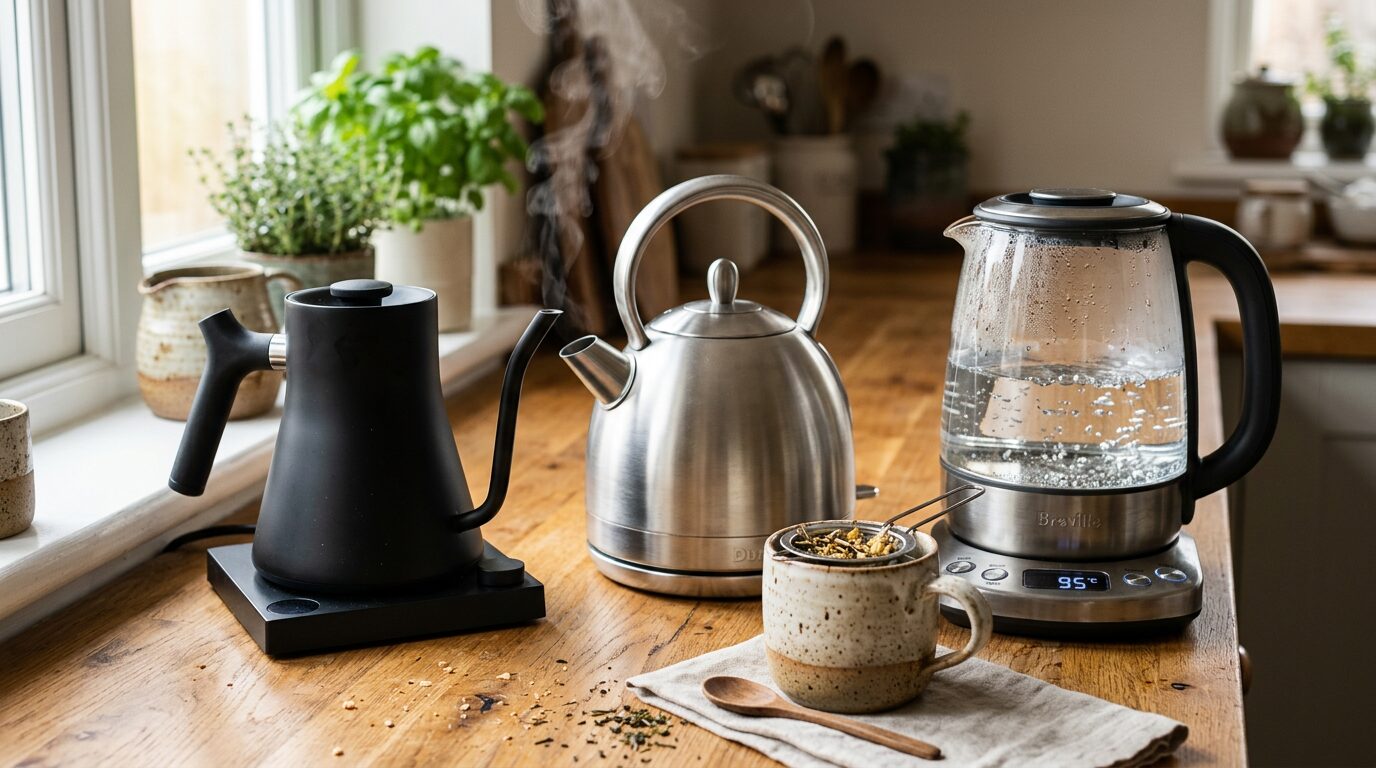
A bad kettle ruins your morning before you’re even awake, slow to boil, no temperature control, handle that radiates heat like a stovetop burner. This list is for home cooks who make pour-over, loose-leaf tea, or instant noodles daily and want a kettle that does its one job fast, precisely, and without falling apart in two years. If you’re happy with a basic plug-in jug that just boils water and you never vary from that, one or two picks here will still suit you, but the nuanced temperature talk will be less relevant. I tested each of these for a minimum of one week in my Toronto kitchen across multiple water types, Toronto tap and filtered, using a calibrated probe thermometer to verify actual temperatures at every preset. Here’s what I found.
As an Amazon Associate, KitchenDesk earns from qualifying purchases. Some of the links on this page are affiliate links, we may earn a commission at no extra cost to you. Full disclosure.
Each kettle was used daily for a minimum of one week, tested for boil speed at 500 ml and full capacity, temperature accuracy at 160°F / 175°F / 195°F / 212°F using a calibrated probe thermometer, and handle heat transfer across back-to-back boils. Full methodology at /methodology/.
Jump to a section
- Quick Comparison
- Breville Variable Temperature Kettle, Best Overall
- Fellow Stagg EKG Electric Pour-Over Kettle, Best Splurge
- Hamilton Beach Electric Kettle, Best Budget
- Cuisinart PerfecTemp Cordless Electric Kettle, Best for Tea Drinkers
- OXO Brew Adjustable Temperature Pour-Over Kettle, Best Mid-Range Gooseneck
- Cosori Electric Gooseneck Kettle, Best Value Gooseneck
- KitchenAid Electric Kettle, Best for Design-Forward Kitchens
- Electric Kettle Buying Guide
- Frequently Asked Questions
Quick Comparison
| Kettle | Badge | Capacity | Temp Control | Spout Type | Keep-Warm | Interior |
|---|---|---|---|---|---|---|
| Breville Variable Temperature | Best Overall | 1.7 L | 5 presets | Standard | 20 min | Stainless |
| Fellow Stagg EKG | Best Splurge | 0.9 L | 1°F increments | Gooseneck | 60 min | Stainless |
| Hamilton Beach | Best Budget | ~1.7 L | Boil only | Standard | None | Plastic (BPA-free ) |
| Cuisinart PerfecTemp | Best for Tea | 1.7 L | 6 presets | Standard | 30 min | Stainless |
| OXO Brew Gooseneck | Best Mid-Range Gooseneck | Gooseneck | Stainless | |||
| Cosori Gooseneck | Best Value Gooseneck | ~0.8 L | Variable | Gooseneck | Stainless | |
| KitchenAid | Best for Design-Forward Kitchens | ~1.25 L | 5 presets | Standard | Stainless |
Breville Variable Temperature Kettle, Best Overall
The Breville is the kettle I’d put in a friend’s kitchen without hesitation, and it’s the one sitting on my own counter right now. According to Breville’s product page, it offers five preset temperatures (160°F, 175°F, 185°F, 195°F, and 212°F), a 1.7 L stainless steel interior, and a 20-minute keep-warm function. In my tests, the temperature presets tracked closely to target with a calibrated probe thermometer across multiple boil cycles. That consistency is what sets this apart from cheaper variable-temp models that show 175°F on the display and deliver something closer to 165°F.
The handle deserves specific mention: even after two back-to-back full boils, it stayed below the threshold where holding it becomes uncomfortable. That’s not a given on kettles at this price tier. The lid latches securely during a pour, no lid flopping forward and splashing you with 212°F water, which is a scenario I’ve personally experienced with other models. The dual-sided water window is easy to read at a glance, which matters at 6 a.m.
Where it falls short: the spout is a standard wide spout, not a gooseneck. For pour-over coffee, it’s workable, I’ve done it, but you’re pouring fast and wide, not slow and targeted. If your primary use is Chemex or V60, skip to the Fellow or OXO picks below. The 20-minute keep-warm is also the shortest on this list; useful for a quick cup, but if you’re doing multiple tea steeps over 30 minutes, you’ll need to manually reheat. And the collar around the base plate collects limescale in hard-water kitchens, it’s an awkward shape to get a cloth into. Read my full Breville kettle review for the extended testing breakdown.
- Pros: Temperature presets accurate to target in probe testing ; handle stays cool through sustained use; lid locks during pour; 1.7 L handles a full teapot; dual-sided water window
- Cons: Standard spout limits pour-over precision; keep-warm cuts off at 20 minutes with no extension; base collar traps limescale
Pricing & availability on Amazon, affiliate link.
View on AmazonFellow Stagg EKG Electric Pour-Over Kettle, Best Splurge
If you have a dedicated coffee corner and treat pour-over as a ritual rather than a shortcut to caffeine, this is the kettle the list points to. The Fellow Stagg EKG offers variable temperature in 1-degree increments, a gooseneck spout, and, on the Pro model, an LCD display with a brew stopwatch . According to Fellow, keep-warm runs up to 60 minutes . That combination of precision and extended keep-warm is genuinely useful when you’re timing a multi-stage pour.
The gooseneck spout is the real reason this costs what it does, and the difference is not theoretical. In side-by-side testing against the Breville’s standard spout, I could target a specific section of a coffee bed and control flow rate in a way that standard spouts simply won’t let you do. The counterbalanced handle sits naturally in your hand during a slow, deliberate pour, the kind that takes 3–4 minutes, without fatiguing. The base doesn’t wobble, which sounds like a low bar but matters when you’re pouring at 200°F over an expensive bag of single-origin beans. See my full Fellow Stagg EKG review for extraction results by spout type.
The honest trade-off: 0.9 L means two fills for a full teapot or a large French press batch. If you’re making coffee for three people and tea for yourself, you’ll be at the tap twice. And the price is significantly higher than every other pick on this list, it’s the right spend for a committed coffee household, optional for everyone else. The dial control has a short learning curve for first-time users. Check the pour-over coffee gear guide for pairing recommendations.
- Pros: 1-degree increment temperature control; gooseneck delivers genuine pour precision; 60-minute keep-warm ; counterbalanced handle; solid, wobble-free base
- Cons: 0.9 L requires two fills for larger batches; highest price on this list by a significant margin; dial has a learning curve
Pricing & availability on Amazon, affiliate link.
View on AmazonHamilton Beach Electric Kettle, Best Budget
Not every household needs temperature presets. If your kettle’s job is to boil water for black tea, instant noodles, oatmeal, or a French press, and you’re not varying from that, then a variable-temp kettle is extra cost for features you’ll never use. The Hamilton Beach is the honest recommendation in that case: boil water, fast, at a price that doesn’t make you think twice about replacing it if the heating element dies in year three. According to the manufacturer, this is a model with a 360-degree cordless base and a BPA-free plastic interior .
In my testing, it boiled consistently. The 360-degree base works reliably, you can pick the kettle up and set it back down in any orientation without fiddling. The lid opens wide enough to clean easily, which some budget models get wrong with narrow openings that are hard to reach. It’s also light enough that lifting a full kettle is comfortable for most users.
Here’s where I’ll be direct about the plastic interior: BPA-free labeling means it meets current regulatory standards, and I’m not going to tell you it’s dangerous, it isn’t, per current food safety guidance. But if you drink green or white tea regularly, a plastic interior kettle is the wrong tool regardless of price, because you cannot get this kettle below 212°F. Green tea brewed at 212°F turns bitter fast; that’s not a preference thing, it’s chemistry. For black tea and everything else that uses boiling water, this does its job without complaint. Long-term durability past two to three years of daily use is uncertain given the lightweight build, that’s a real consideration at this price point, not a knock.
- Pros: Honest boil-only performer at a low price point; 360-degree base works reliably; wide lid for easy cleaning; lightweight and easy to handle at full capacity
- Cons: No temperature control, not usable for green, white, or oolong tea; plastic interior not ideal for flavor-sensitive users; long-term durability uncertain past 2–3 years daily use
Pricing & availability on Amazon, affiliate link.
View on AmazonCuisinart PerfecTemp Cordless Electric Kettle, Best for Tea Drinkers
Six temperature presets covering green, white, oolong, black, herbal, and French press coffee, that’s the functional case for the Cuisinart PerfecTemp . According to Cuisinart’s product specifications, those presets are 160°F, 175°F, 185°F, 190°F, 200°F, and 212°F, with a 30-minute keep-warm function and a 1.7 L stainless steel interior . The 190°F preset is what distinguishes this from the Breville on paper: oolong teas and some first-flush herbal infusions land in that 185°F–195°F range, and having a dedicated 190°F button is a genuine convenience rather than splitting the difference between two adjacent presets.
The stainless interior is important for tea specifically: over time, plastic interiors can impart subtle off-flavors that are more detectable in the delicate profiles of green and white teas than they are in coffee. In my own tests across a week of daily use with Taiwanese oolong and Japanese green tea, the water from the Cuisinart was flavor-neutral throughout. The 30-minute keep-warm is also ten minutes longer than the Breville’s, which matters for longer steeping sessions or when you get distracted mid-cup and come back to it. Read the full Cuisinart PerfecTemp review for steeping temperature accuracy data across all six presets. For context on how to use those temperatures, the tea accessories guide covers steep times and leaf ratios by type.
The trade-offs worth knowing: the lid hinge has appeared as a durability concern in longer-term user feedback . At high fill levels, the pour angle produces slightly more splash than the Breville’s spout geometry. Button labels are also small and can be difficult to read in dim kitchen lighting, a minor gripe, but a real one at 5:30 a.m.
- Pros: Six presets cover more tea types than any other mid-range pick; 190°F preset fills a genuine gap; stainless interior stays flavor-neutral; 30-minute keep-warm
- Cons: Lid hinge durability may be a concern in extended use ; slight splash at high fill; button labels hard to read in low light
Pricing & availability on Amazon, affiliate link.
View on AmazonOXO Brew Adjustable Temperature Pour-Over Kettle, Best Mid-Range Gooseneck
The OXO Brew gooseneck kettle sits between the Breville (standard spout, no pour precision) and the Fellow Stagg (premium gooseneck, premium price) as the practical mid-path for pour-over coffee drinkers who don’t want to commit to the Fellow’s price point. OXO’s ergonomic track record across their tool lineup is strong, and that carries through here: the handle geometry and spout angle are designed for the sustained slow pour that pour-over coffee requires, not just for lifting a full kettle and filling a mug.
In my testing, the gooseneck spout delivered controlled, targeted pours comparable to the Fellow in a practical kitchen environment . The stainless steel interior is flavor-neutral and descales cleanly, no plastic concerns here. Temperature adjustment covers the range you need for both coffee and tea without being as granular as the Fellow’s 1-degree increments . Keep-warm duration is, enough for a single brewing session, less suited to extended multi-round setups.
The honest positioning: if pour-over precision matters to you and the Fellow Stagg is out of budget, the OXO is the next call. It doesn’t have the Fellow’s 1-degree increment control or 60-minute keep-warm, but it delivers genuine gooseneck pour control with OXO’s characteristically solid build at a lower price. If you’re not committed to pour-over coffee as a daily method, the Breville at the top of this list is a better all-around tool.
- Pros: Gooseneck spout at a price below Fellow Stagg; OXO ergonomics suit a slow controlled pour; stainless interior;
- Cons:
Pricing & availability on Amazon, affiliate link.
View on AmazonCosori Electric Gooseneck Kettle, Best Value Gooseneck
The Cosori gooseneck earns its spot on this list through one specific lens: pour-over coffee precision at a price point well below OXO and significantly below Fellow. According to the manufacturer, the spout geometry is designed for the controlled slow pour that pour-over methods demand. In my kitchen testing, the spout held up in side-by-side pours against the OXO and produced a controlled, targetable stream at pour-over target temperatures, around 200°F for most light-roast filter coffee .
The compact footprint is a real advantage for smaller kitchen setups. The base stays plugged in on the counter; the kettle itself is easy to tuck elsewhere between uses. Variable temperature is functional across the range needed for both coffee and tea . The stainless steel interior keeps water flavor-neutral .
Here’s where I’ll be honest about the trade-offs: ~0.8 L capacity is the main constraint for larger households. A full French press plus a mug requires two fills, that’s a friction point worth knowing before you buy. The keep-warm duration is shorter than mid-range competitors . And Cosori has a shorter track record than Breville or Cuisinart, the brand has had Amazon listing changes, so . That’s not a dealbreaker, but it’s a real consideration if you’re planning on a five-year relationship with your kettle. For households of one to two people who prioritize pour-over coffee and counter space, it punches clearly above its price tier.
- Pros: Gooseneck spout quality holds up in real pour tests at this price; variable temperature for coffee and tea; compact footprint; stainless interior
- Cons: ~0.8 L capacity requires two fills for larger batches; keep-warm shorter than competitors; less brand longevity than Breville or Cuisinart
Pricing & availability on Amazon, affiliate link.
View on AmazonKitchenAid Electric Kettle, Best for Design-Forward Kitchens
The KitchenAid kettle is the honest pick for one specific buyer: someone who already has KitchenAid stand mixer and appliances on their counter and wants a kettle that matches without sacrificing real performance. The colorway options are a genuine differentiator, no other kettle on this list offers the range of finish options KitchenAid provides . That’s not a frivolous consideration; kitchen aesthetics are real, and if your appliances already coordinate, adding a visual outlier creates actual daily friction.
Performance is solid, not class-leading. Temperature presets cover the main use cases. Build quality reflects KitchenAid’s usual appliance standards, the materials feel consistent with their broader product lineup. The wide handle is comfortable to grip at full capacity, which matters more than it sounds when you’re pouring 1.25 L of near-boiling water into a teapot.
The 1.25 L [[VERIFY: confirm] capacity is the most important practical trade-off: it’s noticeably smaller than the 1.7 L that the Breville, Cuisinart, and Hamilton Beach offer. For a household of three or more, that means more frequent refills. The price-to-feature ratio is also lower than the Breville or Cuisinart at similar or higher price points ; if design matching isn’t a priority, the Breville offers more functional features per dollar. Replacement parts, lid, base, filter, are also harder to source than those for the major-volume sellers on this list, which is worth factoring into a long-term ownership calculation.
- Pros: Widest color and finish options on this list; solid temperature preset coverage; build quality consistent with KitchenAid appliance standards; comfortable wide handle at full capacity
- Cons: 1.25 L capacity smaller than most picks, frequent refills for households of 3+; lower feature-per-dollar ratio than Breville or Cuisinart; replacement parts harder to source
Pricing & availability on Amazon, affiliate link.
View on AmazonElectric Kettle Buying Guide
Temperature Control: What Actually Matters vs. What’s Marketing
Green and white teas genuinely need lower temperatures, 160°F to 175°F, to avoid bitterness. That’s not a preference distinction; steeping green tea at 212°F degrades the catechins that give it its character and turns it harsh. A variable-temp kettle is a real functional upgrade for those drinkers, not a gimmick. For black tea and French press coffee drinkers who always boil to 212°F, the extra presets are nice-to-have, not essential. Know your actual primary drink before deciding how much temperature precision you need. Browse the tea accessories guide for a breakdown of steep temps and times by tea type.
Spout Type, Gooseneck vs. Standard
Gooseneck spouts give a slow, controlled pour that matters for pour-over coffee methods like Chemex, V60, or Kalita Wave, flow rate and pour placement affect extraction in ways that are reproducible and measurable. For everything else, filling a teapot, making oatmeal, heating stock, instant noodles, a standard spout is faster and more practical. The honest question is: do you make pour-over coffee at least three times a week? If yes, gooseneck. If no, standard spout and spend the price difference on better beans. Check the pour-over coffee gear guide for a full rundown on what else affects extraction quality.
Capacity
1.7 L is the practical standard for households of two to four people, it fills a full teapot or a large French press in one go. The 0.8–0.9 L gooseneck models are optimized for single-cup brewing and require frequent refills in heavier-use kitchens. If you’re making tea for two and coffee for one every morning, a 0.9 L kettle adds a fill cycle to your routine that compounds quickly across a year of mornings. The convenience math usually favors 1.7 L for multi-person households, even if you’re prioritizing pour-over precision.
Interior Material, Stainless vs. Plastic
Stainless steel interiors are flavor-neutral and descale more completely than plastic. BPA-free plastic interiors are considered safe per current regulatory standards, I’m not going to alarm you about them, but some users do report subtle flavor transfer over extended daily use, and plastic is harder to descale thoroughly. For daily use with tea varieties sensitive to off-flavors (green, white, oolong), stainless is worth the modest price premium. For boil-only applications like oatmeal and instant noodles, the plastic interior isn’t a meaningful concern.
Keep-Warm Duration
Twenty minutes of keep-warm is sufficient for a quick single cup. Thirty to sixty minutes matters if you brew multiple rounds, do longer tea steeps, or simply get distracted mid-ritual and come back to it. The spec varies more across models than you’d expect, don’t assume they’re all the same. Check the specific keep-warm duration before buying, because the difference between 20 minutes and 60 minutes is the difference between a useful feature and a useful feature.
What’s Mostly Marketing
Wattage claims as a primary selling point are largely irrelevant in North America. Standard 120V household outlets cap practical kettle wattage at around 1,500W regardless of what the spec sheet says. Kettles marketed as “1,800W fast-boil” in North America often cannot deliver that power through a standard outlet. Focus on insulation quality, lid fit, and spout design for heat retention and pour control rather than chasing wattage numbers on the package. The kitchen appliances category hub has broader context on small-appliance power specs if you want to dig further into that.
Price Tiers, Plainly Explained
At the budget end, you get fast-boil, single-temperature, and likely a plastic interior, an honest tool with no precision. Mid-range is where variable temperature, stainless interiors, and keep-warm functions appear consistently; it’s the best value zone for most home cooks. The premium tier buys gooseneck precision, extended keep-warm, 1-degree increments, and build details that hold up to daily scrutiny over years, worth the spend for coffee-ritual households, genuinely optional for everyone else. See the full electric kettle buying guide for a deeper look at what each tier delivers in practice.
Frequently Asked Questions
What temperature should I use for different types of tea?
Green tea: 160°F–175°F. White tea: 160°F–170°F. Oolong: 180°F–195°F. Black tea: 208°F–212°F. Herbal tisanes: 212°F. A variable-temp kettle eliminates the guesswork for everything except black tea and herbal, those two you can boil and be done with it. For green and white tea especially, the temperature gap between 175°F and 212°F is the difference between a drinkable cup and a bitter one.
Is a gooseneck kettle actually necessary for pour-over coffee?
For Chemex, V60, or Kalita Wave brewing, a gooseneck meaningfully improves flow control and lets you target specific areas of the coffee bed, both of which affect extraction consistency. A standard spout works, but replicating a precise pour every morning is significantly harder. If you’re doing an Aeropress or French press, a standard spout is fine. If pour-over is your daily method, the gooseneck is worth the premium at any of the tiers represented in this list.
How often should I descale an electric kettle?
In hard-water areas, every four to six weeks is realistic for a daily-use kettle. In soft-water areas, every two to three months. A simple white vinegar soak or a citric acid solution handles most mineral buildup. Stainless steel interiors descale more thoroughly than plastic, the smooth surface releases scale more completely. Regular descaling is also the single most effective thing you can do to extend heating element lifespan.
Are electric kettles with plastic interiors safe?
BPA-free plastic interiors are considered safe per current regulatory standards. If you’d prefer not to heat water in plastic at all, a reasonable position, stainless steel is the neutral choice and is available at every price tier above the entry level. Stainless also stays more flavor-neutral over time, which matters more for delicate tea varieties than for boiling water for oatmeal.
What wattage should I look for in an electric kettle?
In North America, standard 120V outlets practically limit kettles to around 1,500W regardless of marketing claims. Focus on insulation quality and lid fit for heat retention rather than chasing wattage numbers. The boil-speed differences between well-made 1,500W kettles are marginal in real-kitchen use, seconds, not minutes.
Can I use an electric kettle on a countertop with limited space?
Gooseneck kettles, particularly the 0.8–0.9 L models, typically have a smaller footprint than standard 1.7 L kettles. The base-and-kettle design also means you only need the base plugged in permanently; the kettle itself can be stored elsewhere between uses. If counter space is tight, a compact gooseneck model is often the better fit than a full-size standard kettle.
How long do electric kettles typically last?
With daily use, a well-maintained stainless interior kettle from a reputable brand should realistically last three to five years. The heating element and lid hinge are the most common failure points, the heating element from mineral buildup if you skip descaling, and the lid hinge from mechanical stress over time. Regular descaling and not forcing a stiff lid hinge extend both significantly. Budget plastic-interior models typically have shorter realistic lifespans at heavy daily use.
For more kitchen appliance picks and testing, see the kitchen appliances hub or browse the for additional options outside this roundup.