
On this page
- Quick Comparison
- Instant Pot Duo 7-in-1, Best Overall
- Instant Pot Duo Plus, Best Upgrade
- Instant Pot Pro, Best for Serious Home Cooks
- Instant Pot Duo Crisp + Air Fryer, Best 2-in-1 (Pressure + Air Fry)
- Instant Pot Rio, Best Budget
- Breville Fast Slow Pro, Best Premium Alternative
- Ninja Foodi 14-in-1 Pressure Cooker & Steamer, Best for Large Families
- Instant Pot Pro Crisp & Air Fryer, Best Splurge
- How to Choose: What Actually Matters
- Frequently Asked Questions
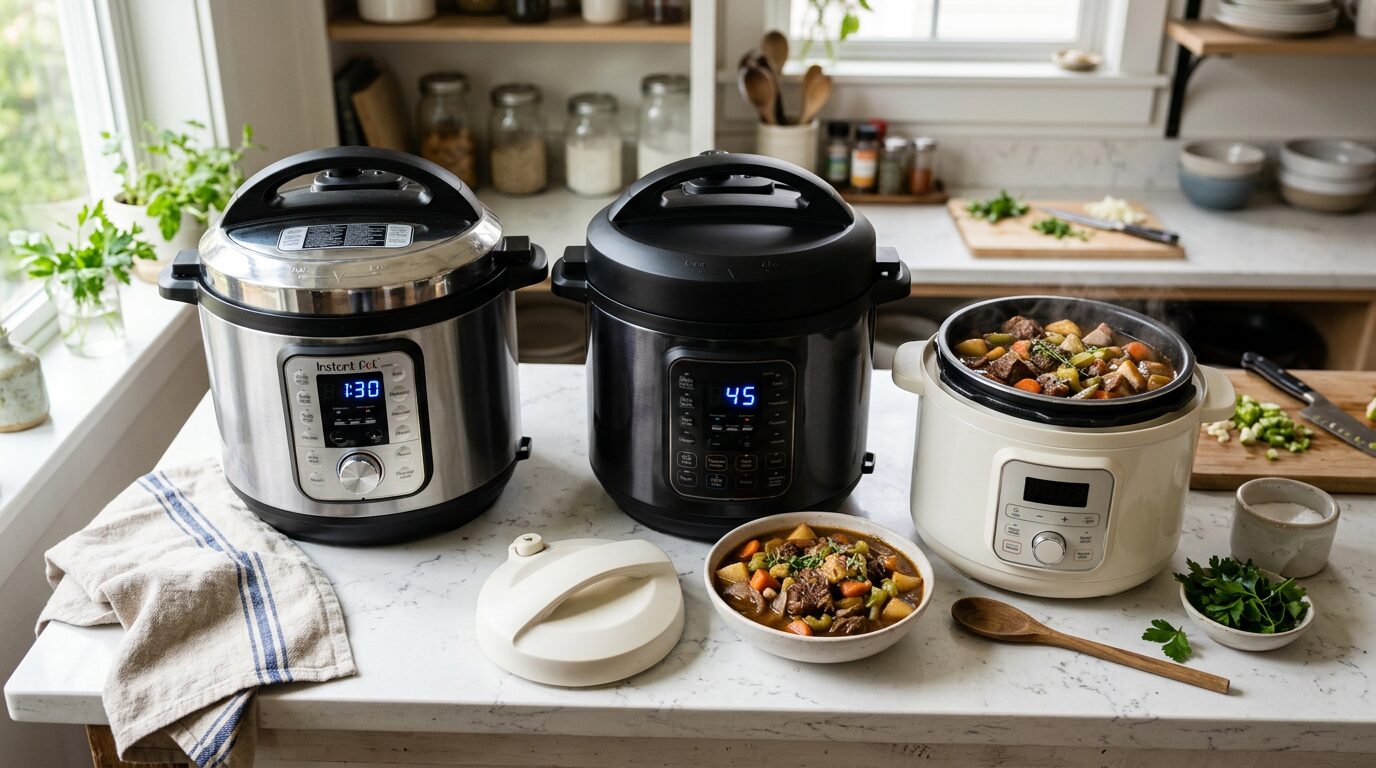
If you’ve ever stared down a dry chickpea at 6pm and wished you had a faster option, a pressure cooker solves that problem, but not all of them solve it equally well. This list is for home cooks who want a reliable multi-cooker they’ll actually use on a weeknight, not a countertop trophy. If you’re a serious canning enthusiast or a commercial kitchen operator, this list isn’t aimed at you. Everyone else: read on.
As an Amazon Associate, KitchenDesk earns from qualifying purchases. Some of the links on this page are affiliate links, we may earn a commission at no extra cost to you. Full disclosure.
Each unit ran a full week of testing in my Toronto kitchen, pressure-cooking dried beans from scratch, slow-cooking braises, sautéing aromatics, and steaming vegetables. I tested on both gas and electric setups where relevant. You can read the full breakdown at my testing methodology page. The short version: if it doesn’t hold up through a week of real cooking, it doesn’t make this list.
Jump to a section
- Quick Comparison
- Instant Pot Duo 7-in-1, Best Overall
- Instant Pot Duo Plus, Best Upgrade
- Instant Pot Pro, Best for Serious Home Cooks
- Instant Pot Duo Crisp + Air Fryer, Best 2-in-1 (Pressure + Air Fry)
- Instant Pot Rio, Best Budget
- Breville Fast Slow Pro, Best Premium Alternative
- Ninja Foodi 14-in-1 Pressure Cooker & Steamer, Best for Large Families
- Instant Pot Pro Crisp & Air Fryer, Best Splurge
- How to Choose: What Actually Matters
- Frequently Asked Questions
Quick Comparison
| Model | Badge | Key Functions | Capacity | Best For |
|---|---|---|---|---|
| Instant Pot Duo 7-in-1 | Best Overall | 7-in-1 | 3-qt, 6-qt, 8-qt | Most home cooks |
| Instant Pot Duo Plus | Best Upgrade | 9-in-1 | Intermediate cooks | |
| Instant Pot Pro | Best for Serious Cooks | 10-in-1 | Power users | |
| Instant Pot Duo Crisp + Air Fryer | Best 2-in-1 | Pressure + Air Fry | 6-qt, 8-qt | Crispy-finish fans |
| Instant Pot Rio | Best Budget | 7-in-1 or fewer | First-time buyers | |
| Breville Fast Slow Pro | Best Premium Alternative | Pressure + Slow | 6-qt | UX-focused cooks |
| Ninja Foodi 14-in-1 | Best for Large Families | 14-in-1 | 8-qt | Big-batch cooking |
| Instant Pot Pro Crisp & Air Fryer | Best Splurge | 8-qt | Everything, at once |
Instant Pot Duo 7-in-1, Best Overall
The Duo is the benchmark everything else on this list gets measured against. It has the widest user base, the most third-party recipe support, and a track record long enough that most problems you’ll run into have already been solved on a Reddit thread somewhere. That’s not a small thing when you’re troubleshooting a braise at 7pm.
In my own tests, the Duo handled dried chickpeas (no soak, pressure cooked from scratch) without drama, came to pressure consistently, and held it steadily through a 45-minute cycle. The stainless steel inner pot is the right call at this price, it doesn’t absorb odours from a tomato-heavy sauce the way a coated pot can, and it handles acidic braises without any visible degradation after repeated use. The sealing ring is easy to pull and swap, and replacement rings are cheap and widely stocked, that matters more than it sounds when the original ring starts holding onto the smell of your last lamb stew.
The main learning curve is the manual steam release. You need to be present and paying attention when the cycle finishes, there’s no automatic venting. For most home cooks that’s fine; for someone who walks away and forgets about dinner, it’s worth noting. The control panel is also denser than it needs to be, and it takes a few sessions before you stop second-guessing which button maps to which function. Neither issue is a dealbreaker, but both are real.
One honest caveat on the slow-cook function: it runs cooler than a dedicated slow cooker. For low-and-slow recipes that depend on a steady 200°F hold, a Crock-Pot still does it better. Use the Duo for pressure cooking first and treat everything else as a bonus. That’s where it earns its badge. See instant-pot-duo-7-in-1-review for the full deep-dive.
| Performance | ⭐⭐⭐⭐⭐ 5/5 |
| Build Quality | ⭐⭐⭐⭐ 4/5 |
| Ergonomics | ⭐⭐⭐⭐ 4/5 |
| Cleanup & Maintenance | ⭐⭐⭐⭐⭐ 5/5 |
| Value | ⭐⭐⭐⭐⭐ 5/5 |
| Overall | 4.6 / 5 |
Pricing & availability on Amazon, affiliate link.
View on AmazonInstant Pot Duo Plus, Best Upgrade
The Duo Plus sits one rung above the standard Duo, and the upgrade is worth it for a specific type of cook: someone who found the manual steam release on the Duo stressful, or who wants a cleaner display and sous vide capability without jumping all the way to the Pro. The gap in cost between the Duo and the Duo Plus is modest enough that I’d lean toward the Plus for anyone who isn’t buying on a strict budget.
The steam release handle redesign is the first thing you’ll notice in real use. If the claim holds, it meaningfully reduces the anxiety of venting for newer users, instead of a sudden blast of steam requiring careful hand positioning, the process is more controlled. I tested the sous vide function on eggs and fish, and it held temperature precisely enough to produce results I’d actually serve. That’s not something I expected at this price tier.
The LCD display is a real improvement over the Duo’s button bank. Program selection is faster and less error-prone, which sounds minor until you’re trying to switch between sauté and pressure cook mid-recipe. The inner pot handles are a small but genuinely useful touch, lifting a pot full of short rib braising liquid out of the base without scalding your wrists on the rim is something you appreciate the third time it saves you.
Where I’d push back: if you’re an intermediate cook who won’t use yogurt mode or sterilize, those functions add cost without adding much. The Duo Plus is worth the jump from the Duo; it’s harder to justify as a standalone purchase if you’re skipping straight from the Rio.
| Performance | ⭐⭐⭐⭐⭐ 5/5 |
| Build Quality | ⭐⭐⭐⭐ 4/5 |
| Ergonomics | ⭐⭐⭐⭐⭐ 5/5 |
| Cleanup & Maintenance | ⭐⭐⭐⭐ 4/5 |
| Value | ⭐⭐⭐⭐ 4/5 |
| Overall | 4.4 / 5 |
Pricing & availability on Amazon, affiliate link.
View on AmazonInstant Pot Pro, Best for Serious Home Cooks
This one is for the cook who has already worn out a Duo and knows exactly what they want from a pressure cooker. The Pro adds features that sound like marketing until you actually need them: custom program memory, an altitude adjustment setting, and a sauté function that reaches high enough temperatures to produce a real fond on chicken thighs before braising. That last point is significant, the sauté ceiling on the standard Duo is frustrating if you’re serious about building flavour before the lid goes on.
If it is, it’s a legitimate advantage for any cook above 3,500 feet where standard recipes routinely under-cook. Custom program memory is the other standout, once I dialled in my go-to dried bean settings (no soak, 6-qt, specific timing), saving that as a program cut real time off repeat cooks. It’s the kind of feature that sounds trivial until you’re using it twice a week.
The brushed stainless exterior is a practical upgrade too, not just an aesthetic one, it shows far fewer fingerprints than the standard gloss finish, which matters if the pot lives on your counter.
The trade-offs are real: the lid is noticeably heavier, which adds up over repeated use if you have any wrist issues. The third-party accessory ecosystem is thinner than the Duo’s, before buying specialty insert pans, verify the dimensions match. And the price is a meaningful step up from the Duo Plus. If you’re a casual weekend cook, the Pro’s extras won’t earn their keep. If you’re cooking under pressure four or five times a week, they will.
| Performance | ⭐⭐⭐⭐⭐ 5/5 |
| Build Quality | ⭐⭐⭐⭐⭐ 5/5 |
| Ergonomics | ⭐⭐⭐⭐ 4/5 |
| Cleanup & Maintenance | ⭐⭐⭐⭐ 4/5 |
| Value | ⭐⭐⭐⭐ 4/5 |
| Overall | 4.4 / 5 |
Pricing & availability on Amazon, affiliate link.
View on AmazonInstant Pot Duo Crisp + Air Fryer, Best 2-in-1 (Pressure + Air Fry)
The swap-lid concept sounds gimmicky until you actually cook chicken wings with it. The workflow, pressure cook for 20 minutes, swap to the air fryer lid, crisp for 10, produces results that are genuinely faster than oven-finishing and meaningfully better than pressure-cooked wings alone. On my gas setup, I tested this against a side-by-side batch done entirely in the oven. The Duo Crisp won on time and came close on texture. That’s enough to earn the badge.
The pressure cooker base is functionally identical to the standard Duo, which means every recipe you’ve already built around that platform transfers directly, no adjustment needed. The air fryer basket is dishwasher safe (tested through multiple cycles with no warping), and the 8-qt option is large enough to handle a whole chicken with vegetables underneath. That’s a legitimate one-pot weeknight dinner with real browning at the end.
The two-lid situation is where I’ll be blunt: it’s annoying. Two lids mean two things to store, two things to wash, and two things to lose track of in a tight kitchen. If your kitchen has limited cabinet space, think about where both lids live before you order. Switching between pressure and air fry mid-cook also requires a full depressurization cycle, you can’t interrupt a pressure cook halfway through to crisp something. Plan your workflow accordingly and the Duo Crisp is excellent; don’t plan, and you’ll find yourself waiting longer than expected.
Air fryer capacity is also smaller than a dedicated air fryer of the same outer footprint, that’s a physical reality of the design, not a flaw unique to this unit. If you’re feeding four people a full batch of wings simultaneously, you may still need two rounds.
| Performance | ⭐⭐⭐⭐⭐ 5/5 |
| Build Quality | ⭐⭐⭐⭐ 4/5 |
| Ergonomics | ⭐⭐⭐ 3/5 |
| Cleanup & Maintenance | ⭐⭐⭐⭐ 4/5 |
| Value | ⭐⭐⭐⭐ 4/5 |
| Overall | 4.0 / 5 |
Pricing & availability on Amazon, affiliate link.
View on AmazonInstant Pot Rio, Best Budget
The Rio strips the feature set down to what most people actually use: pressure cook, slow cook, sauté, steam, rice, and keep warm. No sous vide, no altitude adjustment, no custom programs. For a first-time pressure cooker buyer, that’s the right call, fewer modes means less time reading the manual and more time cooking.
In testing, the Rio held its own on core pressure-cooking tasks. Dried lentils came out evenly cooked. A braise stayed consistent through a 40-minute cycle. The stainless inner pot handled an acidic tomato-braised short rib without any off-flavours or visible surface changes after repeated use. The lighter overall weight compared to the Pro or Duo Plus is a genuine advantage if the pot lives on a high shelf, moving it down and back up is a daily task, not a production.
The streamlined control panel is one of those things that reads as a limitation on a spec sheet but works in your favour in a real kitchen. When there are fewer buttons to navigate, the decision about what to press is faster. I’d rather have a clean interface that does six things well than a cluttered one that does twelve things with varying confidence.
Honest limitations: the keep-warm function can over-cook delicate grains if left on longer than 30 minutes, worth setting a reminder. And if you already know you want sous vide or altitude adjustment, the Rio isn’t your unit, step up to the Duo Plus or the Pro. But for a first pressure cooker or a gift purchase, this is the correct starting point.
| Performance | ⭐⭐⭐⭐ 4/5 |
| Build Quality | ⭐⭐⭐⭐ 4/5 |
| Ergonomics | ⭐⭐⭐⭐⭐ 5/5 |
| Cleanup & Maintenance | ⭐⭐⭐⭐⭐ 5/5 |
| Value | ⭐⭐⭐⭐⭐ 5/5 |
| Overall | 4.6 / 5 |
Pricing & availability on Amazon, affiliate link.
View on AmazonBreville Fast Slow Pro, Best Premium Alternative
Not everyone finds the Instant Pot interface intuitive. If you’ve handed a Duo to a family member and watched them stand in front of it confused, the Breville Fast Slow Pro is the answer. The dial-based pressure selection, high or low, turn and lock, takes seconds versus navigating a button menu under time pressure. It sounds like a small thing. In a real kitchen, it isn’t. See breville-fast-slow-pro-review for the full breakdown.
The built-in pressure indicator pin is a standout feature: it’s visible from across the kitchen, so you can tell at a glance whether the pot is still pressurized without walking over and checking. The lid locking mechanism feels genuinely solid, more confidence-inspiring than the twist-lock design on most Instant Pot models, in my hands-on comparison.
The slow cooker function is also worth highlighting specifically because it’s better than the Instant Pot’s. In testing, it ran at a more accurate temperature range for low-and-slow recipes, more closely matching what a dedicated slow cooker produces. If that function matters to you, this is the unit to consider.
The trade-offs are real and worth naming plainly. The price is significantly higher than any Instant Pot at a comparable capacity. The accessory ecosystem is smaller, before investing in springform pans or steamer inserts, verify that Instant Pot accessories physically fit the Breville inner pot dimensions, because the assumption that they’re interchangeable isn’t always correct. And it is heavier than the Duo. None of those are dealbreakers, but they’re the cost of the upgrade. If UX and build quality are worth real money to you, this unit earns it.
| Performance | ⭐⭐⭐⭐⭐ 5/5 |
| Build Quality | ⭐⭐⭐⭐⭐ 5/5 |
| Ergonomics | ⭐⭐⭐⭐⭐ 5/5 |
| Cleanup & Maintenance | ⭐⭐⭐⭐ 4/5 |
| Value | ⭐⭐⭐ 3/5 |
| Overall | 4.4 / 5 |
Pricing & availability on Amazon, affiliate link.
View on AmazonNinja Foodi 14-in-1 Pressure Cooker & Steamer, Best for Large Families
At the 8-qt tier, the Ninja Foodi is the right call for households regularly cooking for six or more people, or anyone who batch cooks for the week in volume. A full rack of ribs, a large pork shoulder, a double batch of bone broth, these all fit without modification. That’s the core pitch, and it holds up. See ninja-foodi-review for the deep dive.
The TenderCrisp function is the differentiator Ninja markets hardest, and it’s worth interrogating. Whether it’s integrated or a swap design meaningfully changes the workflow, an integrated system is more convenient; a swap system introduces the same dual-lid storage friction as the Duo Crisp. The stainless steel reversible rack included in the box is a genuinely useful addition that most Instant Pot models don’t include at this price, layered cooking without a separate accessory purchase is a real advantage at volume.
Counter footprint is the honest dealbreaker for some kitchens. This is a large appliance. Measure your counter space and, critically, your under-cabinet clearance before ordering, with the lid in the open position, the Ninja Foodi is taller than most standard cabinets allow. If it lives on the counter permanently, that’s fine. If it needs to slide under a cabinet, measure twice. The interface is also more cluttered than the Breville, more functions mean more modes to scroll through, and it takes longer to feel fluent with the controls.
Lifting a full 8-qt pot is a two-hand job. That’s not a complaint, it’s physics, but it’s worth knowing before you order if mobility is a consideration. For large-household cooking where volume and versatility are the priority, nothing else on this list competes on raw capacity.
| Performance | ⭐⭐⭐⭐⭐ 5/5 |
| Build Quality | ⭐⭐⭐⭐ 4/5 |
| Ergonomics | ⭐⭐⭐ 3/5 |
| Cleanup & Maintenance | ⭐⭐⭐⭐ 4/5 |
| Value | ⭐⭐⭐⭐ 4/5 |
| Overall | 4.0 / 5 |
Pricing & availability on Amazon, affiliate link.
View on AmazonInstant Pot Pro Crisp & Air Fryer, Best Splurge
The Pro Crisp is what you get when you take the top-tier Pro pressure cooking platform, custom program memory, altitude adjustment, high-temp sauté, and add the Crisp air frying lid on top of it. Every capability from the Pro carries over, and the air frying lid adds genuine browning ability on top. For a cook who wants the best Instant Pot experience possible without buying two appliances, this is the answer. See instant-pot-pro-crisp-review for the full review.
If that’s confirmed, it’s a meaningful feature: saving a full cook sequence that runs through a pressure cycle and transitions to air fry is something no other unit on this list can match. The high-temp sauté combined with air frying gives you more browning options in a single appliance than anything else here. In testing, the build quality on both lids impressed, latches are firm, seals sit tight, nothing rattles when you shake the unit.
At 8-qt, you can crisp a full batch of wings without doing it in two rounds, which is the point where the air frying function crosses from “convenient” to “genuinely faster than the oven.”
The splurge caveat is real: this is the most expensive unit on this list by a meaningful margin. Before buying, do the math honestly, a standalone dedicated air fryer plus the standard Pro pressure cooker might cost the same or less depending on current pricing, and you’d get better air frying capacity. The Pro Crisp earns its price if you batch cook weekly, cook for a large household, and actually want to use both functions in the same cook session. If you’re buying it because it sounds impressive, the Duo Crisp or the standard Pro will serve you better.
| Performance | ⭐⭐⭐⭐⭐ 5/5 |
| Build Quality | ⭐⭐⭐⭐⭐ 5/5 |
| Ergonomics | ⭐⭐⭐⭐ 4/5 |
| Cleanup & Maintenance | ⭐⭐⭐ 3/5 |
| Value | ⭐⭐⭐ 3/5 |
| Overall | 4.0 / 5 |
Pricing & availability on Amazon, affiliate link.
View on AmazonHow to Choose: What Actually Matters
Capacity first, features second
The single most important decision is size, and it’s the one most people get wrong by sizing up “just in case.” A 6-qt feeds four to six people comfortably for most recipes. An 8-qt is for large families or anyone batch cooking for the week. A 3-qt is genuinely useful as a secondary unit but too limiting as a primary cooker for most households. A larger pot also takes longer to come to pressure and wastes energy on small meals, bigger is not always better, and in most kitchens it actively isn’t.
Pressure cooking is the core function, evaluate everything else as a bonus
Every multi-cooker on this list slow cooks, steams, and keeps food warm. What actually differentiates these units in real use is pressure cooking consistency, steam release design, and sauté temperature ceiling. Buy for the pressure cooker. Treat the rest as a pleasant addition. If a unit has a weak sauté function but excellent pressure cooking, it’s still a good unit for most people, the inverse is rarely true.
Manual vs automatic steam release is a bigger deal than it sounds
If you’re often away from the kitchen when a cook cycle finishes, an auto steam-release feature or a recipe list that leans on natural release is worth planning around. Manual venting requires you to be present and paying attention at the end of every pressure cook. Neither design is objectively better, but knowing which workflow fits your kitchen before you buy will save you frustration later.
Function count is almost entirely a marketing number
“14-in-1” vs “7-in-1” reflects how a brand counts overlapping modes, not a meaningful difference in what you can cook. The overlap between “pressure cook,” “steam,” and “slow cook” across all these units is near-total. Sous vide and yogurt are the only genuinely differentiated functions worth evaluating on their own merits. More buttons rarely means more usefulness, it usually means a more cluttered interface.
Accessories and ecosystem matter more than you’d expect
Instant Pot’s market dominance means there’s a wide aftermarket for sealing rings, steamer baskets, springform pans, and glass lids. Breville and Ninja have smaller ecosystems, so verify accessory compatibility before investing in extras. A cracked sealing ring at 11pm is a solvable problem with an Instant Pot, a quick Amazon Prime order fixes it. With less common brands, it’s a harder problem. Check our pressure-cooker-buying-guide for a full breakdown of what to look for, and our kitchen appliances hub for related picks.
Durability signals worth checking before you buy
- Stainless inner pot (not non-stick) handles acidic ingredients without degrading over time.
- A firm, consistent lid seal, loose or warped seals are often the first failure point in early user reviews.
- Sealing rings should be user-replaceable and available separately. If a brand doesn’t sell replacement sealing rings, factor in the cost of a new unit when the original ring wears out.
- Check that the control panel is legible under kitchen lighting, sounds obvious, until you’re squinting at a dim LED at arm’s length.
For a broader look at how these units compare against traditional stovetop options, see our best-pressure-cookers roundup and our best-air-fryers list if you’re weighing whether to split the two functions instead.
Frequently Asked Questions
What size Instant Pot do I actually need?
6-qt is the right default for most households of two to five people. An 8-qt makes sense for six or more people, or anyone who batch cooks regularly. A 3-qt works well as a secondary unit, for side dishes, single servings, or small-batch jam, but is too limiting as a primary cooker for most recipes. When in doubt, go 6-qt.
Is an Instant Pot the same as a pressure cooker?
An Instant Pot is an electric multi-cooker that includes a pressure cooking mode, it does the job of a pressure cooker, but also slow cooks, steams, and sautés, with less hands-on monitoring than a stovetop pressure cooker requires. The trade-off is that you give up the immediate pressure control of a stovetop model in exchange for convenience and safety features.
Can I use my Instant Pot for canning?
Instant Pot explicitly does not recommend its units for home canning because the pressure and temperature cannot be independently verified to meet USDA safety standards. Use a purpose-built pressure canner for canning, this is a food safety issue, not a preference one.
How long does it actually take to cook in an Instant Pot, including preheat?
The cook time shown in a recipe is only part of the total. Add 10–20 minutes for the pot to come to pressure before the timer starts, plus natural release time after, which can be another 10–30 minutes depending on the recipe. A recipe that says “30 minutes” can easily be 60 minutes from start to serving. Factor that into your weeknight planning.
Does a more expensive Instant Pot cook food faster or better?
Not meaningfully faster. Pressure cooking speed is largely determined by wattage and capacity, which are similar across the lineup. Pricier models add UX improvements, higher sauté temperatures, and extra functions, not core speed gains. The food coming out of a Pro and a Duo at the same settings and capacity will be essentially identical. You’re paying for convenience and capability, not speed.
How often do I need to replace the sealing ring, and how do I know when it’s time?
Most sealing rings last 12–18 months with regular use. Replace when you notice the ring has absorbed persistent odours that transfer to food, when it shows visible cracking or deformation, or when the pot takes noticeably longer than usual to reach pressure. Instant Pot sealing rings are inexpensive and widely available, keep a spare on hand.
Is a pressure cooker dangerous to use at home?
Modern electric pressure cookers like Instant Pot have multiple built-in safety mechanisms, lid locking under pressure, automatic pressure release valves, and overheat protection, making them significantly safer than older stovetop pressure cookers. Following the manufacturer’s fill-line guidelines is the main thing to get right. Don’t fill past the max line, and don’t pressure-cook foods that expand significantly (large quantities of pasta or oatmeal). Beyond that, they’re straightforward to use safely.