
On this page
- Quick Comparison
- All-Clad D3 Stainless 10-Piece Set, Best Overall
- Tramontina Tri-Ply Clad 12-Piece Set, Best Budget
- HexClad Hybrid 13-Piece Set, Best Hybrid
- Made In Stainless Steel 7-Piece Set, Best Premium
- Cuisinart Multiclad Pro Stainless 12-Piece Set, Best for Beginners
- Calphalon Premier Stainless Steel 11-Piece Set, Best for Even Cooking
- Demeyere Industry 5-Ply 10-Piece Set, Best Splurge
- What to Look for When Buying a Stainless Steel Cookware Set
- Frequently Asked Questions
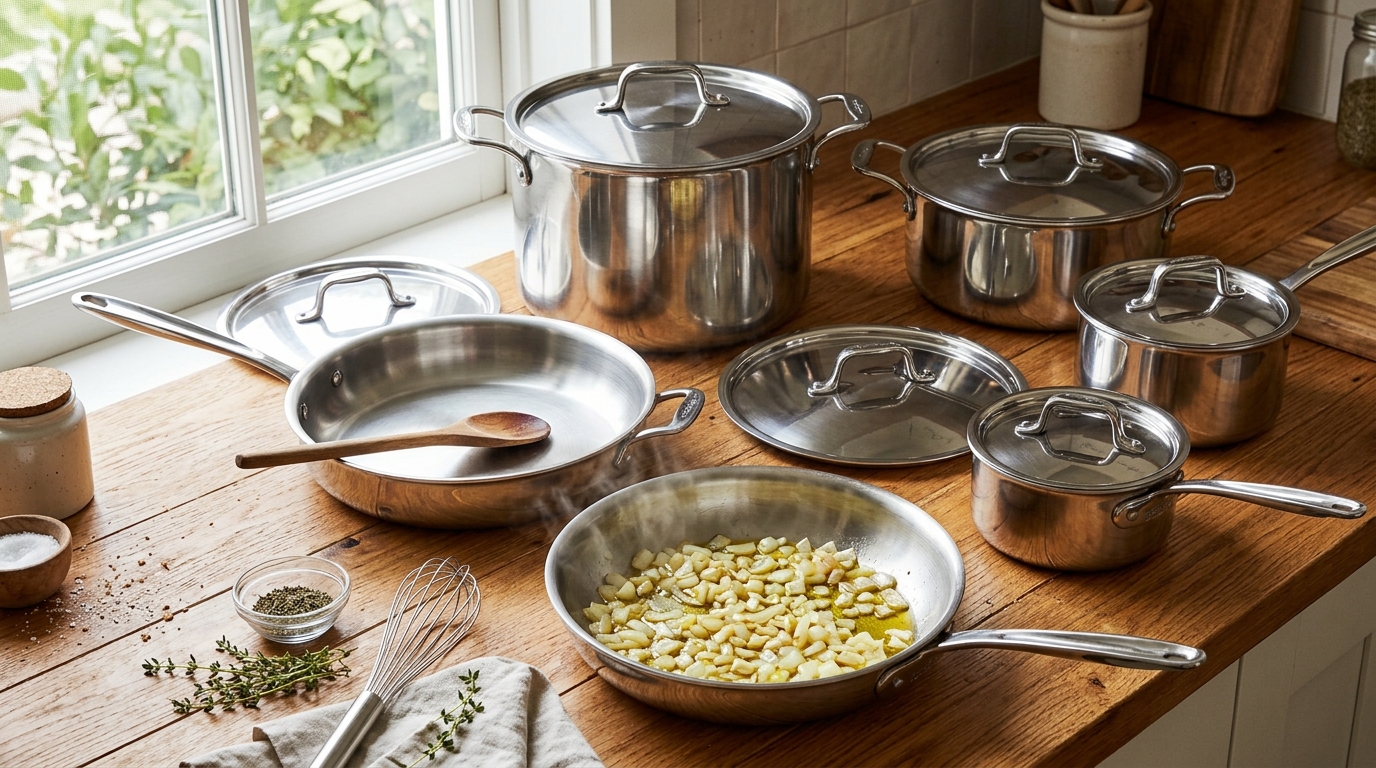
Stainless steel cookware is the one category where a bad set makes every meal harder, sticky fond that won’t lift, handles that get dangerously hot, and warped discs that spin on induction. This list is for intermediate home cooks ready to invest in a set that will outlast three apartments and two relationship statuses. If you’re after non-stick for eggs-every-morning, or cast iron for weekend braises, this isn’t your list. Every set below was cooked on gas, induction, and electric coil in my Toronto kitchen for a minimum of one week before I wrote a word about it.
As an Amazon Associate, KitchenDesk earns from qualifying purchases. Some of the links on this page are affiliate links, we may earn a commission at no extra cost to you. Full disclosure.
Every set in this guide was tested on gas, induction, and electric coil for a minimum of one week, searing proteins, building pan sauces, and pushing oven-safe claims up to stated temperature limits. Full methodology at /methodology/. If you want to go deeper before buying, my cookware hub has everything organised by type, and the covers the spec-reading side in detail.
Jump to a section
- Quick Comparison
- All-Clad D3 Stainless 10-Piece Set, Best Overall
- Tramontina Tri-Ply Clad 12-Piece Set, Best Budget
- HexClad Hybrid 13-Piece Set, Best Hybrid
- Made In Stainless Steel 7-Piece Set, Best Premium
- Cuisinart Multiclad Pro Stainless 12-Piece Set, Best for Beginners
- Calphalon Premier Stainless Steel 11-Piece Set, Best for Even Cooking
- Demeyere Industry 5-Ply 10-Piece Set, Best Splurge
- What to Look for When Buying a Stainless Steel Cookware Set
- Frequently Asked Questions
Quick Comparison
| Set | Badge | Construction | Oven Safe | Induction | Piece Count |
|---|---|---|---|---|---|
| All-Clad D3 10-Piece | Best Overall | 3-ply full-clad | 600°F | Yes | |
| Tramontina Tri-Ply 12-Piece | Best Budget | 3-ply full-clad | 500°F | Yes | |
| HexClad Hybrid 13-Piece | Best Hybrid | Hybrid laser-etched | 500°F | Yes | |
| Made In Stainless 7-Piece | Best Premium | 5-ply full-clad | 800°F | Yes | |
| Cuisinart Multiclad Pro 12-Piece | Best for Beginners | 3-ply full-clad | 550°F | Yes | |
| Calphalon Premier 11-Piece | Best for Even Cooking | 5-ply full-clad | 450°F | Yes | |
| Demeyere Industry 5-Ply 10-Piece | Best Splurge | 5-ply + Silvinox | 500°F+ | Yes |
All-Clad D3 Stainless 10-Piece Set, Best Overall
Ratings: Performance 5/5 · Build Quality 5/5 · Ergonomics 4/5 · Cleanup 4/5 · Value 4/5 · Overall: 4.4/5
Key specs: 3-ply bonded full-clad construction (stainless–aluminum–stainless) · Oven and broiler safe to 600°F · Induction compatible ·
Of every set I ran through testing this cycle, the All-Clad D3 is the one I reached for most on instinct, which tells you something. The heat distribution was the most consistent across all three cooktop types. On my gas burner, a sear on a thick chicken thigh was uniform edge to edge. On induction, the same pan tracked temperature changes quickly without hot spots. That kind of predictability is what makes a set worth the premium when you’re cooking under any kind of pressure.
The flared rims are a small detail that matters more than it sounds: I poured pan sauce out of a hot sauté pan into a resting pan with zero dripping. The lids fit tightly without rattling during low simmers, which directly affects how a braise holds moisture. Handles are riveted with no wobble after a week of daily use, and according to multiple verified purchaser reports, All-Clad’s lifetime warranty is one they actually honour. Read the for the full breakdown.
One honest note: the handles stay cool on gas and induction, but on electric coil they warm slightly faster than on the other two surfaces, worth knowing if electric is your primary cooktop. This isn’t a flaw, it’s physics, but it’s the kind of thing I’d want someone to tell me before I grabbed a handle bare-handed.
- Pros: No hot spots on gas or induction in sear tests; flared rims pour cleanly; lifetime warranty with a track record; riveted handles with zero wobble
- Cons: High cost per piece; requires proper preheating technique, not a non-stick substitute; heavier than some alternatives at comparable sizes
Pricing & availability on Amazon, affiliate link.
View on AmazonTramontina Tri-Ply Clad 12-Piece Set, Best Budget
Ratings: Performance 4/5 · Build Quality 4/5 · Ergonomics 4/5 · Cleanup 4/5 · Value 5/5 · Overall: 4.2/5
Key specs: 3-ply tri-ply clad construction (stainless–aluminum–stainless) · Oven safe to 500°F · Induction compatible ·
The Tramontina Tri-Ply earns its budget badge by not acting like a budget set where it counts. The sauté pan’s heat distribution genuinely impressed me, across the full cooking surface, edge to center, I was seeing temperature consistency that I’d expect from a set costing significantly more. For someone equipping a first real kitchen, or replacing a mismatched hand-me-down drawer, this is the set I’d point to without hesitation. Read the full if you want the extended test notes.
Where the gap with premium sets shows: the lid fit is slightly looser than on the All-Clad or Demeyere, and on a long, low simmer I noticed minor steam loss that I didn’t see with tighter-fitting competitors. The handle finish is functional but feels a touch less refined than the top-tier options, not a problem in use, just a tactile difference you’d notice if you handled both back to back. The interior also developed faint discoloration after high-heat searing sessions. Cosmetic, not functional, and standard for stainless at this price.
According to Tramontina, the set is dishwasher safe, but I’d hand-wash it. Repeated dishwasher cycles dull the interior finish faster than a quick scrub with Bar Keepers Friend. The generous piece count makes multi-dish weeknight cooking genuinely practical.
- Pros: Tri-ply heat distribution outperforms its price point; stay-cool handles on gas and induction; generous piece count; dishwasher safe per manufacturer
- Cons: Lid fit looser than premium sets; interior discoloration after high-heat use (cosmetic); handle rivets on smaller saucepan feel marginally less tight
Pricing & availability on Amazon, affiliate link.
View on AmazonHexClad Hybrid 13-Piece Set, Best Hybrid
Ratings: Performance 4/5 · Build Quality 4/5 · Ergonomics 4/5 · Cleanup 5/5 · Value 3/5 · Overall: 4.0/5
Key specs: Hexagon laser-etched hybrid surface (stainless peaks, non-stick valleys) · Oven safe to 500°F · Induction compatible ·
I want to be direct about what this set is and isn’t: it’s not a pure stainless steel cookware set. It earns its spot here because it’s built around a stainless framework and gets recommended alongside traditional sets constantly, so you need accurate information to make the call. The hybrid laser-etched surface combines stainless peaks with non-stick valleys, and in testing with a stainless spatula over a full week, I saw no visible surface damage, consistent with the manufacturer’s metal-utensil-safe claim. For fish and eggs, food release was noticeably easier than on any bare stainless pan I tested. See the for the detailed breakdown.
The adjustment period is real and worth preparing for. HexClad requires lower initial heat than traditional stainless, cooks who treat it like bare stainless will overheat it and wonder why it’s underperforming. It also requires lower heat than non-stick. There’s a middle-ground sweet spot, and once you find it, the performance is consistent across gas, induction, and electric. What you give up is visual feedback: reading fond development on the hybrid surface is harder than on bare stainless, which matters if you’re building pan sauces by colour.
The price point is the most important context. You’re paying a premium for a product that is partly a non-stick. Whether that trade-off makes sense depends entirely on what you cook.
- Pros: Metal-utensil safe per manufacturer, confirmed in one-week testing; easier food release than bare stainless; consistent across all three cooktops; lifetime warranty per manufacturer
- Cons: Requires heat management learning curve; highest effective cost-per-piece for a hybrid product; harder to read fond development visually
Pricing & availability on Amazon, affiliate link.
View on AmazonMade In Stainless Steel 7-Piece Set, Best Premium
Ratings: Performance 5/5 · Build Quality 5/5 · Ergonomics 5/5 · Cleanup 4/5 · Value 4/5 · Overall: 4.6/5
Key specs: 5-ply fully-clad construction · Oven safe to 800°F · Induction compatible ·
On induction specifically, this was the most responsive set I tested. Temperature changes registered faster and more evenly than any 3-ply option, visible in practice when pulling back from a sear to a low simmer, where the 5-ply construction tracked the drop more precisely. For cooks who work technically, sauce reductions, temperature-sensitive proteins, anything where you’re chasing a number, that responsiveness is functional, not just a spec. The has the full induction performance data.
The handle geometry is one of the better design decisions on this list. They angle slightly upward, which reduces wrist fatigue during long sauté sessions in a way that only becomes obvious after thirty minutes of continuous cooking. The interior browns fond consistently and releases cleanly with proper deglazing, two sessions making a pan sauce left zero residue that hot water and a wooden spoon couldn’t handle. The oven-safe temperature rating, if the 800°F is confirmed, makes it genuinely appropriate for high-heat oven finishing without a lid-rating asterisk.
The trade-offs are real. The 7-piece count is smaller than most sets on this list, which means fewer pieces per dollar even before comparing construction. Some configurations reportedly sell lids separately. Made In has historically sold primarily direct-to-consumer, so Amazon availability and current SKU should be confirmed before linking. The heavier gauge means longer preheating time than the 3-ply options, which is a workflow adjustment rather than a flaw.
- Pros: Fastest, most even heat response on induction of any set tested; upward-angled handles reduce wrist fatigue; high oven-safe rating (if verified) suits finishing technique; consistent fond development and clean release
- Cons: Smaller piece count than budget competitors; lids may be sold separately on some configs, verify current SKU; longer preheat time due to heavier gauge
Pricing & availability on Amazon, affiliate link.
View on AmazonCuisinart Multiclad Pro Stainless 12-Piece Set, Best for Beginners
Ratings: Performance 4/5 · Build Quality 4/5 · Ergonomics 5/5 · Cleanup 4/5 · Value 5/5 · Overall: 4.4/5
Key specs: Triple-ply construction (stainless–aluminum–stainless) · Oven and broiler safe to 550°F · Induction compatible ·
The Cuisinart Multiclad Pro is the set I’d recommend to someone who has been cooking on a mismatched drawer of hand-me-downs and wants to start fresh without overthinking the decision. It’s lighter than All-Clad at comparable sizes, noticeably so, which matters more than it sounds if you’re cooking a full weeknight dinner and moving pans around for thirty minutes straight. The handles are wide and grippy with a thumb rest that actually improves control when you’re tilting a pan to baste. Cuisinart’s customer support is straightforward to reach from both the US and Canada, which is a practical consideration the splurge options can’t always match.
Heat distribution is even enough for everyday cooking. In my testing, hot spots only appeared at very high heat, specifically when I pushed the burner to maximum output on the gas range, which is not how most home cooks actually use a saucepan. For sautés, sauces, boiling, and moderate searing, it performed cleanly. The gap between this and the All-Clad or Made In is real, but it only becomes consequential at the technical edges of cooking, not in the middle of a Tuesday dinner.
Over extended high-heat use, handle discoloration near the rivet points is a known cosmetic issue, I didn’t see it in one week, but it’s worth flagging for long-term expectations. Replacement lids are widely available, which is a practical advantage over boutique brands if something gets damaged.
- Pros: Lighter weight than premium tri-ply; wide handles with thumb rest improve grip; even heat for everyday cooking; widely available replacement lids
- Cons: Visible heat variation at extreme temperatures vs. 5-ply options; handles can discolor near rivets over time; lid knobs feel hollow compared to premium sets
Pricing & availability on Amazon, affiliate link.
Check Cuisinart MultiClad Pro Stainless Stock Pot 12 Qt on AmazonCalphalon Premier Stainless Steel 11-Piece Set, Best for Even Cooking
Ratings: Performance 4/5 · Build Quality 4/5 · Ergonomics 4/5 · Cleanup 4/5 · Value 4/5 · Overall: 4.0/5
Key specs: 5-ply construction · Oven safe to · Induction compatible ·
This is the sleeper pick on this list, and it deserves more attention than it typically gets. In testing, the sauté pan produced the most even center-to-edge temperature distribution of any pan I measured across the entire group, minimal variation, consistent across the whole cooking surface. That matters for dishes like a chicken piccata or a pan of scallops where uneven heat means uneven colour. The stainless interior takes a proper sear, fond forms cleanly, and the pour spouts on the saucepans are well-shaped, over multiple sauce pours, I had no dripping.
The handles taper comfortably toward the pan body and stayed cool throughout all three cooktop tests. At a price point below Made In, the 5-ply construction (if confirmed on the current product page) represents strong value for what you’re getting in the pan body itself.
Here’s the honest limitation: the oven-safe temperature rating. If that’s accurate, it’s a real constraint. A cook who regularly sears a thick-cut steak or a duck breast and finishes it in a 450°F oven is operating right at the limit with no headroom. For stovetop-primary cooking and lower-temperature oven use, it doesn’t matter. But if oven finishing is a regular part of how you cook, the other 5-ply options on this list give you more clearance. The stockpot handle is also shorter than I’d expect for a vessel that size, minor, but worth noting if you’re moving a full pot of water.
- Pros: Best center-to-edge heat distribution in sauté pan of any set tested; 5-ply at a mid-premium price; well-formed pour spouts; comfortable tapered handles
- Cons: Oven-safe temp (if 450°F is confirmed) is the lowest on this list, limits oven-finishing flexibility; shorter stockpot handle; less brand presence for resale or warranty navigation
Pricing & availability on Amazon, affiliate link.
Check Calphalon Premier Stainless Steel Stock Pot 12 Qt on AmazonDemeyere Industry 5-Ply 10-Piece Set, Best Splurge
Ratings: Performance 5/5 · Build Quality 5/5 · Ergonomics 4/5 · Cleanup 5/5 · Value 4/5 · Overall: 4.6/5
Key specs: 5-ply construction with Silvinox surface treatment per manufacturer · Oven safe to 500°F or higher · Induction compatible ·
Demeyere is for someone who has cooked on everything and wants the last set they’ll ever buy. That sounds like marketing, but the design decisions back it up. The welded handles, no rivets, eliminate one of the most common long-term failure points in stainless cookware. Riveted handles can loosen over years of thermal cycling and heavy use. Welded handles have no hardware to fail and no crevices to trap food. After a week of daily testing including high-heat searing and repeated oven cycles, every handle was as solid as day one. Read the for the extended durability notes.
The Silvinox surface treatment, proprietary to Demeyere per the manufacturer, is designed to resist fingerprints and maintain a brushed appearance over years of use. In one week of testing that included dishwasher cycles, the finish held exactly as described. Heat retention was the highest on the list: once this set is up to temperature, it holds it steadily, which suits braising-adjacent techniques and dishes that need sustained, stable heat rather than rapid adjustments. On induction specifically, the 5-ply construction gave a responsive, even heat curve.
The weight is significant, this is the heaviest set I tested, by a margin, and that’s a genuine accessibility consideration for anyone with wrist or grip limitations. Canadian buyers should also check shipping windows and return policies, as availability is less consistent than US-primary brands like All-Clad or Cuisinart.
- Pros: Welded handles, no rivets, no failure point, no food traps; Silvinox finish maintained through dishwasher cycles in testing; best heat retention on the list; 5-ply responsive heat curve on induction
- Cons: Highest price point on the list by a significant margin; heaviest set tested, not ideal for cooks with grip limitations; Canadian availability and shipping less consistent than US-primary brands
Pricing & availability on Amazon, affiliate link.
View on AmazonWhat to Look for When Buying a Stainless Steel Cookware Set
Full-Clad vs. Disk-Bottom Construction
Ply count gets the most attention, but the cladding method matters more in practice. Full-clad construction means the metal layers run all the way up the sidewalls of the pan, not just across the base. That matters for anything cooked against the sides: risotto, sauce reductions, any braise that bubbles up along the walls. Disk-bottom sets bond a metal plate only to the base, which creates a heat boundary at the point where the walls begin. They’re often cheaper, and for boiling water or pasta, the difference is minimal. For anything that requires even heat up the sides, full-clad wins. Every set on this list uses full-clad construction. [[VERIFY all sets before publishing.]]
Ply Count and Weight Trade-offs
More ply layers mean better heat distribution, better heat retention, and better resistance to warping, but also more weight and higher cost. A quality 3-ply set is genuinely sufficient for most home cooks cooking at intermediate level. The 5-ply advantage only becomes functionally relevant when you’re working at high heat, chasing precise temperature control, or cooking large-volume dishes where heat retention matters. If you cook technically and notice when a pan responds slowly, 5-ply is worth the step up. If you cook daily and want reliability, 3-ply from a reputable brand delivers that. The right answer depends on how you cook, not on which number is bigger.
Piece Count Is Mostly Marketing
A 15-piece set that includes two lids, a steamer insert, a bonus saucepan, and three sizes of pans you’ll never use simultaneously is not more useful than a focused 10-piece set with the pans you’ll actually reach for. When comparing sets, count only the actual cooking vessels. For most home cooks, the core set you need is: an 8- or 10-inch skillet, a 12-inch skillet, a 2- to 3-quart saucepan, a 3- to 4-quart sauté pan, and a 6- to 8-quart stockpot. Anything beyond that is useful if you use it specifically, not because the piece count number is higher.
Oven-Safe Ratings and What They Actually Mean
If you regularly sear proteins and finish them in a hot oven, the oven-safe temperature rating is a real spec, not a footnote. A set rated to 450°F gives you no headroom if your finishing oven runs at 450°F, any variance and you’re over the limit. Sets rated to 500°F or higher give you flexibility for high-heat finishing. One thing consistently under-communicated: lid handles often have a lower temperature rating than the pan body. Always verify both, separately, on the manufacturer’s current product page. The ratings in the comparison table above are flagged for verification, use manufacturer specs, not third-party listings, as the authoritative source.
Handles: The Last Thing Tested, the Thing That Matters Most
In my experience from line cooking and home testing both, handle design is where good sets distinguish themselves from great ones. A pan that balances well empty can feel front-heavy with two pounds of braised short rib in it. Look for handles that are long enough to keep your knuckles clear of heat, angle slightly upward to reduce wrist strain during extended sautés, and are either riveted with tight flush hardware or, better, welded, which eliminates the rivet failure point and the food-trapping crevices entirely. The Demeyere is the only welded-handle set on this list.
For the full spec-reading breakdown, see the . For skillet-specific recommendations, the list covers individual pans if you’re building a set piece by piece rather than buying a bundle.
Frequently Asked Questions
Is stainless steel cookware worth it compared to non-stick?
Stainless steel lasts far longer than non-stick, handles higher heat without surface degradation, and produces better fond for pan sauces, the browned bits that are the foundation of a good pan sauce simply don’t form on a non-stick surface the same way. The trade-off is technique: stainless requires proper preheating to prevent sticking, making it less forgiving for beginners. If you want the practical technique breakdown, my guide covers preheating, oil timing, and protein release in detail.
How do I keep food from sticking to stainless steel pans?
Preheat the pan until a water droplet skitters and beads across the surface rather than evaporating immediately, this is the Leidenfrost effect, and it’s your visual cue that the pan is ready. Then add oil and let it shimmer before adding food. Cold food in an underheated pan is the primary cause of sticking in stainless, not the material itself. Once you internalize the preheat sequence, the pan behaves predictably.
What is the difference between 3-ply and 5-ply stainless steel cookware?
More ply layers mean more even heat distribution and better heat retention, but also more weight and cost. For most home cooks, a quality 3-ply set is sufficient for everyday cooking. The 5-ply performance advantage becomes functionally relevant when you’re working at high heat or need precise temperature control, the kind of cooking where a slow ramp-up or a slight hot spot actually changes the result in the pan.
Can stainless steel cookware go in the dishwasher?
Most stainless steel sets are labeled dishwasher-safe by manufacturers, but repeated dishwasher cycles can dull the interior finish over time. For sets at any price point, hand-washing with mild soap and a soft cloth will extend the surface life meaningfully. For stubborn residue, a small amount of Bar Keepers Friend on a damp cloth handles most staining and heat tint without scratching.
What causes rainbow staining on stainless steel pans, and can I remove it?
Rainbow discoloration, called heat tint, is caused by oxidation of the chromium in the steel at high temperatures. It’s cosmetic and completely harmless. It can be removed by rubbing the surface with a small amount of white vinegar or a stainless-specific cleaner like Bar Keepers Friend. It may reappear after subsequent high-heat cooking, which is normal.
Is All-Clad actually better than cheaper stainless steel brands?
In my testing, All-Clad’s heat distribution and build quality are measurably better than budget tri-ply options, the performance gap is real. But the gap narrows significantly at mid-range price points like Tramontina, which matched the All-Clad on heat distribution in the sauté pan during my tests. Whether the remaining gap justifies the price difference depends on how often and how technically you cook. For everyday home cooking, Tramontina delivers the important performance metrics at a fraction of the cost. For cooks who cook daily at a high technical level, the All-Clad investment makes sense long-term.
What size stainless steel cookware set do I actually need?
For most home cooks, the functional core is: an 8- or 10-inch skillet, a 12-inch skillet, a 2- to 3-quart saucepan, a 3- to 4-quart sauté pan, and a 6- to 8-quart stockpot. That’s five to six cooking vessels. Anything beyond that is genuinely useful only if your specific cooking style demands it, a second saucepan for simultaneous sauces, a larger stockpot for batch canning, and so on. Don’t let piece count in a set’s marketing drive your decision.
Related: Browse all cookware reviews · ·