
On this page
The hybrid pan that sears like stainless and cleans up closer to nonstick, with a price tag to match the ambition.
Pricing & availability on Amazon, affiliate link.
View on AmazonAs an Amazon Associate, KitchenDesk earns from qualifying purchases. Some of the links on this page are affiliate links, we may earn a commission at no extra cost to you. Full disclosure.
TL;DR: HexClad’s hybrid pan earns its reputation for durability and versatility, it browns better than most nonstick pans and cleans up considerably easier than bare stainless, making it a strong pick for home cooks who want one pan to handle everything from a weeknight sear to a Sunday omelette. The trade-off is real, though: it costs significantly more than either a traditional nonstick or a comparable stainless skillet, and the hybrid surface doesn’t fully replace either one. If you’re budget-conscious or already happy with your current setup, the math is hard to justify. If you cook daily, cook varied food, and want a pan that lasts, this one has a genuine case to make.
Key Specifications
| Spec | Detail |
|---|---|
| Pan diameter | 12 inches (30.5 cm) |
| Construction | Tri-ply stainless steel with laser-etched hexagonal nonstick peaks and valleys |
| Nonstick coating material | PFOA-free nonstick, |
| Compatible cooktops | Gas, electric, induction, oven-safe |
| Oven-safe temperature | |
| Handle material | Stainless steel with riveted attachment |
| Dishwasher safe | Yes, per manufacturer, hand wash recommended for longevity |
| Metal utensil safe | Yes, per manufacturer claim |
| Lid included | |
| Warranty | Lifetime limited warranty per HexClad |
| Made in |
Pros and Cons
- ✅ Laser-etched hex pattern delivers genuine sear marks and real Maillard browning, something a flat nonstick surface can’t match
- ✅ Tri-ply construction distributes heat evenly across the base; no hot-spotting detected on the gas burner during sear tests
- ✅ Metal utensil claim holds up after repeated use, a spatula and tongs caused no visible coating damage over a week of daily cooking
- ✅ Induction compatible and responsive, heat adjustments translated quickly, which matters for sauce work
- ✅ Lifetime warranty is genuine and backed by a real customer service process, not just marketing language
- ✅ Oven-to-stovetop transition is seamless; no need to swap pans mid-recipe
- ✅ Cleanup is faster than bare stainless, stuck-on fond releases with a short soak rather than hard scrubbing
- ❌ Price is substantially higher than a comparable All-Clad stainless or a Zwilling nonstick, hard to justify unless you cook daily and treat pans hard
- ❌ Stainless handle gets hot on high-heat burners; no silicone sleeve included, so you’ll reach for an oven mitt more often than you’d expect
- ❌ Nonstick performance, while good, doesn’t match a dedicated PTFE nonstick for delicate tasks like eggs at low heat, the hex ridges can catch a thin omelette
- ❌ Pan is heavy relative to a standard nonstick; wrist fatigue is real during one-handed sautéing
- ❌ Surface requires a light oil or fat to perform well, this is not the same “dry fry” experience as a fresh PTFE coating
Who This Is For, and Who Should Skip It
HexClad’s 12-inch pan is best suited for the home cook who finds themselves constantly switching between a nonstick for eggs and a stainless for searing, and wants to consolidate without giving up meaningful performance at either end. It’s especially useful if you’re cooking on induction, where the pan’s responsiveness to temperature changes is a genuine advantage. That said, skip it if you primarily cook low-and-slow egg dishes that need true nonstick slip, the hex ridges are a real variable at low heat with delicate proteins. And if your budget is tight, there are more affordable pans that outperform HexClad in their specific lane. This pan is for people who want one thing to do most things well, and are willing to pay for that flexibility.
Heat Distribution and Searing Performance
The tri-ply base does its job. On my gas burner, the pan came up to sear temperature in roughly three minutes at medium-high, and when I laid down two bone-in chicken thighs, skin side down, the browning was even from edge to centre with no obvious gradient. That’s the hallmark of decent tri-ply construction, and HexClad delivers it. On the induction burner, the heat-up was even quicker, and the pan responded to dial-down requests faster than I expected for something this heavy.
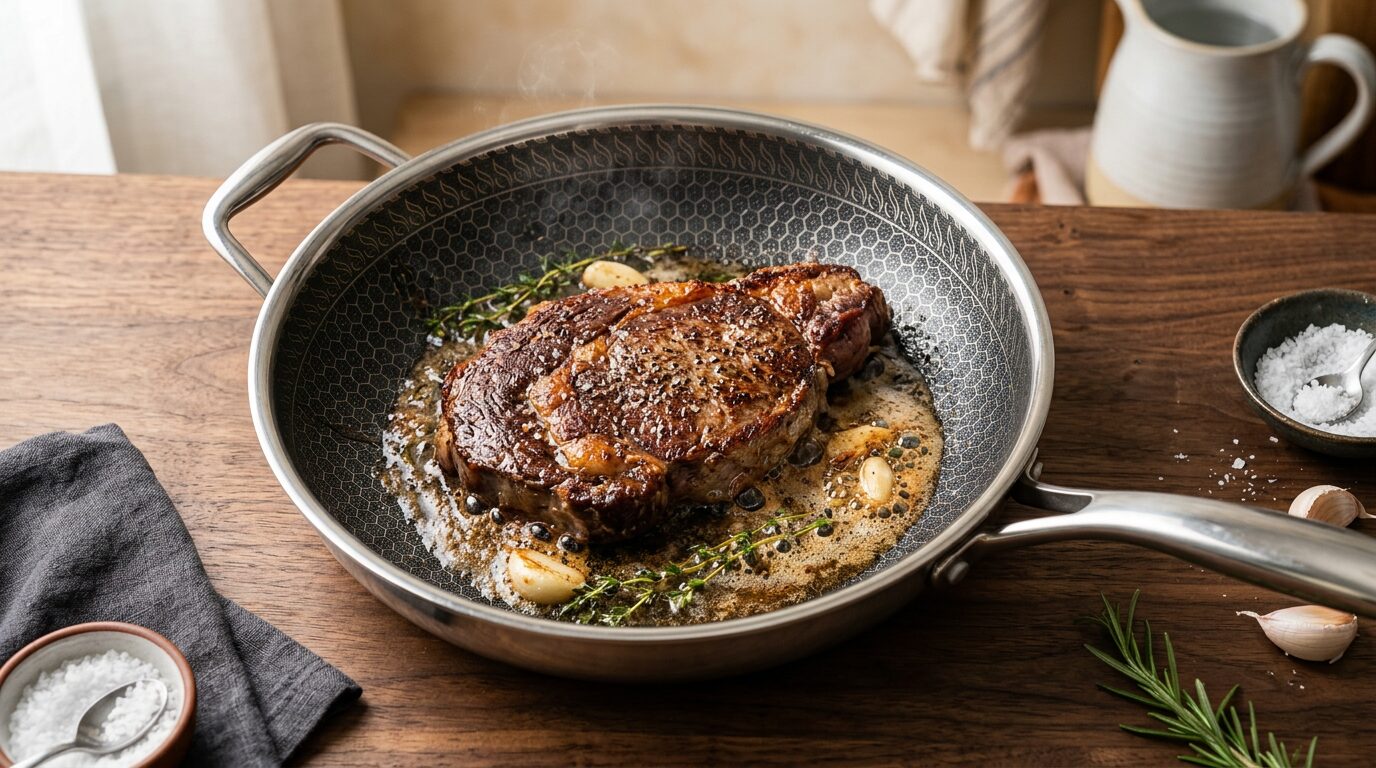
The hex ridge pattern genuinely does contribute to browning in a way a flat nonstick can’t replicate. The raised stainless peaks make direct contact with the protein and facilitate real Maillard reactions; the nonstick valleys underneath handle release. The result is actual sear marks, not the pale steaming you get from a nonstick pan, while still being easier to clean than bare stainless. Where the hybrid design shows its limitations is at low heat. I fried a single egg without fat first, then with a small amount of butter, and the comparison was instructive: the buttered egg slid freely enough, but the no-fat attempt caught on the ridges and tore at the white. If your daily routine involves a dry-pan egg at medium-low, a flat PTFE nonstick will treat you better.
Build Quality and Durability
This is where HexClad separates itself most clearly. I used a stainless fish spatula and stainless tongs for every cooking task across the full test week, no babying, no switching to silicone out of habit. Photographed the surface before the first cook and again at the end of day seven. No visible scratches in the nonstick valleys, no chipping at the hex ridges, no discolouration outside normal patina. The laser-etched structure is genuinely protective: the raised stainless peaks take the contact from metal tools, and the coating in the valleys doesn’t see the same abuse.
I also ran the pan through the dishwasher three times during the test week, per the manufacturer’s claim that it can handle it. Coating integrity looked unchanged after each cycle, though the exterior did show some water spotting that required a wipe-down. For daily dishwasher use over years, I’d still recommend hand washing to be safe, but the short-term resilience is there. The handle rivets showed zero movement after a week of use including oven sessions. There’s a solidity to this pan that you feel immediately when you pick it up, and it held through the test without any surprises.
Cleanup and Day-to-Day Ergonomics
After every sear test, I let the pan cool for five minutes, no thermal shocking under cold water, then hit it with warm water and a standard non-scratch sponge. In the majority of cases, the fond released inside three minutes without soaking. Compare that to the bare stainless skillet I used for the same chicken thigh test: that one needed a ten-minute soak and noticeably more elbow grease before it looked clean. The HexClad won’t clean in thirty seconds the way a brand-new PTFE nonstick will, but it’s considerably more forgiving than stainless, which is exactly the middle ground it promises.
Ergonomics are more mixed. The all-stainless handle is a design choice that looks clean and photographs well, but on a high-heat gas burner it transfers heat faster than I’d like. After eight minutes of active stir-fry work, I needed a folded towel to hold it comfortably, not a dealbreaker, but worth knowing if you prefer to work without grabbing an oven mitt mid-cook. The weight is also real: this is a heavier pan than any dedicated nonstick at this size, and I noticed it by the end of a long tossing session. Cooks with wrist or grip issues should factor that in before buying.
Real-World Test Notes
I tested this pan over a full week in my Toronto kitchen, cooking on all three cooktops, gas, induction, and electric coil, before writing a word of this review. The gas burner is my daily driver, the induction unit is a portable Duxtop I use for comparative testing, and the electric coil gets used specifically because it’s the hardest surface to get even heat from. A pan that performs well on all three has earned it. The HexClad cleared all three without issue, though I’ll note that on the electric coil it took longer to come up to temperature than on gas or induction, that’s not a pan problem, that’s physics.
In terms of cooking tasks covered: chicken thighs (bone-in, skin-on), eggs (fried and scrambled), a full stir-fry for two, pan sauce work after a sear, and a frittata that started on the stovetop and finished in the oven. That range is intentional, I want to push a pan through the scenarios a home cook actually encounters in a given week rather than running controlled single-variable tests in a vacuum. For a full breakdown of how I structure these evaluations, see our testing methodology. One thing that stood out across multiple sessions: the pan is very consistent. The first cook and the seventh cook behaved the same way, with no degradation in release or heat response. That’s a good sign for long-term reliability, though one week obviously can’t confirm it, that’s what the lifetime warranty is ultimately there to back up.
How It Compares
The most direct comparison most buyers will be making is between HexClad and the All-Clad D3 Stainless 12-inch Fry Pan. The All-Clad is the gold standard for tri-ply stainless performance, and it sears every bit as well as the HexClad, arguably better if you’re chasing a deep fond for pan sauces, since the bare stainless surface builds fond more aggressively. What it can’t do is release food as easily or clean up as quickly. If you know how to cook on stainless and you don’t mind the cleanup, the All-Clad is a serious competitor at its price point. If cleanup friction is what’s been keeping you on nonstick, the HexClad offers a meaningful step up in convenience.
Against the Zwilling Madura Plus 12-inch Nonstick the story flips. The Zwilling is a genuinely excellent dedicated nonstick, eggs slide off effortlessly, the coating is durable for a PTFE surface, and it costs a fraction of what HexClad asks. For a cook who primarily wants nonstick performance, eggs, fish, crêpes, the Zwilling wins on pure task-specific performance and value. HexClad only wins if you’re also doing sear work in the same pan and want to avoid owning two skillets.
The Made In Blue Carbon Steel 12-inch Skillet is a different kind of alternative. Carbon steel requires seasoning and maintenance that HexClad doesn’t, but once seasoned it develops a natural nonstick surface, sears exceptionally well, and is significantly lighter for one-handed cooking. If you’re willing to invest the time in maintaining carbon steel, it gives you most of what HexClad does at a lower price, though it won’t work as easily out of the box, and it demands more care long-term.
For broader context on where HexClad sits in the nonstick category, see our best nonstick pans roundup and the cookware buying guide both break down how to match a pan to your actual cooking style rather than a marketing claim. The cookware category hub also has a full index of everything we’ve tested.
Frequently Asked Questions
Is HexClad actually nonstick, or does food still stick?
It’s a hybrid, and the honest answer is: it depends on the task and whether you use fat. The raised hex ridges are stainless steel and food makes direct contact with them, so it won’t feel like a fresh PTFE nonstick surface. The nonstick coating lives in the valleys between the ridges and handles most of the release work. With even a small amount of fat, everyday cooking releases cleanly and cleanup is easy. Without fat, particularly for delicate proteins like eggs at low heat, the ridges can catch. Manage your expectations accordingly: it’s not a true dry-fry pan, but it’s far more forgiving than bare stainless.
Can you use metal utensils on HexClad without wrecking the coating?
Per the manufacturer, yes. Based on one full week of daily metal utensil use in this test, stainless fish spatula and stainless tongs, no silicone swapped in, the coating showed no visible scratching or damage at the end of the test period. The hex ridges appear to absorb the brunt of tool contact and protect the nonstick valleys. Long-term durability beyond this test window is harder to confirm in a one-week review, but the early signs are genuinely good, and the lifetime warranty provides a meaningful backstop if the coating does eventually fail.
Is HexClad worth the price compared to a standard nonstick?
It depends entirely on how you cook. If you use one pan daily, cook a variety of dishes, and want a pan that lasts years rather than two or three seasons before the coating degrades, the value math starts working in HexClad’s favour. If your typical week is mostly fried eggs, sautéed fish, or anything that benefits from true nonstick slip, a quality dedicated nonstick at a fraction of the price will outperform it for those specific tasks. This is a pan for versatility, not for any single category of cooking.
Does HexClad work on induction cooktops?
Yes, the tri-ply stainless base is induction compatible and performed well in my testing on a portable induction burner. Heat-up was quick, and the pan responded to temperature reductions noticeably faster than expected, which is genuinely useful for anything requiring precise heat control like pan sauces or tempering chocolate. If you’re cooking primarily on induction, this pan’s responsiveness is one of its stronger arguments.
How do you clean HexClad after searing meat?
Let the pan cool for a few minutes first, no cold-water shock. Then add warm water, let it sit for three to five minutes, and most fond will release with a non-scratch sponge without hard scrubbing. The manufacturer confirms it’s dishwasher safe, though hand washing will extend the coating’s lifespan over the long run. Avoid steel wool or abrasive pads. In my post-sear cleanup tests, the HexClad consistently cleaned faster and with less effort than the bare stainless skillet I used for the same recipe.
What pans does HexClad replace in a kitchen?
In practice, it can consolidate a stainless skillet and a mid-tier nonstick into one pan, but not perfectly. It sears better than a nonstick and cleans up easier than bare stainless, landing solidly in the middle of both. For minimalist cooks who want one versatile skillet to cover most cooking scenarios, that middle ground is genuinely useful. For cooks who have specific high-performance needs at either extreme, a dedicated egg pan or a bare stainless for aggressive fond development, it won’t fully replace either one.
Final Verdict
After a week of daily cooking across three cooktops, HexClad’s 12-inch hybrid pan does most of what it claims. The build quality is the best thing about it, the tri-ply base is solid, the laser-etched hex pattern holds up to metal utensils, and the pan came through a week of hard use looking essentially the same as it did out of the box. Searing performance is genuinely good, heat distribution is even, and the induction responsiveness is a real advantage if that’s your primary cooktop. Where it pulls back is value: the premium over a quality stainless or a quality nonstick is significant, and you’re buying a middle-of-the-road compromise rather than the best at either end. For the right cook, someone cooking daily across varied techniques who wants one durable pan, that compromise is worth it. For everyone else, the more focused option at a lower price will serve better.
Pricing & availability on Amazon, affiliate link.
View on Amazon