

On this page
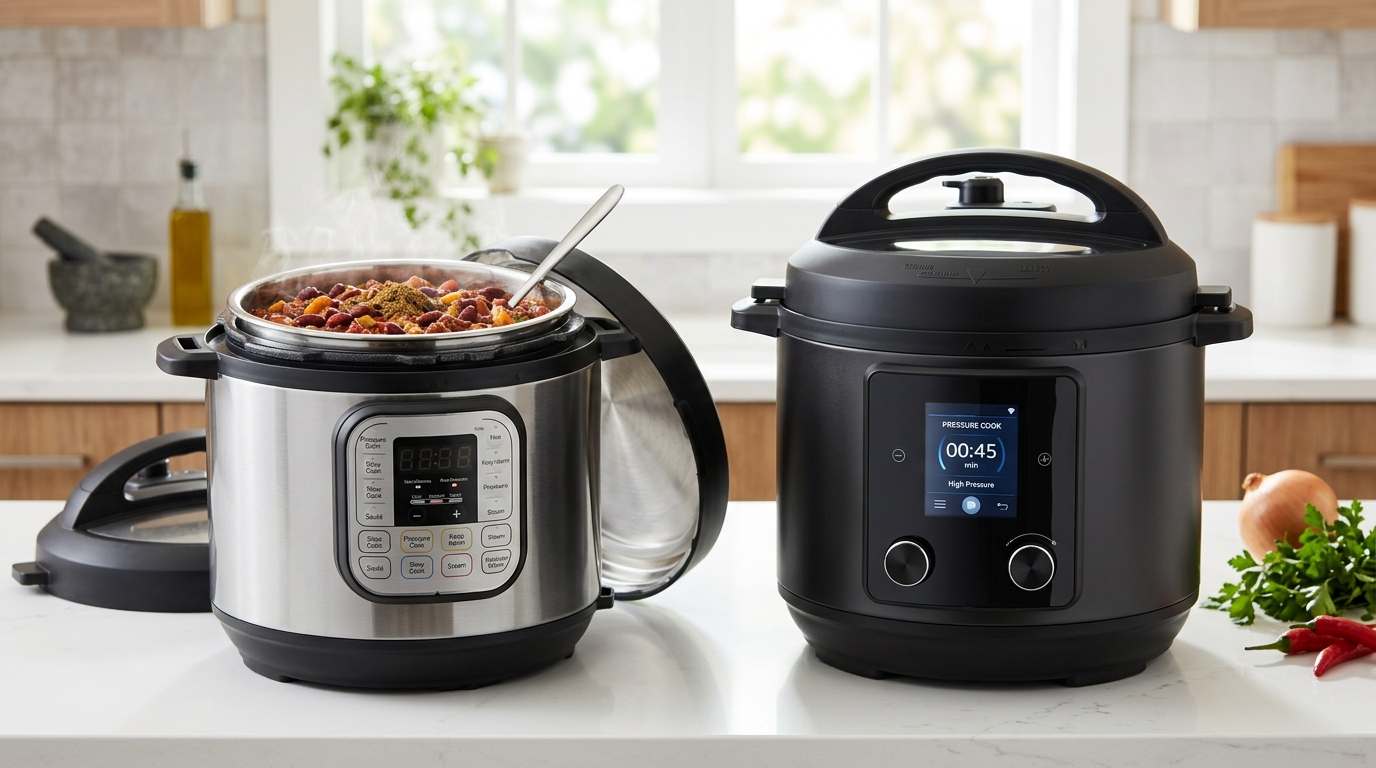
You already know you want an Instant Pot, the real question is whether the extra money for the Pro buys you anything you’ll actually use. Both pressure-cook a braise beautifully, but they diverge on controls, cooking programs, and lid design in ways that matter depending on how you cook. Short answer: the Duo is the smarter buy for most households; the Pro earns its keep only if you slow-cook frequently, cook at altitude, or genuinely want more granular manual control over your sessions.
As an Amazon Associate, KitchenDesk earns from qualifying purchases. Some of the links on this page are affiliate links, we may earn a commission at no extra cost to you. Full disclosure.
I’ve run both the Instant Pot Duo 7-in-1 and the Instant Pot Pro 10-in-1 through a full week of testing each, braises, dried beans from scratch, stock, slow-cooked chili, and a sous-vide chicken breast on the Pro, in my Toronto kitchen on an induction cooktop setup. Here’s what actually separates them.
Spec Comparison: Duo vs. Pro
| Spec | Instant Pot Duo 7-in-1 | Instant Pot Pro 10-in-1 |
|---|---|---|
| Cooking programs | 7 | 10 |
| Capacity options | 3 qt, 6 qt, 8 qt | |
| Inner pot material | Stainless steel (food-grade 304) | Stainless steel (food-grade 304) |
| Lid type | Single sealing lid | |
| Display / controls | Basic LED + preset buttons | Backlit LCD display + dial control |
| Weight (6 qt) | approx. 11.8 lbs | approx. 14.5 lbs |
| Dimensions (6 qt) | ||
| Working pressure (high) | ||
| Altitude adjustment | No | Yes (built-in) |
| Sous-vide mode | No | Yes |
| Cord length | ||
| Warranty | 1 year limited | 1 year limited |
| Country of manufacture |
For deeper context on what to look for before buying any electric pressure cooker, check out our pressure cooker buying guide and the full best electric pressure cookers list. Everything below assumes you’ve narrowed it down to one of these two specifically.
Performance
At the pressure-cooking level, the thing both units are actually built around, the Duo and the Pro are effectively identical. Both reach the same high-pressure setting, which means your 90-minute beef short rib braise will come out the same in either machine. I ran the same batch of dried chickpeas (soaked overnight, 15 minutes at high pressure) back to back in both the 6 qt Duo and the 6 qt Pro, and I couldn’t tell the results apart. If pressure cooking is all you need, you don’t need the Pro.
Where the gap opens up is in the auxiliary modes. The Pro’s sous-vide function works, I held chicken breast at a target temperature for 90 minutes and got a result consistent with my dedicated immersion circulator, though I’d still recommend a real circulator if sous-vide is a serious part of your cooking. The Pro also offers a more precise slow-cook temperature range (low, medium, high with finer control) compared to the Duo’s slow-cook mode, which has drawn consistent criticism in the cooking community for running hotter than intended and overcooking delicate braises . In my own testing, the Duo’s slow-cook mode did run noticeably warm on the low setting, not disastrously so, but enough that I’d add less liquid than I normally would and check it earlier than the recipe suggested.
Steam-release valve design is worth mentioning: both use a float valve and sealing ring system, and the release mechanism functions similarly across models. Neither unit has a fully sealed steam-release in the sense of a completely hands-free venting experience, you still need to move the valve or use a towel when doing a quick release.
Build Quality
Both units share the same food-grade 304 stainless steel inner pot, and Instant Pot claims a tri-ply bottom on both . In practice, the inner pots feel identical, same heft, same finish, same sauté performance. The sealing ring is where most long-term maintenance questions come in: both rings should be replaced roughly every 12–18 months with regular use, and they’re widely available and cross-compatible within the same capacity size .
Handle the two units side by side and the Pro does feel more substantial. The outer housing has a bit more solidity to it, and the lid mechanism closes with a more deliberate click compared to the Duo’s functional-but-plasticky lid lock. Whether that translates to longer physical lifespan over three to five years is genuinely hard to predict, both are and Instant Pot has a strong safety track record across both lines. The Pro’s additional sensors (for altitude adjustment and the more granular slow-cook control) do add a small number of electronic components that aren’t present in the Duo, which is a theoretical additional failure point, though I haven’t seen this reflected in community failure reports to any significant degree.
One honest note on longevity: the Duo has been on the market significantly longer, which means there’s a much larger body of real-world failure and repair data behind it. The Pro is newer, and while early returns look solid, the Duo’s track record is simply better established. That matters if you’re planning to use this thing daily for years.
Ergonomics
This is where the Pro most clearly justifies its price premium, at least in terms of daily feel. The Duo’s membrane-style buttons are fine, but hunting through preset menus to land on exactly 22 minutes at high pressure gets old quickly. The Pro’s backlit LCD and rotating dial let you dial in time and pressure in a few seconds, mid-session, without consulting the manual. After a week with the Pro, going back to the Duo’s button layout felt like a step backward, and I say that as someone who thinks most “premium” interface upgrades in kitchen appliances are marketing fluff. This one is real.
Lid storage is a recurring annoyance on both models. Neither lid has an elegant resting position, you’re setting it on the counter or hanging it somewhere nearby while you finish the cook. If the Pro does include a lid rest and the Duo doesn’t, that’s a legitimate ergonomic win for high-frequency cooks who resent counter clutter.
On steam release: burn risk is real with any pressure cooker and both units put the steam-release valve in a similar position at the top of the lid. I always use a long silicone-tipped tongs or a folded kitchen towel to actuate quick release, I’d recommend the same regardless of which model you buy. Neither unit has addressed this particularly elegantly, which is a fair criticism of the whole product category. Countertop footprint for the 6 qt versions is comparable, though the Pro runs slightly heavier, which matters if you’re lifting it in and out of a cabinet regularly.
Value
The Duo is one of the best-value entry points in the entire electric pressure cooker category, it’s the model recommended by most culinary schools, food media, and experienced home cooks for a reason. It goes on sale frequently, it has an enormous community of recipe developers behind it, and it does the core job as well as anything in its class. The Pro carries a meaningful price premium over the Duo (check current pricing via the links below, prices shift regularly), and whether that premium is worth it comes down to three questions: Do you cook at altitude? Do you slow-cook often enough to care about more precise temperature control? Do you want sous-vide without a separate device?
If the answer to all three is no, the Duo is your machine. The Pro’s one-year limited warranty is identical to the Duo’s, which is honestly a mild disappointment at the Pro’s price tier, a two-year warranty would feel more appropriate for a unit positioned as the premium option. Replacement accessories, sealing rings, extra inner pots, tempered glass lids, are widely available for both models, and most accessories are cross-compatible within the same capacity . That’s a genuine ecosystem advantage for both: you’re not locked into proprietary parts.
Pick the Instant Pot Duo 7-in-1 if you…
- Want a reliable, no-fuss pressure cooker for everyday meals, soups, beans, pulled pork, without a learning curve.
- Are buying your first Instant Pot and aren’t yet sure how often you’ll actually use it.
- Are working with a tighter budget or limited counter space and want the most-proven option at the lowest entry price.
- Already own a dedicated slow cooker or sous-vide circulator and don’t need those functions duplicated in a second appliance.
- Are shopping for a college student, a small household, or a secondary kitchen, particularly relevant if the 3 qt size fits the use case.
Pick the Instant Pot Pro 10-in-1 if you…
- Cook at altitude, above roughly 3,000 ft / 900 m, and want the unit to adjust automatically rather than adapting every recipe manually.
- Slow-cook regularly and want more precise low/medium/high temperature control than the Duo’s slow-cook mode reliably delivers.
- Want sous-vide capability without buying a separate immersion circulator, and you’ll actually use it more than once or twice.
- Find the dial interface genuinely appealing, if you’ve used the Duo and found the button menus frustrating, the Pro’s controls are a real improvement.
- Are replacing an older Instant Pot and the Pro’s incremental upgrades represent a meaningful step up from what you already know.
Skip both if you…
- Already own a quality stovetop pressure cooker and primarily need faster cook times, a good stovetop model will outperform both on operating pressure and direct-heat browning.
- Cook mostly at high heat: sustained sautéing, hard searing, or wok-style cooking. Neither unit is built for that, and the sauté function on both is adequate at best.
- Need air-fry capability built into the same appliance, consider the Instant Pot Duo Crisp or a dedicated air fryer and pressure cooker combination instead .
Verdict
For the overwhelming majority of home cooks, the Duo is the right call. It pressure-cooks just as well as the Pro, costs less, and has years of community recipe support and real-world durability data behind it. The Pro is worth the premium only if altitude adjustment or a genuinely better slow-cook mode are actual needs in your kitchen, not theoretical ones you imagine you might have someday. Buy the Duo, use it hard, and if you find yourself wishing for the Pro’s dial or its sous-vide function a year in, you’ll know exactly what you gave up and whether the upgrade is worth it.
Both models are covered in more depth in our appliances category hub and ranked against the full field in our best electric pressure cookers roundup.
Instant Pot Duo 7-in-1
Pricing & availability on Amazon, affiliate link.
View on AmazonInstant Pot Pro 10-in-1
Pricing & availability on Amazon, affiliate link.
View on AmazonAbout the author: Maya Chen is a Toronto-based home cook and former line cook at Toqué! (2014–2017). She tests every product on gas, induction, and electric for a minimum of one week before writing. Have a question about either of these units? Drop it in the comments below.
Frequently asked questions
Is the Instant Pot Duo or Pro better for most people?
For the overwhelming majority of home cooks, the Duo is the right call. It pressure-cooks just as well as the Pro, costs less, and has years of community recipe support and real-world durability data behind it. The Pro only earns its premium if altitude adjustment, a better slow-cook mode, or built-in sous-vide are genuine needs in your kitchen rather than ones you imagine you might use someday.
Does the Pro pressure-cook faster or better than the Duo?
No. At the pressure-cooking level, the Duo and Pro are effectively identical. Both reach the same high-pressure setting, so a 90-minute beef short rib braise comes out the same in either machine. We ran the same batch of soaked dried chickpeas back to back in the 6 qt Duo and 6 qt Pro and could not tell the results apart. If pressure cooking is all you need, you do not need the Pro.
Which one is the better choice for a beginner?
The Duo. It is a reliable, no-fuss pressure cooker for everyday meals like soups, beans, and pulled pork, with no real learning curve. It is also the smart pick if you are buying your first Instant Pot and aren’t yet sure how often you’ll use it, or if you’re shopping for a college student, a small household, or a secondary kitchen where the 3 qt size fits.
Which model holds up better over the long term?
Both share the same food-grade 304 stainless steel inner pot and feel identical in use, and the Pro’s housing and lid do feel a touch more substantial in the hand. But the Duo has been on the market significantly longer, so its real-world failure and repair data is far better established. The Pro’s extra sensors add a theoretical failure point, though that hasn’t shown up meaningfully in community reports.
How much maintenance does the sealing ring need?
Both models use the same float valve and sealing ring system, and the ring is where most long-term maintenance comes in. Plan to replace it roughly every 12 to 18 months with regular use. The rings are widely available and cross-compatible within the same capacity size, as are other accessories like extra inner pots and tempered glass lids, so you’re not locked into proprietary parts with either unit.
Is the Pro’s dial interface actually worth the extra money?
For daily feel, the controls are where the Pro most clearly justifies its premium. The backlit LCD and rotating dial let you set time and pressure in a few seconds mid-session without consulting the manual, whereas the Duo’s membrane buttons mean hunting through preset menus. After a week with the Pro, going back to the Duo’s buttons felt like a step backward. If you’ve found the Duo’s menus frustrating, this upgrade is real.