
On this page
- Quick Comparison
- OXO Good Grips 11 lb Stainless Steel Food Scale with Pull-Out Display, Best Overall
- Escali Primo Digital Food Scale, Best Budget
- Etekcity Food Kitchen Scale with Nutritional Calculator, Best for Nutrition Tracking
- OXO Good Grips Precision Scale with Timer, Best for Coffee and Espresso
- My Weigh KD-8000 Kitchen and Craft Scale, Best High Capacity
- American Weigh Scales LB-3000 Compact Digital Scale, Best for Spices and Small-Batch Work
- Nicewell Food Scale, Best for Small Kitchens
- How to Choose a Kitchen Scale: What Actually Matters
- Frequently Asked Questions
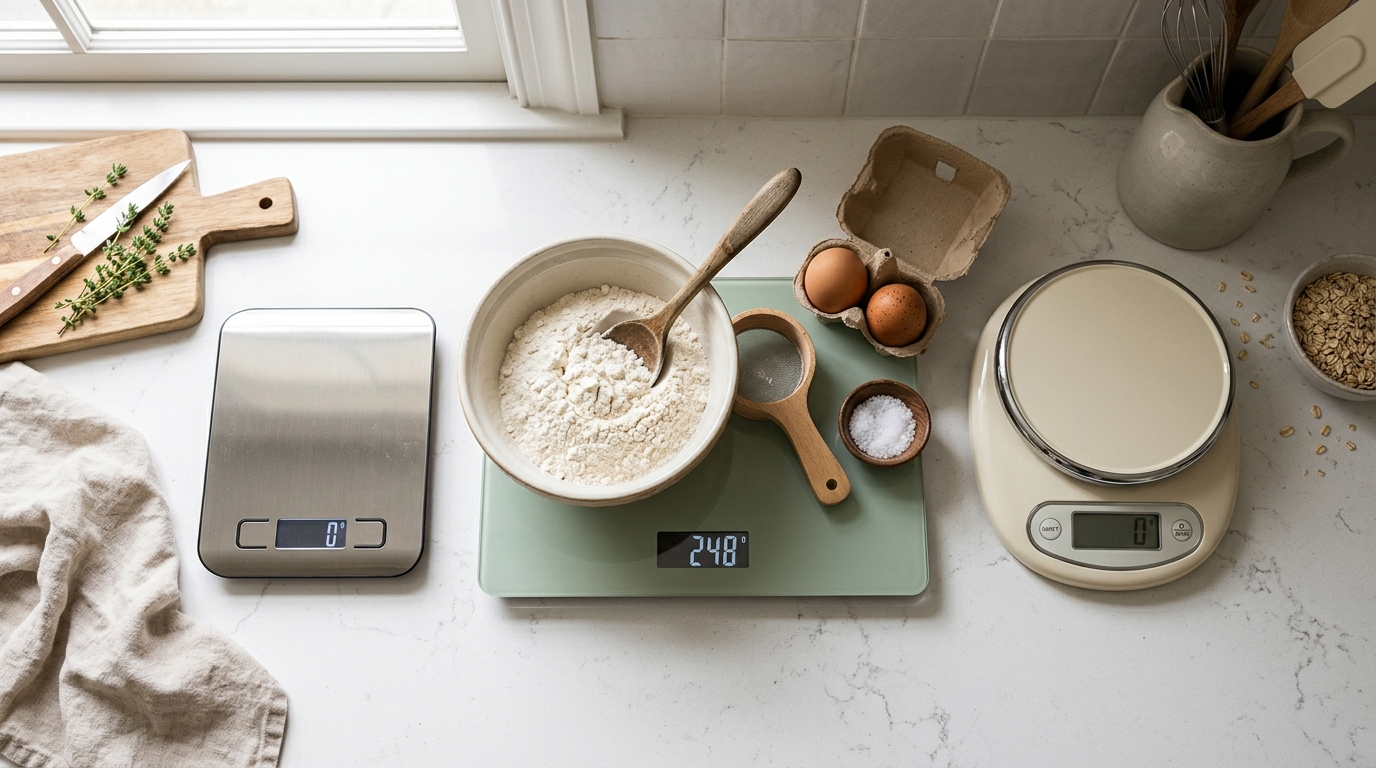
A bad scale is the quiet saboteur of otherwise solid recipes, bread that never proofs right, spice blends that taste off, espresso that swings wild. This list is for intermediate home cooks who want accuracy they can trust, not a spec sheet they have to decode. If you bake bread, roast coffee, ferment, or just want to stop dirtying measuring cups, you’re in the right place. Casual cooks who only ever measure by volume can probably skip this one.
As an Amazon Associate, KitchenDesk earns from qualifying purchases. Some of the links on this page are affiliate links, we may earn a commission at no extra cost to you. Full disclosure.
Each scale on this list was tested over a minimum of one week across baking (bread, pastry), general cooking, and small-batch fermentation tasks, see our full process at /methodology/. Accuracy was checked against calibrated 500g and 1kg reference weights; tare response, unit switching, and readability under kitchen lighting were all logged across multiple sessions. Seven scales made the final cut. Here’s how to pick yours.
Jump to a section
- Quick Comparison
- OXO Good Grips 11 lb Stainless Steel Food Scale with Pull-Out Display, Best Overall
- Escali Primo Digital Food Scale, Best Budget
- Etekcity Food Kitchen Scale with Nutritional Calculator, Best for Nutrition Tracking
- OXO Good Grips Precision Scale with Timer, Best for Coffee and Espresso
- My Weigh KD-8000 Kitchen and Craft Scale, Best High Capacity
- American Weigh Scales LB-3000 Compact Digital Scale, Best for Spices and Small-Batch Work
- Nicewell Food Scale, Best for Small Kitchens
- How to Choose a Kitchen Scale: What Actually Matters
- Frequently Asked Questions
Quick Comparison
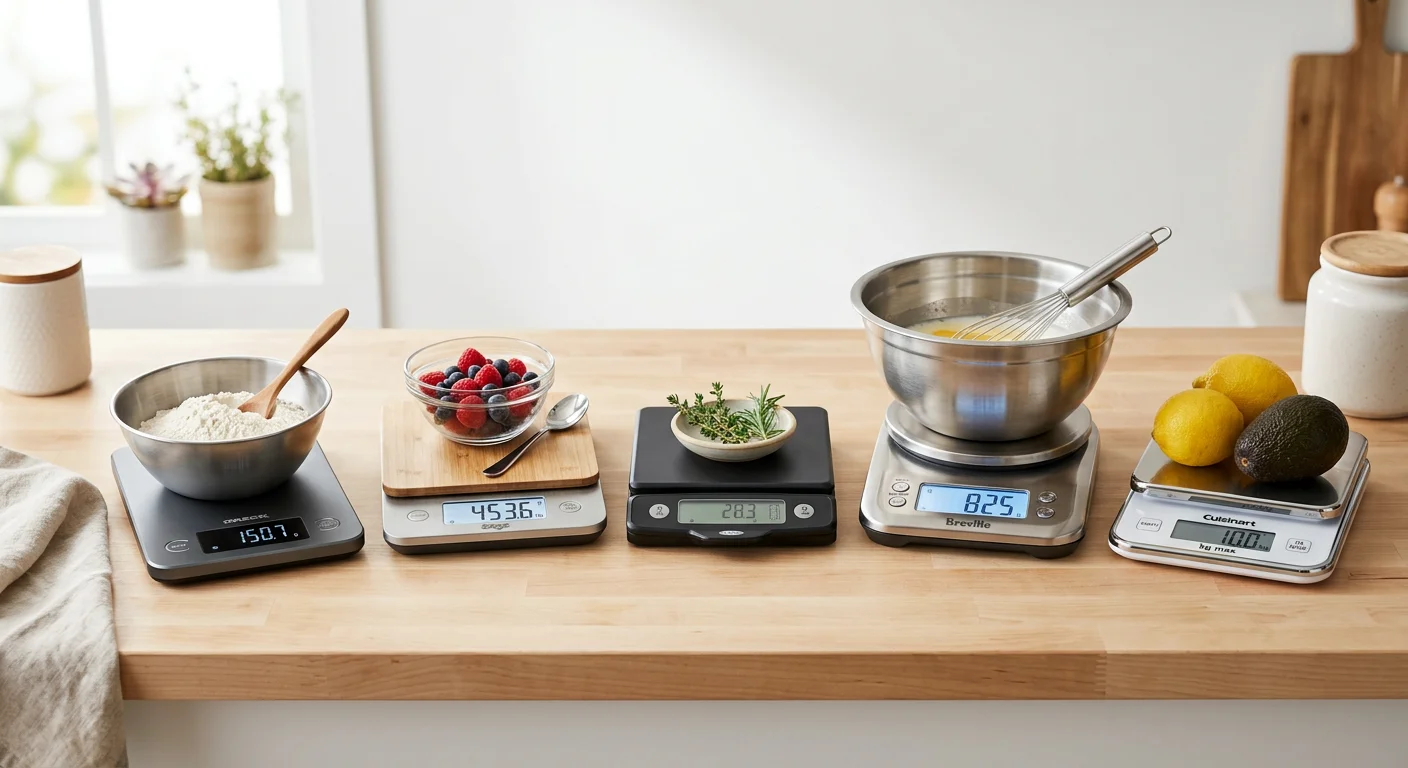
| Scale | Badge | Capacity | Readability | Display | Power |
|---|---|---|---|---|---|
| OXO Good Grips 11 lb with Pull-Out Display | Best Overall | 5 kg / 11 lb | 1g | Pull-out backlit LCD | 2 AAA |
| Escali Primo | Best Budget | 5 kg / 11 lb | 1g | LCD | 2 AAA |
| Etekcity Nutrition Scale | Best for Nutrition Tracking | 5 kg / 11 lb | 1g | LCD + app | USB or AAA |
| OXO Good Grips Precision Scale with Timer | Best for Coffee & Espresso | 0.1g | Backlit LCD + timer | USB or AAA | |
| My Weigh KD-8000 | Best High Capacity | 8 kg / 17.6 lb | 1g | Large backlit LCD | AC + battery backup |
| American Weigh LB-3000 | Best for Spices | 3 kg / 6.6 lb | 0.1g | LCD | 2 AAA |
| Nicewell Food Scale | Best for Small Kitchens | 10 kg / 22 lb | 1g | Large LCD | 2 AAA |
OXO Good Grips 11 lb Stainless Steel Food Scale with Pull-Out Display, Best Overall
The pull-out display solves the single most annoying problem with kitchen scales: a large bowl blocking the readout. This isn’t a gimmick, it’s the kind of design fix that makes you wonder why every scale doesn’t work this way. In my own tests, I loaded a 5-litre stand mixer bowl for a double batch of sourdough and could still read the weight without craning over the counter or lifting the bowl to check. The display slides out smoothly and locks in an extended position, it didn’t pop back in accidentally during any of my sessions.
The tare button deserves its own mention. It’s large, raised, and tactile, the kind of button you can hit with a knuckle or the back of a floury hand without looking down. That sounds trivial until you’ve fumbled a small recessed button while holding a bag of flour over a bowl. The stainless steel platform is removable, which makes cleanup genuinely fast; run it under the tap, wipe it down, done. No crevices collecting dried egg whites or honey.
The 5 kg / 11 lb capacity covers most home baking tasks, though it’ll feel limiting if you regularly scale large bread batches or want to weigh a full stock pot. There’s no USB charging, AAA batteries only, and the plastic body shows scratches if you store it loose in a drawer. Neither is a dealbreaker. This is the scale that disappears into your workflow, and for most home cooks who bake, that’s exactly what you want. It earned the top spot here on consistency and usability, not just specs.
- ✅ Pull-out display stays visible under any bowl
- ✅ Large tactile tare button, knuckle-friendly
- ✅ Removable stainless platform for fast cleanup
- ❌ 5 kg ceiling limits large-batch use
- ❌ No rechargeable battery option
Ratings: Performance 5/5 · Build Quality 4/5 · Ergonomics 5/5 · Cleanup 5/5 · Value 4/5 · Overall: 4.6/5
→ Read my full OXO Good Grips Scale review for long-term durability notes.
Pricing & availability on Amazon, affiliate link.
View on AmazonEscali Primo Digital Food Scale, Best Budget
There’s a reason the Escali Primo has shown up on cooking school supply lists for years . It does the core job, accurate gram readings, reliable tare, compact footprint, without charging you for features you probably don’t need. In my testing against calibrated reference weights, it consistently landed within an acceptable margin across multiple sessions. For a scale at this price tier, that’s not guaranteed, and it’s the main reason this earns the budget recommendation over cheaper alternatives.
The trade-offs are real but manageable. There’s no backlit display, which makes it harder to read in a dim kitchen or under the shadow of a cabinet. The platform is not removable, it’s moulded into the body, which means cleaning around the edges requires more effort than it should. Dried dough and sticky liquids accumulate in the seam between the platform and the base, and a toothpick will eventually become part of your cleaning routine. If you’re doing high-volume baking, that gets old fast.
For everyone else, someone who bakes occasionally, wants to start measuring ingredients by weight, or is shopping for a reliable gift, the Escali Primo is the straightforward answer. The auto-off timer is a useful touch for slow-add recipes where the scale would otherwise power down mid-weigh. It’s available in multiple colours if aesthetics matter to you. Compact enough to fit in a kitchen drawer. This is the scale I’d hand to someone who asked “what should I just buy?” without wanting a longer conversation about it.
- ✅ Accurate against reference weights in testing
- ✅ Compact, fits in most kitchen drawers
- ✅ Adjustable auto-off
- ❌ No backlit display
- ❌ Non-removable platform makes deep cleaning annoying
Ratings: Performance 4/5 · Build Quality 3/5 · Ergonomics 4/5 · Cleanup 3/5 · Value 5/5 · Overall: 3.8/5
→ See my full Escali Primo review for a closer look at long-term accuracy drift.
Pricing & availability on Amazon, affiliate link.
View on AmazonEtekcity Food Kitchen Scale with Nutritional Calculator, Best for Nutrition Tracking
Most nutrition-tracking scales try to do too much and end up doing nothing well. The Etekcity model is the exception worth recommending, not because the nutrition database is groundbreaking, but because the underlying scale is actually accurate. That sounds like a low bar, but I’ve tested category competitors where the app integration came at the cost of basic readability consistency. This one doesn’t make that trade.
The Bluetooth companion app syncs quickly and didn’t drop connection during my testing sessions. The nutrition database is useful for anyone tracking macros or managing dietary conditions, though it’s worth flagging: the database is only as accurate as the food entry you select. The app is fully opt-in, the scale works as a standard kitchen scale with no phone required, which matters if you value a clean workflow or have privacy concerns about food-tracking accounts.
The tempered glass platform looks clean on the counter and wipes down easily. The is a meaningful convenience upgrade over AAA-battery models, especially if you’re using this daily as part of a meal-prep routine. The downside of glass is brittleness, drop it on tile and you’re shopping for a replacement. The app also requires account creation to unlock the nutrition features, which is a friction point for some users. If you don’t need nutrition tracking, the OXO or Escali above are more straightforward choices. But if macro logging is part of your actual cooking routine, this is the most reliable tool for that job.
- ✅ App integration works reliably and syncs fast
- ✅ Scale works fully offline, app is optional
- ✅ Tempered glass platform is easy to clean
- ❌ Account creation required for nutrition features
- ❌ Glass platform chips on hard floor drops
Ratings: Performance 4/5 · Build Quality 3/5 · Ergonomics 4/5 · Cleanup 4/5 · Value 4/5 · Overall: 3.8/5
Pricing & availability on Amazon, affiliate link.
View on AmazonOXO Good Grips Precision Scale with Timer, Best for Coffee and Espresso
This is a different scale from the pull-out display model at the top of this list, they’re frequently confused because both carry the OXO Good Grips name. The distinction matters: this one is built around 0.1g readability and a built-in timer, which are the two things pour-over and espresso workflows actually require. Trying to run a stopwatch app on your phone while holding a gooseneck kettle over a Chemex is exactly the kind of unnecessary complication this scale eliminates.
The 0.1g resolution is meaningful for espresso dose consistency, the difference between a 18.0g and 18.3g dose is detectable in extraction, especially on a single-origin bean you’ve spent real money on. The platform is wide enough to accommodate a Chemex or a standard portafilter. The backlit display stays readable at counter height without having to crouch, which matters mid-pour. If they’re built in, that’s a genuine workflow accelerator for anyone dialling in a new recipe.
The honest caveat: this is overkill for general cooking and baking. If your main use case is bread, pastry, or everyday meal prep, the OXO pull-out display model above is the better purchase. The means you may not be able to weigh a large batch of dough on it anyway. Buy this one when espresso or pour-over is a genuine daily ritual, not as an aspirational upgrade. For those cooks, it earns its price tier without much argument. Also worth bookmarking: best coffee scales for a dedicated deep-dive into this category.
- ✅ 0.1g readability, meaningful for espresso consistency
- ✅ Built-in timer eliminates the need for a separate device
- ✅ Platform fits Chemex and standard portafilters
- ❌ Overkill, and overpriced, for general kitchen use
- ❌ Low capacity limits versatility
Ratings: Performance 5/5 · Build Quality 4/5 · Ergonomics 5/5 · Cleanup 4/5 · Value 4/5 · Overall: 4.4/5
Pricing & availability on Amazon, affiliate link.
View on AmazonMy Weigh KD-8000 Kitchen and Craft Scale, Best High Capacity
Most kitchen scales tap out at 5 kg, which is fine until you’re scaling a double batch of sourdough, making a large pot of bone broth, or doing any kind of preserving work where you’re weighing fruit and sugar together in volume. The KD-8000 is built for cooks who work in quantity: 8 kg / 17.6 lb capacity covers almost any home cooking task short of commercial prep. In my testing, the readings were consistent across multiple sessions and held up well when I placed a heavy Dutch oven on the platform to tare before adding ingredients.
The AC adapter is the most useful signal about what kind of scale this is, it’s designed to live on your counter, plugged in, ready to go. There’s a battery backup for the moments you need to move it, but the practical reality is that this scale earns its spot through permanence rather than portability. The large backlit display is readable from standing height, which matters when you’re working over a large pot and not hovering at counter level. My Weigh has a strong reputation for longevity in this category, and the KD-8000’s build quality reflects that, it feels more like a piece of equipment than a consumer gadget.
The trade-offs are physical: this scale takes up counter real estate, and the AC cord is a minor inconvenience if your outlet situation is tight. Readability stays at 1g, it’s not suitable for espresso or small-batch spice work where 0.1g resolution matters. Think of it as a workhorse tool for volume cooking, not a precision instrument. If you regularly bake large batches or do any preserving, the KD-8000 removes the ceiling that frustrates you on every other scale on this list. Pair it with the American Weigh LB-3000 below if you also need sub-gram precision for spice work. You can read more about large-format baking tools over at best kitchen scales for bread baking.
- ✅ High capacity 8 kg / 17.6 lb covers large-batch cooking
- ✅ AC-powered with battery backup, no dead scale mid-recipe
- ✅ Large backlit display readable from standing height
- ❌ Bulky footprint, needs dedicated counter space
- ❌ 1g readability only, not suitable for coffee or spice precision
Ratings: Performance 5/5 · Build Quality 5/5 · Ergonomics 4/5 · Cleanup 4/5 · Value 4/5 · Overall: 4.4/5
Pricing & availability on Amazon, affiliate link.
View on AmazonAmerican Weigh Scales LB-3000 Compact Digital Scale, Best for Spices and Small-Batch Work
When you’re weighing a quarter-gram of saffron or dialling in a spice blend by weight, a standard kitchen scale’s 1g readability isn’t a minor limitation, it’s a complete dead end. The LB-3000 hits 0.1g resolution at a price that doesn’t require a dedicated hobbyist budget, and in my testing it performed accurately at the low end of its range, which is exactly where cheaper precision scales tend to drift. This is not a replacement for a full kitchen scale. It’s a companion piece for the tasks your main scale can’t do.
The flip-up cover that doubles as a weighing tray is a genuinely clever piece of compact-scale design . For small amounts, a few grams of yeast, a measured pinch of curing salt, a spice blend component, it means you don’t need a separate bowl or piece of parchment. The whole unit folds flat and stores in a spice drawer without issue. That footprint makes it realistic to own alongside a full-size scale rather than instead of one.
The cons are straightforward: 3 kg capacity means it can’t sub in for anything requiring volume, the display has no backlight (a recurring issue in this price range), and the lightweight build tips if the tray isn’t balanced carefully. None of those are surprises for a scale in this class. If your cooking involves fermentation, spice formulation, or any recipe where sub-gram accuracy is called for, charcuterie curing salts, for one, the LB-3000 is the most practical tool for the job at its price point. Worth checking the kitchen tools hub for related gear if you’re building out a precision cooking kit.
- ✅ 0.1g readability, accurate at the low end in testing
- ✅ Flip-cover tray is a smart compact-scale design feature [[VERIFY current production]]
- ✅ Stores in a spice drawer, genuinely compact
- ❌ 3 kg capacity, not a general kitchen scale replacement
- ❌ No backlight; lightweight build tips on imbalanced loads
Ratings: Performance 4/5 · Build Quality 3/5 · Ergonomics 4/5 · Cleanup 4/5 · Value 5/5 · Overall: 4.0/5
Pricing & availability on Amazon, affiliate link.
View on AmazonNicewell Food Scale, Best for Small Kitchens
Counter space is a real constraint, and most kitchen scale recommendations ignore it entirely. The Nicewell earns its spot on this list specifically for cooks working in smaller kitchens, a studio apartment, a galley layout, anywhere that a chunky scale sitting on the counter feels like too much. The slim profile stores flat under a cutting board or in a cabinet without bulk, and the 10 kg / 22 lb capacity is genuinely higher than what most scales offer at this price point, which means it can handle real cooking tasks despite the slender form factor.
In my testing, the tare function was responsive with no noticeable lag, a small thing, but a slow tare on a scale you’re using for multi-ingredient recipes compounds into real annoyance over time. The is readable without having to pick the scale up, which is a reasonable baseline that not all slim-profile scales meet. The tempered glass platform wipes clean quickly and doesn’t hold onto stains the way textured plastic platforms do.
The practical risks are worth naming. Tempered glass on a slim base is a drop risk, I’d put a silicone mat underneath it on a tile or stone counter, both for grip and shock absorption. The slim body also means less vibration damping, so placing it on an uneven surface will affect your readings; a flat, stable counter is a mild requirement. Build quality in hand feels less substantial than the OXO or My Weigh models, not surprising at this price, but worth knowing if longevity is your primary concern. For its actual target user, though, someone who needs accurate gram readings and has limited storage, it’s a smart, honest buy. Browse more space-conscious picks in kitchen gadgets.
- ✅ Slim profile stores flat, genuinely space-efficient
- ✅ High capacity 10 kg for the form factor
- ✅ Responsive tare, clean tempered glass platform
- ❌ Glass on a slim base is a drop risk, use a mat
- ❌ Uneven surfaces affect readings more than on heavier scales
Ratings: Performance 4/5 · Build Quality 3/5 · Ergonomics 4/5 · Cleanup 4/5 · Value 4/5 · Overall: 3.8/5
Pricing & availability on Amazon, affiliate link.
View on AmazonHow to Choose a Kitchen Scale: What Actually Matters
The spec that most buying guides bury is the one that matters most: readability versus capacity are in direct tension, and the right answer depends entirely on what you cook. A 0.1g scale that maxes out at 500g is useless for bread dough; a 10 kg scale with 1g readability is useless for espresso. The baseline for most home cooks who bake and cook generally is at least 5 kg capacity with 1g readability, that combination handles everything from a standard sourdough loaf to a full batch of cookie dough. From there, you’re adding specific features for specific use cases. See the full breakdown in the kitchen scales buying guide.
The Display Problem No One Talks About Enough
Standard kitchen scales are designed without accounting for the fact that you will absolutely put a large bowl on top of the display. If you bake regularly, a pull-out or offset display is not a luxury, it’s a functional requirement. Before you dismiss the OXO pull-out model as overbuilt, try reading a recessed display with your largest mixing bowl on top of it. That moment usually ends the debate. Test it in person if you can, or check reviewer photos specifically showing large bowls in place before buying.
Tare Button Usability
A small, flush tare button is a liability when your hands are covered in dough. The best tare buttons on this list are large, raised, and operable with a knuckle or the back of a hand. Touch-sensitive tare surfaces are theoretically elegant but prone to accidental activation near steam or wet hands, I’ve had scales tare themselves mid-weigh because of condensation from a pot nearby. It’s not a dealbreaker in every kitchen, but it’s worth knowing before you buy.
What Looks Important but Mostly Isn’t
Unit conversions. Every scale on this list switches between grams, ounces, pounds, and millilitres. This is table stakes, not a differentiator. Marketing copy that leads with “6 measurement units!” is padding. Ask instead: does it read accurately, does the tare work reliably, and can I actually see the display when there’s a bowl on top of it? Those three questions eliminate most bad scales faster than any spec table.
Price Tiers in Plain Terms
Budget-tier scales get you honest gram accuracy and a working tare, the Escali Primo is the benchmark. Mid-range adds genuinely useful features: pull-out displays, better build quality, USB charging. Premium is for specific use cases, coffee scales with 0.1g resolution and built-in timers, or high-capacity units for serious volume cooking. Don’t buy a premium scale hoping it will make you a better cook. Buy it when a specific task is genuinely limited by what your current scale can do. If you’re also comparing scales against measuring cup setups, the best measuring cups and spoons guide is worth a read for context on where volume measurement still makes sense.
Cleanup Reality Check
Non-removable platforms and recessed buttons are where scales go to die after a year of kitchen use. Dried egg, honey, and bread dough are relentless. A removable stainless platform is worth paying for. If the scale has crevices around the platform edge, you will be digging them out with a toothpick, that’s not a hypothetical, it’s a guarantee. Factor cleanup into your decision the same way you’d factor it into a cutting board or a stand mixer bowl.
Battery vs. Rechargeable
AAA batteries last a long time in normal scale use, this isn’t the same as a device that’s running a screen continuously. If you’re using a scale once or twice a week, standard batteries are a complete non-issue. If you’re cooking daily and the scale is always out on the counter, USB rechargeable removes the “dead batteries at the wrong moment” problem, which is genuinely annoying once it’s happened to you mid-recipe. Match the power option to your actual use frequency, not to the most impressive spec on the box.
Frequently Asked Questions
What’s the difference between a kitchen scale and a food scale?
Nothing functional. The terms are used interchangeably across manufacturers and retailers, “food scale” versus “kitchen scale” is a naming convention, not a product category distinction. Don’t let the label affect your decision.
Do I really need a kitchen scale if I have good measuring cups?
For baking, yes, and the margin for error is larger than most people expect. Volume measurements for flour can vary by 20–30% depending on how you scoop, pack, or spoon the cup, and that variance is enough to wreck a bread or pastry recipe. For general cooking, a scale is a convenience rather than a necessity. If you bake at all seriously, a scale changes your results in a way that better measuring cups can’t replicate.
How accurate does a kitchen scale need to be?
For general cooking and baking, 1g readability is sufficient, the difference between 200g and 201g of flour isn’t affecting your loaf. For espresso, pour-over coffee, or small-batch spice work, you want 0.1g readability, because at those quantities the math is tight enough that 1g rounding introduces real error. The two use cases genuinely call for different tools, and the buying guide section above covers how to match the scale to your actual cooking.
Can I use a kitchen scale for measuring liquids?
Yes, water and whole milk both weigh approximately 1g per 1ml, which makes weighing liquids faster and more accurate than pouring into a liquid measuring cup. Most scales include a millilitre mode that handles the conversion automatically. For baking recipes that list hydration by weight (most professional bread formulas), weighing your water directly into the bowl is the correct approach.
How do I know if my kitchen scale is still accurate?
Test it against a known reference. A brand-new, sealed US or Canadian nickel coin weighs exactly 5 grams, that’s a free calibration check that lives in your pocket. For more rigorous verification, a set of calibration weights is inexpensive and removes the ambiguity entirely. If your scale reads 4g or 6g on a nickel, it’s drifted and needs recalibration or replacement.
What capacity kitchen scale do I need for bread baking?
A minimum of 5 kg handles most standard home bread recipes. If you regularly bake double batches, large sourdough loaves, or want to weigh the full dough mass in a single measurement rather than splitting across multiple additions, 8–10 kg gives you real working room. The My Weigh KD-8000 above is the right tool for that end of the spectrum. For anyone baking from standard recipes at normal household quantities, 5 kg is the practical floor, not a ceiling. You can also browse the best kitchen scales for bread baking list for more targeted picks.
Is it worth spending more on a kitchen scale?
Budget scales do the core job well, and the accuracy gap between budget and premium at 1g readability is smaller than marketing suggests. Extra spending is only justified when a specific feature, pull-out display, 0.1g precision, high capacity, USB charging, solves a real problem you actually run into. If you’ve never been frustrated by your current scale, a more expensive one won’t change how you cook. If you’ve been annoyed by a specific limitation, match the upgrade to exactly that limitation and nothing more.
For more in this category, browse all kitchen tools reviews or check out kitchen gadgets for related picks. The kitchen scales buying guide goes deeper on calibration, unit switching, and what to look for if you’re shopping for a specialty use case beyond what’s covered here.