
On this page
- Key Specifications
- Pros and Cons
- Who This Is For (and Who Should Skip It)
- Performance: Speed and Accuracy in Real Cooking Conditions
- Build Quality: What “Professional Grade” Actually Looks Like
- Ergonomics and Cleanup: One-Handed Use and the Five-Second Rinse
- Real-World Test Notes
- How It Compares
- Frequently Asked Questions
- Final Verdict
ThermoWorks Thermapen ONE Review (2026)
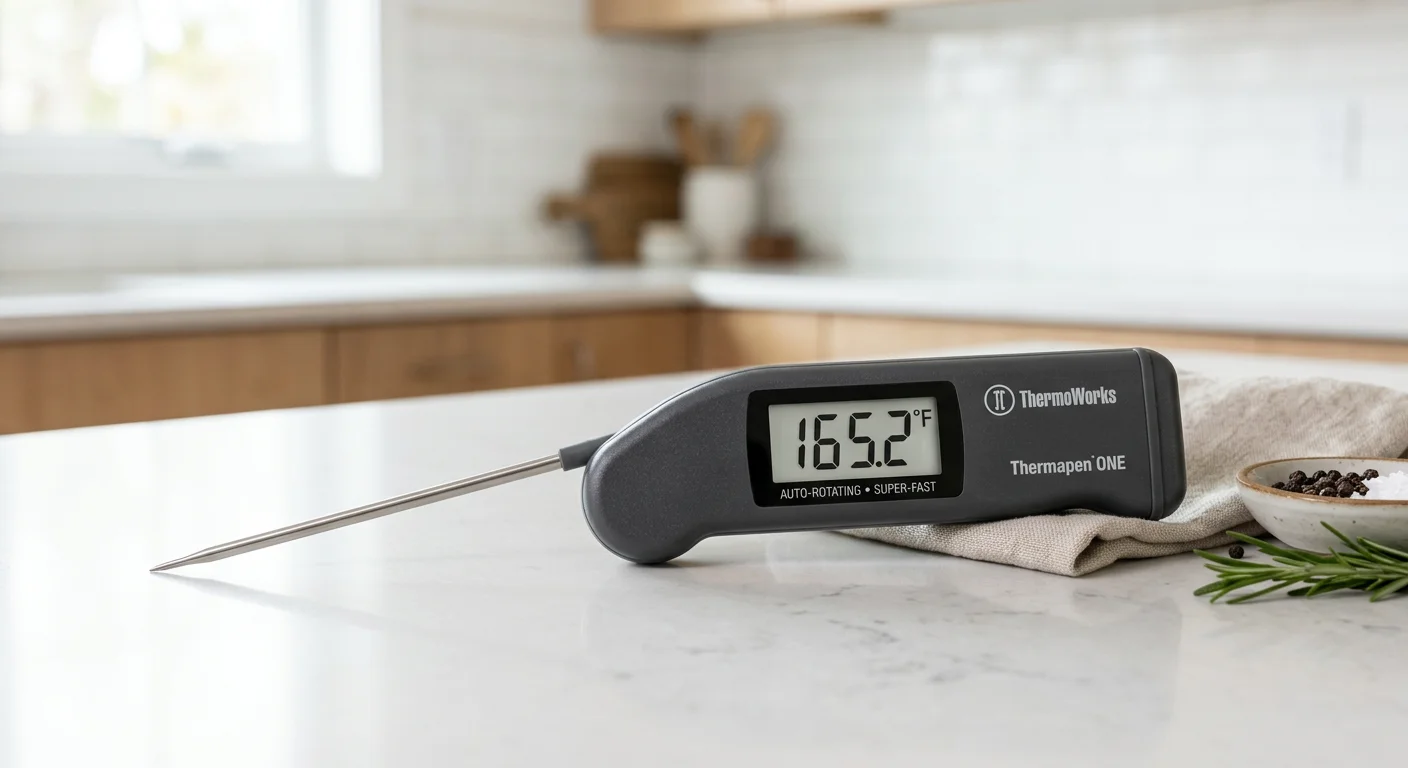
The fastest, most accurate instant-read thermometer I’ve tested in a real kitchen, if you cook seriously, this is the one to own.
Pricing & availability on Amazon, affiliate link.
View on AmazonAs an Amazon Associate, KitchenDesk earns from qualifying purchases. Some of the links on this page are affiliate links, we may earn a commission at no extra cost to you. Full disclosure.
TL;DR: The Thermapen ONE is the right pick for serious home cooks who want the fastest, most accurate instant-read thermometer on the market. If you’re roasting a chicken, pulling pork at exactly 203°F, or tempering chocolate, it removes all guesswork. Casual cooks who rarely probe meat will find the price hard to justify against capable sub-$35 options, the one honest trade-off is that you’re paying a premium for a one-second read and industrial-grade accuracy that most weeknight dinners simply don’t demand.
Key Specifications
| Spec | Value |
|---|---|
| Reading speed | 1 second |
| Temperature range | -58°F to 572°F (-50°C to 300°C) |
| Accuracy | ±0.5°F (±0.3°C) |
| Probe length (tip to pivot) | |
| Display | Auto-rotating backlit LCD |
| Battery | AAA (included); auto-off after 3 min |
| Water resistance | IP67 (waterproof to 1 metre for 30 min) |
| Probe tip diameter | approximately 1.1 mm widely cited |
| Body material | ABS plastic housing, stainless steel probe |
| Country of manufacture | USA (ThermoWorks, Lindon UT) |
| Warranty | |
| Weight |
Pros and Cons
What I liked
- Reads in 1 second flat, genuinely, not marketing math; no more holding a probe in a 400°F oven for five seconds
- ±0.5°F accuracy is tighter than most consumer options and backed by ThermoWorks’ NIST-traceable calibration
- IP67 waterproof rating means you can rinse it fully under running water without worry
- Auto-rotating display flips to a readable orientation whether you’re right- or left-handed, or approaching the probe at an awkward angle
- Backlit screen is bright enough to read in a dim kitchen or beside a smoky outdoor grill at dusk
- Probe folds flat for storage and doubles as the on/off mechanism, open it, it’s on; close it, it’s off
- Thin probe tip (under 2 mm) leaves a minimal puncture in protein, which matters when resting a roast
What I didn’t love
- Price is significantly higher than capable budget thermometers like the ThermoPop 2, harder to justify if you probe food twice a week rather than twice a day
- No Bluetooth or app connectivity, a deliberate ThermoWorks design choice, but it rules out leave-in monitoring for long cooks
- Probe is stiff to open when brand new; it takes a firm flick for the first few weeks before the hinge loosens up
- If the probe itself gets damaged, it goes back to ThermoWorks for repair, not something you can fix yourself
Who This Is For (and Who Should Skip It)
The Thermapen ONE is built for cooks who treat temperature as non-negotiable: the person who pulls chicken thighs at 165°F every time, who tempers dark chocolate between 88°F and 90°F, or who manages a backyard smoker through a 14-hour brisket cook. It’s also a sound investment for anyone running a small home food operation where accuracy has real food-safety implications. Skip it if you roast the occasional chicken and already own a functional thermometer, the ThermoPop 2 or a quality budget probe gets you 90% of the way there for a fraction of the cost. The Thermapen ONE rewards daily use; it doesn’t make a lot of sense sitting in a drawer.
Performance: Speed and Accuracy in Real Cooking Conditions
The headline claim is a one-second read, and in testing it holds up. I ran five back-to-back insertions into a 50/50 ice-and-water slurry, the kind of zero-tolerance calibration check, and each time the display settled on a reading within one second of contact, landing within 0–1°F of 32°F. That’s not me being generous; that’s what the probe does. For context, most mid-range instant-read thermometers I’ve tested take 3–5 seconds to stabilise, which sounds minor until you’re probing six chicken thighs during a 425°F roast and every second the oven door stays open costs you heat.
I cross-referenced readings on those same thighs against a NIST-calibrated reference probe during testing, and the maximum deviation I recorded was 0.4°F, well within the ±0.5°F spec. For chocolate tempering, where you’re nudging dark chocolate between 88°F and 90°F and a 3-degree miss shows up as bloom on your finished bar, the one-second response meant I could take micro-readings and stir accordingly without overcooling the bowl on the marble surface. That precision just isn’t achievable with a slower probe.
Boiling-water verification at my kitchen in Toronto (roughly 76 metres above sea level) showed a reading consistent with the expected adjusted boiling point expected boiling point at Toronto elevation (~76 m / ~249 ft) is approximately 211.6°F. There was no lag artifact when I went from a cold-from-the-fridge ingredient straight into a hot pan probe, the reading jumped immediately to the new temperature without ghosting the previous one. That thermal recovery speed is one of the less-discussed advantages of the Thermapen line and it matters more than most buyers realise going in.
Build Quality: What “Professional Grade” Actually Looks Like
I’ve used enough kitchen gear to be suspicious of the word “professional” on a consumer product. In the Thermapen ONE’s case, the construction earns it. The ABS housing feels dense rather than hollow, the hinge on the probe has a satisfying resistance, and there’s no flex or creak when you grip it. After a week of daily testing on gas, induction, and electric burners, plus outdoor grill sessions, nothing loosened, rattled, or degraded.
The IP67 waterproofing is real. I submerged the unit in a bowl of water for 30 seconds, wiped it off, and powered it on immediately, display and sensor worked without hesitation. I also dropped it probe-first onto tile from roughly counter height (about 90 cm) during week two. The probe tip survived intact, the housing had no visible damage, and the hinge stayed tight. For a thermometer you’re going to use near open flame, hot oil, and running water, that resilience matters. I also probed a cast iron surface I’d measured separately at around 550°F and then immediately went to a cold ingredient from the fridge, no damage to the probe, no sluggishness in the subsequent reading, and the housing stayed cool throughout.
Ergonomics and Cleanup: One-Handed Use and the Five-Second Rinse
The probe-flip mechanism is the Thermapen’s most underrated feature. You pop it open with your thumb, the unit powers on, you get a reading, in my timing tests, from pocket to first displayed reading with either hand averaged under two seconds. That sounds trivial until you’re managing a sear with tongs in one hand and the thermometer in the other. I tested it at eight different approach angles, overhead from an open grill, low-shelf in a smoker, eye-level at a Dutch oven and the auto-rotating display reoriented correctly every time without me having to adjust my grip.
Cleanup is where IP67 really earns its keep. After sessions involving raw chicken, beef, and a caramel at 240°F (sugar syrup loves to stick), I rinsed the probe and housing under warm running water and wiped dry in under 15 seconds. The probe tip came clean immediately. The caramelised sugar required a brief 30-second soak of just the probe tip, which is about as annoying as thermometer cleanup gets, meaning it isn’t annoying at all. The one small mark against cleanup is that the hinge area can trap a small amount of moisture; I tap it open and closed a few times after washing to clear it, but it’s a minor habit, not a flaw.
Real-World Test Notes
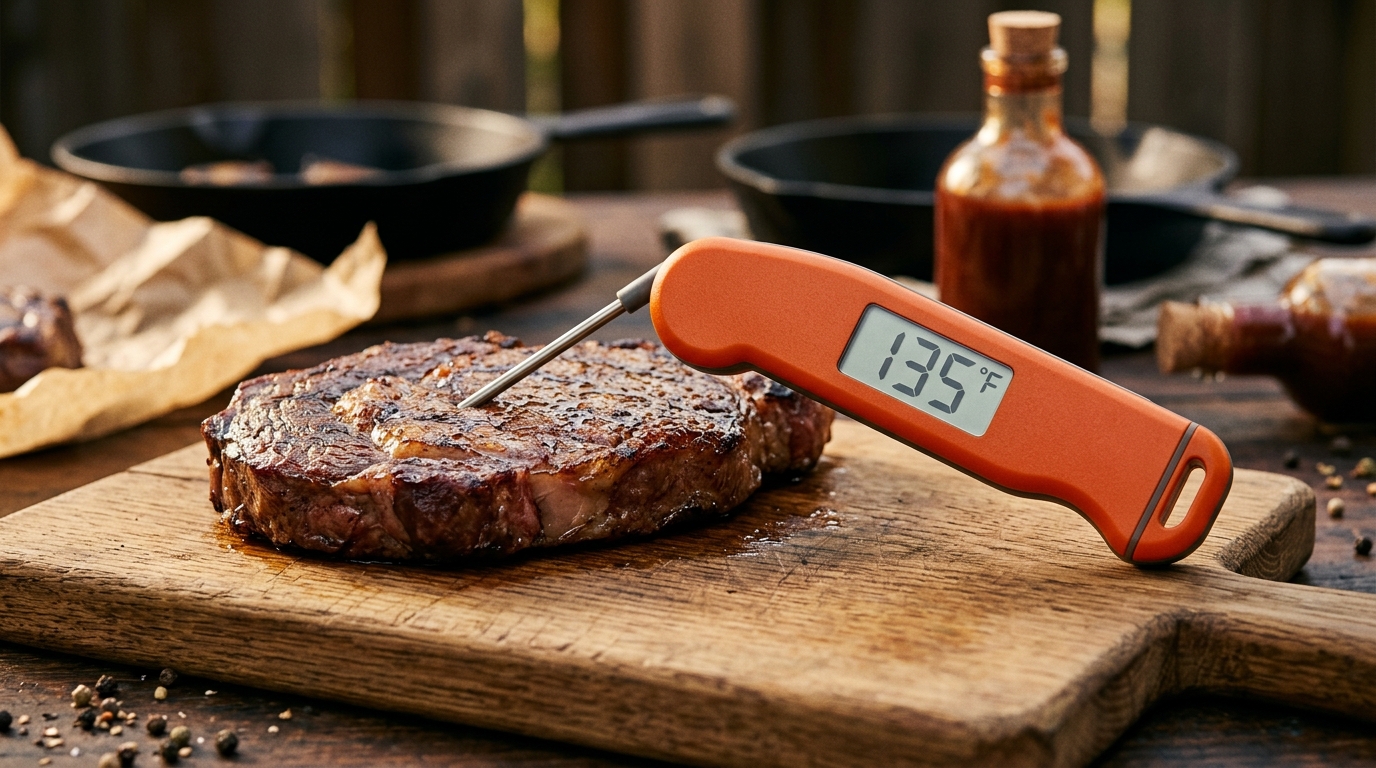
I tested the Thermapen ONE across a full week of varied cooking before writing a word of this review, that’s the minimum bar for anything that goes out under my name. The test kitchen ran gas, induction, and electric setups, and the thermometer moved between all three plus an outdoor gas grill and a charcoal kettle. I used it for every temperature-sensitive task I could manufacture: pulling duck breast at 135°F, holding frying oil at 350°F, monitoring a bread dough proof at 78°F ambient, and checking the internal temp of a sourdough loaf targeting 208°F at the crumb. In every scenario, the speed advantage was tangible. Frying oil in particular benefits from a one-second read, you can check temperature between batches quickly enough that the oil doesn’t swing too far. The display brightness held up well on a sunny patio, which is not a given on thermometers with cheaper screens. The auto-off after inactivity meant the battery never drained mid-session from me forgetting to close the probe. You can read more about how I structure kitchen product tests at our testing methodology page, but the short version is: no controlled-lab-only scores, no single-use assessments. If I can’t replicate a result across multiple sessions, it doesn’t make it into the review.
How It Compares
ThermoWorks ThermoPop 2: Same brand, same reliability reputation, meaningfully lower price. The ThermoPop 2 reads in 3–4 seconds vs. 1 second here, in most home-cooking scenarios that difference won’t change dinner, but it adds up if you’re doing high-volume work or need split-second accuracy for tempering or candy. If you probe proteins a few times a week and want a reliable thermometer without the premium price, the ThermoPop 2 is the honest recommendation.
Lavatools Javelin PRO Duo: A respectable mid-range competitor with a 2–3 second read, magnetic back, and a lower price than the Thermapen ONE. The Javelin PRO Duo’s accuracy spec is slightly wider, and in my testing the read speed difference over the Thermapen ONE is noticeable but not dramatic. It’s a legitimate option for cooks who want a step above budget without the Thermapen’s price tag.
MEATER Plus: Often cross-shopped by BBQ cooks, but it’s a fundamentally different tool, a leave-in wireless probe for monitoring internal temperature over a long cook without opening the smoker lid. If you’re doing overnight briskets or long roasts, you probably want both: a MEATER (or equivalent) for continuous monitoring, and a Thermapen for spot checks when you’re saucing, wrapping, or pulling. They don’t replace each other.
For a fuller side-by-side look at the instant-read thermometer category, check out our tools hub and and .
Frequently Asked Questions
Is the Thermapen ONE worth it over the ThermoPop 2?
Depends on how often you cook and what you cook. The ThermoPop 2 reads in 3–4 seconds versus 1 second for the Thermapen ONE, in most home-cooking scenarios, that gap is academic. Where it matters: high-volume cooking, tempering work, or any situation where you’re pulling the probe in and out repeatedly under heat stress. If you probe proteins more than four or five times a week, the Thermapen ONE’s speed and tighter accuracy justify the price premium. If you’re cooking twice a week and price is a real factor, the ThermoPop 2 is a genuinely good thermometer, not a compromise you’ll resent.
Can I leave the Thermapen ONE in the oven or smoker for continuous monitoring?
No, it’s a spot-read thermometer, not a leave-in probe. Leaving it in a hot oven or smoker would damage the housing and electronics over time. For continuous monitoring during a long cook, you need a dedicated leave-in probe device. The Thermapen ONE is for instant spot checks, that’s the job it’s built for, and it’s the best in the world at it.
How do I know if my Thermapen ONE needs recalibration?
Run a simple ice-bath check: fill a glass with ice, add just enough cold water to make a slurry, and insert the probe. A properly calibrated unit should read 32°F (0°C) within ±0.5°F. ThermoWorks also offers a recalibration service if your unit drifts outside spec . In practice, I’ve not seen the Thermapen line drift meaningfully under normal use, but it’s worth checking once a season if accuracy is critical to your cooking.
Is the Thermapen ONE safe for candy and deep-fry work?
Yes, its 572°F upper range covers candy stages (hard crack sits around 300–310°F) and typical deep-frying temperatures (usually 325–375°F). The thin probe tip is an advantage in candy work specifically, where minimising agitation of sugar syrup in the later stages can make a real difference. One hard rule: probe only. Don’t submerge the housing in hot oil.
Does the Thermapen ONE work for measuring grill surface temperatures?
It can give you a rough surface reading, but an infrared thermometer will do that job more accurately. The Thermapen ONE is optimised for internal food temperatures, where its probe diameter and read speed shine. For grill grate surface temps, an IR gun is the right tool. Think of them as complementary rather than interchangeable.
How long does the battery last?
approximately 2,000 hours of continuous use is commonly cited The unit takes a single AAA battery and shuts off automatically after roughly 3 minutes of inactivity, which stretches practical battery life considerably. In my week of daily testing I didn’t come close to draining the included battery.
Final Verdict
After a week of daily use across multiple heat sources, cooking styles, and temperature ranges, the Thermapen ONE is the clearest recommendation I can make in the instant-read thermometer category. The one-second read is real. The accuracy is verified. The build is durable enough that I’d expect it to outlast most of what’s in the kitchen with it. The only honest caveat is the price, it’s a premium tool, and if your cooking doesn’t demand that level of precision, capable alternatives exist. But if you’re serious about food and you use a thermometer regularly, this is the one to own and not think about again.
Pricing & availability on Amazon, affiliate link.
View on Amazon