

On this page
We may earn a commission from links on this page. Specs are verified from manufacturer/retailer listings (June 2026); first-hand notes are from our own hands-on testing where stated.
If you’re choosing a high-end blender, it almost always comes down to these three. The short version: Vitamix and Blendtec are the two premium workhorses, and Ninja is the budget pick that holds its own for everyday smoothies. The right answer depends entirely on what you actually blend, how often, and how much counter space and quiet you can spare.
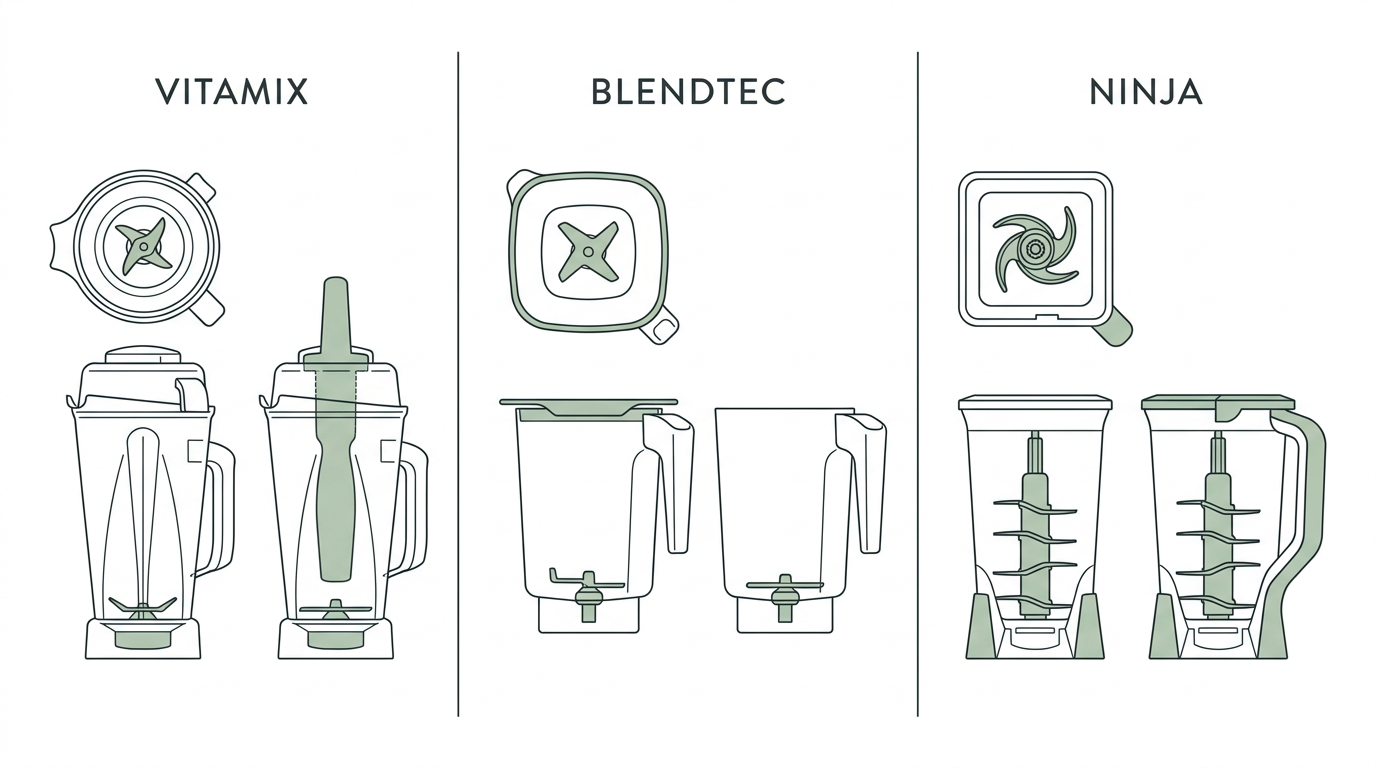
The real difference (it’s not just power)
All three have more than enough motor for daily blending. Chasing “peak horsepower” numbers is mostly marketing, because peak figures describe a single unloaded burst, not sustained blending under a heavy load. What actually separates them is more practical:
- Durability and warranty. This is the big one. Vitamix and Blendtec carry 7-to-8-year warranties and are built to run daily for a decade. Ninja’s is around 1 year, a different longevity class, and that gap is reflected in the price you pay up front.
- How you control the blend. Vitamix uses a variable speed dial for hands-on control, so you can ride the texture from a coarse salsa to a silky purée. Blendtec leans on pre-programmed cycles (push a button, walk away). Ninja gives you presets plus pulse.
- Thick-blend handling. Vitamix includes a tamper to push dense mixes like nut butter into the blades while it runs. Blendtec skips the tamper and uses a tall, wide WildSide jar that folds ingredients back down on its own. Ninja’s stacked blades crush ice well but tend to cavitate (spin an air pocket) on very thick blends.
What two weeks with the Vitamix actually showed
We ran the Vitamix 5200 for two full weeks of daily use in a real kitchen on a standard household circuit, across smoothies, two nut-butter batches, three soup blends, hummus and a couple of chunky-salsa runs. The full write-up is in our Vitamix 5200 review; the findings that matter most to this comparison:
- It handles the hard jobs. A frozen mango, spinach, banana and almond-milk smoothie came out fully smooth with no detectable fibre strands. Two cups of dry-roasted peanuts (no added oil) became nut butter without the motor straining or tripping thermal cutoff. That last test is exactly where budget motors fail, and it’s the strongest argument for paying up.
- It survives sustained load. We deliberately ran three back-to-back full-container blends at high speed, around 60 seconds each, to provoke the thermal protection. It never cut out. For anyone batch-cooking on a Sunday, that matters more than a headline horsepower figure.
- The variable dial earns its keep on texture. A chunky salsa (Roma tomatoes, onion, jalapeño, cilantro) held a genuinely rustic texture at a low speed with a few short pulses, while the same machine took soups completely smooth at the top of the dial. That range is the practical case for hands-on control over push-button presets.
- Hot soup with no stovetop. Run long enough at high speed, blade friction heated a room-temperature soup to steaming. Useful, and a reminder that this class of blender does jobs a cheap one simply can’t.
- Stains and smells didn’t stick. After repeated turmeric and garlic blends we saw no lasting staining and no retained odour in the container.
- Cleanup is good, not magic. A warm-water-and-soap self-clean run (about 30 seconds on high) cleared a turmeric smoothie completely, but left a faint film near the blade base after the nut-butter run. That’s still faster than scrubbing any blender by hand after nut butter.
- The honest downsides. At high speed it was clearly louder than a stand mixer and carried through a standard interior wall. The tall 64 oz jar would not clear standard upper-cabinet clearance with the lid on, so you’ll store it out or remove the lid every time. And one-handed pouring at full volume isn’t really practical, which matters when you’re ladling soup solo.
We haven’t bench-tested the Blendtec or Ninja the same way, so we won’t pretend to first-hand verdicts on those. Their strengths and limits below are drawn from verified specs and design, and we say so where that’s the case.
Spec comparison (verified June 2026)
| Vitamix 5200 | Blendtec (Total / Signature) | Ninja Professional | |
|---|---|---|---|
| Motor | 1380 W (~2.0 peak HP) | ~1560-2400 W (3.0+ peak HP) | ~1000-1600 W |
| Jar | 64 oz, tall & narrow | 75-90 oz WildSide, wide | 72 oz (64 oz max liquid) |
| Blade | Single low-profile (sharp) | Single blunt (safer to clean) | Stacked blade tower |
| Speed control | Variable dial + pulse | Pre-programmed cycles + pulse | Presets + pulse |
| Tamper included | ✓ | ✗ (tall jar instead) | ✗ |
| Warranty | 7 years | 7-8 years | ~1 year |
| Footprint note | Tall, watch cabinet clearance | Wide, shorter than Vitamix | Most compact options |
| Tier | Premium | Premium | Budget |
Figures from manufacturer/retailer listings, June 2026. Wattage varies by exact model within the Blendtec and Ninja lineups.
Match the blender to what you actually make
The “best” blender is the one that fits your most common job. Here’s how the three line up by use case:
- Daily smoothies and protein shakes. All three do this well. If it’s genuinely all you make, the Ninja saves real money. If you want it silky every time with fibrous greens, the Vitamix’s power delivery is the most consistent.
- Nut butters, hummus and thick dips. This is premium territory. The Vitamix tamper (proven in our testing) and the Blendtec’s tall jar are both built for it; the Ninja will get there in small batches but works harder.
- Hot soup from raw ingredients. Vitamix and Blendtec can friction-heat soup to steaming. The Ninja isn’t designed for that, so it stays a cold-blending tool.
- Frozen drinks and crushed ice. The Ninja’s stacked blades are genuinely strong here, which is why it’s a favourite for frozen cocktails at its price.
- Big batches. Blendtec’s 75-90 oz WildSide jar is the largest; Vitamix’s 64 oz is ample for a family; the Ninja’s usable liquid volume is the smallest of the three.
- Small kitchens. Measure first. The Vitamix is tall (a real cabinet-clearance issue we hit), Blendtec is wide but shorter, and the Ninja has the most compact options.
What each one is bad at (the honest limits)
- Vitamix 5200: tall enough to fight your cabinets, noticeably loud, and priced at the top. The dial is manual, so there are no one-touch programs if you prefer set-and-forget.
- Blendtec: no tamper means very thick single-serve blends can cavitate and need a scrape-and-restart; the wide jar eats counter width; touchscreen models climb in price.
- Ninja: the roughly 1-year warranty is the headline limit, the stacked blade tower is fiddlier (and a nick risk) to clean around, and it isn’t built for daily hot-soup or heavy nut-butter duty the way the other two are.
Which should you buy?
Buy the Vitamix 5200 if you want one do-everything blender for the next decade. In our testing the variable dial plus tamper gave the most control for nut butters and thick frozen blends, and it shrugged off sustained back-to-back use. Just plan for its height and noise. Full notes in our Vitamix 5200 review.
Buy a Blendtec if you want push-button convenience and raw power with the biggest jar. The pre-programmed cycles and blunt, easy-clean blade suit people who’d rather press a button than work a dial, and the wide WildSide jar removes the need for a tamper.
Buy a Ninja if budget is the priority and you mostly make smoothies, frozen drinks and crushed ice, where its stacked blades do well for a fraction of the price. Just go in knowing the warranty puts it in a different durability class. Compare options in our best blenders guide.
And if your routine is genuinely just one daily smoothie of soft fruit and protein powder, none of these is mandatory; a good single-serve blender will do that one job for far less. The premium machines start earning their cost the moment you add nut butter, fibrous greens, hot soup or texture control.
FAQ
Is a Ninja as good as a Vitamix? For smoothies and crushing ice it’s close, and far cheaper. For daily heavy use, hot soup, nut butters and longevity, the Vitamix wins on power delivery and its 7-year warranty.
Blendtec or Vitamix? Both are premium and both last. Choose Blendtec for push-button cycles, the biggest jar and a no-tamper workflow; choose Vitamix for variable hands-on control and the included tamper.
Do you really need a tamper? For thick blends, yes. In our Vitamix testing it was the difference between a smooth nut butter and a stalled motor. Vitamix includes one, Blendtec’s tall jar compensates, and with a Ninja you’ll work in smaller batches.
Can you make hot soup directly in these blenders? In the Vitamix, yes; blade friction at high speed heated a room-temperature soup to steaming in our testing. Blendtec can do the same by design. The Ninja is not built for it.
Is the noise a dealbreaker? On any of these high-power blenders, no, but it’s real. Our Vitamix ran clearly louder than a stand mixer and carried through an interior wall, so blend before the house is asleep.
Will the Vitamix fit under my cabinets? Often not with the lid on. The tall 64 oz jar exceeded standard upper-cabinet clearance in our kitchen, so measure your gap before buying or plan to store it on the counter.