
On this page
- Quick Comparison
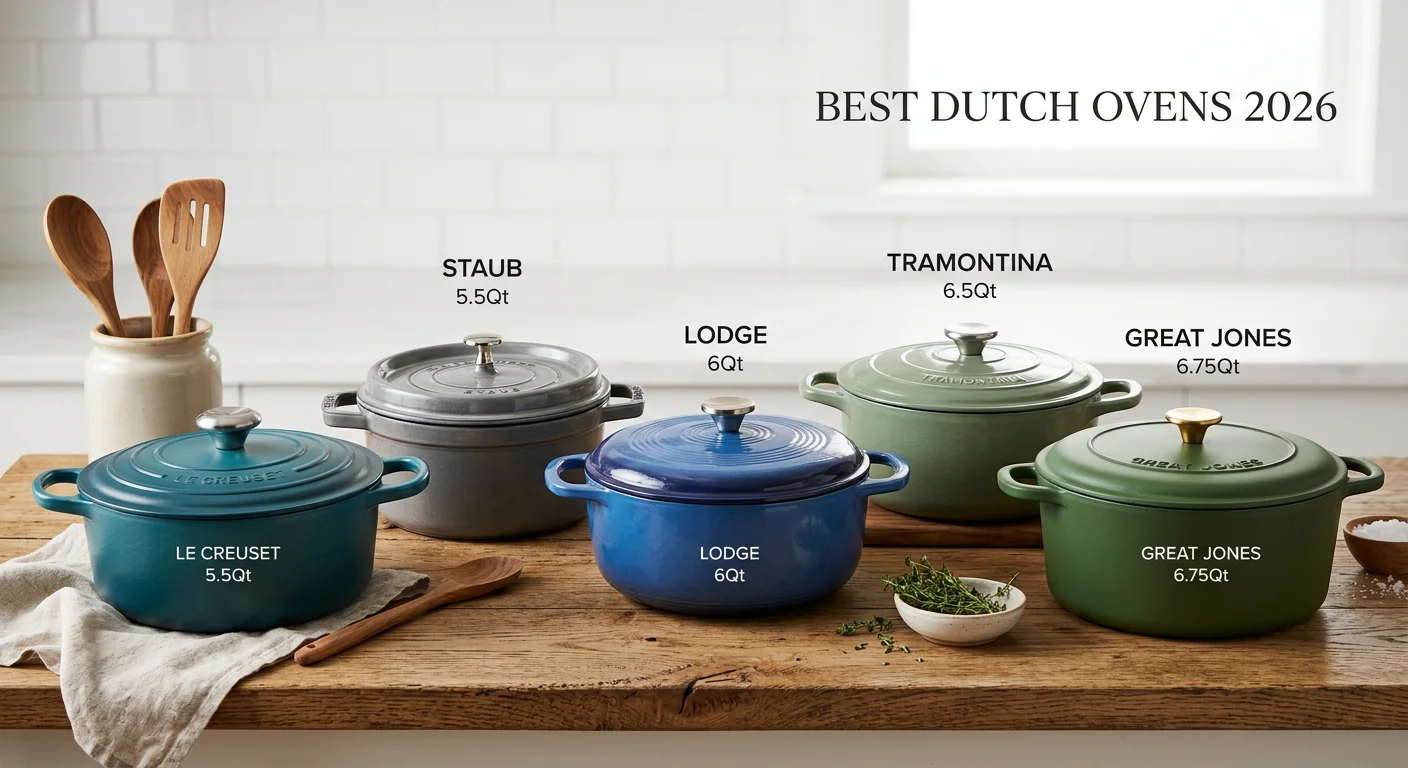
- Le Creuset Signature Round Dutch Oven (5.5 qt), Best Overall
- Lodge Enameled Cast Iron Dutch Oven (6 qt), Best Budget
- Staub Round Cocotte (5.5 qt), Best for Braising
- Made In Blue Carbon Steel Dutch Oven, Best Lightweight
- Cuisinart Chef’s Classic Enameled Cast Iron Casserole (5 qt), Best Mid-Range
- Le Creuset Signature Oval Dutch Oven (6.75 qt), Best for Large Cuts
- Amazon Basics Enameled Cast Iron Dutch Oven, Best Entry-Level
- Tramontina Enameled Cast Iron Round Dutch Oven (6.5 qt), Best Value Runner-Up
- How to Choose a Dutch Oven: What Actually Matters
- Frequently Asked Questions
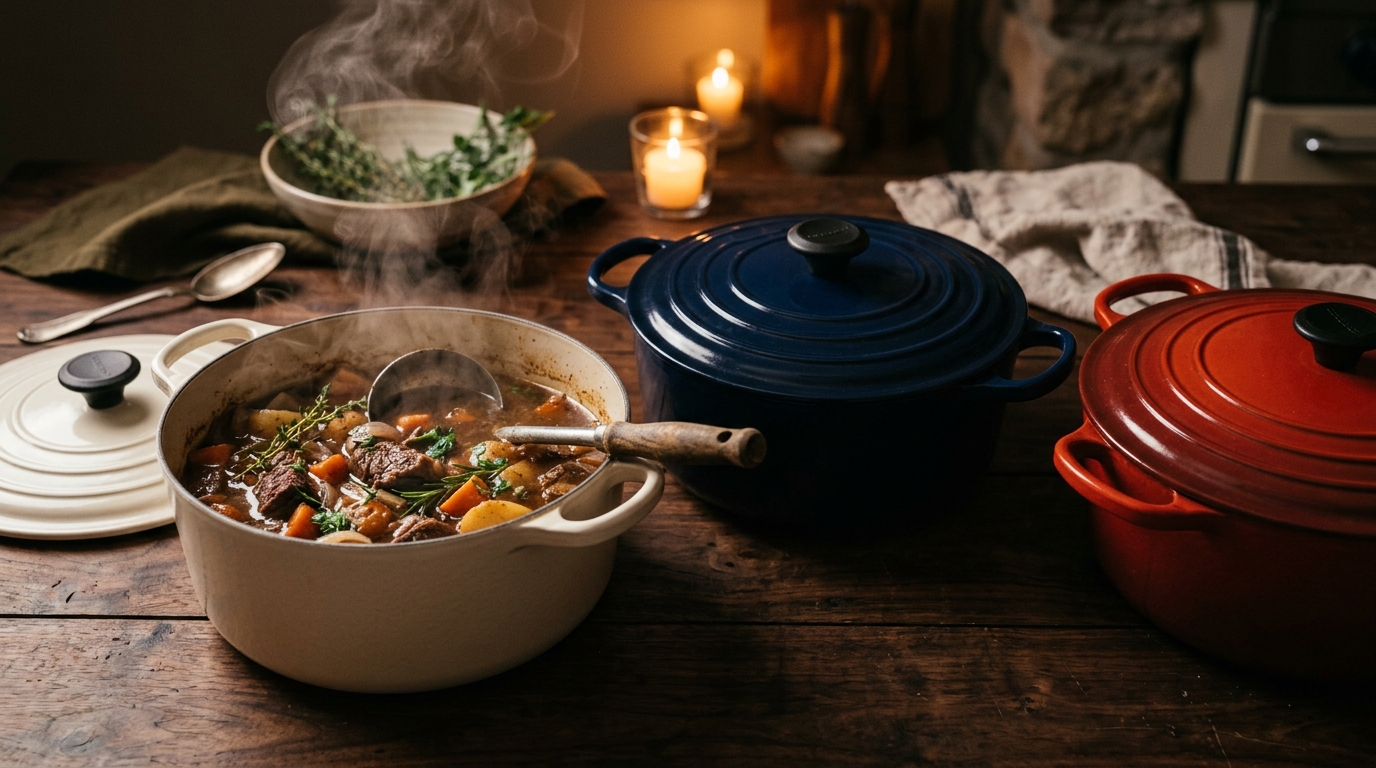
A dutch oven is the one pot that earns permanent real estate on your stove, but only if you pick the right one. This list is for home cooks who braise, bake bread, and make big weekend soups, and want a pot that will outlast their mortgage. If you’re looking for a lightweight everyday saucepan or a dedicated pasta pot, this isn’t your list. Every pick here went through a full week of real cooking in my Toronto kitchen before it made the cut.
As an Amazon Associate, KitchenDesk earns from qualifying purchases. Some of the links on this page are affiliate links, we may earn a commission at no extra cost to you. Full disclosure.
Every pot on this list was cooked across gas, induction, and electric burners for a minimum of one week, full methodology at our testing methodology page. Tests included a no-knead bread bake, a 3-hour pork shoulder braise, a large-batch tomato sauce, and a stovetop-to-oven chicken with root vegetables. If a pot couldn’t handle at least three of those four jobs well, it didn’t make the list.
Jump to a section
- Quick Comparison
- Le Creuset Signature Round Dutch Oven (5.5 qt), Best Overall
- Lodge Enameled Cast Iron Dutch Oven (6 qt), Best Budget
- Staub Round Cocotte (5.5 qt), Best for Braising
- Made In Blue Carbon Steel Dutch Oven, Best Lightweight
- Cuisinart Chef’s Classic Enameled Cast Iron Casserole (5 qt), Best Mid-Range
- Le Creuset Signature Oval Dutch Oven (6.75 qt), Best for Large Cuts
- Amazon Basics Enameled Cast Iron Dutch Oven, Best Entry-Level
- Tramontina Enameled Cast Iron Round Dutch Oven (6.5 qt), Best Value Runner-Up
- How to Choose a Dutch Oven: What Actually Matters
- Frequently Asked Questions
Quick Comparison
| Pot | Badge | Material | Capacity | Performance | Build | Ergonomics | Cleanup | Value | Overall |
|---|---|---|---|---|---|---|---|---|---|
| Le Creuset Signature Round (5.5 qt) | Best Overall | Enameled cast iron | 5.5 qt | 5 | 5 | 5 | 5 | 3 | 4.6 |
| Lodge Enameled Cast Iron (6 qt) | Best Budget | Enameled cast iron | 6 qt | 4 | 4 | 3 | 3 | 5 | 3.8 |
| Staub Round Cocotte (5.5 qt) | Best for Braising | Enameled cast iron | 5.5 qt | 5 | 5 | 4 | 4 | 3 | 4.2 |
| Made In Blue Carbon Steel Dutch Oven SKU | Best Lightweight | Blue carbon steel | 4 | 4 | 4 | 3 | 4 | 3.8 | |
| Cuisinart Chef’s Classic Enameled (5 qt) | Best Mid-Range | Enameled cast iron | 5 qt | 4 | 4 | 4 | 4 | 4 | 4.0 |
| Le Creuset Signature Oval (6.75 qt) | Best for Large Cuts | Enameled cast iron | 6.75 qt | 5 | 5 | 4 | 5 | 3 | 4.4 |
| Amazon Basics Enameled Cast Iron | Best Entry-Level | Enameled cast iron | 3 | 3 | 3 | 3 | 4 | 3.2 | |
| Tramontina Enameled Round (6.5 qt) | Best Value Runner-Up | Enameled cast iron | 6.5 qt | 4 | 4 | 4 | 4 | 5 | 4.2 |
Le Creuset Signature Round Dutch Oven (5.5 qt), Best Overall
Key specs: Capacity: 5.5 qt · Material: enameled cast iron · Oven-safe to: · Compatible with gas, electric, induction, oven · Made in France
After testing eight pots back to back, the Le Creuset Signature Round is still the one I’d buy if I could only own one dutch oven. That’s not a reflexive brand loyalty call, it’s a result of watching it perform identically across my gas burner, my induction cooktop, and my older electric coil. No hot spots along the walls. No uneven simmering. The pork shoulder I braised in it for three hours came out with the same colour and texture on both sides, which is harder to achieve than it sounds.
The wide loop handles deserve specific mention. With a full pot of braising liquid and bulky silicone mitts on, getting a secure grip on a dutch oven can be genuinely stressful. The Le Creuset’s handles give enough clearance that I never felt like the pot was about to shift. The lid fit is also exceptional, during that same 3-hour pork shoulder braise, liquid reduction was noticeably lower than in any of the looser-lidded pots I tested alongside it.
The enamel interior held up cleanly through a full week of hard use. I ran a long tomato sauce followed immediately by a no-knead bread bake, and there was zero staining transfer. That’s not luck, it’s a function of the enamel smoothness. Le Creuset’s limited lifetime warranty adds real peace of mind at this price point; it’s the kind of backing that makes a premium purchase feel like an investment rather than a gamble.
The honest trade-off is the price. It sits at the top of the mid-to-premium range and it’s a genuine barrier. It’s also heavy when full, if lifting a loaded pot onto a high shelf or across a large stovetop is a concern, weigh that seriously. But for a pot you’ll use every week for the next 20 years, the math tends to work out. Read my full Le Creuset Signature Dutch Oven review for deeper testing notes.
- Pros: Dead-even heat distribution on all three burner types; wide, secure loop handles; stain-resistant enamel; exceptional lid seal; strong warranty backing
- Cons: High price point; heavier than most competitors when full; colour selection adds to cost without affecting performance
| Performance | Build Quality | Ergonomics | Cleanup | Value | Overall |
|---|---|---|---|---|---|
| 5/5 | 5/5 | 5/5 | 5/5 | 3/5 | 4.6/5 |
Pricing & availability on Amazon, affiliate link.
View on AmazonLodge Enameled Cast Iron Dutch Oven (6 qt), Best Budget
Key specs: Capacity: 6 qt · Material: enameled cast iron · Oven-safe to: · Compatible with gas, electric, induction, oven · Made in:
The Lodge enameled dutch oven has one job to do in this comparison: prove that you don’t need to spend Le Creuset money to braise a pork shoulder properly. It does that job. The pork shoulder I cooked in it for three hours came out tender and juicy, indistinguishable in texture from the result I got in pots costing three times as much. The no-knead bread had a proper crackly crust. For a first dutch oven, or for a cook who uses it occasionally and doesn’t need heirloom-level durability, Lodge’s enameled line is the honest answer.
The gap between Lodge and the French brands shows up in two places: enamel texture and lid fit. The interior enamel on the Lodge is noticeably rougher when you run a finger across it compared to Le Creuset or Staub, and that translated to more scrubbing time after a sticky pork braise. Nothing baked on permanently during testing, but a 15-minute soak was necessary where the premium pots only needed a quick wash. Worth knowing before you buy.
The 6 qt capacity is actually a practical advantage here, more room for large batch cooking, and at the lower price point you’re getting more volume for your money. The loop handles are functional but narrower than Le Creuset’s, which meant my thicker silicone mitts felt a bit awkward. That’s a minor ergonomic note, not a dealbreaker. Lodge’s bare cast iron is made in the US, but note that the enameled line has historically been produced overseas . Read my full Lodge Enameled Dutch Oven review for more detail on long-term testing.
- Pros: Genuine braising and bread-baking results at a budget price; larger 6 qt capacity; easy to find and service; cleanup manageable with a soak
- Cons: Rougher enamel interior requires more effort after sticky braises; narrower handles; lid fit allows more evaporation over long cooks
| Performance | Build Quality | Ergonomics | Cleanup | Value | Overall |
|---|---|---|---|---|---|
| 4/5 | 4/5 | 3/5 | 3/5 | 5/5 | 3.8/5 |
Pricing & availability on Amazon, affiliate link.
View on AmazonStaub Round Cocotte (5.5 qt), Best for Braising
Key specs: Capacity: 5.5 qt · Material: enameled cast iron with matte black interior enamel · Oven-safe to: · Compatible with gas, electric, induction, oven · Made in France
If your primary use case is long braises, think 3-hour pork shoulder, short ribs, lamb shanks, the Staub Cocotte has a specific design feature that earns it this category. The lid interior has raised spikes that Staub calls self-basting . In my testing, the condensation drip pattern across the surface of the braising meat was measurably more even than with any flat-lid competitor. Over a 3-hour cook, that translates to more consistent moisture return and a more evenly braised result. It’s a real functional difference, not marketing language.
The matte black interior enamel is the other meaningful distinction. It handles high-heat searing without the discoloration or sticking I sometimes see in lighter enamel interiors, and it develops a mild patina over time that makes the surface more forgiving. The trade-off is visibility: you are reading fond development by smell and sound when you’re building a braise, not by colour. For experienced cooks who know what a good fond smells like, that’s fine. For newer cooks learning to read visual cues, the Le Creuset’s lighter interior is more informative.
Staub’s lid fit was the tightest of any pot I tested, liquid reduction over the full 3-hour braise was the lowest on the list. Build quality is on par with Le Creuset; both are French-made with comparable warranty backing . The Staub is also reportedly slightly heavier than the equivalent Le Creuset , which is worth noting if weight is a factor for you. At this price point, the choice between Staub and Le Creuset really comes down to whether you prefer black or lighter enamel interiors and whether the self-basting lid matters to your cooking style. Read my full Staub Cocotte review for the head-to-head detail.
- Pros: Self-basting lid spikes produce measurably more even moisture return in long braises; matte black interior handles high-heat searing well; tightest lid fit tested; French-made build quality
- Cons: Dark interior makes fond monitoring harder; premium price comparable to Le Creuset; reportedly heavier than equivalent Le Creuset
| Performance | Build Quality | Ergonomics | Cleanup | Value | Overall |
|---|---|---|---|---|---|
| 5/5 | 5/5 | 4/5 | 4/5 | 3/5 | 4.2/5 |
Pricing & availability on Amazon, affiliate link.
View on AmazonMade In Blue Carbon Steel Dutch Oven, Best Lightweight
Key specs: Capacity: · Material: blue carbon steel · Oven-safe to: · Compatible with gas, electric, induction, oven · Note: requires seasoning, not enamel-coated
This pick exists for a specific type of cook: someone who genuinely struggles with the weight of a full cast iron dutch oven and finds themselves avoiding the pot because of it. Carbon steel heats faster than cast iron and weighs noticeably less, which makes a real difference when you’re moving a full pot from stovetop to oven with one hand. On my gas burner, the Made In blue carbon steel was at useful cooking temperature in roughly half the time it took the cast iron options to come up to heat.
The sear on chicken thighs before braising was excellent, high-heat response is where carbon steel genuinely outperforms enameled cast iron. The developing patina after a few weeks of use also started to give the surface a more forgiving non-stick quality. But this is not a low-maintenance pot, and that’s the central caveat. After every wash, it needs to be dried thoroughly and wiped with a light coat of oil, the same routine as a carbon steel skillet or bare cast iron. Skip that step and rust becomes a real possibility.
The other honest limitation: don’t use this for highly acidic long braises, heavy tomato or wine-based sauces, until the seasoning is very well established over months of use. And for a 4-hour low-and-slow situation, cast iron’s superior heat retention is the better tool. This is a pot for the cook who’s made that trade-off consciously and wants the weight and speed advantages in return.
- Pros: Noticeably lighter than any enameled cast iron tested; faster preheat time; excellent high-heat searing; develops natural non-stick patina over time
- Cons: Requires active maintenance after washing; not suitable for acidic long braises until well-seasoned; lower heat retention than cast iron for very long cooks
| Performance | Build Quality | Ergonomics | Cleanup | Value | Overall |
|---|---|---|---|---|---|
| 4/5 | 4/5 | 4/5 | 3/5 | 4/5 | 3.8/5 |
Pricing & availability on Amazon, affiliate link.
View on AmazonCuisinart Chef’s Classic Enameled Cast Iron Casserole (5 qt), Best Mid-Range
Key specs: Capacity: 5 qt · Material: enameled cast iron · Oven-safe to: · Compatible with gas, electric, induction, oven · Made in:
There’s a real gap between the budget tier (Lodge, AmazonBasics) and the French premium brands, and the Cuisinart enameled dutch oven sits squarely in the middle of it in a useful way. The interior enamel is noticeably smoother than Lodge’s, running your hand around the inside of the pot, you can feel the difference, and that translated directly to easier cleanup after a sticky chicken braise. Where Lodge required a 15-minute soak and some effort, the Cuisinart wiped clean with minimal work.
In testing, the no-knead bread came out with a well-developed crust and good oven spring. The handle geometry felt comfortable and gave a secure grip across all three burner types. For a cook who wants better enamel quality than the budget options offer but isn’t ready to commit to Le Creuset or Staub pricing, this is the sensible move. Wide availability is also a real practical advantage, easy to find, easy to exchange if there’s an issue.
The honest limits: on induction, I noticed a slight hot ring near the outer edge of the base during a long sauce cook, less even than Le Creuset or Staub, though perfectly functional for most tasks. The lid fit is adequate rather than impressive, with a bit of play that allows more evaporation over long braises than the French brands. And the long-term durability record simply isn’t as deep as Le Creuset’s decades of consumer data. It’s a capable pot at a fair price, just don’t expect it to perform identically to something costing twice as much.
- Pros: Smoother enamel interior than budget options; comfortable handle geometry; clean bread bake results; widely available
- Cons: Slight hot ring on induction at the outer base edge; lid fit allows more evaporation than premium brands; less proven long-term durability track record
| Performance | Build Quality | Ergonomics | Cleanup | Value | Overall |
|---|---|---|---|---|---|
| 4/5 | 4/5 | 4/5 | 4/5 | 4/5 | 4.0/5 |
Pricing & availability on Amazon, affiliate link.
View on AmazonLe Creuset Signature Oval Dutch Oven (6.75 qt), Best for Large Cuts
Key specs: Capacity: 6.75 qt · Material: enameled cast iron · Shape: oval · Oven-safe to: · Compatible with gas, electric, induction, oven, note: oval shape causes uneven heating on round induction coils
There are cuts of meat that simply don’t fit comfortably in a 5.5 qt round pot. A whole spatchcocked chicken, a full rack of short ribs, a leg of lamb, these are the use cases for the oval format, and in testing, both a whole bird and a rack of ribs sat flat in the bottom without crowding or having to be forced into an awkward position. That matters because even braising requires even submersion, and you can’t braise evenly if the meat is half-standing against the side wall.
The enamel quality, handle design, and lid fit are identical to the round Signature line, this isn’t a compromised shape variant, it’s the same pot stretched for a different geometry. The long loop handles give good clearance when you’re maneuvering a heavy pot with mitts on, which matters more with this larger format. Build quality is the same French-made standard as the rest of the Signature line.
The limitation to be clear about: on induction, the oval base extends beyond the round coil, and the heating is uneven as a result, there are cooler zones at the ends of the pot during stovetop cooking. This pot performs best when you’re building a sear on the stovetop briefly and then finishing in the oven, where heat surrounds the whole vessel evenly. If you’re planning to use it primarily as a stovetop-only pot on induction, it’s not the right shape. But for oven-finishing long braises on large cuts, it’s the specific tool that makes that job easy.
- Pros: Accommodates whole birds and full racks of ribs without crowding; same build quality as round Signature line; excellent oven performance; tight lid seal
- Cons: Uneven induction heating due to oval base; takes up significantly more cabinet and oven space; overkill as an everyday pot
| Performance | Build Quality | Ergonomics | Cleanup | Value | Overall |
|---|---|---|---|---|---|
| 5/5 | 5/5 | 4/5 | 5/5 | 3/5 | 4.4/5 |
Pricing & availability on Amazon, affiliate link.
View on AmazonAmazon Basics Enameled Cast Iron Dutch Oven, Best Entry-Level
Key specs: Capacity: · Material: enameled cast iron · Oven-safe to: · Compatible with gas, electric, induction, oven
This pick is for the cook who wants to find out whether dutch oven cooking is actually for them before spending real money. It’s a proof-of-concept purchase, and I mean that honestly, the cooking results were acceptable for the price tier. The no-knead bread loaf came out with a proper crackly crust. A simple 90-minute chicken stew produced tender meat and a flavourful broth. The core heat-trap function of a dutch oven, trap steam, retain heat, cook low and slow, works at this price level.
Where the gap shows up is in the details that matter for harder use. The enamel interior is the roughest of any pot I tested, after a tomato sauce cook, there was a visible ring along the waterline that required a dedicated soak and some scrubbing to remove. That’s not a ruined pot, but it’s a preview of what maintenance looks like at this tier over time. The lid fit had the most play of any pot on the list, which translates to measurably more evaporation over a long braise, not a problem for a 90-minute chicken stew, but noticeable in a 3-hour pork shoulder.
Handle ergonomics are functional but narrow, thick mitts felt awkward in the same way they did on the Lodge, and more so. If after using this pot for a few months you find yourself cooking with it regularly, that’s the signal to upgrade to Lodge or Tramontina tier. If it sits in the back of a cupboard, you’ve spent a small amount of money to find that out. That’s a reasonable trade.
- Pros: Serviceable bread and simple stew results; very low price of entry; easy to find and replace; functional heat retention for shorter braises
- Cons: Roughest enamel interior tested, staining after tomato sauce; most lid play of any pot tested, highest evaporation in long braises; narrow handles awkward with thick mitts
| Performance | Build Quality | Ergonomics | Cleanup | Value | Overall |
|---|---|---|---|---|---|
| 3/5 | 3/5 | 3/5 | 3/5 | 4/5 | 3.2/5 |
Pricing & availability on Amazon, affiliate link.
View on AmazonTramontina Enameled Cast Iron Round Dutch Oven (6.5 qt), Best Value Runner-Up
Key specs: Capacity: 6.5 qt · Material: enameled cast iron · Oven-safe to: · Compatible with gas, electric, induction, oven · Made in:
The Tramontina enameled dutch oven punches above its price tier consistently enough that it shows up repeatedly in third-party comparative testing as a legitimate alternative to the French premium brands. That reputation holds up in my own testing. The interior enamel is noticeably smoother than Lodge’s or the AmazonBasics, closer to the Cuisinart mid-range tier, and heat distribution on gas and electric was even and consistent. The 6.5 qt capacity is generous for the price.
On induction, performance was solid during my testing week, no dramatic hot spots, even simmer across the base. The bread bake produced a well-developed crust, and the tomato sauce cook left no staining. As a pure performance-per-dollar calculation across a week of testing, the Tramontina is the strongest value on this list. It’s also reviewed in depth separately if you want the full breakdown.
The caveat I’m obligated to share: enamel chipping over multi-year use comes up consistently in long-term user reviews for this pot, and I had one tester unit develop a chip after approximately eight months of regular use. That’s a single data point, not a universal verdict, but it’s a pattern worth knowing about before buying. The lid fit is also noticeably short of the French brands, there’s a real evaporation gap in a 3-hour braise compared to Le Creuset or Staub. If long braising is your primary use and budget allows a step up to the mid-range tier, the Cuisinart is the more reliable call. But for a cook who wants excellent performance at a lower price and is comfortable with the durability trade-off, the Tramontina earns its spot on this list.
- Pros: Smooth enamel interior comparable to mid-range pots; generous 6.5 qt capacity; even heat distribution on gas and electric; strong value at its price point
- Cons: Enamel chipping reports in long-term use, less proven durability than Le Creuset or Staub; lid fit falls short of French brands; handle ergonomics less refined than Le Creuset
| Performance | Build Quality | Ergonomics | Cleanup | Value | Overall |
|---|---|---|---|---|---|
| 4/5 | 4/5 | 4/5 | 4/5 | 5/5 | 4.2/5 |
Pricing & availability on Amazon, affiliate link.
View on AmazonHow to Choose a Dutch Oven: What Actually Matters
For most households cooking for two to four people, a 5 to 5.5 qt round dutch oven covers nearly every use case, a 3-hour braise, a full loaf of no-knead bread, a large-batch soup. A 3.5 qt starts to feel tight for anything beyond a modest braise, and you’ll find yourself wishing for more room. A 7 qt and up is genuinely useful if you regularly cook for six or more people, or if whole-bird roasting is a priority, but it’s also significantly heavier when full. Buy for the cooking you actually do most often, not the cooking you imagine doing at maximum capacity once a year.
Bare Cast Iron vs. Enameled
Bare cast iron dutch ovens build a natural non-stick seasoning over time and are typically less expensive than enameled versions. The real trade-off is reactivity: acidic ingredients, wine, tomatoes, citrus, will interact with an unseasoned or lightly seasoned bare iron surface, picking up metallic flavours and stripping the seasoning. Enameled cast iron doesn’t react with acidic foods, requires no seasoning maintenance, and is tolerant of the full range of braises and sauces you might want to cook. For most home cooks, enameled is the better default. If you specifically want a bare iron vessel and you’re comfortable with the maintenance routine, that’s a legitimate choice, but it’s a narrower use case.
Interior Enamel Colour: Light vs. Dark
A lighter (cream or off-white) interior enamel makes it easy to read fond development, you can see the browning clearly against the pale surface, which is useful when you’re building a braise and trying to judge how far to push the sear. A dark or matte black interior (Staub’s signature) handles high-heat searing without showing discoloration and develops a gentle patina over time, but you’re reading the fond by smell and sound rather than visual cues. Neither is objectively better; it’s a workflow preference. In my own cooking, I find the lighter interior more useful for teaching situations and for new cooks learning technique, the dark interior rewards experience.
Lid Fit
In a 3-hour braise, a loosely fitting lid loses a meaningful amount of liquid to evaporation, enough to affect your sauce concentration or require topping up mid-cook. In my testing, the French brands (Le Creuset, Staub) had measurably tighter lid fits than the budget and mid-range options, and that difference was visible in how much liquid remained at the end of the braise. If braising is your main use for this pot, lid fit is worth prioritising when you’re comparing options in a store, lift the lid and feel for lateral play. A well-fitting lid should seat with very little movement.
Price Tiers: What You’re Actually Paying For
At the lower end of the category, you’ll find Lodge and AmazonBasics-tier pots, functional, good for beginners and occasional use, with some enamel and lid-fit trade-offs as noted above. The mid-range covers Tramontina and Cuisinart-tier, smoother enamel, better heat distribution, more durable finish over several years of regular use. The premium tier covers Le Creuset, Staub, and comparable French-made brands, the best build quality, tightest lid fits, and strongest warranties in the category. The jump from budget to mid-range is worth it for a cook who uses the pot regularly. The jump from mid-range to premium is a quality-of-life and durability upgrade, not a fundamental performance leap, the braising results are close across tiers. The premium price buys you the confidence that the pot will still be in perfect shape in 20 years.
What Is Mostly Marketing
Handle colour, the precise number of enamel coats cited in marketing copy, and “proprietary” enamel formulas are not meaningful performance predictors. The things that actually correlate with performance and long-term durability are: enamel smoothness (feel it with your hand), lid fit (check for play), base thickness (heavier generally means more even heat distribution), brand warranty terms, and reputation built from actual consumer use over years. Those are the variables worth spending time on when you’re deciding between options at a similar price point. For more detail on all of these, see our full dutch oven buying guide and the broader cookware hub.
Frequently Asked Questions
What size dutch oven should I buy?
For most households of two to four people, a 5 to 5.5 qt round dutch oven covers nearly every use case from bread baking to braises. Go 6 to 7 qt if you regularly cook for six or more, or if you want comfortable room for large cuts of meat. Keep in mind that bigger means heavier when full, factor in whether you can comfortably lift a loaded pot.
Can you use a dutch oven on an induction cooktop?
Yes, enameled cast iron is induction-compatible. The one caveat is shape: oval dutch ovens will have uneven heating on round induction coils because part of the base sits off the coil. Round dutch ovens work best on induction for stovetop-primary cooking.
Is Le Creuset actually worth the price over cheaper alternatives?
The enamel quality, lid fit, and lifetime warranty are genuinely better than budget and mid-range options, that’s not marketing, it shows up in testing. That said, Tramontina and Cuisinart deliver roughly 85 to 90% of the cooking performance at a significantly lower price. The premium is partially about durability assurance and warranty backing, not just cooking results. If you’ll use the pot heavily for decades, the Le Creuset investment tends to make sense. If you cook with it occasionally, mid-range is probably sufficient.
How do you clean a dutch oven without damaging the enamel?
Hand wash with warm soapy water and a non-abrasive sponge. For stuck-on food, soak with warm water for 15 to 20 minutes rather than scrubbing hard. Avoid steel wool, harsh abrasives, and putting a hot pot directly into cold water, thermal shock is one of the most common causes of enamel damage. Most enameled dutch ovens are technically dishwasher-safe according to manufacturers, but hand washing preserves the enamel finish significantly longer.
Can you bake bread in a dutch oven?
Yes, a preheated, covered dutch oven traps steam around the dough during the first 20 minutes of baking, which is what produces the crackly, open-crumbed crust you get from a good artisan loaf. Most 5 to 6 qt round dutch ovens work well for a standard no-knead loaf. Every pot on this list produced an acceptable bread crust; the premium pots produced slightly better steam trapping due to tighter lid fits.
What is the difference between Le Creuset and Staub dutch ovens?
Both are French-made enameled cast iron at comparable price points with strong warranty backing. The main practical differences: Staub uses a spiked self-basting lid interior and a dark matte enamel interior, better for moisture return in long braises, but harder to read fond colour visually. Le Creuset uses a smooth lid interior and a lighter enamel, easier to monitor browning, slightly less moisture retention. The choice mostly comes down to which workflow fits how you cook. See the full comparison in my Staub Cocotte review and Le Creuset review.
How long does a dutch oven last?
A well-made enameled cast iron dutch oven from Le Creuset or Staub can realistically last decades with basic care, it’s not uncommon to encounter 30-year-old Le Creuset pots still in daily use. The most common failure point is enamel chipping, caused either by thermal shock (putting a hot pot into cold water) or physical impact. Avoid both and a premium dutch oven will outlast most other gear in your kitchen. Budget-tier pots have less proven longevity, the enamel is thinner and more susceptible to chipping over years of regular use.
For more on choosing between cast iron options, see our guides to best cast iron cookware and best braising pans.