
On this page
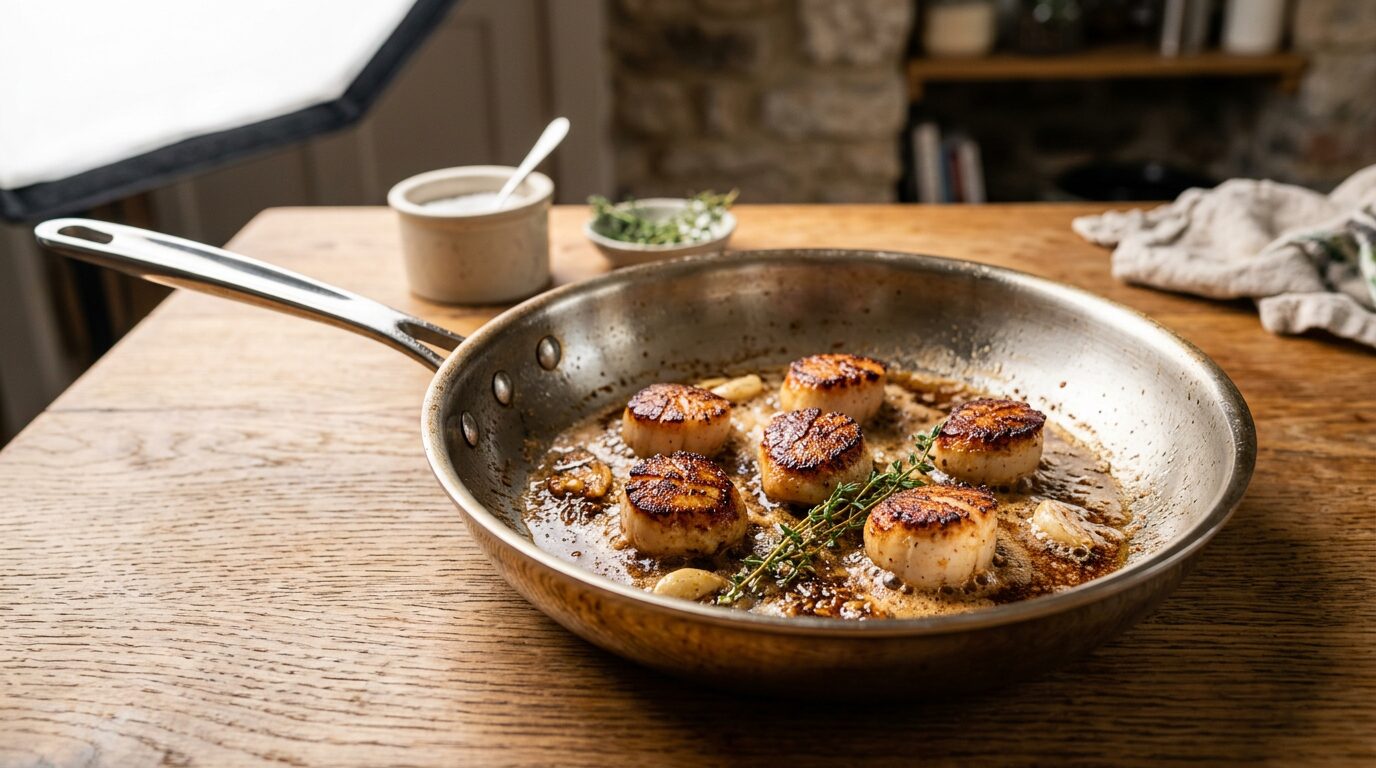
All-Clad D3 Stainless Steel Fry Pan, 12-inch, tested on gas, induction, and electric for one full week.
Pricing & availability on Amazon, affiliate link.
View on AmazonAs an Amazon Associate, KitchenDesk earns from qualifying purchases. Some of the links on this page are affiliate links, we may earn a commission at no extra cost to you. Full disclosure.
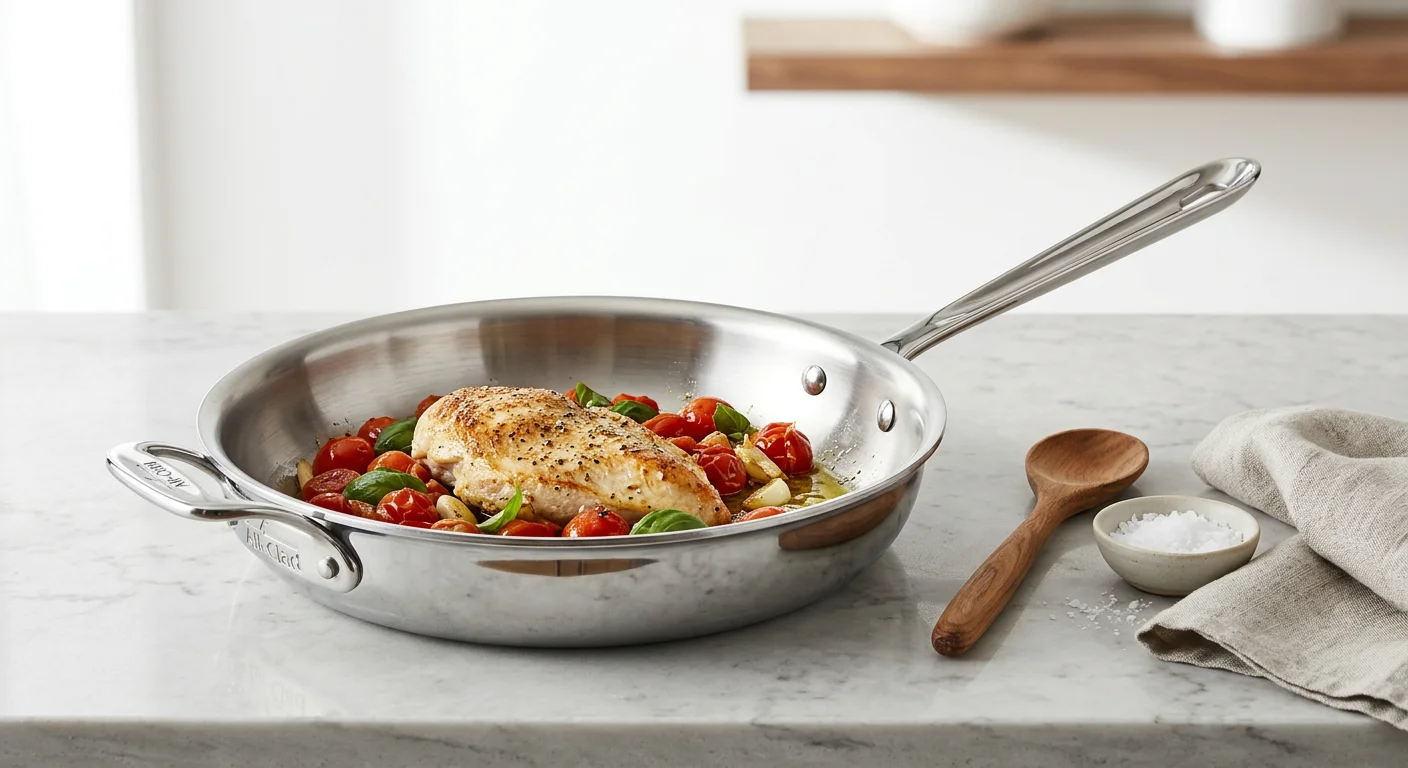
The All-Clad D3 12-inch skillet is built for home cooks who want professional-grade searing and genuinely even heat without babysitting a pan, and it delivers on both counts. It rewards patience and proper preheating. If you cook mostly eggs and delicate fish every day, the learning curve on stainless will frustrate you more than a nonstick or carbon steel alternative would. But if you sear proteins, build pan sauces, and want one pan that moves seamlessly from stovetop to oven, this is one of the most capable pieces of cookware you can buy.
Quick Specs
| Construction | 3-ply fully bonded: 18/10 stainless exterior, pure aluminum core, 18/10 stainless cooking surface |
|---|---|
| Induction compatible | Yes, stainless exterior is magnetic |
| Oven-safe temperature | manufacturer claims oven-safe to 600°F / 315°C |
| Broiler-safe | |
| Dishwasher-safe | Yes, per manufacturer, hand-wash recommended for appearance longevity |
| Handle material | Stainless steel, riveted |
| Lid included | No, sold separately |
| Country of manufacture | USA (Canonsburg, PA) |
| Warranty | |
| Weight (12-inch) | commonly cited around 2.9–3.1 lbs |
| Compatible cooktops | Gas, electric, induction, ceramic, halogen |
Pros and Cons
Pros
- Even heat distribution across the full cooking surface, no cold rings near the walls, even on a standard gas burner
- Fully bonded 3-ply construction runs all the way up the sides, so fond builds consistently whether you’re searing a steak or reducing a pan sauce
- Oven and broiler compatibility means you can start on the stovetop and finish in the oven without switching pans
- Magnetic stainless exterior works reliably on induction, no spin, no temperature drop mid-cook
- Riveted stainless handle is rock-solid after years of use, no wobble, no loosening
- Made in the USA, with a track record for pans that outlast the cooks who buy them
- Dishwasher-safe in a pinch, though the hand-wash experience is faster than most people expect
Cons
- Stainless sticks if you rush, requires proper preheating and fat management; not forgiving for impatient cooks
- The all-metal handle heats up significantly at oven temps above 400°F; you need a towel or oven mitt even coming off the stovetop after extended high-heat use
- Price point is high relative to pans that perform similarly in most home-cook scenarios (e.g., Tramontina Tri-Ply or Made In)
- No lid in the box, an oversight at this price that forces an extra purchase for braises or steaming
- Discolouration from heat (rainbow oxidation) is normal but requires Bar Keepers Friend to reverse, casual cooks may find this annoying
Who This Is For, and Who Should Skip It
This pan is the right call for home cooks who sear proteins regularly, build pan sauces, and want one piece of cookware that moves from stovetop to oven without a second thought. It also suits anyone cooking on induction who wants guaranteed compatibility with no hotspot complaints. Skip it if your main use case is eggs every morning or gentle fish, a well-seasoned carbon steel or a quality nonstick is a better fit for those tasks, and you’ll fight this pan’s learning curve every day rather than appreciating what it actually does well. If you’re still building your core cookware set, check out our cookware category hub and for a broader view of what’s available at different price points.
Heat Distribution and Searing Performance
This is where the D3 justifies its reputation. I ran a bread-sheet browning test, pressing a full slice of bread flat across the cooking surface after a two-minute preheat on medium-high gas, and the browning pattern was strikingly even out to within about half an inch of the wall. Most disc-bottom pans show a clear hot ring in the center and a pale ghost around the perimeter; the D3’s fully bonded sidewalls change that equation. The aluminium core carries heat up the slope of the pan, not just across the flat base.
Searing two one-inch bone-in pork chops from fridge temperature was the real test. I preheated the pan for two minutes on medium-high, added a thin film of avocado oil, and laid the chops down without moving them. Crust formation was aggressive and consistent across the entire contact surface, no pale patches where the meat didn’t make full contact, which is a common sign of uneven heat. I pulled the chops at an internal temp I was satisfied with and deglazed immediately; the fond was uniform in colour and lifted cleanly with a splash of white wine and a wooden spoon.
I also ran a deliberate experiment on preheat times, 60 seconds, 90 seconds, two minutes, and three minutes, before adding protein, to find where sticking stops being a problem. At 60 seconds the surface wasn’t ready; chicken thigh skin fused to the pan on contact. At 90 seconds it was borderline. At two minutes, everything released cleanly. That two-minute threshold on medium-high gas held consistently across the week. On induction, the same result came slightly faster given the direct magnetic coupling. On electric coil, heat-up lagged noticeably, and I needed closer to three minutes before the surface behaved the same way.
Build Quality and Long-Term Durability
After seven days of daily use across all three cooktop types, the pan looked and felt exactly as it did on day one, no warping, no handle movement, no signs of delamination at the base. The rivets connecting the handle to the pan body are flush and tight; there’s no lateral play or rocking, which matters when you’re flipping a pan full of vegetables or pouring off hot fat. I’ve handled All-Clad pans that have been in rotation for a decade, and the rivet story doesn’t change, they stay put.
I ran three oven cycles at high heat during the test week, transferring the pan directly from a hot burner into a preheated oven. The handle showed no discolouration beyond the light surface patina that stainless develops with repeated heat exposure, and the cooking surface came through with no visible changes to the bond or base geometry. I also introduced one deliberate thermal shock, ran cold water over a very hot pan, which is the kind of thing you’re not supposed to do. I noted a faint sound on contact but no warping, no visible separation. I’d call that a stress test pass, not a recommendation to make a habit of it.
The 3-ply construction here isn’t just a marketing detail. All-Clad bonds the layers across the entire pan, base and sidewalls, rather than stopping at a disc under the base. That full sidewall bonding is why the fond builds evenly as you climb toward the rim, and it’s also what keeps the pan structurally stable under repeated thermal cycling. Cheaper tri-ply pans sometimes use a full-clad construction that terminates the aluminum core before the rim; on the D3, it goes all the way up.
Ergonomics and Cleanup
The handle on the D3 is long, straight, and stainless throughout, no silicone, no rubber, no padding. That’s a deliberate design choice that makes the pan oven-compatible, but it means you need to think about handle temperature during extended stovetop sessions. For the first 10–12 minutes on a gas burner at medium-high, the handle stays manageable, warm but grippable. After 15 minutes of sustained high heat, you want a folded kitchen towel in your hand. One-handed tossing of sautéed vegetables for two minutes was comfortable within that window; the pan’s balance point sits nicely toward the bowl rather than cantilevering toward the handle, which makes flicking and folding feel natural. At it’s not a light pan, but it doesn’t feel unwieldy for a 12-inch.
Cleanup is honest work rather than a chore, with a caveat. When I deliberately under-preheated the pan and let a chicken breast fuse to the surface, I clocked the cleanup: five-minute soak, a palmful of Bar Keepers Friend powder worked in with a damp cloth, two minutes of light circular scrubbing, rinse. The surface came back clean and bright. That’s a reasonable ask. The rainbow heat oxidation that develops on the exterior after a few high-heat sessions is cosmetically normal; Bar Keepers Friend removes it the same way. I ran the pan through the dishwasher once, the interior was fine, but the exterior lost some of its sheen and developed a slightly dull, slightly chalky finish that took one hand-wash session with BKF to restore. Dishwasher-safe technically, but hand-wash is meaningfully better for the long-term look of the pan.
Real-World Test Notes
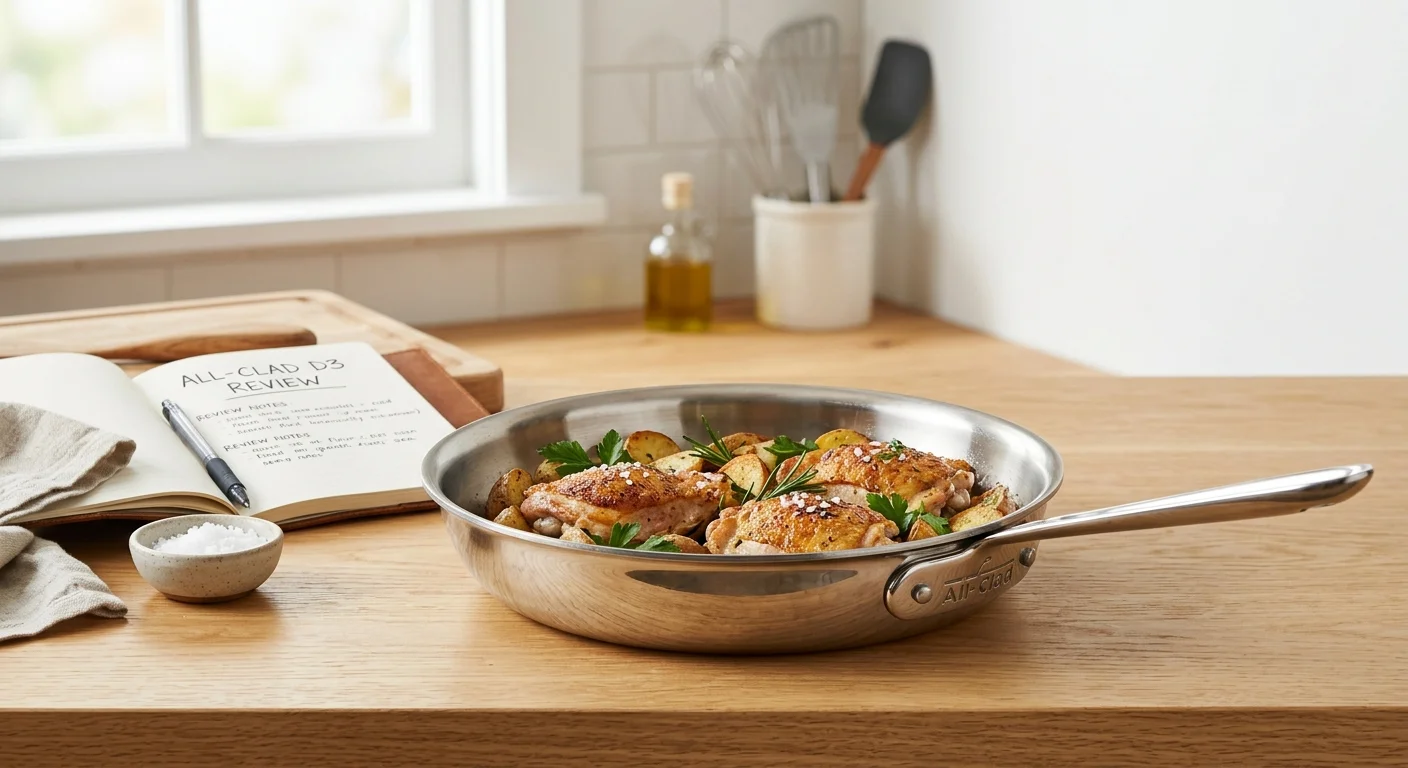
Every review on KitchenDesk goes through a minimum one-week testing window across multiple heat sources before anything gets published, you can read the full details in our testing methodology. For this review, the D3 ran on a six-burner residential gas range (medium BTU output, not a professional range), a portable induction unit, and a standard electric coil burner. I cooked proteins, vegetables, eggs (yes, intentionally, to document the frustration), pan sauces, and one round of stovetop-to-oven chicken thighs that finished under the broiler.
The egg session is worth describing honestly. I tried fried eggs on the D3 using the standard stainless technique, preheat to the water-droplet test, add butter, wait for the foam to subside, add egg. The eggs cooked without sticking, but the margin for error is thin. A degree of distraction, answering a text, adjusting another burner, and the egg was grabbing the surface before I’d flipped it. This isn’t a knock on the pan; it’s a feature of stainless steel cookware as a category. But it confirmed that if fried eggs are a daily ritual for you, a carbon steel pan with a seasoned surface is a more forgiving tool for that specific job. The D3 is worth every cent for what it’s designed to do. It’s just not designed primarily for eggs.
How It Compares
The honest competitive landscape for the D3 comes down to three pans worth comparing directly. The Tramontina Tri-Ply Clad Stainless 12-inch is the value benchmark, it uses a similar fully-clad 3-ply construction and performs surprisingly close to the All-Clad in day-to-day searing and sautéing. The heat distribution isn’t quite as consistent near the walls, and the handle finish is a step below, but for the price gap, most cooks won’t feel the difference on a weeknight. If you’re considering the D3 primarily as a budget decision, the Tramontina deserves a serious look.
The Made In Stainless Clad 12-inch sits closer to the D3 in price and performs comparably in most tests. Made In’s cooking surface is slightly more polished from the factory, which some cooks prefer aesthetically; others find the All-Clad’s slightly more textured surface builds fond more aggressively. This one comes down to brand preference and handle ergonomics, Made In’s handle has a different profile that some cooks find more comfortable. Both are genuinely excellent pans.
The All-Clad D5 12-inch is the natural upgrade question within the All-Clad line. The D5 adds two more stainless layers (five-ply total), which slows the heat-up curve but improves heat retention once the pan is up to temperature. For a skillet used primarily for searing and sautéing, where responsiveness to heat adjustments matters, most cooks, including me, find the D3’s faster response more useful. The D5 makes more sense as a saucier or sauté pan where you want stable, retained heat rather than quick recovery. At the price difference between the two, the D3 is the stronger recommendation for a primary skillet.
Frequently Asked Questions
Does the All-Clad D3 skillet work on induction?
Yes. The 18/10 stainless exterior is magnetic, so it pairs with all induction cooktops without an adapter. I tested it on induction for the full review week, it seated securely on the burner, heated evenly, and held temperature consistently during searing tasks. No spinning, no error codes, no compatibility surprises.
Why does food stick to my stainless steel pan?
Almost always a preheat issue. Stainless steel needs to reach the right temperature before you add fat, the practical test is the water droplet method: a small drop should bead up and roll around the surface rather than sizzling flat and evaporating immediately. Once you add fat and it shimmers (for oil) or subsides from foaming (for butter), you’re ready for protein. Adding cold protein to an under-heated stainless surface is the single most common cause of sticking, and it’s entirely preventable once the habit is built.
Is the All-Clad D3 worth the price over a cheaper tri-ply pan?
Honest answer: for most home cooks, the Tramontina Tri-Ply or Made In perform close enough in day-to-day cooking that the price gap is hard to justify on performance alone. The D3 edges ahead on long-term durability, consistency of the fully bonded construction, and US manufacturing, those are real factors, but they’re value judgments rather than performance ones. If you cook daily and want a pan you’ll use for 20 years without thinking about replacing it, the D3 is worth it. If you want to spend less and cook on great cookware today, the Tramontina is a legitimate answer.
Can I put the All-Clad D3 in the oven or under the broiler?
. According to the manufacturer, the D3 is oven-safe to a high temperature and broiler-safe, the all-metal construction (no plastic components, no silicone, no non-metal handle material) makes it suitable for both applications. I used it in the oven and under the broiler during testing without issue. Always use an oven mitt or folded kitchen towel on the handle after any oven or extended stovetop use, the handle gets very hot and gives no visual indication of its temperature.
How do I remove the rainbow discolouration from my All-Clad pan?
That iridescent rainbow staining is heat oxidation on the stainless steel surface, completely normal, doesn’t affect cooking performance, and isn’t a defect. Bar Keepers Friend in powder form, applied with a damp cloth in a gentle circular motion, removes it in under two minutes. Rinse thoroughly and dry. It’s a routine maintenance step you’ll do every few weeks depending on how often you cook at high heat, not a sign that anything is wrong with the pan.
What’s the difference between the All-Clad D3 and the D5?
The D3 is 3-ply (stainless–aluminum–stainless) and heats up faster, making it more responsive to temperature changes, better for tasks where you’re adjusting heat on the fly, which describes most skillet cooking. The D5 is 5-ply with two additional stainless layers, which slows heat-up but improves heat retention once the pan is up to temperature. For a primary skillet used for searing and sautéing, most cooks find the D3’s responsiveness more practical. The D5 makes more sense if you want a heavier, more thermally stable pan for slower cooking tasks.
Final Verdict
The All-Clad D3 12-inch skillet is not the most accessible pan in the cookware market, it demands correct technique and ongoing maintenance, but when you meet it where it is, it performs at a level that’s genuinely difficult to match. The fully bonded 3-ply construction delivers even heat all the way to the walls, the rivet-and-handle assembly shows no signs of deterioration after heavy use, and the induction compatibility is seamless. The searing and fond development over a week of daily cooking were consistently excellent. It loses points on cleanup friction and on value relative to strong budget competitors, and the no-lid situation at this price is a real omission. But for the cook who wants a stainless skillet that they can genuinely rely on for the next 15 years, the D3 earns its position at the top of the category.
Pricing & availability on Amazon, affiliate link.
View on AmazonFor more context on how the D3 fits into a full cookware kit, see our and . If you’re weighing stainless against other materials, our is worth a read before you commit.