

On this page
- Why the size matters more than you would think
- The number that actually matters: interior diameter
- Sizing by how much flour your recipe uses
- Round or oval? Match the pot to the loaf shape
- What the popular sizes really hold
- The shallow-base alternative worth knowing about
- How to actually bake in it once you have the right size
- Frequently asked questions
- The bottom line
The Dutch oven is the single most important piece of kit for sourdough, because it traps the loaf’s own steam to give you that blistered, crackling crust a home oven cannot. But buy the wrong size and you fight it on every bake: a loaf that pancakes flat, a crust that scorches against the wall, or burnt knuckles every time you lower the dough in. Here is how to pick the size that actually fits the bread you want to make.
I bake sourdough most weekends, and the loaf that finally clicked for me came after I stopped using the giant 9-quart pot I already owned and switched to a 5.5-quart round. The same dough that had been spreading into a frisbee suddenly stood up and sprang. Size is not a detail here; it shapes the loaf.
Why the size matters more than you would think
A Dutch oven works by sealing the loaf in a small, screaming-hot chamber so the water leaving the dough becomes trapped steam. That steam keeps the crust soft just long enough for the loaf to expand fully, the “oven spring,” before it sets. The size of the chamber decides how well that works.
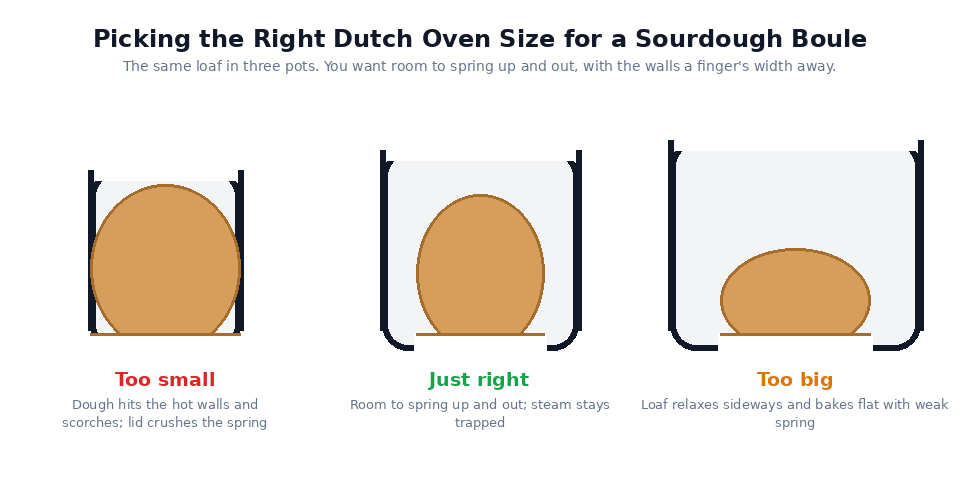
- Too big: the dough has room to relax sideways before it sets, so it spreads into a flat, wide loaf with weak spring. The extra air volume also dilutes the steam, softening the crust effect. A standard boule in a 9-quart pot is the classic pancake mistake.
- Too small: the rising dough touches the searing-hot walls, scorching the sides before the center is done, and the lid can crush the top as it springs. You also cannot get your hands or a sling in to load and retrieve it safely.
- Just right: the loaf has room to spring up and out by maybe 30 to 50 percent, the walls stay a finger’s width away at full expansion, and the steam stays concentrated. That is the zone you are aiming for.
The number that actually matters: interior diameter
Quarts measure volume, but a boule is a question of footprint and headroom. Two 5.5-quart pots from different brands can have noticeably different interior diameters and depths, which is why the quart number alone is a rough guide. What you really want to match is the interior diameter against your proofed dough’s width.
A standard banneton-proofed boule lands around 7 to 8 inches across before baking and spreads a little as it goes in. An interior diameter of 9 to 10 inches gives that loaf room to bloom without pancaking. Much wider and it spreads; much narrower and it cramps. Depth matters too: you want enough height to clear the lid after a full spring, which a 5-quart-plus pot comfortably provides for a single loaf.
Sizing by how much flour your recipe uses
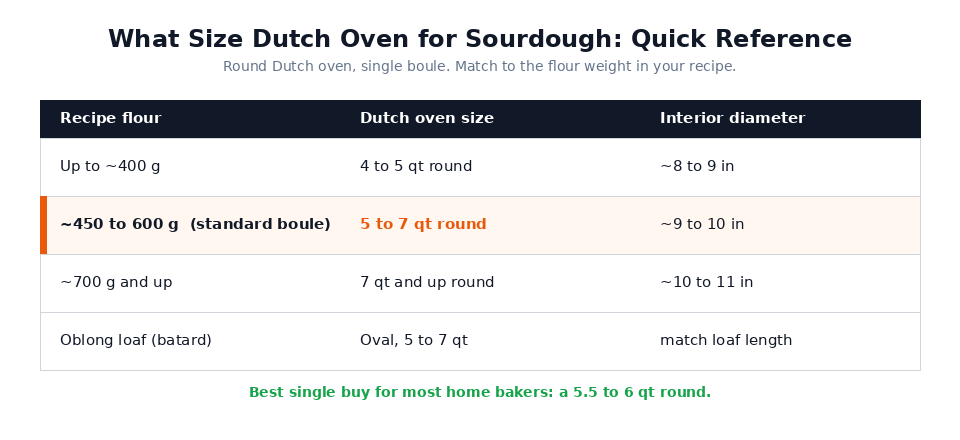
The cleanest way to choose is by the flour weight in your usual recipe, since that drives the finished loaf size. These are practical ranges, not hard rules:
| Your recipe (flour weight) | Finished loaf | Dutch oven size | Interior diameter |
|---|---|---|---|
| Up to ~400 g | Small boule (~600 g) | 4 to 5 qt round | ~8 to 9 in |
| ~450 to 600 g | Standard boule (~800 to 1000 g) | 5 to 7 qt round | ~9 to 10 in |
| ~700 g and up | Large or high-hydration boule | 7 qt and up round | ~10 to 11 in |
| Any, for oblong loaves | Batard (oval) | Oval, 5 to 7 qt | matched to loaf length |
If you only ever bake one loaf at a time, a 5.5 to 6 quart round is the most versatile single purchase. It handles a standard boule beautifully and still copes with a slightly larger one. The brands KitchenDesk has tested in this range are covered in our best Dutch ovens roundup, with head-to-head detail in Lodge vs Le Creuset and Staub vs Le Creuset.
Round or oval? Match the pot to the loaf shape
This trips up a lot of first-time buyers. The shape of the Dutch oven should match the shape of the loaf you proof:
- Round for boules, the classic round sourdough loaf. This is what most home bakers make, so a round pot is the default recommendation.
- Oval for batards, the longer torpedo-shaped loaf. An oval pot gives a batard room along its length; in a round pot a batard has to curl or gets squashed at the ends.
If you are not sure which you bake, you almost certainly make boules, so buy round. Only go oval if you have committed to batards.
What the popular sizes really hold
Some perspective on the models people ask about most, so the quart numbers mean something:
- 5.5 qt round (the size of a Le Creuset or Staub signature round): the gold standard for a single standard boule. Interior diameter around 10 inches. If you buy one pot for sourdough, this is it.
- 6 qt round (common in Lodge enameled): a touch more room, great if your loaves run large or you like high hydration. Still excellent for a standard boule.
- 7 qt and up: better for big batches or very large loaves. A single average boule can spread in one, so size up only if your dough is genuinely bigger.
- 4 to 5 qt: fine for smaller loaves and tighter kitchens, but watch that the dough is not crowding the walls.
The shallow-base alternative worth knowing about
A deep Dutch oven means lowering wet dough down past hot walls, which is how people burn their forearms. A growing number of sourdough bakers use a combo cooker instead: a cast iron pan with a shallow base and a deep lid, used upside down so the shallow part is the bottom. You set the dough on the flat base at counter level and lower the dome over it, which is far easier and safer to load.
The Lodge Combo Cooker is the budget favorite here; purpose-built bread pans like the Challenger or the Le Creuset bread oven take the same shallow-base idea upmarket. If loading a deep pot intimidates you, a shallow-base loader can be a better first buy than a traditional Dutch oven, and it doubles as a skillet. For seasoning and care of bare cast iron, our cast iron skillet guide covers the basics.
How to actually bake in it once you have the right size
- Preheat the empty pot with the lid on for 45 minutes to an hour at 450 to 500 F. A fully heated pot is what drives the spring; a cold one gives a dull loaf.
- Load with a parchment sling so you can lower the dough without touching the hot walls. Score the top just before it goes in.
- Lid on for the first ~20 minutes to trap steam, then lid off for another 20 to 25 minutes to brown and crisp the crust.
- Lift the loaf out onto a rack as soon as it is done so the bottom does not steam soft, and let it cool fully before slicing. A serrated knife matters here; see our best bread knives.
If you are weighing a Dutch oven against a dedicated bread machine for everyday loaves, that is a different decision; our bread machine comparison covers when a machine makes more sense.
Frequently asked questions
What is the best all-around Dutch oven size for sourdough?
A 5.5 to 6 quart round. It fits a standard single boule with room to spring, and still handles a slightly larger or higher-hydration loaf. If you buy one pot, buy this size.
Can I bake sourdough in a 7-quart or bigger Dutch oven?
Yes, but a single average boule may spread and lose height in one. Size up to 7 quarts or more only if you bake large loaves, double batches, or very high-hydration dough that needs the room.
Is a 4 or 5 quart Dutch oven too small?
Not for a small to standard boule. It works as long as the rising dough is not touching the hot walls. For bigger loaves it gets cramped, and it is tighter to load by hand.
Round or oval for sourdough?
Round for boules, which is what most people bake. Oval is for batards, the longer torpedo-shaped loaf. When in doubt, buy round.
Do I need an expensive enameled Dutch oven, or will plain cast iron work?
Both make excellent sourdough; the heat behavior is what matters, not the price. Enameled is easier to clean and never needs seasoning, while a bare cast iron combo cooker is cheaper and easier to load. The crust comes from the trapped steam either way.
Why does my loaf spread flat in my Dutch oven?
Usually the pot is too big for the loaf, so the dough relaxes sideways before it sets. A tighter fit, a stronger final shape, and a fully preheated pot all help it spring up instead of out.
The bottom line
Match the pot to the loaf and the rest gets easier. For a standard sourdough boule, a 5 to 7 quart round Dutch oven with roughly a 9 to 10 inch interior diameter is the reliable sweet spot, and a 5.5 to 6 quart round is the best single buy for most home bakers. Go round for boules and oval for batards, size up only if your dough is genuinely large, and consider a shallow-base combo cooker if loading a deep pot worries you. Get the size right and your oven spring will tell you immediately.
Written by Maya Chen, lead reviewer at KitchenDesk. Sizing recommendations are based on standard sourdough loaf dimensions and the published interior dimensions of common Dutch ovens; your own recipe weight and proofing style will shift the ideal size slightly.