

On this page
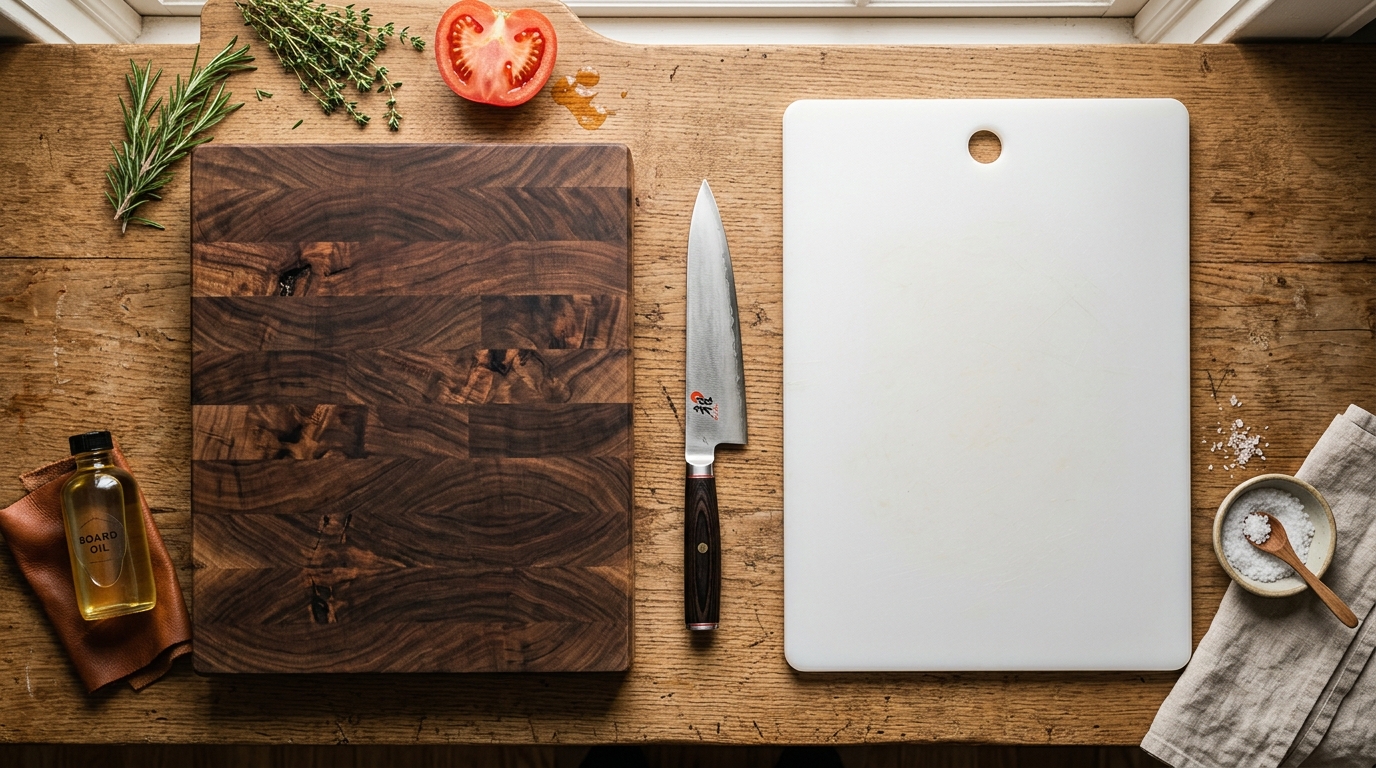 Cutting Boards: Which Is Right for You?, KitchenDesk”/>
You’re standing in a kitchen store, or scrolling at midnight, staring at two cutting boards that both claim to be the right choice, and somehow every article you’ve read has made the decision harder, not easier. Wood boards look beautiful and feel serious; plastic boards seem hygienic and practical. The truth is messier than either camp admits, and the right answer genuinely depends on how you cook, what you cut, and how you clean. By the end of this guide you’ll understand the real tradeoffs, knife friendliness, bacteria science, durability, maintenance, and know exactly which type belongs in your kitchen.
As an Amazon Associate, KitchenDesk earns from qualifying purchases. Some of the links on this page are affiliate links, we may earn a commission at no extra cost to you. Full disclosure.
Jump to a section
TL;DR
- Wood boards (maple, walnut, teak) are gentler on knife edges than hard plastic and self-heal minor cuts, but they require hand-washing and periodic oiling to stay in good shape.
- Plastic boards are dishwasher-safe, lighter, and inexpensive to replace, but once they develop deep knife grooves, studies suggest they can harbor bacteria that washing won’t fully remove [[CITE: bacteria-in-grooved-plastic-boards]].
- The FDA Food Code permits both wood and plastic in home kitchens; NSF certification on a plastic board is a useful signal of material safety, not a guarantee of hygiene over time.
- For raw meat, a dedicated thin plastic board you can run through the dishwasher after every use is a defensible choice, but only if you actually do that, every time.
- End-grain wood boards cost significantly more than edge-grain but are easier on knives and hide surface wear better; they are not inherently more sanitary.
- “Antimicrobial” labeling on plastic boards is regulated by the EPA in the US, but independent testing by Cook’s Illustrated has questioned how meaningful the real-world benefit is [[CITE: cooks-illustrated-antimicrobial-plastic-boards]].
- A two-board system, one large wood board for vegetables and general prep, one dedicated plastic board for raw proteins, is what most food-safety-minded professional kitchens use at home scale.
- Thickness matters more than most buyers expect: boards under ¾ inch warp faster and feel unstable under a heavy cleaver.
A Little Background
Cutting boards have been a kitchen staple for centuries, but the wood-versus-plastic debate didn’t heat up until the mid-20th century, when plastic became cheap enough for domestic use and food-safety regulators started pushing synthetic surfaces in commercial kitchens under the assumption they were more hygienic. That assumption was challenged in a widely cited 1994 UC Davis study by Dean Cliver, formally published as Cliver, D.O. (1994), “Cutting boards in Salmonella cross-contamination,” Journal of AOAC International which found that bacteria introduced into knife cuts on wooden boards were harder to recover and less likely to multiply than bacteria on scored plastic [[CITE: cliver-1994-wood-plastic-bacteria-uc-davis]]. Since then the picture has grown more nuanced: surface condition, cleaning method, and wood species all affect outcomes, which is why understanding the underlying mechanisms matters more than picking a side and sticking to it.
For more context on specific board recommendations, see our Kitchen Tools category hub and the roundup, which covers top picks across both materials.
What Actually Matters When Choosing a Cutting Board
Not all cutting board specs are created equal. A handful of factors have real, measurable impact on performance, knife longevity, and food safety, and these are worth understanding before you buy anything.
Material hardness. A board that’s too hard will dull knife edges faster than you’d expect. Hard maple sits around 1,450 lbf on the Janka hardness scale [[CITE: janka-hardness-maple-vs-bamboo]] and is widely considered the benchmark for wood cutting boards, firm enough to resist scoring, soft enough not to punish a blade. High-density polyethylene (HDPE) is the standard for NSF-certified plastic boards used in professional kitchens; it’s softer than maple in practice, which is part of why it’s the default in food-service environments. Glass and ceramic boards are on the far wrong end of this spectrum, they will wreck an edge in a single prep session and belong on no one’s cutting surface.
Surface condition over time. A new plastic board sanitizes easily. A plastic board with deep knife grooves is a different problem entirely. Dean Cliver’s UC Davis research found bacteria could survive in grooved plastic even after washing, while wood’s physical properties, the closing of grain cells around cuts, along with naturally occurring tannins, seemed to suppress bacterial survival [[CITE: cliver-1994-wood-plastic-bacteria-uc-davis]]. The practical takeaway is straightforward: replace plastic boards when they show deep scoring, and lightly sand wood boards when the surface gets rough.
Moisture management. Wood expands and contracts with water exposure, and boards that are too thin, improperly dried, or conditioned with the wrong oil will cup, crack, or split. Food-grade mineral oil is the standard conditioning agent, it’s inexpensive, odorless, and won’t go rancid in the grain. Walnut oil and coconut oil can both turn rancid over time, leaving off-odors in the wood. How a board is milled also matters: face-grain, edge-grain, and end-grain boards each have different amounts of seasonal movement and different surface behavior under a knife.
Grip, stability, and size. A board that slides is a safety hazard before it’s anything else. Rubber feet, a non-slip mat, or a damp towel underneath are all valid fixes. On size: the single most common buying mistake is choosing a board that’s too small. A primary prep board should be at least as long as your longest knife with a few inches of clearance on each side, 12×18 inches is a practical minimum for most home cooks. Juice grooves get marketed heavily, but they’re genuinely useful only for carving roasts or whole birds; for everyday prep they add a cleaning step without adding much value.
What Looks Important But Mostly Isn’t
Plenty of cutting board marketing sounds scientific without changing real-world outcomes in a home kitchen. A few categories worth being skeptical about:
“Antimicrobial” labeling. The EPA does require that antimicrobial claims be registered and substantiated, but the treatment is typically a biocide embedded in the surface layer. Once knife cuts score past that layer, which happens quickly with regular use, the antimicrobial property is largely gone. Cook’s Illustrated has noted skepticism about the practical value of this feature for home cooks [[CITE: cooks-illustrated-antimicrobial-plastic-boards]]. It’s not a reason to pay more for a plastic board.
Bamboo as a premium option. Bamboo is technically a grass, not a wood, and is marketed heavily on eco-credentials and hardness. The hardness is actually the problem, bamboo is significantly harder than maple and measurably rougher on knife edges [[CITE: bamboo-hardness-knife-edge-impact]]. The sustainability argument has merit if sourcing is verified, but it shouldn’t override a performance tradeoff that affects your knives every time you cook.
Decorative resin and epoxy boards. These look striking on a countertop and photograph beautifully, but resin surfaces are extremely hard, comparable to stone, and will destroy a knife edge in one session. They are serving boards, not prep boards. That distinction is often buried in the fine print of a product listing.
Color-coded board sets. The HACCP color-coding system is legitimate in a commercial kitchen where multiple cooks are running a line simultaneously. In a single-person or single-family home kitchen, a two-board system, one for proteins, one for everything else, achieves the same outcome without six boards cluttering a cabinet.
Exotic wood species. Acacia, zebra wood, and similar species are sold at premium prices partly on aesthetics. Teak is a reasonable exception, its natural oil content makes it genuinely moisture-resistant and durable. Many of the others offer no functional advantage over well-made maple or walnut, and some have inconsistent grain density that leads to uneven wear over time.
Common Mistakes (and How to Avoid Them)
Most cutting board problems aren’t caused by buying the wrong type, they happen afterward, in the way the board gets used and maintained.
Putting a wood board in the dishwasher. The high heat and prolonged water exposure will warp or crack virtually any wood board, including those marketed as “dishwasher-safe.” The damage is often cumulative, the first cycle might look fine, and the third cycle splits the board down the middle. Hand-wash with hot soapy water and dry immediately, standing upright or flat on a rack where both sides can breathe. Never lay a wet wood board flat on a solid surface to dry.
Never oiling the board. An unprotected wood board dries out, develops micro-cracks, and becomes genuinely harder to keep clean. Mineral oil applied monthly, more frequently when the board is new, keeps the grain sealed and the surface smooth. Apply generously, let it soak for a few hours or overnight, then wipe off the excess. Board cream (mineral oil plus beeswax) adds a surface layer that helps repel moisture between oil treatments and is worth having on hand.
Using one board for everything. Cross-contamination risk is real when raw chicken juice sits in knife grooves and then gets covered by herbs you’ll eat without cooking. A dedicated board for raw proteins, ideally plastic, so it goes straight into the dishwasher after use, is the fix. The habit of cleaning it immediately matters more than the material itself.
Ignoring flatness. A warped board rocks on the counter and is a genuine safety hazard. Check flatness periodically. Minor warping in a wood board can sometimes be reversed by wetting the concave side and weighting the board flat while it dries; severe warping means it’s time to replace it. For plastic, a warped board typically can’t be corrected and should go.
Buying too small to save counter space. A cramped board forces tight quarters, increases the chance of food falling off the edge, and slows prep. If counter space is genuinely limited, a board sized to sit over a sink basin or one with fold-down legs is a better solution than buying undersized and fighting it every time you cook.
What to Expect at Each Price Point
Budget
Entry-level plastic boards, typically thin HDPE or polypropylene, and basic wood boards work well as secondary boards: the dedicated raw-meat plastic board you replace every couple of years, or a wood board for a small household doing light prep. Expect minimal thickness, often under ¾ inch, which means faster warping in wood and more flex in plastic under heavy cuts. This tier makes sense when you need a second board for protein separation, you’re outfitting a first apartment, or you want to test whether you’ll actually maintain a wood board before investing more. Don’t use a budget board as your only board if you cook regularly.
Mid-Range
This is where most home cooks should land for their primary board. Mid-range edge-grain maple or walnut boards from established makers are thick enough to resist warping, heavy enough to stay stable on the counter, and will last years with basic care. Mid-range plastic boards in this tier tend to be thicker HDPE with rubber feet and a more substantial feel underhand. You start seeing juice grooves, over-sink sizing options, and better fit-and-finish on the edges. For a two-board household, one mid-range wood board plus one mid-range plastic board covers virtually every prep scenario without overspending. See our and roundups for specific picks in this range.
Premium
At the premium tier, you’re mostly paying for end-grain wood construction, a more labor-intensive process that produces a board where the knife cuts into the wood fibers rather than across them. The result is gentler on knife edges, and surface cuts tend to self-heal as the grain closes back around them. Well-made end-grain boards from established makers can last decades with proper care and regular oiling. The cost is justified if you cook daily, care about knife maintenance, and will commit to the upkeep. Premium plastic in a home context is less compelling, the performance ceiling for plastic doesn’t rise as dramatically with price. The exception is thick commercial-grade HDPE boards, which are close to indestructible and worth the investment if you’re doing heavy butchery work regularly.
Frequently Asked Questions
Are wood cutting boards actually more hygienic than plastic?
The evidence is genuinely mixed, but the UC Davis research by Dean Cliver found that bacteria survived better on scored plastic than on wood. The key variable is surface condition, a new, unscarred plastic board is easy to sanitize; a deeply grooved plastic board is harder to clean than a well-maintained wood one. Neither material is inherently safe if you’re not washing properly and replacing boards when they show serious wear.
Can I put my wood cutting board in the dishwasher just once in a while?
No. Even occasional dishwasher cycles generate enough heat and moisture to start the warping or cracking process in most wood boards, including thick ones. The damage is often cumulative and doesn’t show up immediately. Hand-wash, dry promptly, and oil regularly instead, that routine takes about two minutes and will keep a good board in service for years.
What oil should I use to condition a wood cutting board?
Food-grade mineral oil is the standard recommendation, it’s inexpensive, odorless, and won’t go rancid in the grain. Avoid vegetable oils, olive oil, or coconut oil, all of which can turn rancid over time and create off-odors. Board cream (mineral oil plus beeswax) is a useful follow-up layer after oiling and helps the surface repel water between treatments.
How often do I need to replace a plastic cutting board?
When it develops deep knife grooves that feel rough to the touch and can’t be scrubbed clean, it’s time. For a board used daily for mixed prep, that might be every one to two years depending on how aggressively you cut. Boards used exclusively for light tasks, slicing bread, cutting fruit, can last considerably longer. If you can feel the grooves catching your fingernail, replace it.
Is bamboo better than wood or plastic?
Bamboo is harder than hard maple, which makes it rough on knife edges, a genuine functional downside for most cooks [[CITE: bamboo-hardness-knife-edge-impact]]. Its sustainability credentials have some merit if sourcing is verified, but the hardness tradeoff is real and affects your knives every session. It’s not a middle ground between wood and plastic; it’s essentially a harder wood with different maintenance needs and no clear hygiene advantage over either.
Do I need a separate board for raw meat?
Yes, functionally speaking. You don’t need six color-coded boards, but a dedicated board, ideally plastic so it can go in the dishwasher after every use, for raw poultry, meat, and seafood meaningfully reduces cross-contamination risk. The habit of cleaning it immediately after use matters more than the material choice.
What size cutting board should I buy?
For a primary prep board, 12×18 inches is a practical minimum for most home cooks. If you regularly break down whole chickens, prep large quantities of vegetables, or work with long cuts of meat, go larger. The right frame for thinking about it: a board should fit your longest knife with room to spare on both sides.
Are end-grain boards worth the higher price?
If you cook daily, care about knife maintenance, and will commit to regular oiling, yes. End-grain boards are gentler on edges because the knife cuts between wood fibers rather than across them, and surface cuts tend to self-heal as the grain closes. If you cook a few times a week and won’t reliably oil the board, a well-made edge-grain board is a more realistic and still excellent choice.
Does the thickness of a cutting board matter?
More than most buyers expect. Boards under ¾ inch are prone to warping (wood) or flexing (plastic) and feel unstable under heavy cuts. For a primary wood board, 1.5 inches is a reasonable target minimum; for a main plastic board, ¾ to 1 inch gives meaningful rigidity. Thicker boards are also heavier, which is worth factoring in if you’ll be lifting them frequently to clean underneath.
What does NSF certification mean on a cutting board?
NSF International certifies that the materials used in a plastic board meet safety standards for food contact, essentially confirming the plastic won’t leach harmful substances into food [[CITE: nsf-certification-food-contact-materials]]. It’s a useful baseline signal when shopping for plastic boards, but it says nothing about how hygienic the board will be once it’s scored with knife cuts. Think of it as a floor, not a ceiling.
The Bottom Line
The wood-versus-plastic debate has a real answer, and it’s not that one is universally better, it’s that the two materials solve different problems. A well-made wood board (edge-grain maple or walnut at minimum, end-grain if you cook seriously and will maintain it) should be your primary prep surface for vegetables, herbs, bread, and general work. A dedicated plastic board, thick enough to stay stable, thin enough to toss in the dishwasher without guilt, belongs next to it for raw proteins. That two-board setup is what most experienced home cooks land on, and it works because it matches material properties to actual use rather than forcing one board to do everything.
If you’re ready to shop, the roundup covers our top-tested picks across both categories. For wood-specific guidance, see ; for plastic, breaks down the best options by size, thickness, and use case.
Maya Chen, KitchenDesk. Maya is a Toronto-based home cook and former line cook (Toqué!, 2014–2017). She tests kitchen products on gas, induction, and electric for a minimum of one week before any review is published.