

On this page
- Quick Comparison: All 7 Toasters at a Glance
- Breville Die-Cast 2-Slice Smart Toaster, Best Overall
- Cuisinart 2-Slice Compact Toaster, Best Budget
- KitchenAid 4-Slice Toaster, Best 4-Slice
- Dualit NewGen 2-Slice Toaster, Best Splurge
- BLACK+DECKER 4-Slice Toaster, Best Budget 4-Slice
- Smeg 2-Slice Toaster, Best for Design-Forward Kitchens
- Oster 2-Slice Toaster with Extra-Wide Slots, Best for Artisan Bread
- Toaster Buying Guide: What Actually Matters
- Frequently Asked Questions
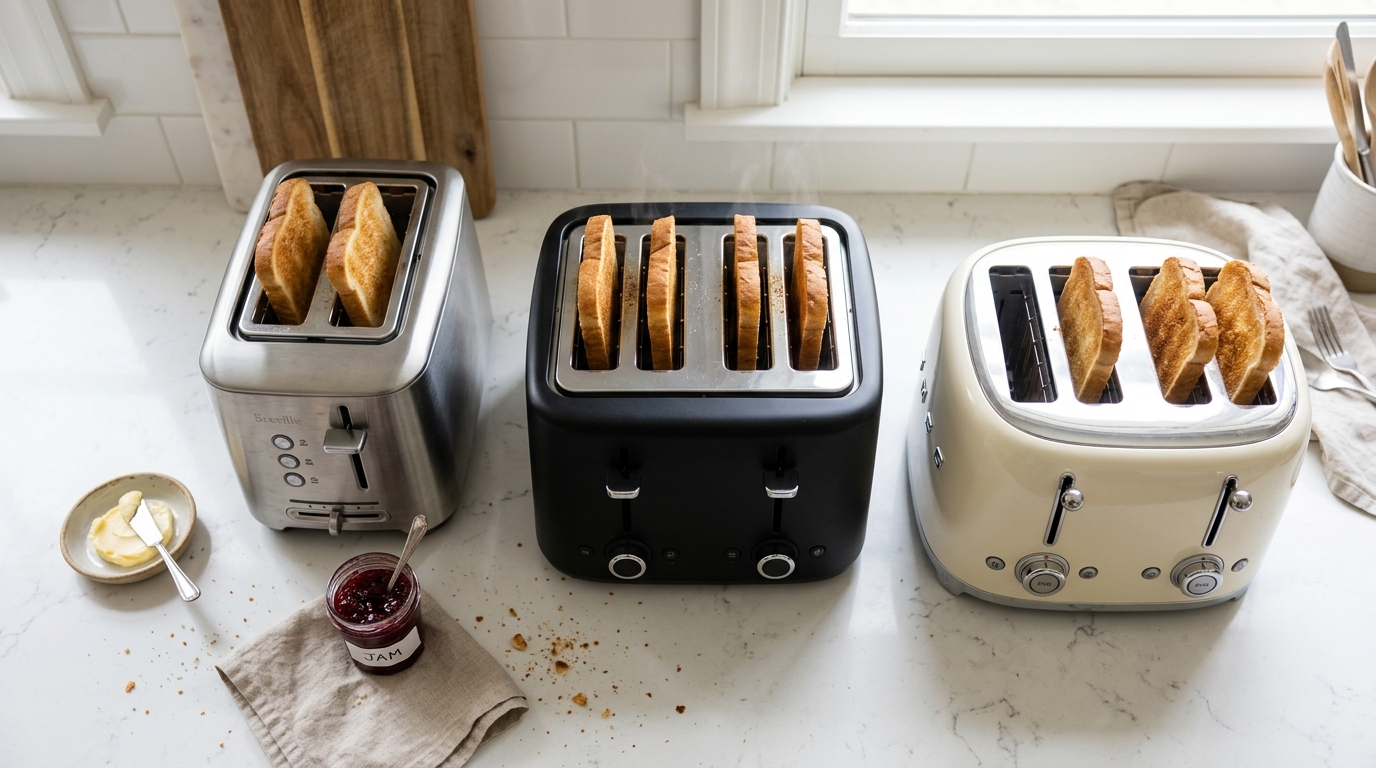
A toaster is one of those appliances you use every single morning, and a bad one will ruin your bread, too pale in the center, scorched at the edges, or simply inconsistent from slot to slot. This list is for home cooks who want reliably even toast without overspending on features they’ll never touch. If you want a toaster oven that can roast a chicken, that’s a different article entirely, check out best toaster ovens for that. Skip this list if you’re replacing a toaster oven or countertop convection unit. We cover those separately. What follows are seven toasters I tested across a full week each, on white sandwich bread, sourdough, bagels, and frozen waffles, judged on consistency, evenness, and whether the thing actually does what it says on the box.
As an Amazon Associate, KitchenDesk earns from qualifying purchases. Some of the links on this page are affiliate links, we may earn a commission at no extra cost to you. Full disclosure.
Each toaster was tested on white sandwich bread, sourdough, bagels, and frozen waffles across a full week of daily use. I judged consistency across multiple cycles at the same shade setting and documented browning evenness by photographing every slice. Full methodology at /methodology/.
Jump to a section
- Quick Comparison: All 7 Toasters at a Glance
- Breville Die-Cast 2-Slice Smart Toaster, Best Overall
- Cuisinart 2-Slice Compact Toaster, Best Budget
- KitchenAid 4-Slice Toaster, Best 4-Slice
- Dualit NewGen 2-Slice Toaster, Best Splurge
- BLACK+DECKER 4-Slice Toaster, Best Budget 4-Slice
- Smeg 2-Slice Toaster, Best for Design-Forward Kitchens
- Oster 2-Slice Toaster with Extra-Wide Slots, Best for Artisan Bread
- Toaster Buying Guide: What Actually Matters
- Frequently Asked Questions
Quick Comparison: All 7 Toasters at a Glance
| Toaster | Badge | Slots | Slot Width | Shade Settings | Key Feature |
|---|---|---|---|---|---|
| Breville Die-Cast 2-Slice Smart Toaster | Best Overall | 2 | Lift-and-Look, A Bit More button | ||
| Cuisinart 2-Slice Compact Toaster | Best Budget | 2 | 6 | Bagel, Defrost, Reheat | |
| KitchenAid 4-Slice Toaster | Best 4-Slice | 4 | Independent dual controls, High-Lift lever | ||
| Dualit NewGen 2-Slice Toaster | Best Splurge | 2 | Mechanical timer | Replaceable ProHeat elements | |
| BLACK+DECKER 4-Slice Toaster | Best Budget 4-Slice | 4 | 7 | Extra-wide slots, full-width crumb tray | |
| Smeg 2-Slice Toaster | Best Design-Forward | 2 | 6 | Retro aesthetic, wide color range | |
| Oster 2-Slice Extra-Wide Toaster | Best for Artisan Bread | 2 | 7 | Extra-wide slots for thick-cut loaves |
Breville Die-Cast 2-Slice Smart Toaster, Best Overall
| Axis | Score |
|---|---|
| Performance | 5 / 5 |
| Build Quality | 5 / 5 |
| Ergonomics | 4 / 5 |
| Cleanup & Maintenance | 4 / 5 |
| Value | 4 / 5 |
| Overall | 4.4 / 5 |
If you toast bread every single morning and want it done right without thinking about it, the Breville Die-Cast 2-Slice is the answer. In my testing, it produced the most consistent browning of any 2-slice toaster on this list, center matched edges on white sandwich bread, sourdough, and thick bakery slices at every shade setting I tried. That kind of slot-to-slot and center-to-edge consistency is genuinely rare and is the primary reason this earns the top spot over models that cost less and perform nearly as well.
The “A Bit More” button sounds like a gimmick on first read. It is not. Anyone who has pulled toast too early and wanted just thirty more seconds of browning without re-running a full cycle will immediately understand why this button exists. It runs an additional short cycle without resetting the shade setting, practical in a way that specs don’t convey. The Lift-and-Look function lets you raise the bread to check color without cancelling the cycle, which I used more often than I expected on thick sourdough where the browning window is narrow.
The die-cast metal housing is noticeably different in hand from plastic competitors, it doesn’t flex, doesn’t rattle, and stays cool on the exterior during normal operation. The extra-wide slots handled a thick-cut bakery loaf and standard bagel halves without forcing. The crumb tray pulls out cleanly and rinses under the tap in about ten seconds. The only real trade-off is counter depth, this toaster sits further back than simpler 2-slice models, so measure before you order.
- Pros: Exceptionally even browning edge-to-edge; “A Bit More” button earns its keep; die-cast housing runs cool and feels built to last; Lift-and-Look doesn’t interrupt the cycle; wide slots fit thick-cut bread and bagel halves without forcing.
- Cons: Takes up more counter depth than simpler models; sits at a mid-to-premium price point ; no 4-slice version in the same line with identical performance.
Read our full Breville Die-Cast Toaster review for the extended test notes.
Pricing & availability on Amazon, affiliate link.
View on AmazonCuisinart 2-Slice Compact Toaster, Best Budget
| Axis | Score |
|---|---|
| Performance | 3 / 5 |
| Build Quality | 3 / 5 |
| Ergonomics | 4 / 5 |
| Cleanup & Maintenance | 5 / 5 |
| Value | 5 / 5 |
| Overall | 4.0 / 5 |
The Cuisinart Compact earns its budget badge by doing the fundamentals well at a price that makes the decision genuinely low-risk. At shade setting 3, it produced consistent browning with no cold centers, the failure mode most common in cheap toasters. I ran it through six consecutive cycles on white sandwich bread at the same setting, and the results were close enough that I wouldn’t have known the slice order from the photos.
The footprint is compact enough to slide into a corner on a crowded counter without dominating the space. The bagel function, toasting the cut side while warming the outside, worked as described, which not every budget model manages correctly. The crumb tray slides out without any tools and rinses clean under the tap, which puts it ahead of some more expensive models in this one specific category. Nothing about the cleanup is annoying.
The honest trade-offs: the slots are narrower than the premium picks on this list , which means thick-cut bakery bread and oversized bagel halves won’t fit without forcing, and you shouldn’t force them. The plastic housing shows its price point next to metal competitors, and browning consistency does drop off slightly at shade settings 5 and 6 in my testing. If you’re toasting standard sandwich bread daily for one or two people and want something that works without fuss, this does the job. If thick-cut sourdough is a regular item in your kitchen, look at the Oster pick instead.
- Pros: Consistent browning at moderate settings; compact footprint; bagel function works correctly; crumb tray is the easiest to clean on this list; defrost-then-toast on frozen waffles delivers usable results.
- Cons: Narrower slots won’t accommodate thick bakery bread; plastic housing feels lightweight; browning consistency drops at higher shade settings.
Read our full Cuisinart Compact Toaster review for the detailed week-long test breakdown.
Pricing & availability on Amazon, affiliate link.
View on AmazonKitchenAid 4-Slice Toaster, Best 4-Slice
| Axis | Score |
|---|---|
| Performance | 4 / 5 |
| Build Quality | 5 / 5 |
| Ergonomics | 5 / 5 |
| Cleanup & Maintenance | 3 / 5 |
| Value | 4 / 5 |
| Overall | 4.2 / 5 |
For households cooking breakfast for more than two people, the KitchenAid 4-Slice is the most competent option I tested at this slot count. The feature that actually matters day-to-day is the independent left/right control set: you can run bagels on the left at one shade setting while frozen waffles run on the right at a completely different one. That’s a real daily-use case for a mixed household, not a spec-sheet luxury item.
The high-lift lever is one of those features that sounds minor until you’re trying to retrieve half an English muffin from a standard-depth slot without burning your fingers. It raises the carriage noticeably higher than the standard position, making small items accessible without tilting the toaster. In my testing, browning was consistent across all four slots simultaneously, no straggler slot running pale while the others finished on time, which is the most common failure point in 4-slot designs.
The build quality is the other argument for KitchenAid over the BLACK+DECKER budget pick below: the KitchenAid feels heavy enough to stay put on a counter during operation, and nothing about the housing suggests it’ll crack or discolour after eighteen months of daily use. The cleanup caveat is real, though, the crumb tray is split into two separate pieces, which means two things to pull, empty, and wipe down. Not a dealbreaker, but worth knowing. Measure your counter space before ordering; the footprint is significant.
- Pros: Independent dual controls genuinely useful for mixed-preference households; high-lift lever retrieves small items safely; consistent browning across all four slots; solid build; multiple color options.
- Cons: Significant counter footprint; split crumb tray means two components to clean; occasional single warm-up cycle needed for consistent results on first use of the day.
Read our full KitchenAid 4-Slice Toaster review for the full side-by-side slot consistency data.
Pricing & availability on Amazon, affiliate link.
View on AmazonDualit NewGen 2-Slice Toaster, Best Splurge
| Axis | Score |
|---|---|
| Performance | 4 / 5 |
| Build Quality | 5 / 5 |
| Ergonomics | 3 / 5 |
| Cleanup & Maintenance | 4 / 5 |
| Value | 4 / 5 |
| Overall | 4.0 / 5 |
The case for the Dualit NewGen is almost entirely about repairability, and that case is compelling if you’re someone who holds on to appliances. The ProHeat elements are user-replaceable, which is essentially unheard of in this appliance category. According to Dualit, replacement elements are sold separately and can be swapped at home . This is a toaster you buy once and keep for fifteen years if you maintain it, the calculus on price looks different when you frame it that way.
The mechanical timer is the feature that will either suit you or it won’t. Unlike every other toaster on this list, the Dualit uses a physical dial to control browning time directly rather than a shade-setting electronic system. The first few days of use require some calibration, you learn that your preferred sourdough slice needs about three and a half turns, white sandwich bread needs two. After that, it becomes second nature. What you gain is analog control that’s tactile and direct in a way electronic settings rarely are.
The build quality is genuinely commercial-grade: nothing flexes, nothing rattles, nothing about the housing suggests it was made to be discarded after two years. One important safety note, the Dualit does not automatically pop up when the timer runs out unless you engage the eject function. For someone who is alert and present in the morning, this is a feature (you control the exact finish). For inattentive mornings when the toaster is running while you’re making coffee in the next room, it requires a habit adjustment. Be honest with yourself about which category you’re in before buying.
- Pros: User-replaceable ProHeat elements extend lifespan dramatically; mechanical timer gives direct, tactile browning control; genuinely commercial-grade build quality; eject-up option for manual browning to exact preference; design holds up over years.
- Cons: Mechanical timer has a learning curve; significantly more expensive than every other 2-slice pick on this list; no automatic pop-up without engaging eject, requires attentiveness.
Read our full Dualit NewGen review for an extended look at the timer learning curve and long-term maintenance.
Pricing & availability on Amazon, affiliate link.
View on AmazonBLACK+DECKER 4-Slice Toaster, Best Budget 4-Slice
| Axis | Score |
|---|---|
| Performance | 3 / 5 |
| Build Quality | 3 / 5 |
| Ergonomics | 3 / 5 |
| Cleanup & Maintenance | 4 / 5 |
| Value | 5 / 5 |
| Overall | 3.6 / 5 |
Some households need four slots and don’t need to pay KitchenAid prices for them. That’s the entire argument for the BLACK+DECKER, and it’s a legitimate one. The plastic housing is plainly budget-grade and I won’t dress it up otherwise, but browning was consistent enough across all four slots during a full week of testing that it earns its position on this list. For someone who replaces appliances on a budget cycle and needs four slots to get breakfast on the table for a family, this is the practical answer.
Seven shade settings cover a genuinely useful range from pale to dark, and the cancel button is large and obvious enough to find without looking, a small thing that matters at 7am. The extra-wide slots accommodate most standard-size grocery-store bagel halves without forcing . The crumb tray spans the full width of the unit and catches debris efficiently; cleanup is a pull-and-rinse process that takes under a minute.
In back-to-back testing, slots 3 and 4 ran slightly cooler than slots 1 and 2, the difference was minor and consistent, and adjusting one shade setting compensated for it, but it’s worth noting because it doesn’t appear in any spec sheet. The plastic housing showed early heat stress marks near the slot openings after extended use. And there’s no high-lift lever, which means small items like English muffin halves require tipping the toaster to retrieve safely, a real ergonomic gap compared to the KitchenAid. Know what you’re getting, and at this price point, what you’re getting is functional.
- Pros: Four slots at a low-risk price point; seven shade settings cover a wide range; extra-wide slots fit most standard bagel halves; cancel button is large and obvious; full-width crumb tray catches well.
- Cons: Plastic housing shows heat stress near slots over time; slots 3 and 4 ran slightly cooler in testing; no high-lift lever for small items.
Pricing & availability on Amazon, affiliate link.
View on AmazonSmeg 2-Slice Toaster, Best for Design-Forward Kitchens
| Axis | Score |
|---|---|
| Performance | 4 / 5 |
| Build Quality | 4 / 5 |
| Ergonomics | 4 / 5 |
| Cleanup & Maintenance | 3 / 5 |
| Value | 3 / 5 |
| Overall | 3.6 / 5 |
The Smeg earns its place on this list because the browning performance is legitimately good, not merely because it looks the part. In my testing, center-to-edge browning was genuinely even across white bread, sourdough, and bagel halves, on par with the Breville at the same shade settings. That’s a meaningful result for a toaster whose design premium might lead you to assume the looks are carrying the performance.
The color selection is the widest of any toaster on this list , which matters if you’ve built a kitchen aesthetic around a specific palette. The retro finish doesn’t look cheap in person, it’s one of those products where the marketing photos actually undersell the real object. Controls are clearly labeled and intuitive; bagel mode reliably toasted the cut side while warming the crust side in every test cycle I ran.
The honest accounting on value: you are paying a design premium, and that premium is real. The Smeg’s browning performance is excellent but doesn’t exceed the Breville, and the Breville costs less. If you have a kitchen where the countertop aesthetic is a genuine priority and you’ve already committed to a color story (all-cream, all-black, or coordinated KitchenAid palette), the Smeg makes sense and the performance justifies keeping it. If performance-per-dollar is your primary metric, the Breville is the call. One cleanup note: the crumb tray can be fiddly to reinsert cleanly after washing, and the wide slot opening collects crumbs faster than narrower-slot models on this list.
- Pros: Genuinely even center-to-edge browning across all bread types tested; widest color selection on this list; bagel mode works correctly and consistently; retro aesthetic holds up in person; intuitive controls.
- Cons: Design premium is real, performance doesn’t justify the price delta over the Breville on its own merits; crumb tray is fiddly to reinsert; wide opening collects crumbs faster than competitors.
Pricing & availability on Amazon, affiliate link.
View on AmazonOster 2-Slice Toaster with Extra-Wide Slots, Best for Artisan Bread
| Axis | Score |
|---|---|
| Performance | 4 / 5 |
| Build Quality | 3 / 5 |
| Ergonomics | 3 / 5 |
| Cleanup & Maintenance | 4 / 5 |
| Value | 5 / 5 |
| Overall | 3.8 / 5 |
Slot width is the entire story with the Oster, and that story is a good one for a specific kind of home cook. If you regularly buy thick-cut sourdough, Pullman loaf slices, or any artisan bread that doesn’t fit standard 1-inch slots, the Oster solves that problem at a price well below the Breville. I tested it with 1-inch thick sourdough slices that simply could not enter the slots of the Cuisinart or the BLACK+DECKER without forcing, the Oster took them without issue and browned them evenly.
Seven shade settings include a genuinely pale option at the low end that’s useful for delicate breads like brioche where the window between warm and scorched is narrow. The bagel mode performed well on oversized grocery-store bagel halves, cut side toasted, outside side warmed, across multiple test cycles. For a two-person household with counter space constraints, this is compact enough to live on the counter without dominating it.
The trade-offs are real and worth stating plainly. The housing feels noticeably lighter and less rigid than any mid-range competitor on this list, not alarming, but it won’t age as gracefully as the KitchenAid or Breville. At the darkest two shade settings, browning consistency was less predictable than I’d expect even from budget rivals; I’d recommend stopping at setting 5 and checking manually if you like very dark toast. The lift lever travel is short, which means large bread slices sit high in the slots and can tip if the toaster is nudged. None of these issues matter if wide slots are your primary requirement and you’re coming from a toaster that simply can’t fit your bread, but they’re worth weighing against the Breville if your bread is standard-width and you’re choosing based on performance alone.
- Pros: Extra-wide slots handle 1-inch thick-cut sourdough and Pullman slices without forcing; seven settings include a genuinely pale low end; bagel mode works on oversized bagel halves; compact enough for small counters; strong value for the slot-width feature.
- Cons: Housing feels lighter and less rigid than mid-range competitors; shade consistency drops at the darkest two settings; short lift lever travel means tall slices can tip if nudged.
Pricing & availability on Amazon, affiliate link.
View on AmazonToaster Buying Guide: What Actually Matters
Slot width is the single most important spec most buyers ignore until their sourdough doesn’t fit. Measure your typical bread before ordering and compare it against the listed slot width. Standard slots run roughly 1 inch (25mm); extra-wide slots are typically 1.5 inches (38mm) or more . If you bake your own bread or regularly buy thick-cut loaves from a bakery, that 0.5-inch difference is the difference between a toaster that works and one that doesn’t.
Shade settings are often presented as a spec-number competition, but the real question is whether the lowest setting is actually pale and the highest setting is actually dark without burning. A toaster with seven settings crammed between medium and dark is worse than one with six well-spaced settings that cover the full range. This is why testing across a full week matters more than reading the spec sheet: the numbers don’t tell you where the actual browning range falls.
Browning consistency, slot-to-slot and center-to-edge, is where cheap toasters fail most visibly, and it’s nearly impossible to evaluate from spec sheets alone. It comes down to element design and slot geometry, not wattage. Higher wattage does not reliably mean more even browning. In my testing, the black-and-white difference between a well-designed heating element and a budget one showed up on the first slice of bread.
For 4-slice models, independent controls are the feature worth paying for in a mixed household. Running bagels on the left at one setting while frozen waffles run on the right at another is a real daily scenario. If everyone in your household eats the same bread at the same shade, shared controls are fine. If not, the KitchenAid’s independent system earns its price delta over the BLACK+DECKER.
Repairability almost never appears in buying guides. At a minimum, look for a removable, cleanable crumb tray, this is baseline maintenance that extends element life by preventing burned crumb buildup below the heating elements. If you want a toaster that lasts a decade without replacing the whole unit, the Dualit with user-replaceable elements is the only consumer option in this category worth noting. Features that are largely marketing: high-wattage claims, smart connectivity (unnecessary for a toaster), and countdown display timers. A well-calibrated shade dial makes the timer display redundant.
For a deeper look at how these categories connect, see the small kitchen appliances hub and the full how to choose a toaster guide. If you’re shopping for a countertop unit that does more than toast, the best toaster ovens list covers that territory.
Frequently Asked Questions
What is the best 2-slice toaster for everyday use in 2026?
Based on a full week of daily testing, the Breville Die-Cast 2-Slice is the top pick for everyday use, consistent edge-to-edge browning, the practical “A Bit More” button, and a build quality that suggests it will outlast most appliances in this category. If budget is the primary constraint, the Cuisinart compact delivers consistent browning at moderate shade settings and a footprint that suits smaller kitchens.
Are expensive toasters actually worth it?
At the mid-range price point, yes, you get meaningfully better browning consistency, wider slots, and better-quality materials than budget models. At the premium and splurge tier, you’re paying for build quality and repairability more than raw toasting performance, which is a worthwhile trade-off only if you’re keeping the appliance long-term. The Dualit argument is a fifteen-year appliance, not a two-year one.
How do I clean a toaster properly and how often?
Pull the crumb tray weekly if you use the toaster daily, empty it over the sink, and wipe it down with a damp cloth. For the interior, unplug the toaster first, hold it upside down over the sink, and gently shake to dislodge loose crumbs. Never use water inside the toaster body, and never put any component other than the crumb tray in the dishwasher.
What slot width do I need for artisan bread and bagels?
Standard slots (roughly 1 inch / 25mm) handle most sandwich bread without trouble but will struggle with thick-cut artisan loaves and oversized bagel halves. If sourdough, Pullman, or thick-cut bread is part of your regular routine, look for extra-wide slots rated at 1.5 inches (38mm) or more . The Oster and Breville picks on this list both accommodate thick-cut bread.
Can a toaster replace a toaster oven?
No. A toaster is purpose-built for sliced bread, bagels, and frozen flat items like waffles. If you need to reheat pizza, toast a whole baguette, roast vegetables, or cook anything that requires a pan or a lid, a toaster oven or countertop convection oven is the right tool. These are different appliance categories with almost no overlap in actual function.
Why does my toaster burn the edges but leave the center pale?
This is the clearest symptom of uneven element heat distribution, a design and build quality issue, not a maintenance one. It typically shows up in budget toasters with single-wire elements rather than the quartz or ProHeat-style elements used in mid-range and premium models. It does not improve with use or cleaning. If this is happening with a toaster you’ve owned for less than a year, it’s a reason to replace it rather than troubleshoot it.
How long should a toaster last, and when should I replace it?
A quality toaster should last five to ten years under normal daily use. Replace it when browning becomes noticeably uneven despite a clean crumb tray, when the shade dial stops producing predictable results across cycles, or if you detect any scorching smell not explained by crumb buildup. If longevity is a priority, the Dualit NewGen with user-replaceable elements is the only consumer option on this list that meaningfully extends that window.