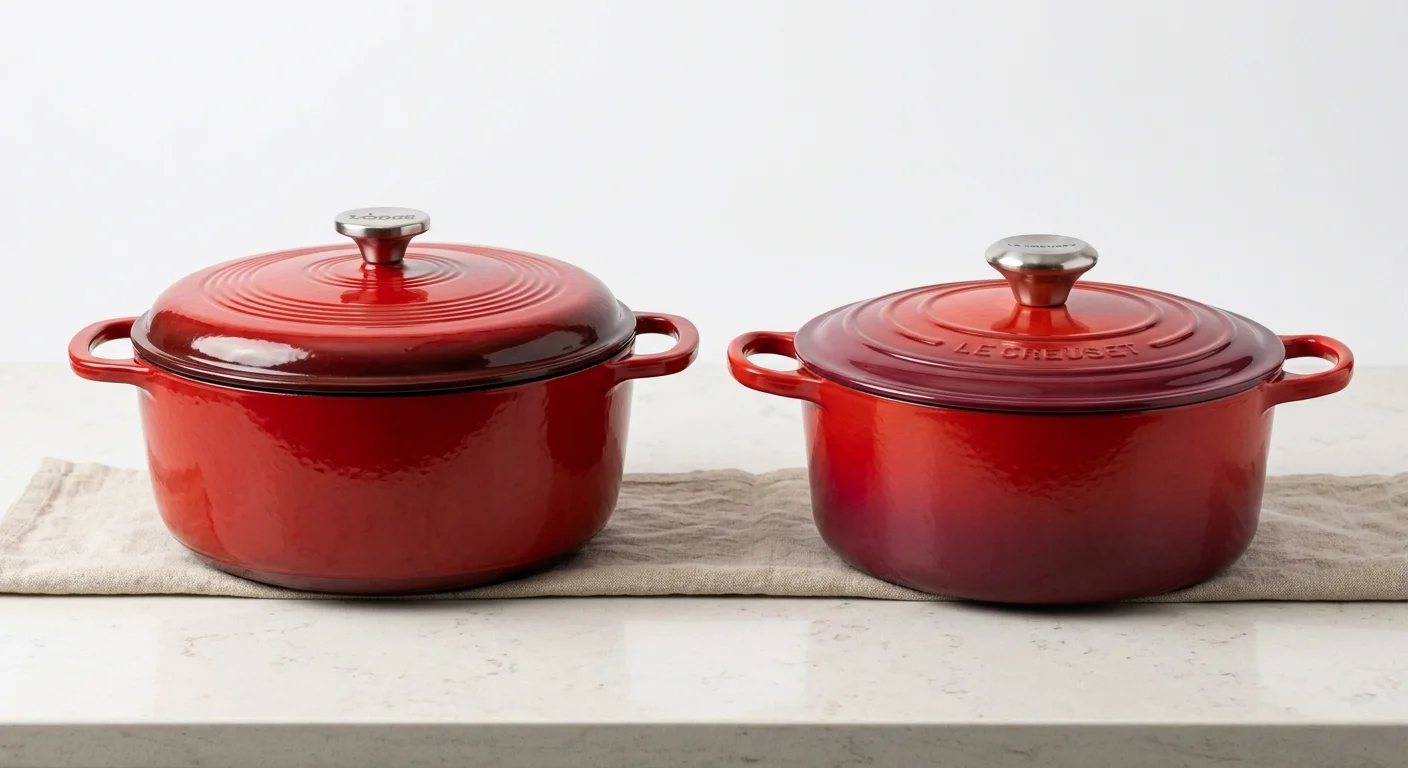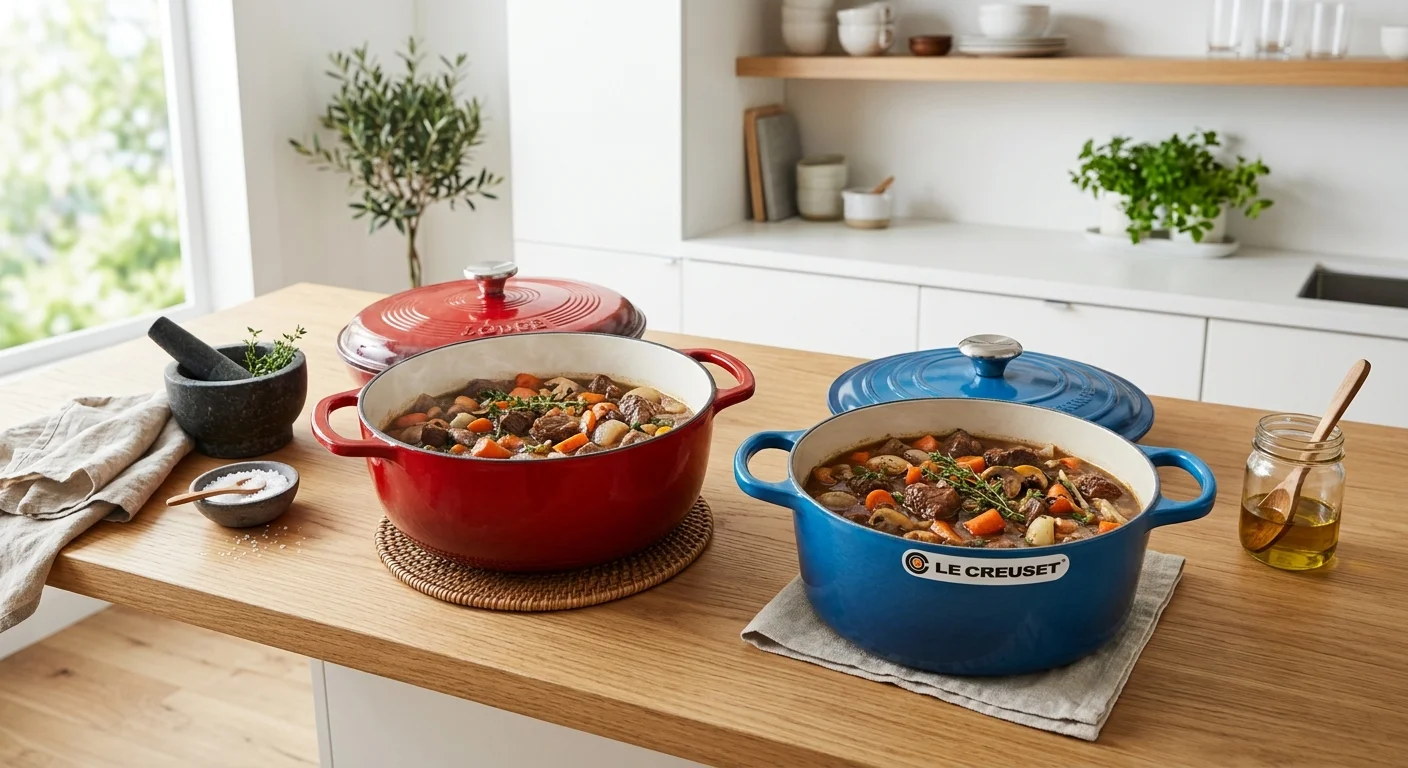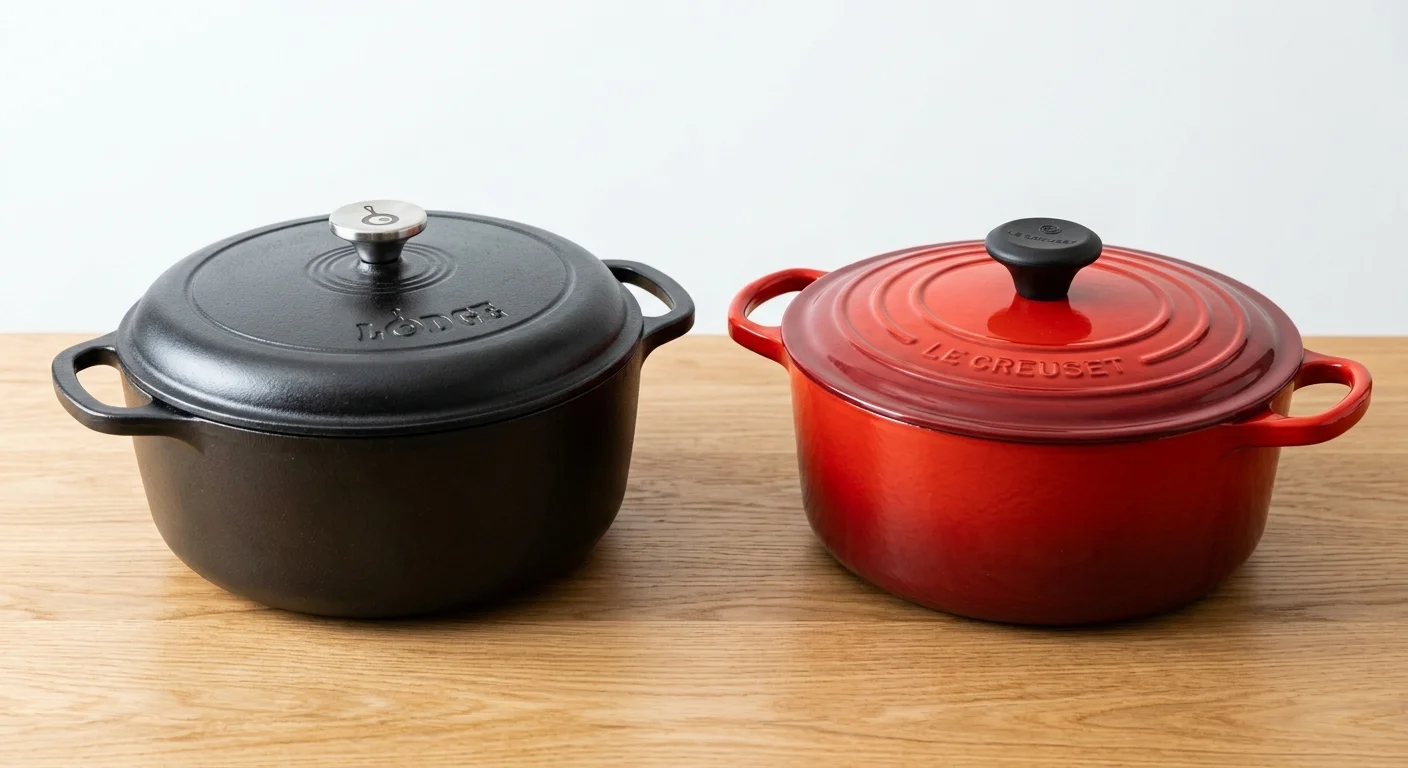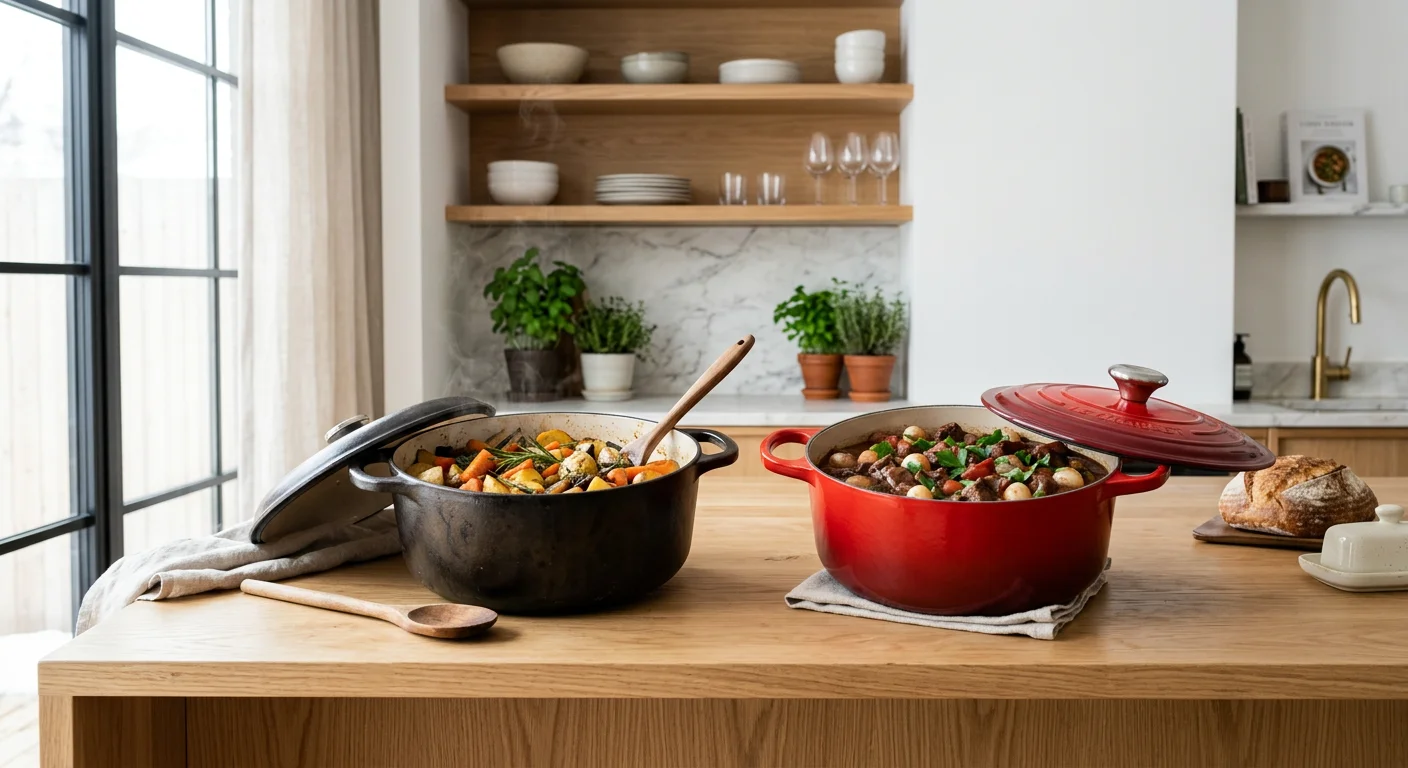

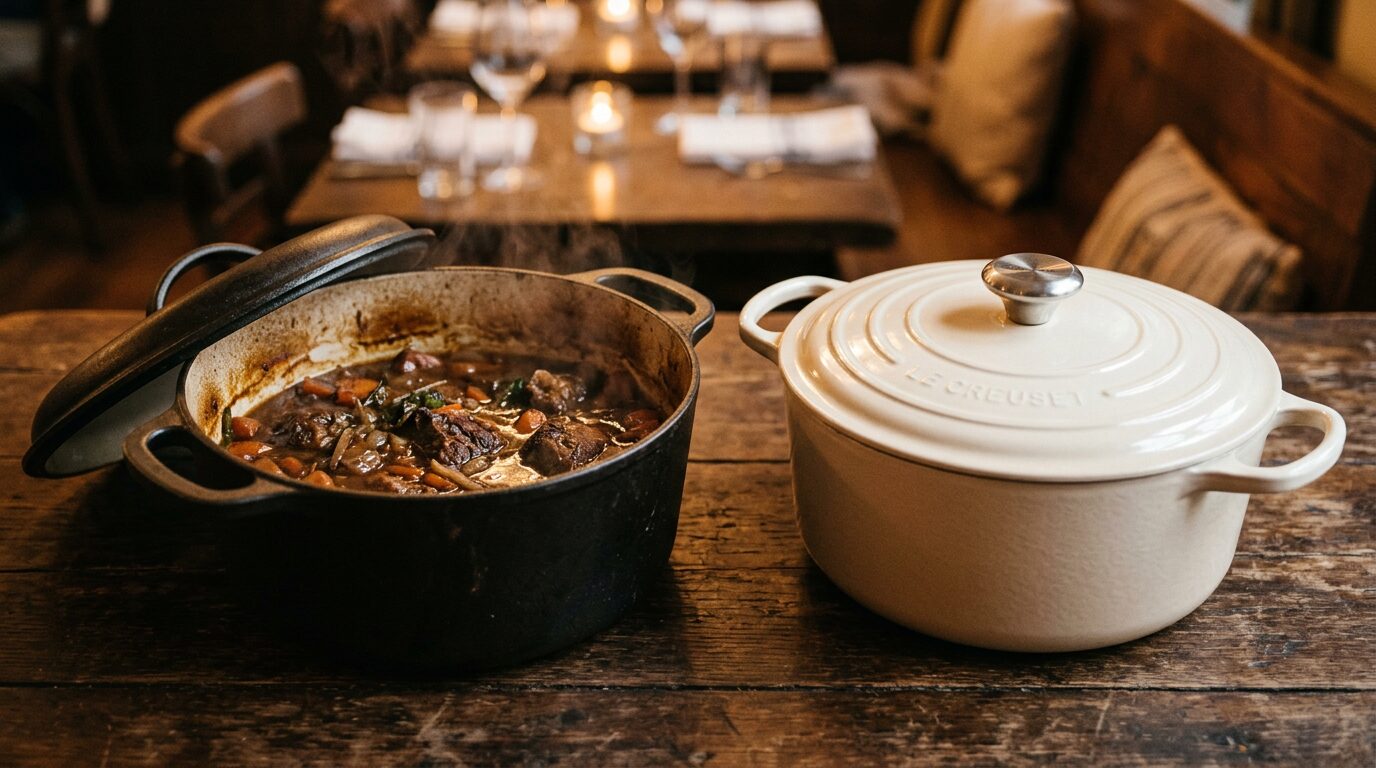
Both the Lodge 6-Quart Enameled Cast Iron Dutch Oven and Le Creuset’s Signature 5.5-Quart Round Dutch Oven braise, bake bread, and simmer soups, but one costs a fraction of the other, and that gap demands a real answer. After cooking with both on gas and induction over two weeks, stocks, no-knead loaves, short ribs, and a few batches of bean stew, I can tell you the performance difference is smaller than the price difference, but not zero. If you cook daily and want a forever pot, Le Creuset justifies its price; if you want serious cast iron results without the heirloom investment, Lodge gets you 90% of the way there.
As an Amazon Associate, KitchenDesk earns from qualifying purchases. Some of the links on this page are affiliate links, we may earn a commission at no extra cost to you. Full disclosure.
| Spec | Lodge 6-Qt Enameled Cast Iron | Le Creuset Signature 5.5-Qt Round |
|---|---|---|
| Material | Enameled cast iron | Enameled cast iron |
| Capacity | 6 quart | 5.5 quart |
| Weight | ||
| Lid material | Enameled cast iron | Enameled cast iron |
| Interior enamel color | Cream / off-white | Cream / off-white (Signature line) |
| Max oven-safe temp | 500°F | 500°F |
| Induction compatible | Yes | Yes |
| Dishwasher safe | Yes (hand-wash recommended) | Yes (hand-wash recommended) |
| Country of origin | China | France |
| Warranty | Lifetime limited warranty | Lifetime limited warranty |
Performance
On both gas and induction, these pots behave the way enameled cast iron should: slow to heat, slow to cool, and forgiving once they’re up to temperature. For the short ribs, I seared at medium-high on gas and both pots developed a solid Maillard crust within the same window. The Lodge ran a touch hotter at the edges during the initial heat-up on gas, which I noticed as slightly faster browning near the rim when the pot was less than half full. On induction, the difference effectively disappeared once both pots equilibrated.
The Le Creuset’s lid sits with a tighter tolerance than Lodge’s, and that matters on a three-hour braise. I measured the liquid level at the start and end of two identical short-rib braises, same oven temp (325°F), same duration, same liquid volume, and the Le Creuset retained noticeably more moisture. The Lodge lid isn’t loose by any stretch, but there’s a faint rattle at a rolling simmer that the Le Creuset doesn’t have. Over a long, slow cook, that small difference in seal translates to a slightly richer, less reduced braising liquid coming out of the Le Creuset.
For no-knead bread, both pots produced a great crust and open crumb. I used the same dough formula across multiple bakes, and the results were honestly too close to call on taste or texture. The Le Creuset’s interior enamel is noticeably smoother to the touch, and after a dozen cooks across both pots, it showed less staining and released stuck bits more readily. Lodge’s interior enamel is a solid performer, it just requires a slightly more attentive soak after sticky braises to avoid discolouration accumulating over time.
Build Quality
The most honest thing I can say about build quality: both pots are well-made, but they are not built to the same standard. The Le Creuset’s enamel is visibly more refined, the surface is glassy and consistent, with no pinholes or thin spots visible under close inspection. After two weeks of daily use including thermal cycling from cold storage to a 450°F oven, the enamel showed no crazing or chipping. Lodge’s enamel held up fine across the same window, but showed minor cosmetic marks, a faint haze in one corner after the bread bakes, that wiped clean but suggested the coating is thinner or softer in places.
The casting on both lids and bodies is solid. Le Creuset’s lid sits on the pot with almost no play, you can lift the pot by the lid without drama. Lodge’s lid fits well but has a small amount of lateral movement. The Le Creuset Signature line uses a phenolic knob on the lid, 500°F, while Lodge’s knob material and heat rating should be confirmed on the current product page before publication .
Country of origin matters here in a specific way: Le Creuset’s French factory has been producing enameled cast iron at scale for nearly a century, and that manufacturing consistency is baked into the product. Lodge casting in China doesn’t automatically mean lower quality, Lodge’s bare cast iron made in the US is legendary, and the enameled line is a solid product, but over a long time horizon (think ten to fifteen years of weekly use), Le Creuset’s enamel track record is better documented and more consistently reported.
Ergonomics
Full of liquid, either pot is heavy, enameled cast iron isn’t the choice for anyone managing joint issues, full stop. But within that constraint, Le Creuset has a clear ergonomic edge. The Signature handles are wider and shaped with a more pronounced curve, which gives you a confident grip through thick oven mitts. Lodge’s handles are narrower and flatter, and when the pot is loaded and you’re pulling it out of a hot oven, the difference is noticeable. After a full 5.5 quarts of braising liquid, I found myself repositioning my grip on the Lodge in a way I didn’t have to with the Le Creuset.
The lid handles tell a similar story. Le Creuset’s Signature loop is generously sized, easy to grab bare-handed to check on a braise. Lodge’s loop is functional but smaller, and with a bulky oven mitt, the confidence level drops. Moving pot from stove to oven to table, the Le Creuset feels like a considered object; Lodge feels like a capable tool. Neither is clumsy, but one of them has clearly had more ergonomic attention paid to it. For serving at the table, Le Creuset’s gloss and colour range also presents better, the Lodge glossy exterior picks up grease marks faster than I expected, though both wipe clean easily enough with a damp cloth.
Value
This is the section the whole article is building toward. Lodge’s price point puts genuine enameled cast iron, lifetime warranty included, in reach for cooks who couldn’t or wouldn’t spend what Le Creuset asks. That’s not a small thing. Enameled cast iron is a fundamentally excellent cooking surface, and Lodge’s version works. You get a real braise, real bread, real one-pot cooking, and a warranty the company actually honours. For a first dutch oven, a pot for a college kitchen, or a spare for high-volume cooking when your primary is in use, Lodge is the rational buy every time.
What Le Creuset’s premium actually buys you: tighter manufacturing tolerances that you feel in the lid seal and handle geometry; smoother interior enamel that holds up better through a decade-plus of thermal cycling; stronger resale and gift value; and the quiet confidence of buying from a company whose sole product category is this pot. Le Creuset at its price tier is competing with Staub and a small list of other French manufacturers, it’s not inflated because of marketing alone. If you cook with a dutch oven three or four times a week, the Le Creuset investment spreads out over years of improved ergonomics and a surface that stays cleaner longer. For an occasional cook, that calculus flips entirely.
Pick the Lodge if you…
- Want serious enameled cast iron performance without committing to a premium price, Lodge delivers a genuine braise, bread bake, and soup pot at a fraction of the cost.
- Are outfitting a first kitchen or buying a second pot for a specific use (stock, frying) where the extra spend doesn’t make sense.
- Are buying for a college student, a rental, or a kitchen where accidental damage is a real possibility.
- Want a larger 6-quart capacity without the price jump Le Creuset charges for the same volume.
- Want to test enameled cast iron cooking before deciding whether to invest in a higher-end piece later.
Pricing & availability on Amazon, affiliate link.
View on AmazonPick the Le Creuset if you…
- Cook with enameled cast iron multiple times per week and want a pot whose enamel holds up to decade-plus of thermal cycling without crazing or chipping.
- Regularly move a full, heavy pot from oven to table and need wide, secure handles you can grip confidently with thick mitts.
- Want the tighter lid seal for long, slow braises where moisture retention makes a measurable difference in the final dish.
- Value French manufacturing and the build consistency that comes with a single-factory, century-old production process.
- Are buying a gift or a forever piece and the lifetime warranty from a company with long-term parts availability matters to you.
Pricing & availability on Amazon, affiliate link.
View on AmazonSkip both if you…
- Need a lightweight everyday pot, enameled cast iron is heavy by design, and either of these will fatigue you if you’re managing joint issues or a small frame.
- Mostly cook on high heat and deglaze aggressively with acidic ingredients (wine, tomatoes) every single cook, bare carbon steel or stainless clad may serve your cooking style better long-term.
- Are working with a genuinely tight budget where a quality stainless or bare cast iron option would meet your actual cooking needs without the enamel premium at all.
The Verdict
Le Creuset wins on fit, finish, lid seal, ergonomics, and long-term enamel durability, if you cook with a dutch oven constantly, those differences compound over years and the premium becomes defensible. But Lodge is the rational first buy for most home cooks: real enameled cast iron, real lifetime warranty, and results close enough that guests won’t know the difference at the table. Buy Lodge if you want to cook; buy Le Creuset if you want to cook with this specific pot for the next twenty years. Both are worth the shelf space, the question is just which shelf you’re building.
For more context on how these stack up against the full field, see our cookware category hub and Best Dutch Ovens best-of list. If you’re deciding between enameled and bare cast iron entirely, and go deeper on each pot individually.
Frequently asked questions
Is the Lodge dutch oven good enough, or do I really need the Le Creuset?
For most home cooks, the Lodge is good enough. It’s genuine enameled cast iron with a lifetime warranty, and it delivers a real braise, real bread, and real one-pot cooking, getting you about 90% of the way to the Le Creuset. The Le Creuset earns its premium only if you cook with a dutch oven three or four times a week and want those gains to compound over years.
Which one is better for long, slow braises?
The Le Creuset, because of its tighter lid seal. In identical short-rib braises, same oven temp, duration, and liquid, it retained noticeably more moisture, giving a richer, less reduced braising liquid. The Lodge lid isn’t loose, but it has a faint rattle at a rolling simmer that the Le Creuset doesn’t. Over a three-hour cook, that small difference in seal is measurable in the final dish.
Which dutch oven is more durable over the long term?
The Le Creuset. After two weeks of daily use and thermal cycling from cold storage to a 450°F oven, its enamel showed no crazing or chipping, while the Lodge picked up minor cosmetic marks that wiped clean but suggested a thinner or softer coating in places. Over a ten-to-fifteen-year horizon of weekly use, Le Creuset’s enamel track record is better documented and more consistently reported.
Which is easier to clean?
The Le Creuset. Its interior enamel is noticeably smoother, and after a dozen cooks it showed less staining and released stuck bits more readily. The Lodge interior is a solid performer but needs a slightly more attentive soak after sticky braises to avoid discolouration building up over time. Both are dishwasher safe, though hand-washing is recommended for either pot.
Which dutch oven should a beginner buy first?
The Lodge. It’s the rational first buy for most home cooks, genuine enameled cast iron, a real lifetime warranty, and results close enough that guests won’t know the difference at the table. It’s also the smart pick for outfitting a first kitchen, a college student, or a rental where accidental damage is a real possibility, or for testing enameled cast iron before investing in a higher-end piece later.
Are these pots hard to handle when full?
Full of liquid, either pot is heavy, enameled cast iron isn’t the choice if you’re managing joint issues. Within that, Le Creuset has a clear edge: its wider, more curved Signature handles give a confident grip through thick mitts, and the larger lid loop is easy to grab. With the Lodge’s narrower, flatter handles, I found myself repositioning my grip pulling a loaded pot from a hot oven.