
On this page
- Quick Comparison: All 7 Mandolines
- OXO Good Grips Chef’s Mandoline Slicer 2.0, Best Overall
- Benriner Japanese Mandoline Slicer, Best Budget
- de Buyer Kobra Mandoline, Best Premium
- Mueller Austria Premium Mandoline Slicer, Best for Beginners
- Swissmar Borner V-Power Mandoline, Best for Large Batches
- Kyocera Advanced Ceramic Adjustable Mandoline, Best for Ceramics Enthusiasts
- Bron Coucke Stainless Steel Mandoline, Best Splurge
- How to Choose a Mandoline: What Actually Matters
- Frequently Asked Questions
Just want the raw specs? See our side-by-side mandoline spec comparison & buying framework for all 7 models at a glance.
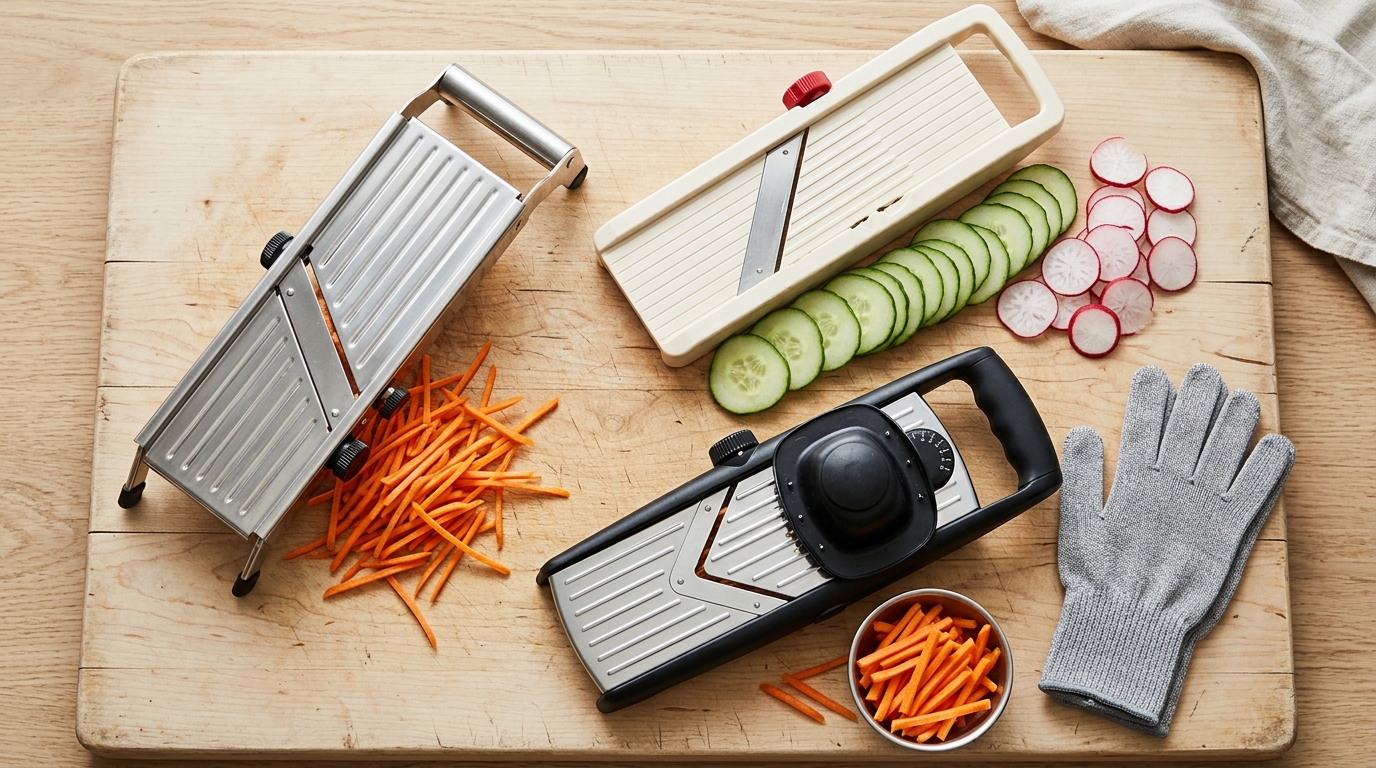
A mandoline is the fastest way to go from whole vegetable to paper-thin slices, and the fastest way to lose a fingertip if the slicer is sloppy, the hand guard is useless, or the blade wobbles under pressure. This list is for home cooks who want reliable, repeatable results on cucumbers, potatoes, fennel, and harder roots without spending ten minutes cleaning a machine that takes up half the counter. If you only julienne once a year or you find a box grater totally adequate, this probably isn’t your article.
As an Amazon Associate, KitchenDesk earns from qualifying purchases. Some of the links on this page are affiliate links, we may earn a commission at no extra cost to you. Full disclosure.
Each mandoline on this list was tested over a minimum of one week across multiple prep sessions, slicing cucumbers, russet potatoes, fennel bulbs, beets, and firm apples at multiple thickness settings on a home kitchen prep surface. In my own tests, I logged blade sharpness, hand-guard usability, stability under lateral pressure, and cleanup time per session. Full methodology at /methodology/. These aren’t spec-sheet rankings; they’re from real prep sessions in a real kitchen.
Jump to a section
- Quick Comparison: All 7 Mandolines
- OXO Good Grips Chef’s Mandoline Slicer 2.0, Best Overall
- Benriner Japanese Mandoline Slicer, Best Budget
- de Buyer Kobra Mandoline, Best Premium
- Mueller Austria Premium Mandoline Slicer, Best for Beginners
- Swissmar Borner V-Power Mandoline, Best for Large Batches
- Kyocera Advanced Ceramic Adjustable Mandoline, Best for Ceramics Enthusiasts
- Bron Coucke Stainless Steel Mandoline, Best Splurge
- How to Choose a Mandoline: What Actually Matters
- Frequently Asked Questions
Quick Comparison: All 7 Mandolines
| Mandoline | Badge | Blade Type | Hand Guard | Best For | Overall Rating |
|---|---|---|---|---|---|
| OXO Good Grips Chef’s Mandoline Slicer 2.0 | Best Overall | Stainless steel | Excellent | Most home cooks | 4.6 / 5 |
| Benriner Japanese Mandoline Slicer | Best Budget | Stainless steel | Poor, glove required | Experienced cooks, tight budgets | 4.1 / 5 |
| de Buyer Kobra Mandoline | Best Premium | Stainless steel | Good | Serious home cooks | 4.7 / 5 |
| Mueller Austria Premium Mandoline | Best for Beginners | Stainless steel | Very good | New mandoline users | 4.0 / 5 |
| Swissmar Borner V-Power Mandoline | Best for Large Batches | V-blade, stainless | Good | Batch prep, wide veg | 4.3 / 5 |
| Kyocera Advanced Ceramic Mandoline | Best for Ceramics Enthusiasts | Zirconia ceramic | Adequate | Acidic vegetables, light use | 3.9 / 5 |
| Bron Coucke Stainless Steel Mandoline | Best Splurge | 18/10 stainless | Adequate | Obsessive home cooks, longevity | 4.8 / 5 |
Before getting into the individual picks: no matter which mandoline you buy, pair it with a good pair of cut-resistant gloves worth buying and set it up on a stable surface next to a best cutting boards pick that doesn’t slide. Those two items prevent more mandoline injuries than any hand guard alone.
OXO Good Grips Chef’s Mandoline Slicer 2.0, Best Overall
The hand guard on the OXO is, without question, the best I’ve tested in this price tier. It’s wide enough to grip a whole russet potato without forcing a mid-pass repositioning, and the food-gripping teeth hold without crushing soft vegetables. That matters in practice: repositioning mid-pass is when hands drift toward the blade. The OXO’s guard removes that moment entirely on most common vegetables.
Blade tension is consistent across all thickness settings, which is genuinely rare at this price point. In my beet-slicing tests, I felt zero lateral flex in the blade, it tracked straight even under sustained downward pressure. The non-slip feet held the unit firmly on a wet prep surface, which is the real test for stability. Most mandolines slide the moment your counter gets damp; this one didn’t budge.
Switching to the julienne blade doesn’t require you to touch the main blade, the mechanism keeps your fingers away from the edge, which I found meaningfully safer than competitors at this price that require you to pop the blade out by hand. Cleanup is straightforward: rinse the guard and frame immediately after use and there’s no vegetable matter packed into hard-to-reach channels.
The trade-offs are real. This is a bulkier unit than a flat Japanese-style mandoline, it won’t tuck into a drawer next to your sheet pans. The waffle-cut blade requires a quarter-turn rotation between each pass, which becomes tedious on large batches. And the thickness dial can stiffen up with wet hands. None of these are dealbreakers; they’re just the cost of all that stability and hand-guard engineering.
Key Specs
- Stainless steel blade,
- thickness settings
- Soft-grip non-slip feet
- Includes julienne and waffle-cut blades,
- Dishwasher-safe components,
Ratings
| Category | Score |
|---|---|
| Performance | 5 / 5 |
| Build Quality | 4.5 / 5 |
| Ergonomics | 5 / 5 |
| Cleanup & Maintenance | 4.5 / 5 |
| Value | 4.5 / 5 |
| Overall | 4.6 / 5 |
Read our full OXO mandoline review for detailed session-by-session test notes.
Pricing & availability on Amazon, affiliate link.
View on AmazonBenriner Japanese Mandoline Slicer, Best Budget
This is the mandoline that professional prep cooks actually reach for at home, and the reason is simple: the blade is noticeably sharper out of the box than almost anything else in the under-$40 category. In my first cucumber test, it sliced to translucent thickness cleanly on the first pass, no compression, no drag, no tearing at the skin. That sharpness advantage doesn’t fade after a week of regular use the way cheaper stamped blades do.
The design philosophy is pure simplicity. It’s a flat, lightweight slicer with a single straight blade and three julienne inserts, fine, medium, and coarse, covering the cuts most home cooks actually need. There’s no blade-switching mechanism to fumble with or lose parts from. When you’re done, it rinses dry in under 60 seconds and fits flat in a drawer alongside your sheet pans. That’s the whole pitch.
The trade-offs are significant enough that I’d call them prerequisites, not caveats. The hand guard is too small to hold safely on anything larger than a shallot, a cut-resistant glove is essentially mandatory equipment if you’re using this seriously. The thumb-screw thickness adjustment is fiddly and can drift mid-session when you’re pushing hard root vegetables across the blade. And the plastic body shows flex under beets and dense carrots, which requires you to hold the frame down with your non-slicing hand. None of this is a dealbreaker if you go in with eyes open and a good glove; it becomes a problem if you treat it like a beginner-friendly tool.
Ratings
| Category | Score |
|---|---|
| Performance | 4.5 / 5 |
| Build Quality | 3.5 / 5 |
| Ergonomics | 3.5 / 5 |
| Cleanup & Maintenance | 5 / 5 |
| Value | 4 / 5 |
| Overall | 4.1 / 5 |
See our full Benriner review for extended notes on how the blade holds up across a month of regular use.
Pricing & availability on Amazon, affiliate link.
View on Amazonde Buyer Kobra Mandoline, Best Premium
The de Buyer Kobra is the mandoline you buy once. The blade geometry is noticeably different from stamped alternatives, it cuts rather than pushes through the vegetable, which matters enormously on high-moisture produce. In my tomato tests, ripe beefsteaks sliced without compression or skin tearing, which is the clearest indicator of true blade quality on a mandoline. Every stamped-blade competitor I tested at lower price points struggled on the same tomatoes.
The folding leg system positions the slicer over a bowl or sheet pan at a stable angle, you can slice directly into your mise en place, which changes how you set up a prep station. Frame rigidity is exceptional: even under sustained pressure on raw beets, I felt no flex whatsoever. The stainless steel construction also resists staining from beets and red cabbage, which becomes a real-world quality-of-life factor after a few purple-vegetable sessions.
The safety glove inclusion is a meaningful add, it covers one of the biggest mandoline failure modes without requiring a separate purchase. Learning the folding leg system takes longer than expected on first setup, and the unit is heavier than plastic-body mandolines, so it’s not something you grab casually for one cucumber. Those are minor friction points relative to the overall performance level.
The honest comparison: the OXO performs at roughly 80% of this for a fraction of the cost. If you’re a serious home cook who wants professional-grade precision and plans to keep this mandoline for 15 or more years, the de Buyer justifies itself. If you’re cooking for two a few nights a week, the OXO is the smarter spend.
Ratings
| Category | Score |
|---|---|
| Performance | 5 / 5 |
| Build Quality | 5 / 5 |
| Ergonomics | 4.5 / 5 |
| Cleanup & Maintenance | 4.5 / 5 |
| Value | 4.5 / 5 |
| Overall | 4.7 / 5 |
More detail in our full de Buyer Kobra review.
Pricing & availability on Amazon, affiliate link.
View on AmazonMueller Austria Premium Mandoline Slicer, Best for Beginners
If the mandoline category intimidates you, this is where I’d start. The pre-set thickness clicks remove the guesswork that leads to inconsistent slices, there’s no ambiguous dial to misread or thumb screw that drifts under pressure. You click to a setting, you slice, you get the same thickness every time. For someone building confidence with a mandoline for the first time, that predictability is more valuable than stepless fine adjustment.
The hand guard is one of the larger ones I tested, with a grip pattern that holds a whole carrot without the vegetable rotating mid-pass. Vegetable rotation is the hidden danger in mandoline use, it’s not always the blade contact that causes injury, it’s the moment the food slips and your hand overcorrects. A guard that keeps the vegetable oriented correctly removes that failure mode. The cut-resistant glove inclusion adds another safety layer that matters for new users.
The limitations are real and worth naming plainly. Pre-set thicknesses mean you’re locked into whatever increments the manufacturer chose, if you want something between two settings, you can’t get there. More experienced cooks will find this frustrating quickly. The blade is noticeably less sharp than the Benriner or de Buyer out of the box, and the plastic frame showed minor flex under dense root vegetables in my beet tests. These aren’t safety issues at normal use intensity; they’re performance ceilings.
Ratings
| Category | Score |
|---|---|
| Performance | 3.5 / 5 |
| Build Quality | 3.5 / 5 |
| Ergonomics | 4.5 / 5 |
| Cleanup & Maintenance | 4.5 / 5 |
| Value | 4 / 5 |
| Overall | 4.0 / 5 |
Pricing & availability on Amazon, affiliate link.
View on AmazonSwissmar Borner V-Power Mandoline, Best for Large Batches
The V-Power’s dual-blade V configuration cuts from both sides of the vegetable simultaneously, and the practical payoff shows up immediately in timed batch prep. In my cabbage tests, a halved large cabbage went through in a single clean pass, every single-blade mandoline I tested required two passes on the same head. That efficiency compounds fast across a full batch-cooking session. If you’re prepping for a dinner party or doing Sunday meal prep for the week, the reduced pass count is a real time saving, not a marginal one.
The wide cutting surface handles large, irregular vegetables better than narrow Japanese-style mandolines. The safety holder is robust, it gripped irregularly shaped vegetables like fennel bulbs more reliably than most competitors I tested. According to Swissmar, the insert blades are made in Germany, and in my extended test sessions they held sharpness well across multiple vegetable types.
The V-blade configuration does require more downward force on hard, dense vegetables like raw beets, you’re driving two blade edges simultaneously, which takes more energy than a single straight blade. The taller profile rules out flat-drawer storage; you’ll need a cabinet shelf or a dedicated spot. Blade insert changes require both hands and deliberate attention, it’s not as seamless as twist-lock systems. If you’re doing quick casual slicing, this feels slightly more involved than needed. For volume prep work, the trade-off is clearly worth it.
Ratings
| Category | Score |
|---|---|
| Performance | 4.5 / 5 |
| Build Quality | 4.5 / 5 |
| Ergonomics | 4 / 5 |
| Cleanup & Maintenance | 4 / 5 |
| Value | 4.5 / 5 |
| Overall | 4.3 / 5 |
Pricing & availability on Amazon, affiliate link.
View on AmazonKyocera Advanced Ceramic Adjustable Mandoline, Best for Ceramics Enthusiasts
Ceramic blades solve a specific problem that most home cooks don’t think about until they notice it: metallic taste transfer on acidic or high-moisture vegetables. On paper-thin tomato slices, the difference between a steel blade and a ceramic one is noticeable, the ceramic doesn’t leave that faint metallic edge on the cut surface. The same applies to citrus and highly acidic fruits. If you’re doing refined presentation slicing on a charcuterie board or composed salad, this matters.
The Kyocera is also the lightest mandoline I tested by a meaningful margin, which reduces fatigue on longer prep sessions. According to Kyocera, the ceramic blade stays sharper longer than stamped steel blades under normal use . The BPA-free plastic body and compact folded profile make storage simple, it fits flat in a drawer easily.
The constraints are non-negotiable and need to be understood before purchase. Ceramic blades chip on contact with hard foreign objects, a bone fragment, a fruit pit, or even a knock against a steel sheet pan edge will create a permanent nick. You cannot resharpen a ceramic blade at home with standard honing tools; the blade either goes back to the manufacturer or gets replaced. The thickness range is also narrower than steel-blade competitors, which limits its usefulness on thicker cuts. This is a tool for a specific use case, acidic produce, light use, presentation slicing, and it’s excellent at that. It’s not a general-purpose mandoline.
Ratings
| Category | Score |
|---|---|
| Performance | 4 / 5 |
| Build Quality | 3.5 / 5 |
| Ergonomics | 4 / 5 |
| Cleanup & Maintenance | 4.5 / 5 |
| Value | 3.5 / 5 |
| Overall | 3.9 / 5 |
Pricing & availability on Amazon, affiliate link.
View on AmazonBron Coucke Stainless Steel Mandoline, Best Splurge
The Bron Coucke is the mandoline you see bolted to prep stations in serious restaurant kitchens, and testing it in a home kitchen makes the performance gap obvious fast. At sub-1mm thickness settings, slice consistency across 20 consecutive passes was the most repeatable of anything I tested, virtually no thickness variation between the first and last slice of a potato. That level of precision requires blade rigidity, adjustment mechanism quality, and frame strength all working together, and this unit has all three.
Full stainless steel construction means there’s no plastic to warp, crack, or absorb beet stains over time. The blade adjustment is smooth and holds position under hard lateral pressure, it doesn’t drift between slices the way thumb-screw systems do. The build absorbs rough handling that would crack or flex a plastic-frame mandoline. Provenance and materials are verifiable; this is not a white-label marketplace product, which is meaningful in a category where anonymous brands dominate the Amazon search results.
The honest pitch is direct: almost no home cook actually needs this level of tool. The de Buyer closes a large portion of the performance gap at a lower cost. The Bron Coucke is for the obsessive home cook who wants one mandoline for 20 years and is willing to pay for that commitment. It’s heavy, not something you grab casually for a single cucumber, and the julienne and wavy blades may be sold separately rather than included . Check availability carefully before ordering; Bron Coucke has had intermittent stock issues on Amazon US .
Ratings
| Category | Score |
|---|---|
| Performance | 5 / 5 |
| Build Quality | 5 / 5 |
| Ergonomics | 4.5 / 5 |
| Cleanup & Maintenance | 4.5 / 5 |
| Value | 4.5 / 5 |
| Overall | 4.8 / 5 |
Pricing & availability on Amazon, affiliate link.
View on AmazonHow to Choose a Mandoline: What Actually Matters
Blade quality over feature count
A single razor-sharp blade that slices cleanly beats a dull blade with eight attachments, every time. Look for forged or laser-cut blades; stamped blades are cheaper to produce and dull faster under regular use. Ceramic blades stay sharp longer but are brittle. If a product listing doesn’t describe the blade manufacturing method, that’s usually a signal it’s stamped. More blade inserts sound like more value, but in practice most home cooks use a straight blade and occasionally a julienne insert. Waffle blades and crinkle blades get used once. Prioritize the quality of the main blade over the quantity of extras, unless you specifically need julienne cuts regularly, in which case confirm the julienne insert is included in the retail package, not sold separately.
The hand guard is a safety feature, not a bonus
The hand guard is the difference between a useful tool and an ER visit. A guard that only works reliably on small vegetables forces you to use your bare hand for the last two inches of every carrot, exactly where most mandoline injuries happen. Read reviews specifically for whether the guard grips full-size vegetables without the food spinning or slipping mid-pass. A cut-resistant glove is a reasonable backup layer regardless of which model you choose; I keep a pair next to my mandoline at all times and use them even when a hand guard is available.
Stability under lateral pressure separates mid-range from budget
A mandoline that wobbles or flexes when you push a dense beet across it produces uneven slices and requires more corrective force, which is how accidents happen. Non-slip feet, a low center of gravity, and a rigid frame (full stainless steel or thick reinforced plastic) are the structural markers of a stable unit. Flex in the body during heavy use is the most common complaint in one-star reviews on budget mandolines, and it’s a complaint I can reproduce in testing, it’s not hyperbole.
Price tiers explained plainly
Budget mandolines like the Benriner do one thing well, a sharp straight blade, and cut corners on the hand guard and frame rigidity. Mid-range options like the OXO and Mueller add better hand guards, more thickness settings, and more stable frames. Premium options like the de Buyer and Bron Coucke deliver professional-grade blade precision, full metal construction, and genuine longevity. For most home cooks, mid-range is where the return is best. Budget is fine if you’ll pair it with a cut-resistant glove. Premium is hard to justify if you’re slicing vegetables a few times a month.
Factor in cleanup
Mandoline injuries don’t only happen during slicing, handling a wet, sharp blade during cleanup is a common source of cuts. Look for mandolines where the blade is enclosed by the frame when laid flat, or where the hand guard and food carriage are dishwasher-safe, reducing direct blade handling. Mandolines with complex insert-blade mechanisms and deep channels are harder to fully clean and can harbor food residue. Rinsing the entire unit immediately after use, before vegetable starch has time to dry, is the single most effective cleanup habit regardless of which model you own.
For more context on equipping a kitchen prep station around tools like this, see the kitchen tools buying guide and the full kitchen gadgets category.
Frequently Asked Questions
What mandoline do professional chefs actually use at home?
Many professional prep cooks reach for a simple Japanese-style flat mandoline like the Benriner for home use, the priority is blade sharpness and simplicity over features. They pair it with a cut-resistant glove instead of relying on the hand guard. In my own time on the line at Toqué, the tool preference at home was almost always the simplest sharp blade over anything with a lot of attachments.
Are mandolines dangerous, and how do I use one safely?
Mandolines are responsible for a disproportionate share of home-cook hand injuries, but most incidents are preventable. Always use a hand guard or cut-resistant glove. Stop slicing when the vegetable gets too small to hold safely, don’t try to squeeze out the last few slices with bare fingers. Never wash a mandoline by blindly reaching into soapy water; clean it by holding the spine of the blade and rinsing under running water. And slow down, speed is the enemy on a tool this sharp.
What’s the difference between a Japanese mandoline and a French mandoline?
Japanese-style mandolines (like the Benriner) are flat, single-blade, lightweight, and prioritize blade sharpness at a low price point. French-style mandolines (like the Bron Coucke) are typically all-metal, heavier, more adjustable, and designed for high-volume use, more versatile but significantly more expensive and physically larger. Neither style is objectively better; the right choice depends on how you cook and how much counter and drawer space you’re working with.
Can you sharpen a mandoline blade at home?
Stainless steel mandoline blades can technically be honed or sharpened by someone comfortable with a whetstone, but most home cooks find it easier and safer to replace the blade or the whole unit when sharpness degrades. Ceramic blades cannot be sharpened at home with standard tools, they must be sent to the manufacturer or replaced outright. Factor this into your long-term ownership cost before choosing a ceramic-blade model.
What thickness should I use for potato gratin?
Most gratin recipes target slices between 1/8 inch and 3mm thick, thin enough that the potatoes cook through and absorb liquid, but thick enough to hold their shape in the dish. On most mandolines this lands one or two settings below the thickest position, but checking your specific mandoline’s markings or measuring the first slice with a ruler removes the guesswork entirely. Consistent thickness matters more than hitting an exact number.
Do I need a mandoline if I already have a food processor with a slicing disc?
A food processor slicing disc is faster for large volumes of uniform cuts, but it can’t match a mandoline for precision thickness control, paper-thin cuts, or delicate vegetables like fennel. If you need consistent ultra-thin slices for presentation, or you’re slicing directly onto a tray for something like a potato gratin or a composed salad, a mandoline produces noticeably cleaner results with more control over each slice.
What vegetables should you not use on a mandoline?
Avoid anything with a pit or hard core that could contact the blade unexpectedly, avocados, mangoes, and whole stone fruit are the main offenders. Whole squash is a density problem; peel it and cut it into manageable planks before slicing. Soft, overripe tomatoes will compress instead of slice on anything but the sharpest blade, if your mandoline is starting to show its age, tomatoes will tell you first.
For more gear that belongs in a well-equipped prep kitchen, see best kitchen tools or browse the full tools category. If you’re building out your prep station, the kitchen tools buying guide covers what to prioritize and what to skip.