

On this page
- How I Tested
- Quick Comparison
- 1. Microplane 4-Sided Box Grater, Best Overall
- 2. OXO Good Grips Box Grater, Best for Ergonomics
- 3. Cuisipro Surface Glide Technology Box Grater, Best Premium
- 4. KitchenAid Gourmet Box Grater, Best Mid-Range
- 5. Rösle Stainless Steel Box Grater, Best Splurge
- 6. Deiss PRO Cheese Grater Box, Best Budget
- 7. Zyliss Classic Rotary Cheese Grater, Best for Soft Cheese
- What to Look for When Buying a Box Grater
- Frequently Asked Questions
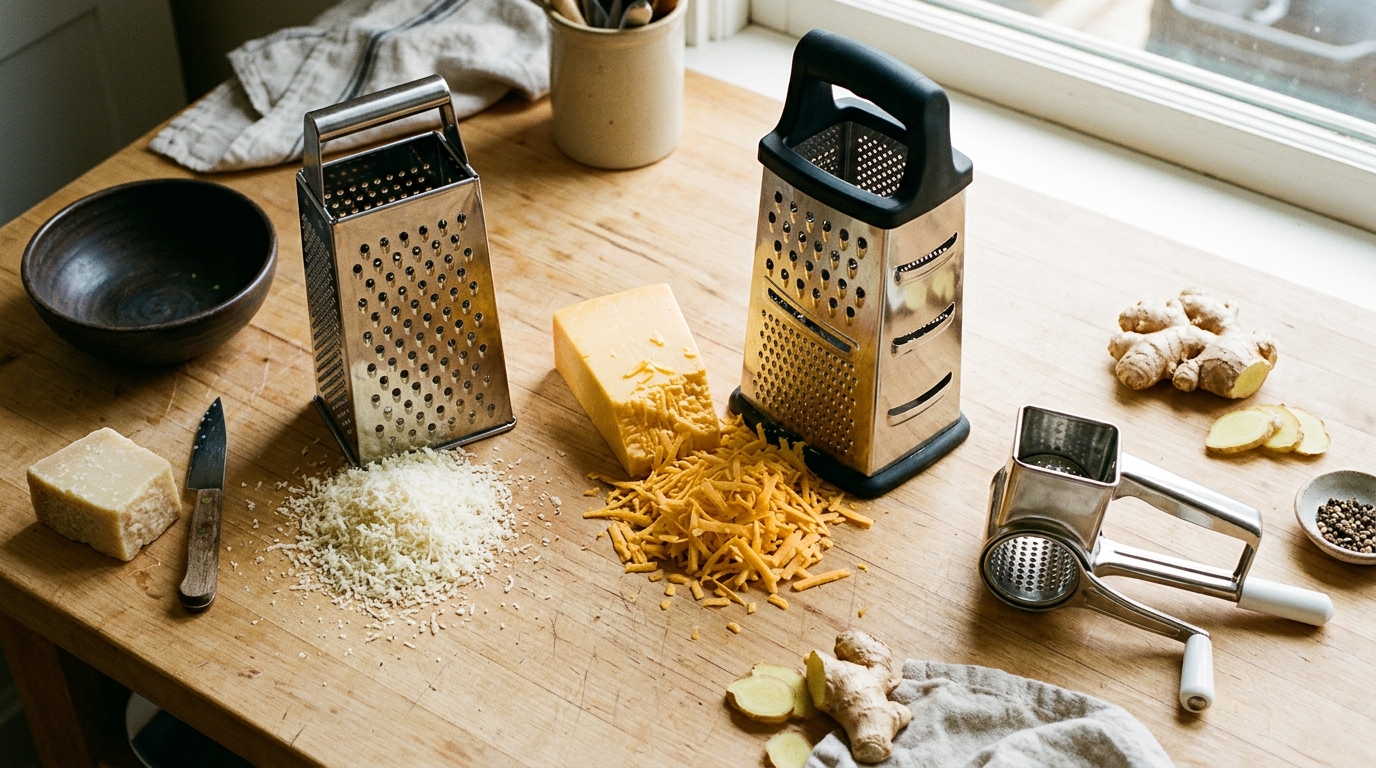
A dull or awkwardly built box grater turns a five-minute job into a knuckle-scraping ordeal, and most home cooks either own a cheap one they hate or a fancy one they barely understand. This list is for intermediate home cooks who grate cheese, zest citrus, shred vegetables, and want a tool that holds up over years of real use. If you only grate a block of Parmesan twice a year, a basic paddle grater is probably fine, this guide is for the rest of us. Every grater on this list was tested in my Toronto kitchen across at least a week of real sessions, not a single afternoon of light duty. I’ll tell you exactly who each pick is for and where it falls short.
As an Amazon Associate, KitchenDesk earns from qualifying purchases. Some of the links on this page are affiliate links, we may earn a commission at no extra cost to you. Full disclosure.
Jump to a section
- How I Tested
- Quick Comparison
- 1. Microplane 4-Sided Box Grater, Best Overall
- 2. OXO Good Grips Box Grater, Best for Ergonomics
- 3. Cuisipro Surface Glide Technology Box Grater, Best Premium
- 4. KitchenAid Gourmet Box Grater, Best Mid-Range
- 5. Rösle Stainless Steel Box Grater, Best Splurge
- 6. Deiss PRO Cheese Grater Box, Best Budget
- 7. Zyliss Classic Rotary Cheese Grater, Best for Soft Cheese
- What to Look for When Buying a Box Grater
- Frequently Asked Questions
How I Tested
Each grater went through a minimum of one week of multi-session testing: hard cheeses (aged cheddar, Parmigiano-Reggiano), soft cheeses (mozzarella, gruyère), root vegetables (carrots, ginger, beets), and citrus zesting. I tracked stability on a dry cutting board and a damp one, hand fatigue during longer prep sessions, and how painful, or painless, cleanup was after each use. The slicing face on every four-sided model got a proper workout too, not just a polite pass with a soft cucumber. Full methodology is at /methodology/.
Quick Comparison
| Grater | Badge | Blade Type | Non-Slip Base | Overall Rating |
|---|---|---|---|---|
| Microplane 4-Sided Box Grater | Best Overall | Photo-etched | Yes | 4.7 / 5 |
| OXO Good Grips Box Grater | Best for Ergonomics | Stamped steel | Yes | 4.4 / 5 |
| Cuisipro Surface Glide Box Grater | Best Premium | Stamped (raised arch) | Yes | 4.5 / 5 |
| KitchenAid Gourmet Box Grater | Best Mid-Range | Stamped steel | Yes | 4.2 / 5 |
| Rösle Stainless Steel Box Grater | Best Splurge | Stamped steel | No (all-stainless) | 4.3 / 5 |
| Deiss PRO Cheese Grater Box | Best Budget | Stamped steel | Yes | 3.8 / 5 |
| Zyliss Classic Rotary Cheese Grater | Best for Soft Cheese | Rotary drum | Yes | 4.0 / 5 |
For deeper context on what separates a good grater from a great one, see my box grater buying guide and the broader roundup of best cheese graters. If you’re also shopping for slicing tools, my best mandolines list is worth a read before you over-invest in a box grater’s slicing panel.
1. Microplane 4-Sided Box Grater, Best Overall
Microplane built its reputation on rasp graters, and the same photo-etching process that makes those so effective carries over to their four-sided box grater. Photo-etched blades are laser-cut rather than punched from sheet steel, which leaves each cutting edge sharper and more precisely angled than standard stamped-steel alternatives. You feel this most on hard aged cheeses and ginger: where a stamped grater drags and tears, the Microplane shaves cleanly, producing that lighter, fluffier pile of Parmigiano that actually melts properly over pasta rather than clumping.
In my own tests, the fine grating surface handled a wedge of aged cheddar with noticeably less effort than any of the stamped-steel options in this roundup. The handle keeps your knuckles further from the blade face on the downstroke, which matters when you’re moving fast. The non-slip base stayed put on both my dry cutting board and a slightly damp surface, which isn’t a given even among mid-range graters.
The slicing panel is the honest weak spot. It’s thin enough that it deflects under real pressure from dense vegetables, use it for soft zucchini or cucumber and it’s fine, but don’t expect mandoline-level results. And if you run photo-etched blades through the dishwasher regularly, the edges can dull faster than stamped steel . Hand-washing takes thirty seconds and is the right move here. For anyone who grates hard cheese, ginger, or citrus zest with any regularity, this is the tool I’d reach for first. I’d also point you to the full Microplane 4-Sided Box Grater review for the longer breakdown.
Pros & Cons
- Photo-etched blades cut rather than tear, noticeably less effort on hard aged cheeses and ginger
- Fine surface produces fluffier, lighter grated cheese than any stamped-steel competitor tested
- Handle geometry keeps knuckles clear of the blade face during downstrokes
- Non-slip base holds reliably on wet and dry surfaces
- Slicing panel deflects under pressure from dense vegetables
- Higher price point than most stamped-steel options in its size class
- Photo-etched blades may dull faster with repeated dishwasher cycles
Pricing & availability on Amazon, affiliate link.
View on Amazon2. OXO Good Grips Box Grater, Best for Ergonomics
Not everyone grates in short bursts. Holiday baking, meal prep Sundays, cooking for a crowd, those sessions add up fast, and a grater with a thin or rigid handle starts to hurt well before you’re done. The OXO Good Grips handle is meaningfully softer and wider than what you get on most competitors at this price, and after thirty minutes of grating carrots and cheese for a batch of latkes, the difference was obvious. My hand wasn’t fatigued the way it gets with narrower handles. This is the pick I’d hand to anyone dealing with grip weakness, arthritis, or just long prep sessions.
The integrated measurement container is genuinely useful rather than a gimmick. When a recipe calls for a cup of shredded cheese, you can grate directly into the container and read the measurement without transferring to a separate bowl. The wide, stable base minimises tipping even when you’re pressing hard on the coarse surface, a real safety point that’s easy to underestimate until a grater slides on you mid-stroke.
The blades are competent stamped steel. They’re sharp out of the box and handled both hard and semi-soft cheeses without complaint, but they don’t cut as cleanly as photo-etched alternatives on the fine surface, you can feel a bit more drag on Parmigiano compared to the Microplane. The handle’s textured grip can also trap small food particles if you don’t rinse it right away; let it sit and you’re scrubbing the texture with a brush. For a complete look at how it performs across more edge cases, see the full OXO Good Grips Box Grater review.
Pros & Cons
- Soft, wide Good Grips handle reduces fatigue noticeably during extended grating sessions
- Integrated container with pour spout is useful for measured recipe quantities
- Wide, stable base minimises tipping risk even under hard downward pressure
- Mid-range price with build quality that justifies it
- Stamped steel blades don’t cut as cleanly as photo-etched alternatives on hard cheeses
- Container adds bulk to the storage footprint
- Textured grip can trap food particles if not rinsed immediately after use
Pricing & availability on Amazon, affiliate link.
View on Amazon3. Cuisipro Surface Glide Technology Box Grater, Best Premium
Cuisipro’s Surface Glide Technology sounds like marketing language until you actually use it. The raised-arch blade pattern lifts food off the flat steel surface so it only contacts the cutting edges, not the full plane of the grater face. The practical result is less drag, especially on firm vegetables like carrots and beets where a flat stamped-steel surface creates real resistance. In back-to-back tests grating a pound of carrots, the Cuisipro required measurably less effort than any flat-surface competitor in this roundup, and the shred consistency across the full blade surface, not just the centre, was notably even. See the full Cuisipro Surface Glide Technology Box Grater review for more detail on how it stacks up over extended use.
The build feels substantial in a way that budget and mid-range options don’t, there’s no flex in the frame when you lean into it, and all four surfaces perform at a high level rather than the coarse side doing all the heavy lifting while the other faces feel like afterthoughts. This is the grater for someone who does serious meal prep, cooks for a crowd regularly, or wants something that performs closer to professional kitchen gear without actually buying from a restaurant supply house.
The trade-offs are real. It’s the priciest stamped-steel option tested, and it doesn’t have the blade-sharpness advantage that photo-etching gives the Microplane on the fine surface. The raised blade pattern is also harder to clean thoroughly than a flat surface, a stiff pastry brush is genuinely necessary here, not optional. And the industrial look is either a selling point or a drawback depending on your kitchen aesthetic, which is a real enough consideration .
Pros & Cons
- Raised-arch blade pattern measurably reduces drag on firm vegetables vs flat-surface graters
- Consistent shred size across the entire blade surface, not just the centre
- Sturdy frame with zero flex under hard pressure
- All four surfaces perform at a high level
- Higher price than OXO or KitchenAid without the photo-etched blade advantage of the Microplane
- Raised blade pattern requires a stiff brush for thorough cleanup
- Industrial aesthetic isn’t for every kitchen
Pricing & availability on Amazon, affiliate link.
View on Amazon4. KitchenAid Gourmet Box Grater, Best Mid-Range
There’s a real category of kitchen purchase that boils down to: “I want something good, I trust the brand, I don’t want to overthink it.” The KitchenAid Gourmet Box Grater is that purchase. It’s sharp out of the box, the non-slip base holds reliably on a dry cutting board, and the handle is comfortable through a normal prep session. I tested it back-to-back with the OXO across hard cheddar, mozzarella, and a couple of large carrots, and the performance gap is narrow, both are capable, honest graters .
Where it earns its place on this list is reliability and brand backing. If something goes wrong, a manufacturing defect, a blade issue, KitchenAid is a recognised name with accessible customer service and wide retail availability. That’s not a trivial consideration for a tool you’ll use for years. The build quality is solid, the blades handled both hard and semi-soft cheeses without any drama, and the grater felt appropriately rigid under pressure.
It doesn’t do anything meaningfully better than the OXO, which is worth naming plainly. If ergonomics are your priority, the OXO’s handle wins. If blade performance is your priority, the Microplane wins. The KitchenAid sits in the middle, a dependable workhorse that doesn’t require you to care about photo-etching or raised arch geometry. The handle can feel slightly narrow for larger hands during a long session, and there’s no included container or any extras. It’s a grater, and it does that job well. For those shopping within this tier, also worth comparing against options in my roundup of best kitchen tools for meal prep.
Pros & Cons
- Sharp blades straight from packaging, performs well on both hard and semi-soft cheeses
- Non-slip base holds reliably on a dry cutting board
- Comfortable handle for average-to-large hand sizes
- Widely available and easy to warranty-claim through a recognised brand
- Handle can feel slightly narrow for larger hands during extended use
- No included container or accessories
- Doesn’t differentiate meaningfully from OXO at the same price point
Pricing & availability on Amazon, affiliate link.
View on Amazon5. Rösle Stainless Steel Box Grater, Best Splurge
Rösle is a German kitchenware brand that takes its stainless steel seriously, and this box grater is built to the same standard as the rest of their line. The construction is fully stainless, according to the manufacturer, 18/10 grade, with no rubber feet, no plastic handle, no silicone components. Nothing to crack, nothing to discolour, nothing to degrade. That’s the core argument for spending this much on a box grater: you buy it once and you never have to think about replacing it.
In use, the rigidity is the first thing you notice. There’s zero flex in the frame even when pressing hard on dense beets or a firm wedge of aged Parmigiano. Most graters with plastic bases have a small amount of give that you stop noticing after a while, but picking up the Rösle after using lighter competitors makes the difference obvious. The blades performed well across all four surfaces, and the all-stainless construction means it’s dishwasher safe without worrying about rubber feet drying out or a handle grip separating over time .
The lack of a non-slip base is the one genuine trade-off, and it’s not a small one, on a smooth countertop, this grater slides unless you brace it with your off-hand or place a damp towel underneath. That becomes second nature quickly, but it’s still an extra step every time. It’s also noticeably heavier than plastic-base competitors, which some people prefer and others find tiring over a long session. If the ask is “I want to buy a box grater for the last time,” this is the answer. If you just want a solid daily driver, the Microplane or OXO will serve you better per dollar .
Pros & Cons
- Full 18/10 stainless construction, no rubber or plastic components to degrade
- Zero frame flex under hard pressure on dense vegetables
- Dishwasher safe without degradation concerns
- Realistically a lifetime tool if cared for
- No non-slip base, slides on smooth surfaces without a stabilising cloth underneath
- Noticeably heavier than plastic-base competitors
- Hard to justify the price unless you’re genuinely buying for the long haul
Pricing & availability on Amazon, affiliate link.
View on Amazon6. Deiss PRO Cheese Grater Box, Best Budget
Deiss doesn’t have the retail shelf presence of OXO or the rasp-grater legacy of Microplane, but this grater earned its spot on this list by simply performing well above what its price suggests. The blades were sharp on arrival and handled aged cheddar and a full bag of shredded carrots without excessive effort. The non-slip base worked reliably on both dry and slightly damp cutting boards. For equipping a first kitchen, furnishing a vacation property, or picking up a functional backup grater without any stress, this is the rec .
The lightweight build is both its strength and its limit. It’s easy to grab, use, and put away quickly, there’s no heft to deal with. But that same lighter gauge steel means the frame can flex slightly under hard downward pressure, and if you’re the type who leans into a grater when you’re pushing through a dense beet, you’ll feel it. The handle is functional but noticeably thinner and less padded than OXO or KitchenAid options, fine for a quick session, less ideal for twenty minutes of meal prep.
The fine grating surface is where the budget tier shows most clearly. On hard aged cheeses, it drags more than the premium options and produces a slightly coarser, less fluffy result than the photo-etched Microplane. That matters if hard cheese is your primary use case. For everything else, shredding semi-soft cheese, grating carrots, zesting a lemon, it gets the job done. When it eventually dulls or the frame shows its age, replacing it won’t cause any financial pain. That’s a legitimate feature at this price point, not a rationalisation. Browse the broader kitchen tools category for other budget-friendly options in this tier.
Pros & Cons
- Sharp blades for the price, handles aged cheddar and carrots without excessive effort
- Non-slip base works well on dry and slightly damp cutting boards
- Lightweight and easy to grab and use quickly
- Affordable enough to replace without stress if it eventually dulls
- Lighter gauge steel, frame flexes slightly under hard downward pressure
- Handle is thinner and less padded than OXO or KitchenAid
- Fine grating surface underperforms on hard aged cheeses compared to photo-etched options
Pricing & availability on Amazon, affiliate link.
View on Amazon7. Zyliss Classic Rotary Cheese Grater, Best for Soft Cheese
Soft cheeses are the nemesis of every flat box grater on this list. Fresh mozzarella, gruyère, fontina, they warm slightly from hand contact, get tacky, and start smearing against the blade rather than shredding cleanly. The result is clumped, torn strings rather than clean shreds, and a blade face that takes real effort to unclog. Zyliss’s rotary drum approach sidesteps this problem entirely. The drum mechanism handles soft and semi-soft cheeses far better than any flat surface I tested, producing clean, even shreds with significantly less blade-clogging. If you regularly cook with soft cheeses and grate directly into a pan, this is the tool that actually solves the problem.
The enclosed hopper design also keeps grated cheese contained until you’re ready to use it, which reduces mess on the counter and makes it easier to portion. Swapping drums for different grate sizes is straightforward, and the hand crank reduces the effort of pressing cheese against a flat blade down to almost nothing. In my tests on a block of gruyère that was borderline too soft for a flat grater, the Zyliss handled it cleanly start to finish.
The limitations are real and worth naming. This is not a versatile tool. It can’t zest a lemon, it won’t shred beets, and the fine-grating surface for hard cheese, while serviceable, doesn’t match the output of the Microplane’s fine face. The drum capacity is also smaller than an open box grater, so larger quantities require reloading. More parts means more washing and more storage space. This is a niche pick, not a Swiss Army knife. But for the specific problem of soft cheese, it’s the right answer on this list.
Pros & Cons
- Drum mechanism significantly outperforms flat graters on soft and semi-soft cheeses
- Enclosed design keeps grated cheese contained, less counter mess
- Easy drum-swapping for different grate sizes
- Hand crank reduces effort compared to pressing against a flat blade
- Not versatile, not suitable for zesting, slicing, or shredding firm vegetables
- More parts to wash and store than a standard box grater
- Smaller drum capacity requires reloading for larger quantities
Pricing & availability on Amazon, affiliate link.
View on AmazonWhat to Look for When Buying a Box Grater
Blade manufacturing method matters more than marketing language. Photo-etched blades, like the ones Microplane uses, are laser-cut, which leaves sharper, more precisely angled cutting edges than stamped steel, where the blade is punched out of a flat sheet. The difference is most obvious on hard cheeses and ginger: photo-etched blades shave cleanly, stamped blades drag and tear to varying degrees. Most graters don’t advertise their manufacturing method prominently, so it’s worth checking the product description specifically. My full box grater buying guide breaks this down in more detail if you want to go deeper.
Stability is underrated as a buying criterion. A grater that slides around a cutting board while you’re pressing down on it is a safety issue, not just an annoyance. Look for a wide, rubberised base and, if you can, test it on both a wet and a dry surface before committing. All-stainless graters like the Rösle trade the non-slip base for build longevity, which is a reasonable trade-off only if you’re willing to keep a damp towel under the base as standard practice.
The slicing panel on most four-sided box graters is mediocre. I’ll be direct about this: if you need clean, consistent slices for cucumber, zucchini, or anything that requires precision, a mandoline will always outperform the slicing face of any box grater. See my list of best mandolines if slicing is a genuine priority for you. Don’t buy up to a premium box grater expecting a great slicer, it’s a bonus surface, not a feature worth paying for.
Price tiers break down roughly like this: budget graters approximately under $20 use lighter gauge stamped steel and thinner frames, they work for occasional use but aren’t built for daily meal prep. Mid-range approximately $25–$45 is where most home cooks should shop, OXO, KitchenAid, and Cuisipro live here and offer a meaningfully better experience across the board. Premium options approximately $50+ get you either photo-etched blade technology (Microplane) or heirloom-grade materials (Rösle), worth it if you grate frequently or want a tool that genuinely outlasts everything else in your kitchen.
Cleanup is a real differentiator week over week. Photo-etched blades tend to release food more easily under running water than stamped steel with deep punched holes. A stiff pastry brush kept near the sink is useful for any box grater, it clears blade cavities faster than running water alone and is a far safer option than a sponge, which catches on blades and wears out quickly. Rinse immediately after use, before anything dries, and cleanup on every grater on this list stays manageable.
Finally: ergonomics are personal and worth taking seriously. If you have grip weakness, arthritis, or regularly spend a long stretch grating at a stretch, holiday baking, meal prep days, the handle design matters as much as the blade. OXO’s Good Grips handle is the clearest ergonomic differentiator in this category. The wider, softer grip reduces fatigue in a way that’s immediately obvious after a few minutes of use, and that’s worth more than a marginal blade performance gain for a lot of people.
Frequently Asked Questions
What is the best box grater for hard cheeses like Parmesan?
Photo-etched blades, like those on the Microplane 4-Sided Box Grater, perform best on hard aged cheeses. The sharper cutting edges shave rather than drag through dense cheese, producing lighter, finer results with less effort and less hand fatigue than stamped-steel alternatives. If hard cheese grating is your primary use case, the Microplane is the clear first choice on this list.
Can you put a box grater in the dishwasher?
It depends on the grater. All-stainless models like the Rösle are generally dishwasher safe according to the manufacturer, but graters with rubber bases, plastic handles, or photo-etched blades can degrade faster with repeated dishwasher cycles. Always check the manufacturer’s guidance for your specific model. For photo-etched blade graters like the Microplane, hand-washing is the right call to preserve edge sharpness.
What’s the difference between a box grater and a flat grater?
A box grater has four sides with different grating surfaces, typically fine, medium, coarse, and a slicer, and stands upright on its own base, making it more stable and versatile for large-volume tasks. A flat grater is a single-surface paddle that’s more compact but requires you to hold it at an angle over a bowl. For occasional use or zesting, a paddle grater is fine. For regular grating of multiple ingredients, a box grater is the more practical tool.
How do you keep a box grater from sliding on the counter?
Graters with rubber or silicone feet stay put on most dry surfaces without any extra effort. For smooth or wet countertops, or for all-stainless graters that have no non-slip feet, placing a damp kitchen towel under the base works reliably and takes two seconds. It becomes second nature after the first few uses.
How do you clean a box grater without cutting yourself?
Rinse immediately after use before food dries. Use a stiff pastry or dish brush rather than a sponge, sponges catch on blades and tear. Scrub downward away from the cutting edges, not into them. If hand-drying, wrap a towel around the outside of the grater rather than wiping the blade face directly. That habit, kept consistently, removes most of the cut risk.
How long should a good box grater last?
A mid-range stainless grater that’s used regularly and hand-washed should last five to ten years before the blades dull noticeably. All-stainless premium models like the Rösle are realistically lifetime tools if cared for. Budget graters, lighter gauge steel, thinner frames, may show blade dullness or frame flex after one to two years of frequent use. Dishwasher exposure accelerates blade dulling on most graters, regardless of tier.
Is a box grater worth it, or should I just buy a food processor?
For small quantities, a handful of cheese, one carrot, a lemon’s worth of zest, a box grater is faster to grab, use, and clean than a food processor. A food processor earns its place when you’re shredding multiple pounds of cheese or large volumes of vegetables in one session, particularly for meal prep at scale. Most home cooks genuinely need both tools, but they solve different problems at different quantity thresholds.