
On this page
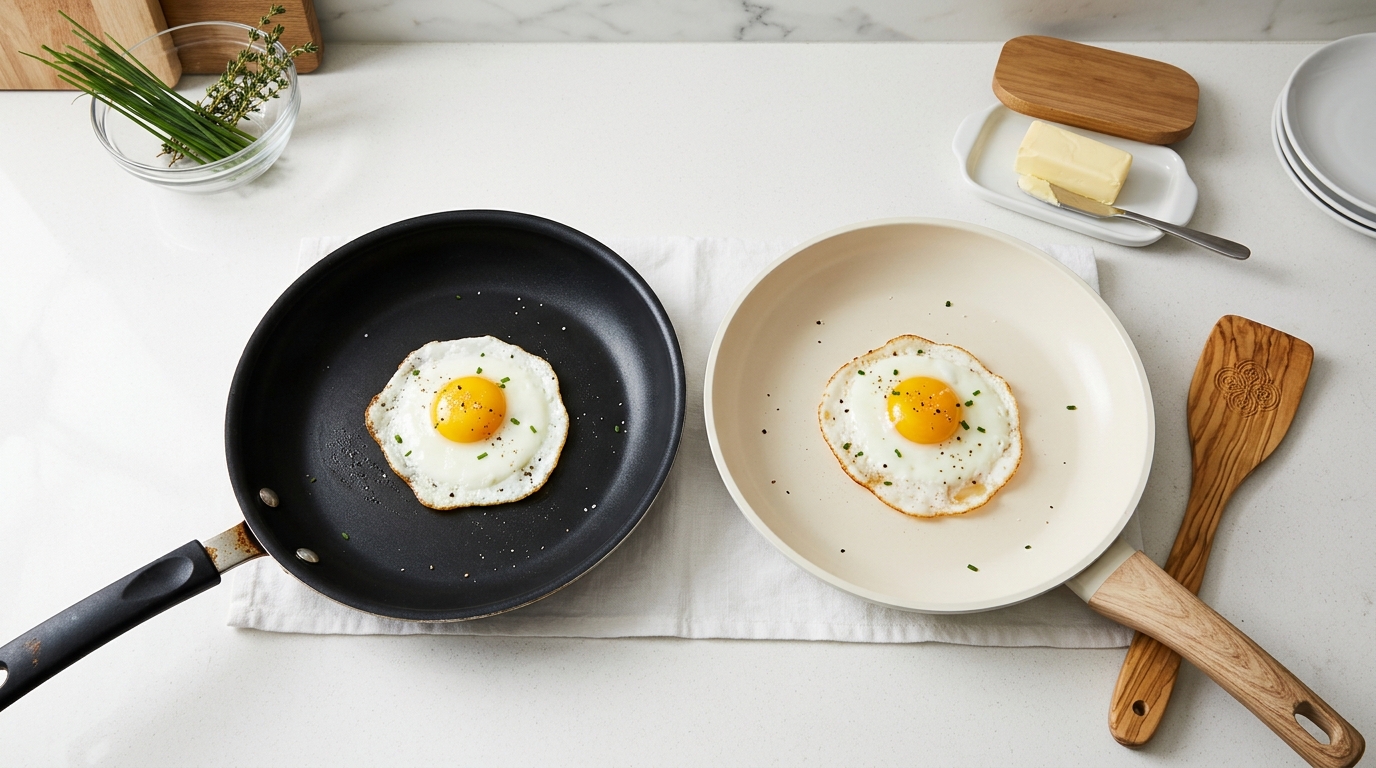
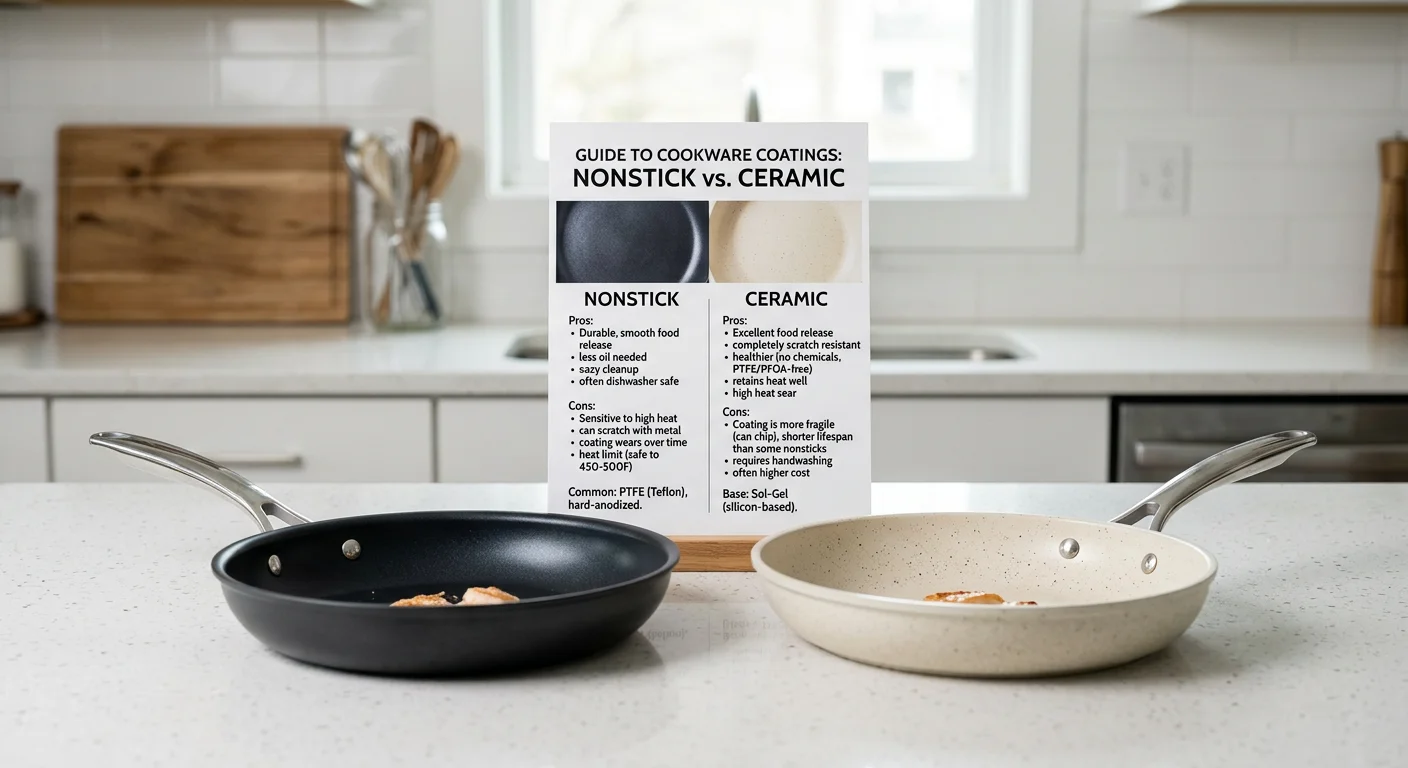
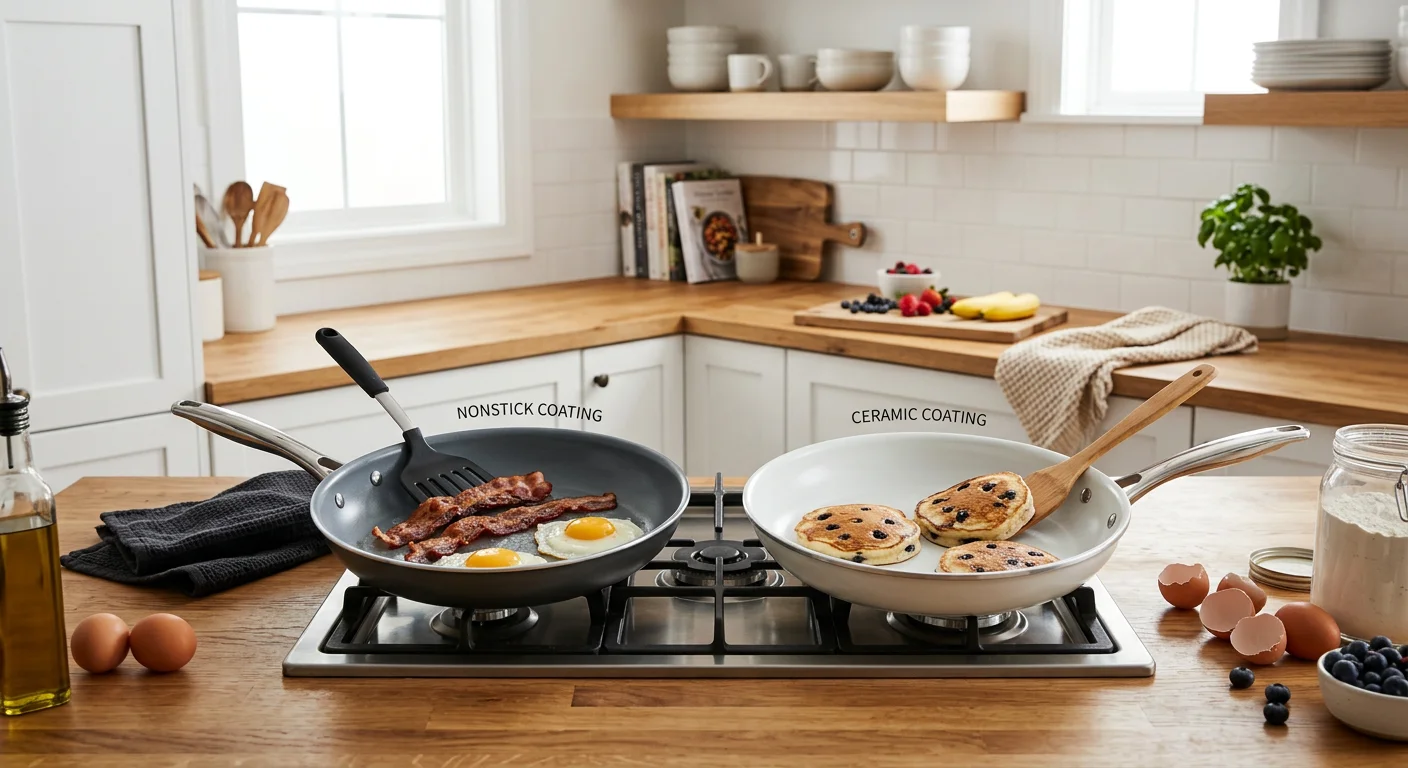
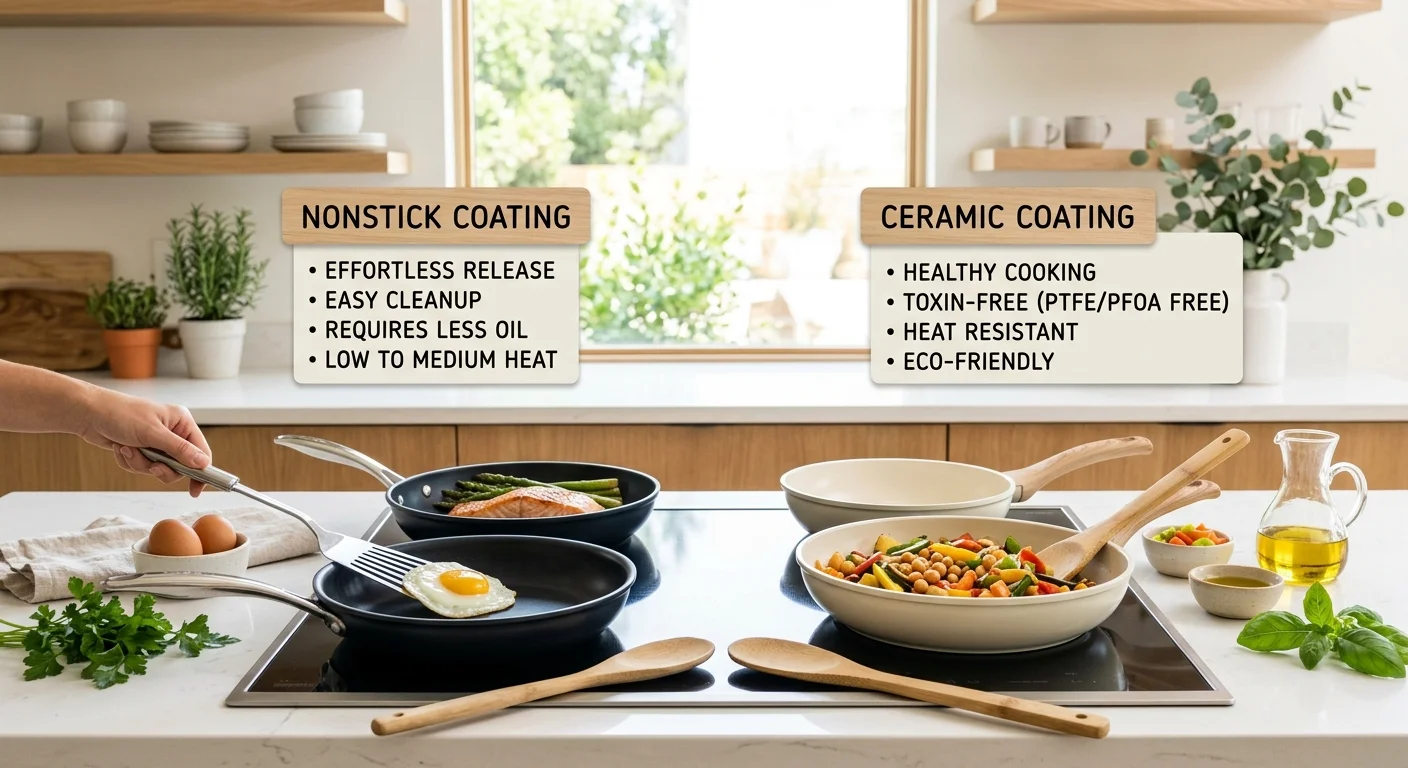
You’re standing in front of two skillets, one coated in PTFE, one marketed as “ceramic”, and the box copy on both promises effortless eggs and easy cleanup. The problem is they’re built differently, degrade differently, and suit different cooks. By the end of this guide you’ll understand what each coating actually is, how they hold up over real use, what the marketing gets wrong, and which one makes sense for your kitchen and cooking style.
As an Amazon Associate, KitchenDesk earns from qualifying purchases. Some of the links on this page are affiliate links, we may earn a commission at no extra cost to you. Full disclosure.
Jump to a section
TL;DR, Quick Answers Before We Get Into It
- Traditional nonstick (PTFE/Teflon) still outperforms ceramic on pure release performance and generally lasts longer at the same price point.
- Ceramic coatings are sol-gel silica-based, not true ceramic, they’re PTFE-free, which matters if that’s a health or environmental concern for you.
- Both coatings degrade. Ceramic tends to lose its nonstick properties faster than a quality PTFE pan; expect 1–3 years of peak performance from ceramic vs. 3–5 from mid-grade PTFE.
- High heat is the enemy of both: PTFE should stay under 500°F/260°C manufacturer max and ceramic coatings become sticky faster when repeatedly pushed to high temperatures.
- The single biggest factor in longevity for either coating is metal-utensil avoidance and hand-washing, not the brand or the coating chemistry.
- If you cook acidic foods often (tomatoes, citrus braises), ceramic’s non-reactive surface is a minor advantage, but a well-seasoned PTFE pan is also non-reactive in practice.
- Budget ceramic pans are often a worse value than budget PTFE; the performance gap narrows only at the mid-range and above.
- Neither coating is forever, budget both types as a 2–5 year consumable, not a lifetime investment.
What These Coatings Actually Are
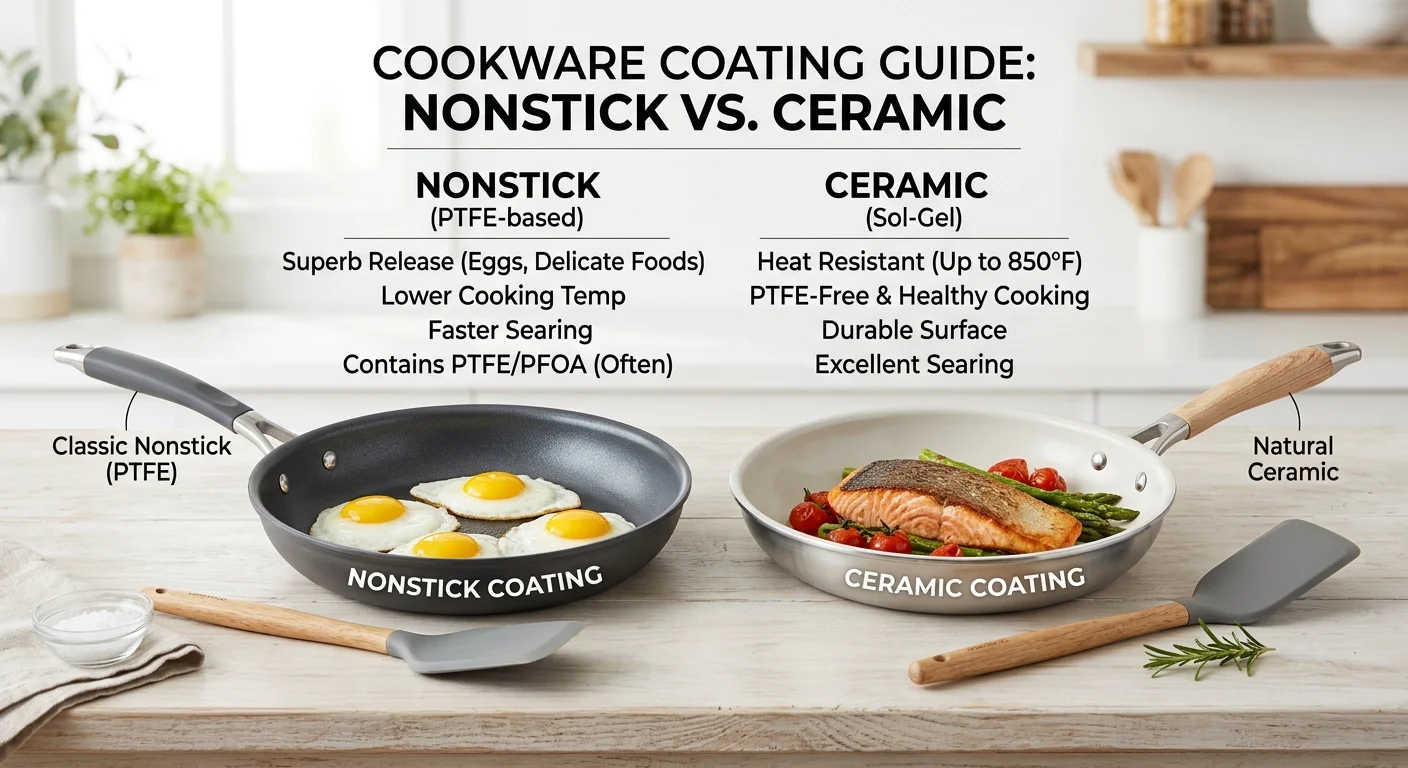
PTFE (polytetrafluoroethylene), sold under brand names like Teflon, has been the dominant nonstick coating since the 1960s. Its near-zero surface friction comes from fluoropolymer chemistry that bonds tightly to a roughened aluminum substrate, the coating is literally fused into the microscopic peaks and valleys of the pan surface. Ceramic coatings arrived as a consumer product in the mid-2000s, partly as a response to concerns about PFOA, a processing chemical (not PTFE itself) that was phased out of PTFE manufacturing by 2013 per the EPA’s PFOA Stewardship Program. EPA PFOA Stewardship Program, https://www.epa.gov/assessing-and-managing-chemicals-under-tsca/pfoa-stewardship-program
Ceramic coatings use a sol-gel process to deposit an inorganic silicon-dioxide-based layer onto the pan. [[CITE: Serious Eats cookware science explainer or peer-reviewed materials science source, verify]] When that layer is new, the surface is genuinely slick. As the microscopic sol-gel matrix micro-cracks from repeated heating and washing, that slickness fades, and it doesn’t come back. This is the central mechanical difference between the two: a fluoropolymer film vs. a silica-based sol-gel layer. That distinction explains almost everything you’ll read below about real-world performance, care, and lifespan.
What Actually Matters When Choosing a Coating
Cut through the spec sheet and look at the factors that actually predict how a pan performs two years from now, not two weeks after unboxing.
Coating thickness and layer count. PTFE pans are typically sprayed in multiple coats, a primer layer bonded to a mechanically or chemically etched aluminum base, then one or two topcoats. More layers generally correlates with longer durability [[CITE: ATK or Cook’s Illustrated nonstick durability testing methodology, verify specific article]]. Ceramic coatings are applied in one or two sol-gel layers; thicker formulations from better manufacturers hold up longer, but this is rarely stated on packaging, which makes brand track record your best proxy for quality.
Base material and gauge. A thin aluminum base warps under temperature swings, and a warped base can crack or delaminate either coating type. Look for at least 3mm of aluminum, or a hard-anodized base, regardless of which coating you’re considering. Warping also creates hot spots that concentrate heat in one zone and accelerate coating breakdown in that area first.
Temperature ceiling. PTFE coatings from reputable manufacturers are rated to 500°F / 260°C for cooking surfaces; sustained use above that can cause the polymer to off-gas and degrade. Ceramic coatings are often marketed as “high-heat safe,” but repeated exposure to temperatures above 450°F / 230°C visibly and measurably reduces their release properties faster than PTFE does, the sol-gel matrix micro-cracks under that thermal stress. Neither coating should ever be preheated empty on high.
Declared PFAS content. As of 2023–2026, reputable PTFE manufacturers have removed PFOA from production, and the PTFE polymer itself is chemically stable at normal cooking temperatures [[CITE: FDA position on PTFE cookware safety, verify current FDA guidance URL]]. If avoiding all fluoropolymers is a hard requirement for you, ceramic is the right lane, but verify: some low-cost “ceramic” pans have been found to use PTFE in the base or reinforcing layers [[CITE: Consumer Reports or similar independent lab testing of ceramic coating composition, source needs verification before publication]]. A “ceramic” label on the front of the box is not the same as a third-party test certificate.
Handle attachment method. Riveted handles are more durable than welded or screwed-on handles, but rivets create cleaning traps around the base. For either coating type, a stainless-steel rivet through a helper handle with a silicone overmold gives you the most practical combination of strength and comfort.
What Looks Important But Mostly Isn’t
Some specs move units. Very few of them predict how well your eggs slide out of the pan in year three. Here’s what to ignore:
“Diamond-infused” or “titanium-reinforced” coatings. These terms describe hard particles added to the coating matrix to resist abrasion. In practice, independent cook testing [[CITE: Serious Eats cookware testing or ATK nonstick pan review, verify specific article]] has not found a consistent real-world durability advantage from these additives in home use. The coating surface still degrades from heat and from oils polymerizing on the surface over time. Hard particles are not a substitute for using silicone utensils and washing by hand.
Oven-safe temperature ratings printed on the box. These typically refer to the base pan, not the coating. A pan rated “oven safe to 500°F” may have a PTFE coating with a lower actual ceiling, or a handle that discolors or warps at that temperature. Check manufacturer documentation specifically for the coating and the handle, not just the pan body.
Color and surface texture. Dark gray, sand-colored, speckled granite-look, none of these indicate a better or worse coating. They are aesthetic choices made in a marketing meeting. A pan is not more nonstick because it looks like a countertop.
Brand country-of-origin marketing. “Swiss engineering,” “German quality,” and similar phrases refer to where a brand is headquartered or where R&D occurs, not necessarily where the pan is manufactured or where the coating is applied. What matters is whether the specific product has been independently tested and whether the manufacturer publishes coating specifications and PFAS testing results.
Induction compatibility icons. Relevant if you cook on induction, you genuinely do need a magnetic base layer for the pan to work, but this is a base-material spec with zero connection to coating quality or nonstick performance. Don’t let it factor into your coating decision.
Common Mistakes That Kill Both Coating Types
The habits below do more damage to nonstick and ceramic coatings than anything on the spec sheet. Most are easy to fix once you know the mechanism.
Preheating empty on high. Both coating types are designed to transfer heat through a layer of fat or food, not to absorb a full blast of direct heat with nothing on them. Dry preheating, especially on gas, where temperatures at the center of the pan can spike fast, is the single quickest way to degrade either coating. Medium heat for 60–90 seconds before adding oil or butter is the right protocol.
Dishwasher use. Dishwasher detergents are alkaline and abrasive, and the high-heat drying cycles stress the bond between the coating and the pan base. Even pans marketed as “dishwasher safe” degrade measurably faster in a machine than hand-washed. This applies to both coating types but is especially hard on ceramic, whose sol-gel structure is more susceptible to alkaline attack.
Stacking pans without protection. Metal pan bases sliding against coated cooking surfaces scratch and gouge both PTFE and ceramic. A felt pan protector, or just a folded kitchen towel, between stacked pans costs almost nothing and extends coating life meaningfully. This is a five-second habit that pays off over years.
Using the wrong fat or cooking spray. Both coatings work best with a light layer of butter or neutral oil applied before adding food. Aerosol cooking sprays with lecithin (most standard sprays) can polymerize and build up a sticky residue layer on ceramic surfaces faster than on PTFE [[CITE: manufacturer care documentation, GreenPan and Caraway both warn against aerosol sprays in their FAQ/care pages, verify live URLs]]. If you use spray, use a pump-style oil mister with plain oil.
Waiting too long to replace. A coating that has flaked, turned deeply brown and sticky, or shows scratches through to the base material is past its service life. Continuing to cook on a degraded coating means food sticks and burns unevenly. In the case of visibly damaged PTFE, small polymer fragments may enter food, though the toxicity of those quantities is debated [[CITE: FDA position on PTFE ingestion]]. Replace on a schedule, not when it fails completely mid-scramble.
Choosing by Price Tier
Budget
Entry-level nonstick typically means a single or dual PTFE coat on a thin-gauge aluminum body. It gets the job done for eggs and pancakes, degrades faster under heavy use, and makes sense as a first pan, a camping pan, or a replacement you’re not emotionally invested in. Budget ceramic in the same range is generally a weaker value, in testing, the coating loses its release properties within a year of regular use, and the thin base warps on high heat. If cost is the primary constraint, budget PTFE beats budget ceramic at this tier.
Mid-Range
This is where the category gets genuinely interesting. Multi-layer PTFE pans from brands with established track records use harder-anodized bases and thicker coating systems that meaningfully extend service life over the budget tier. Mid-range ceramic pans address the thin-base problem and use better-formulated sol-gel coatings that hold their release longer. This is the sweet spot for most home cooks who want reliable performance for 3–5 years without the premium price. If you’re on the fence about which coating to try, start here, a bad pan at mid-range prices is an honest test of the technology, and a good one tells you whether it’s worth going further.
For tested picks at this tier, see Best Nonstick Skillets We’ve Tested and Best Ceramic Cookware Sets.
Premium
Premium nonstick and ceramic pans are differentiated by base construction more than coating chemistry. Brands at this tier use fully-clad or impact-bonded stainless-steel and aluminum bases that distribute heat evenly, resist warping, and can handle higher oven temperatures. The PTFE or ceramic coating on top is high-grade, but the real payoff is the pan underneath it, a base that can outlast multiple coating cycles. Worth the investment if you cook daily, want excellent heat distribution with induction compatibility, and take care of your tools. The coating will still degrade eventually. You’re paying for a base that makes it worthwhile to re-coat or replace the pan rather than retire it.
Frequently Asked Questions
Is ceramic coating actually safer than PTFE/Teflon?
The original concern about traditional nonstick cookware centered on PFOA, a manufacturing processing chemical, not PTFE itself. PFOA was phased out of PTFE production by 2013 under voluntary industry agreements with the EPA EPA PFOA Stewardship Program. The FDA considers PTFE cookware safe at normal cooking temperatures [[CITE: FDA PTFE safety guidance, verify current FDA guidance URL]]. Ceramic coatings are PTFE-free, which genuinely matters if you want to avoid fluoropolymers entirely. But “safer” is a more nuanced claim than most ceramic-pan marketing implies, particularly now that PFOA is out of the picture for reputable manufacturers.
How long should a nonstick or ceramic pan last?
With careful use, no metal utensils, hand-washing, medium heat, a quality PTFE pan should hold good release for 3–5 years. Ceramic typically runs 1–3 years. Budget versions of both degrade faster. Treat them as a consumable with a replacement budget built in, not a lifetime purchase. That framing makes the buying decision much cleaner.
Can I use metal utensils on ceramic cookware?
Most manufacturers say no, and in practice metal utensils scratch the sol-gel surface and accelerate degradation whether or not the box claims scratch resistance. Silicone, wood, or nylon utensils extend the life of both coating types significantly, this is one of the highest-ROI habits you can develop with coated cookware.
Why does my ceramic pan suddenly stick after a few months?
The most common culprit is polymerized oil residue, especially lecithin from aerosol cooking sprays, building up on the surface and creating a sticky layer the coating can’t overcome. A gentle scrub with a baking soda paste can sometimes restore partial performance. The other cause is heat damage from high-heat preheating that micro-cracks the sol-gel matrix. That damage isn’t reversible, and it compounds with each high-heat session.
Are “PFAS-free” ceramic pans truly free of all fluorochemicals?
Reputable ceramic-coating manufacturers like GreenPan and Caraway others with published third-party testing publish independent test results supporting PFAS-free claims. Some lower-cost brands have been flagged in independent testing as potentially using fluoropolymers in base or reinforcing layers [[CITE: Consumer Reports or independent lab source, source needs verification before publication]]. Look for actual third-party test documentation, not just a label claim on the front of the box.
Can I put a nonstick or ceramic pan in the oven?
Most PTFE-coated pans are rated for oven use up to 350–500°F depending on the specific product and handle material, check your manufacturer’s documentation for the coating and handle specifically, not just the pan body. Many ceramic pans have similar or slightly higher oven ratings, but the handle is often the limiting factor. Neither coating type is broiler-safe.
Once a nonstick pan is scratched, does it have to go?
Light surface marks that don’t expose the base material don’t require immediate replacement. Deep scratches, peeling, or flaking do, at that point the coating is failing structurally, food will stick unpredictably, and you don’t want degraded coating material in your food regardless of where you land on the toxicity debate. A pan that’s visibly failing is a pan that isn’t doing its job anyway.
Which is better for high-heat searing, ceramic or PTFE?
Neither. Both coating types are designed for low-to-medium heat cooking: eggs, fish, delicate proteins, pancakes. For high-heat searing you want cast iron, carbon steel, or uncoated stainless steel. Pushing either nonstick coating to searing temperatures accelerates degradation significantly, and in the case of PTFE risks off-gassing at sustained very high temperatures. Save the nonstick pan for what it’s actually good at.
What’s the difference between hard-anodized nonstick and regular nonstick?
Hard-anodized refers to the aluminum base material, which has been electrochemically treated to create a harder, denser surface. The PTFE or ceramic coating is still applied on top of that base. The benefit is a more warp-resistant, durable foundation that bonds better with the coating and distributes heat more evenly, not a fundamentally different coating type or chemistry.
Do I need a whole ceramic cookware set, or just one pan?
Most home cooks get the most value from a single 10–12 inch nonstick or ceramic skillet for egg and delicate-protein work, paired with stainless or cast iron for everything else. Full ceramic sets make sense if you want to avoid PTFE throughout your kitchen, but given that ceramic coatings degrade faster, replacing a full set is a more expensive proposition than replacing one skillet. Start with the skillet, see how you maintain it, and scale from there.
The Bottom Line
If you want the most reliable nonstick performance for the longest time at the lowest price, a mid-range multi-layer PTFE pan is still the practical choice for most home cooks. If avoiding fluoropolymers entirely is a genuine priority, not just marketing appeal, a quality ceramic skillet from a brand that publishes third-party PFAS testing is a reasonable trade-off, with the clear understanding that you’ll likely replace it sooner. Either way: buy one good skillet, use it on medium heat, wash it by hand, keep metal utensils away from it, and treat it as a 3–5 year tool. That approach will serve you better than any coating claim on the box.
For specific tested recommendations, head to Best Nonstick Skillets We’ve Tested or Best Ceramic Cookware Sets. If you want to dig into specific models in detail, the full cookware review index lives at All Cookware Reviews & Guides.
Tested and written by Maya Chen Toronto. Former line cook (Toqué!, 2014–2017). All KitchenDesk guides are based on hands-on testing across gas, induction, and electric cooktops for a minimum of one week before publication.