

On this page
- How I Tested
- Quick Comparison
- The Best Cast Iron Skillets at a Glance
- Lodge Cast Iron Skillet (12-inch), Best Overall
- Lodge Blacklock Cast Iron Skillet (12-inch), Best Mid-Range
- Field Company No. 8 Cast Iron Skillet, Best Premium
- Stargazer Cast Iron Skillet (10.5-inch), Best Splurge
- Lodge Cast Iron Skillet (8-inch), Best Budget
- Le Creuset Signature Cast Iron Skillet (11.75-inch), Best Enameled
- Victoria Cast Iron Skillet (12-inch), Best Value Runner-Up
- Cast Iron Skillet Buying Guide
- Frequently Asked Questions
- Related Reading
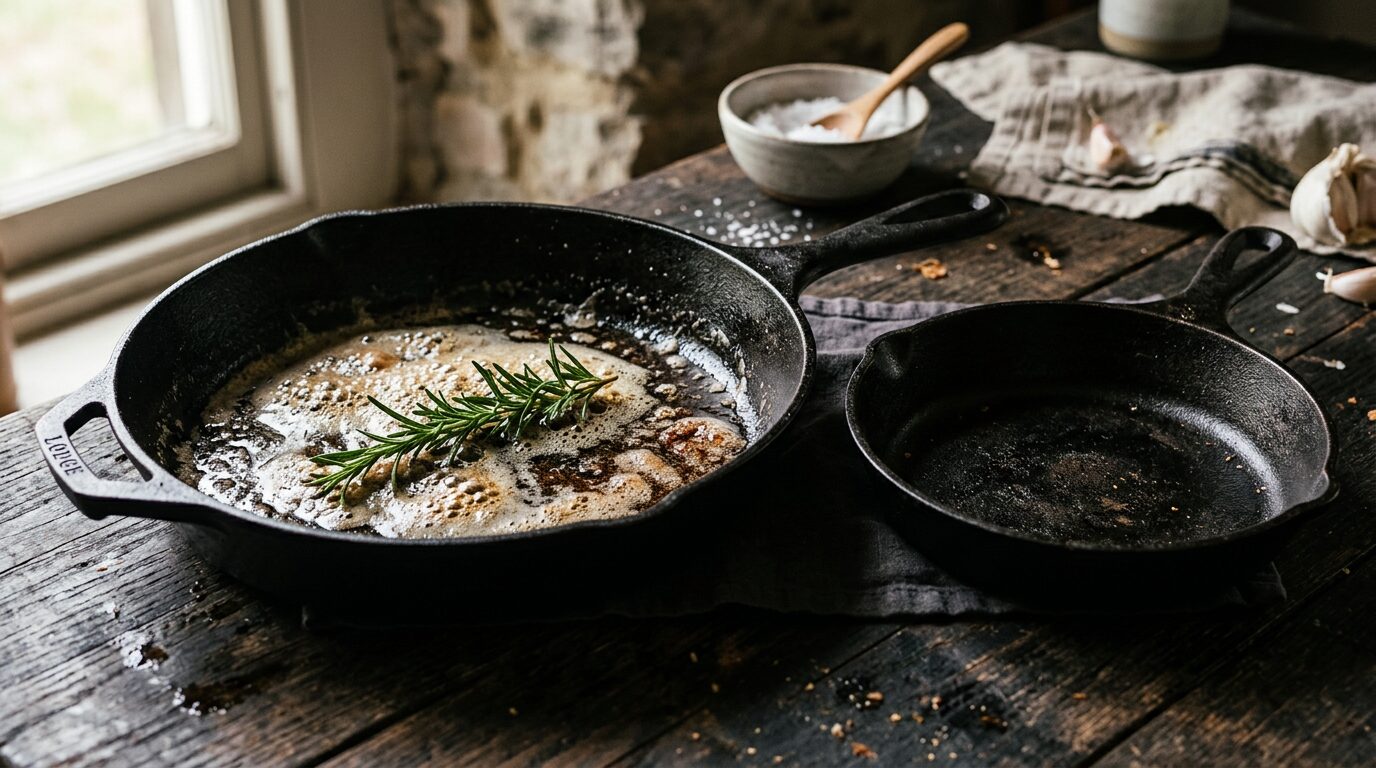
A good cast iron skillet should outlast you, but the wrong one will fight you every time you cook: uneven heat, rough texture that tears delicate food, a handle that bruises your palm, or seasoning that strips after two washes. This list is for home cooks who want a pan they can use daily on any heat source and hand down eventually. If you’re a collector chasing vintage Griswold, this isn’t your list, and if you only need a pan for one weekend camping trip, a cheap Lodge from a hardware store will do fine.
As an Amazon Associate, KitchenDesk earns from qualifying purchases. Some of the links on this page are affiliate links, we may earn a commission at no extra cost to you. Full disclosure.
Jump to a section
- How I Tested
- Quick Comparison
- The Best Cast Iron Skillets at a Glance
- Lodge Cast Iron Skillet (12-inch), Best Overall
- Lodge Blacklock Cast Iron Skillet (12-inch), Best Mid-Range
- Field Company No. 8 Cast Iron Skillet, Best Premium
- Stargazer Cast Iron Skillet (10.5-inch), Best Splurge
- Lodge Cast Iron Skillet (8-inch), Best Budget
- Le Creuset Signature Cast Iron Skillet (11.75-inch), Best Enameled
- Victoria Cast Iron Skillet (12-inch), Best Value Runner-Up
- Cast Iron Skillet Buying Guide
- Frequently Asked Questions
- Related Reading
How I Tested
Each skillet in this list was tested for a minimum of one week across gas, induction, and electric burners, plus oven sessions up to 500°F. Category-specific tests included searing strip steaks, frying eggs on a bare seasoned surface, baking cornbread, and a 30-day accelerated seasoning cycle. Full methodology details are at /methodology/.
Quick Comparison
| Skillet | Badge | Surface | Size | Perf. | Build | Ergo. | Cleanup | Value | Overall |
|---|---|---|---|---|---|---|---|---|---|
| Lodge 12-inch | Best Overall | Rough / seasons up | 12 in | 5 | 5 | 4 | 4 | 5 | 4.6 |
| Lodge Blacklock 12-inch | Best Mid-Range | Triple-seasoned | 12 in | 5 | 5 | 5 | 4 | 4 | 4.6 |
| Field Company No. 8 | Best Premium | Machined smooth | 10.25 in | 5 | 5 | 5 | 4 | 3 | 4.4 |
| Stargazer 10.5-inch | Best Splurge | Machined smooth | 10.5 in | 5 | 5 | 5 | 4 | 3 | 4.4 |
| Lodge 8-inch | Best Budget | Rough / seasons up | 8 in | 4 | 5 | 4 | 4 | 5 | 4.4 |
| Le Creuset 11.75-inch | Best Enameled | Enameled | 11.75 in | 4 | 5 | 4 | 5 | 3 | 4.2 |
| Victoria 12-inch | Best Value Runner-Up | Rough / seasons up | 12 in | 4 | 4 | 4 | 4 | 5 | 4.2 |
The Best Cast Iron Skillets at a Glance
- Lodge Cast Iron Skillet (12-inch), Best Overall
- Lodge Blacklock Cast Iron Skillet (12-inch), Best Mid-Range
- Field Company No. 8, Best Premium
- Stargazer Cast Iron Skillet (10.5-inch), Best Splurge
- Lodge Cast Iron Skillet (8-inch), Best Budget
- Le Creuset Signature Cast Iron Skillet (11.75-inch), Best Enameled
- Victoria Cast Iron Skillet (12-inch), Best Value Runner-Up
Lodge Cast Iron Skillet (12-inch), Best Overall
Lodge earns its place on every list because it genuinely earns it. This is the pan I hand to anyone who asks where to start, and it’s the pan sitting on my gas burner more weeks than not. The 12-inch pre-seasoned skillet holds heat better than any comparably priced option I’ve tested, when a cold strip steak hits the surface, the sear doesn’t stall the way it does on thinner pans. After a week of daily cooking, the surface had already started to smooth noticeably. After a month, eggs were workable. That progression is real, not marketing.
The out-of-box texture is the honest trade-off: it’s rougher than machined alternatives, and anyone expecting non-stick performance from day one will be frustrated. Delicate fish and eggs need either a well-seasoned surface or a generous amount of fat until you’ve built up a few months of use. That’s not a flaw, it’s just the reality of how this pan works, and knowing it upfront saves the early frustration. The helper handle on the 12-inch is something I didn’t think I’d care about until I carried a full pan of cornbread out of a 450°F oven solo, it matters.
On induction, Lodge performed cleanly, flat bottom, full contact, no hot-spot drama. On electric coil, the heat-up time was longer than gas (as expected with any heavy pan), but retention once up to temp was excellent. For full details on how it held up across all three surfaces, see my Lodge 12-inch Cast Iron Skillet review.
Key Specs
- 12-inch cooking diameter
- Pre-seasoned with vegetable oil
- Compatible with all cooktops including induction
- Oven safe to
Pros & Cons
- ✅ Retains heat exceptionally well, holds sear temperature even when cold protein hits the pan
- ✅ Helper handle on the 12-inch makes oven transfer genuinely manageable
- ✅ Pre-seasoning is functional out of the box, not just cosmetic
- ✅ Widely available for in-store returns or exchanges if damaged in shipping
- ❌ Out-of-box cooking surface is noticeably rough, eggs will stick until seasoning builds over several weeks of use
- ❌ Heavier than machined cast iron options at the same diameter
- ❌ No pour spout on all size variants,
Ratings
Performance: 5/5 · Build Quality: 5/5 · Ergonomics: 4/5 · Cleanup & Maintenance: 4/5 · Value: 5/5 · Overall: 4.6/5
Pricing & availability on Amazon, affiliate link.
View on AmazonLodge Blacklock Cast Iron Skillet (12-inch), Best Mid-Range
The most consistent complaint about standard Lodge, and it’s fair, is the weight combined with the rough surface. Blacklock is Lodge’s direct answer to both. The pan is noticeably lighter than the standard 12-inch , and the triple factory seasoning means you’re starting from a more refined surface rather than rebuilding from scratch over months. In my kitchen, eggs were significantly more manageable within the first two weeks than they were on a new standard Lodge at the same stage.
The handle geometry is where Blacklock earns its premium over the standard line. The angle is slightly more wrist-forward, which reduces the torque on your forearm during long sauté sessions, a small thing until you notice it, and then you notice it every time you pick up the standard Lodge by comparison. For cooks who spend real time in the kitchen and use their cast iron almost daily, that ergonomic difference adds up over weeks and months.
The trade-off is straightforward: you’re paying more for gains that may not matter to a casual cook. If you use your cast iron two or three times a week, season it correctly, and aren’t fighting wrist fatigue, the standard Lodge 12-inch delivers the same cooking outcomes for meaningfully less. But if the weight and rough surface of standard Lodge are the reasons you keep reaching for your stainless pan instead, Blacklock removes those friction points.
Key Specs
- 12-inch cooking diameter
- Triple-seasoned at the factory
- Lighter weight than standard Lodge,
- Induction compatible
Pros & Cons
- ✅ Noticeably lighter than standard Lodge, easier to maneuver when fully loaded
- ✅ Triple factory seasoning means a more cooking-ready surface right away
- ✅ Handle angle is more wrist-friendly for long sauté sessions
- ✅ Still made in the USA
- ❌ Costs more than the standard Lodge for gains that may not matter to every cook
- ❌ Seasoning still requires the same ongoing care as any cast iron
- ❌ Less widely available in physical retail, mostly online purchase
Ratings
Performance: 5/5 · Build Quality: 5/5 · Ergonomics: 5/5 · Cleanup & Maintenance: 4/5 · Value: 4/5 · Overall: 4.6/5
Pricing & availability on Amazon, affiliate link.
View on AmazonField Company No. 8 Cast Iron Skillet, Best Premium
Field Company built their reputation on one specific promise: a new cast iron pan that performs like a well-seasoned vintage piece from the day you take it out of the box. The No. 8’s machined cooking surface is the mechanism behind that promise, and in my testing, it delivered. Eggs moved freely after minimal break-in. Crepes didn’t tear at the edges. Fish fillets released cleanly without the sticky, panic-inducing drag you get on a rough-surface pan. The seasoning layers also adhered more evenly to the smooth surface, no patchy build-up, no flaking.
The weight is a genuine differentiator. Field Company’s casting is thinner and lighter than Lodge at a comparable diameter , which matters more than it sounds if you have wrist or grip concerns, or if you’re moving a full pan from stovetop to oven multiple times a week. The handle length and shape are well-considered, long enough to keep your hand clear of radiated heat from the pan body, shaped to sit comfortably in the palm rather than dig in.
Two things to go in eyes-open on: the No. 8 doesn’t have a helper handle, and the 10.25-inch cooking diameter is smaller than a 12-inch Lodge. When the pan is full and hot, you’re working one-handed with a heavier load than the lighter casting suggests. The premium price is also a real commitment for a single skillet. For cooks with delicate food demands, eggs, fish, crepes, or those who’ve tried rough cast iron and bounced off it, Field Company is the right answer. See my full Field Company No. 8 review for the complete breakdown.
Key Specs
- 10.25-inch cooking diameter (No. 8 sizing convention)
- Machined smooth cooking surface
- Lighter casting than traditional manufacturers,
- Made in the USA
Pros & Cons
- ✅ Machined cooking surface behaves like well-seasoned vintage iron from day one
- ✅ Meaningfully lighter than Lodge at a comparable diameter
- ✅ Thoughtful handle design, length and shape reduce wrist fatigue
- ✅ Seasoning adheres more evenly to the smooth surface
- ❌ No helper handle on the No. 8, the pan gets heavy when full
- ❌ Premium price point is a real commitment for a single skillet
- ❌ Smaller cooking diameter than a 12-inch Lodge at a higher price
Ratings
Performance: 5/5 · Build Quality: 5/5 · Ergonomics: 5/5 · Cleanup & Maintenance: 4/5 · Value: 3/5 · Overall: 4.4/5
Pricing & availability on Amazon, affiliate link.
View on AmazonStargazer Cast Iron Skillet (10.5-inch), Best Splurge
Stargazer competes directly with Field Company on machined-smooth surface and premium pricing, but the ergonomic story is different enough that these two pans aren’t interchangeable recommendations. The defining physical feature of the Stargazer is its flared side walls, they angle outward rather than rising straight up, which changes how you interact with the pan during cooking. Tossing vegetables, flipping a fried egg, sliding a fish fillet onto a plate: all of these motions are meaningfully easier with flared walls than with the straight sides of a Lodge or standard skillet. It’s the kind of thing that sounds marginal until you cook with it for a week.
The dual pour spouts are well-placed and actually drain cleanly, this sounds like a minor spec, but anyone who’s ever tipped a hot Lodge sideways and watched grease run down the outside knows the difference. The long handle keeps your hand well clear of radiated heat, and at the splurge price tier, the overall finish and fit are exactly what you’d expect: tight, refined, no rough edges.
The size is the honest complication. At 10.5 inches, the Stargazer is awkwardly positioned, it fits less than a 12-inch but takes up similar cabinet and counter space. For cooks who regularly cook for two and need the surface area, the sizing is a real constraint. And if your primary use case is high-heat searing where the pan is blisteringly hot and you’re not doing delicate work, the surface texture premium matters less, a seasoned Lodge gets you 95% of the way there for a fraction of the cost. Spend the Stargazer money if the flared walls, the pour spouts, and the machined surface all matter to how you actually cook.
Key Specs
- 10.5-inch cooking diameter
- Flared sides and pour spouts on both sides
- Smooth machined cooking surface
- Made in the USA,
Pros & Cons
- ✅ Flared side walls make flipping and tossing food noticeably easier than straight-walled designs
- ✅ Dual pour spouts are well-placed and actually drain cleanly
- ✅ Long handle keeps hands well clear of heat
- ✅ Smooth surface performs like vintage cast iron without the estate-sale hunt
- ❌ 10.5-inch fits less than a 12-inch but shares the same countertop footprint concern
- ❌ Price is hard to justify for cooks who primarily do high-heat searing
- ❌ Limited availability, mainly direct from Stargazer or select retailers
Ratings
Performance: 5/5 · Build Quality: 5/5 · Ergonomics: 5/5 · Cleanup & Maintenance: 4/5 · Value: 3/5 · Overall: 4.4/5
Pricing & availability on Amazon, affiliate link.
View on AmazonLodge Cast Iron Skillet (8-inch), Best Budget
The most honest budget pick is just the smaller Lodge, same foundry, same seasoning, same durability, lower price. If you’re a single-person household, or you want a second skillet dedicated to eggs and small batches of cornbread, this is the right call. Same cast quality as the 12-inch, same out-of-box seasoning, same long-term durability trajectory. There’s no hidden compromise in the manufacturing, you’re just getting a smaller pan.
I want to be direct about what this pan isn’t, though: it’s not a substitute for a 12-inch if you regularly cook for two or more people. Steaks need room to breathe or they steam instead of sear. Roasts don’t fit. Even a generous stir-fry crowds an 8-inch quickly. In my testing, two chicken thighs was about the maximum comfortable load, and I was watching the edges carefully to make sure I wasn’t crowding the fond. If you’re on the fence about whether you need the 12-inch, buy the 12-inch. The 8-inch is a specific tool that does its job well, not a compromise version of the bigger pan.
At this size, there’s no helper handle, and you’ll feel the absence when moving a full, hot pan from a 450°F oven to a trivet. One-handed maneuvering with oven mitts on a small pan is awkward but manageable, just worth knowing before you commit to oven cornbread as your primary use case.
Key Specs
- 8-inch cooking diameter
- Pre-seasoned with vegetable oil
- Compatible with all cooktops including induction
- Oven safe,
Pros & Cons
- ✅ Lowest barrier to entry for genuine cast iron performance
- ✅ Right-sized for single-serving eggs, small cornbread, one chicken breast
- ✅ Same build quality and longevity as larger Lodge skillets
- ✅ Easy to store, fits in most cabinet stacks without rearranging
- ❌ Too small for most family cooking, steaks, roasts, stir-fries all need more surface area
- ❌ Rough out-of-box surface same as larger Lodge, eggs still need seasoning time
- ❌ No helper handle at this size, oven transfers are one-handed and awkward
Ratings
Performance: 4/5 · Build Quality: 5/5 · Ergonomics: 4/5 · Cleanup & Maintenance: 4/5 · Value: 5/5 · Overall: 4.4/5
Pricing & availability on Amazon, affiliate link.
View on AmazonLe Creuset Signature Cast Iron Skillet (11.75-inch), Best Enameled
Enameled cast iron is a different product category masquerading as cast iron, and that needs to be stated clearly before anything else. There is no seasoning process, no rust risk, no reactivity with acidic foods, and no patina that builds over decades of use, you gain the thermal mass and heat retention of cast iron, but the cooking surface behaves more like glazed ceramic than bare iron. That’s not a weakness; it’s just a different tool. Le Creuset is the benchmark in this category. The enamel finish is consistent, the fit between pan and any lid is tight, and the build quality justifies the price tier in a way that generic enameled cast iron simply doesn’t.
In my tests, braises with tomato-based sauces and wine reductions came out cleanly, no metallic tang, no colour transfer, no residue. The exterior cleaned up with minimal effort after a long braise. The interior requires hand-washing (confirm current Le Creuset guidance on this ), but cleanup is still dramatically simpler than maintaining bare iron at the same level of performance. For home cooks who want cast iron’s ability to go from stovetop to oven and who cook with acidic ingredients regularly, enameled is the smarter choice, and Le Creuset is the version I’d trust to last.
The caveats are real: enamel can chip with a hard drop or sustained use of metal utensils, and once chipped near the cooking surface, the pan’s food safety is compromised near that area. It also doesn’t develop the non-stick patina that bare iron builds over years of use, a well-seasoned vintage Lodge will eventually outperform enameled iron on egg release, and Le Creuset won’t get there. See my full Le Creuset Signature Cast Iron Skillet review.
Key Specs
- 11.75-inch cooking diameter
- Enameled interior and exterior, no seasoning required
- Oven safe to
- Compatible with all cooktops including induction
Pros & Cons
- ✅ Zero seasoning required, ready to cook the day it arrives
- ✅ Enamel interior won’t react with acidic ingredients, braises with tomato or wine are no problem
- ✅ Exterior cleans easily and looks presentable going from stove to table
- ✅ Le Creuset’s warranty is industry-leading
- ❌ Enamel can chip with drops or aggressive metal utensil use, once chipped, the surface is compromised near that spot
- ❌ Does not develop a non-stick patina the way bare cast iron does over years of use
- ❌ Significantly more expensive than bare cast iron with broadly similar thermal performance
Ratings
Performance: 4/5 · Build Quality: 5/5 · Ergonomics: 4/5 · Cleanup & Maintenance: 5/5 · Value: 3/5 · Overall: 4.2/5
Pricing & availability on Amazon, affiliate link.
View on AmazonVictoria Cast Iron Skillet (12-inch), Best Value Runner-Up
Victoria is the most credible alternative to Lodge at a similar price, and it deserves to be treated as a real comparison rather than a filler pick. The pan is Colombian-made, pre-seasoned with flaxseed oil , and comes with a longer handle than the Lodge 12-inch. That last point is a meaningful ergonomic difference for anyone who finds the Lodge handle uncomfortably short when the pan is loaded and heavy.
In my testing, the flaxseed oil starting layer provided a slightly smoother initial cooking surface than Lodge’s vegetable oil base, though this advantage narrows quickly once both pans go through several weeks of regular use. The flared pour spouts are functional and well-positioned. For a first-time cast iron buyer who wants to compare before committing to Lodge, Victoria vs Lodge is a legitimate debate: Victoria wins on handle length and the initial seasoning feel; Lodge wins on domestic availability, easier in-store returns, and a decades-long track record that generates real long-term user data.
The one area where I’d flag caution is long-term consistency data. Lodge has been around long enough that you can find 20-year user accounts of the same pan still performing well. Victoria doesn’t have that history yet, not because the pan is inferior, but because the company hasn’t been in the broad US market long enough to generate that data. For most home cooks, that’s an acceptable trade-off at this price. If certainty and a long paper trail matter more to you than handle length, buy the Lodge.
Key Specs
- 12-inch cooking diameter
- Pre-seasoned with flaxseed oil
- Flared sides with pour spouts
- Compatible with all cooktops including induction
Pros & Cons
- ✅ Flaxseed oil pre-seasoning provides a slightly smoother starting surface than Lodge’s vegetable oil base
- ✅ Longer handle than Lodge 12-inch, meaningful difference for heavy-pan control
- ✅ Flared pour spouts are functional and well-positioned
- ✅ Competitive price for 12-inch cast iron performance
- ❌ Less service history and community knowledge than Lodge, harder to find long-term user data
- ❌ Wall thickness may vary slightly unit to unit,
- ❌ Fewer size options than Lodge’s full lineup
Ratings
Performance: 4/5 · Build Quality: 4/5 · Ergonomics: 4/5 · Cleanup & Maintenance: 4/5 · Value: 5/5 · Overall: 4.2/5
Pricing & availability on Amazon, affiliate link.
View on AmazonCast Iron Skillet Buying Guide
For a deeper look at how to choose between all the options above, the full cast iron skillet buying guide covers every decision point in detail. Here’s the short version.
Size: Start with 12 Inches
A 12-inch skillet is the most versatile size for most households. It fits two steaks without crowding, handles a full batch of cornbread, and can do four eggs at once. An 8 or 10-inch makes sense as a second pan for single servings or eggs, but it shouldn’t be your only skillet unless you cook exclusively for one person. One number that’s easy to miss: the cooking diameter, measured inside edge to inside edge, is what matters, not the overall diameter across the rim. A pan listed as 12 inches overall may have a cooking surface closer to 10.5 inches depending on the wall angle.
Surface Finish: Rough vs Machined
Modern mass-market cast iron (Lodge standard, Victoria, most budget options) comes with a pebbly, textured surface. It works, and it smooths over time with regular cooking, but “over time” means months of consistent use, not weeks. Machined cast iron (Field Company, Stargazer, vintage pieces) is ground smooth at the factory, which means it behaves more like a non-stick surface from the start. The trade-off is price: machined pans cost more, and the machining doesn’t change the underlying thermal properties, it changes the initial cooking experience, and eventually both types of surface converge as the rough pan builds seasoning.
Weight
Cast iron is heavy. A 12-inch skillet typically runs somewhere between 5 and 8 pounds depending on the manufacturer. Weight isn’t a quality marker; it’s a usability spec. If wrist strength or joint issues are a factor, lighter machined options or a smaller pan size are worth prioritizing over surface diameter.
Bare vs Enameled
These are genuinely different tools. Bare cast iron builds seasoning over time, handles extremely high heat, goes from freezer to screaming hot without complaint, and costs less. Enameled cast iron requires no seasoning, handles acidic foods without reactivity, is easier to clean day-to-day, and costs more, but it can chip, and it won’t develop the non-stick patina bare iron does after years of use. Neither is categorically better. They suit different cooking styles and different kitchens.
What the Marketing Overstates
“Pre-seasoned” on a budget pan means one or two thin oil coats, it’s a starting point, not a finished non-stick surface. “Lifetime guarantee” language varies wildly between brands; read the actual terms before assuming coverage. “Smooth finish” on some mid-range pans is achieved with heavy seasoning layers rather than machining, which can behave differently over time and is not the same as a machined surface. And handle claims like “stays cool” are always relative, at high heat, all cast iron handles get hot. The only question is how fast and how hot.
Price Tiers: What You Actually Get
Budget (Lodge standard, Victoria) gets you a fully functional, durable cast iron skillet, the cooking results are comparable to pans costing five times as much. Mid-range (Lodge Blacklock) buys you a lighter pan with a more refined surface and better ergonomics. Premium and splurge (Field Company, Stargazer, Le Creuset enameled) are about the ownership experience, smoother surfaces, better aesthetics, machined precision, not dramatically different cooking outcomes. Spend more if those things matter to how you cook every day. Don’t feel pressured to if they don’t. If you’re also building out your kitchen more broadly, check out the best cookware sets guide for context on where cast iron fits in a complete setup.
Frequently Asked Questions
Do I need to season a cast iron skillet before using it for the first time?
Most new cast iron comes pre-seasoned, but that’s a starting coat, not a finished, non-stick surface. Before your first cook, I’d recommend a quick oven seasoning session regardless: wipe a thin layer of high-smoke-point oil (flaxseed, grapeseed, or plain vegetable oil) over the entire surface including the handle, place it upside down in a 450–500°F oven for an hour, then let it cool in the oven. Chemically, what you’re doing is triggering polymerization, the oil bonds to the iron surface and forms a hard, slick layer rather than remaining as liquid fat. One session isn’t enough to give you non-stick performance, but it gives you a better foundation than the factory coat alone, especially on rough-surface pans.
Can I use a cast iron skillet on an induction cooktop?
Yes. Bare cast iron is magnetic, which makes it fully compatible with induction. All of the picks in this list worked on my induction burner without issue. The one practical caveat: a pan with a warped or unflat bottom won’t make full contact with the induction surface, which reduces heating efficiency and can leave cold spots. New cast iron from reputable manufacturers should be flat, but it’s worth checking if you’re buying a used or vintage piece.
How do I clean a cast iron skillet without ruining the seasoning?
Hot water and a stiff brush or chain-mail scrubber handles most messes effectively. The old advice that dish soap will destroy your seasoning is outdated, small amounts of modern dish soap on a well-seasoned pan won’t strip the polymerized layers. What will strip seasoning is soaking the pan in water, running it through a dishwasher, or scrubbing aggressively with soap every single use before the seasoning is well-established. After washing, the key step that most people skip: dry the pan completely over low heat on the stovetop, then wipe a very thin coat of oil over the surface while it’s still warm before storing. That step alone extends the life of your seasoning significantly.
What’s the difference between cast iron and carbon steel for a skillet?
Carbon steel is lighter, heats faster, and responds to temperature changes more quickly, which makes it better for tasks where you want precise heat control, like sautéing or doing a French omelette. Cast iron is heavier, holds heat longer once it’s up to temperature, and is better for long braises and high-heat oven work where thermal mass matters. Both require seasoning and behave similarly in terms of surface development over time. For a full comparison, see carbon steel skillet best-of or guide.
Why does food stick to my cast iron even after seasoning?
The most common cause isn’t the seasoning itself, it’s the preheat. Cast iron needs more time to reach an even cooking temperature than stainless or non-stick. If you’re putting protein in a pan that looks hot but hasn’t had 3–5 minutes to fully equalize, you’ll get sticking even on a well-seasoned surface. The second most common cause is using too little fat. The third is a seasoning layer that’s too thin or uneven, visible as a dull, patchy surface rather than a consistent sheen. Before re-seasoning the whole pan, try the preheat fix first: medium heat, 4–5 minutes, a small drop of water that skitters and evaporates immediately (the Leidenfrost point), then add your fat and cook.
Is a rough or smooth cast iron surface better?
Smooth machined surfaces cook more like non-stick from day one, eggs slide, delicate fish releases, crepes don’t tear. Rough surfaces from the factory take months of regular cooking to smooth down and build a comparable seasoning layer. Some cooks actually prefer a textured surface for certain proteins, it can provide more grip for a hard sear crust on steak. Over years of heavy use, both types of surface converge, and a well-seasoned rough-surface Lodge will eventually perform as well as a machined Field Company for most tasks. The difference is how long it takes to get there.
How long should a cast iron skillet last?
Indefinitely, with basic care. Functional cast iron skillets from the early 1900s are still in daily use, you can find them in estate sales, antique shops, and handed down through families. The main failure modes are severe rust from prolonged moisture exposure (recoverable with a re-seasoning process in most cases) and cracking from thermal shock, which typically happens when a very hot pan is plunged directly into cold water. Avoid that, keep it dry between uses, and there’s no practical ceiling on how long a cast iron skillet lasts.
Related Reading
- Cast Iron Skillet Buying Guide, full decision framework if you want to go deeper before buying
- Lodge 12-inch Cast Iron Skillet review full single-product review with extended test notes
- Field Company No. 8 review, complete breakdown of the premium machined option
- Le Creuset Signature Cast Iron Skillet review, full enameled cast iron review
- Best carbon steel skillets if you want a lighter, faster-responding alternative
- Best cookware sets, for building out a full kitchen beyond a single skillet