

On this page
 Dutch Oven (2026), KitchenDesk”/>
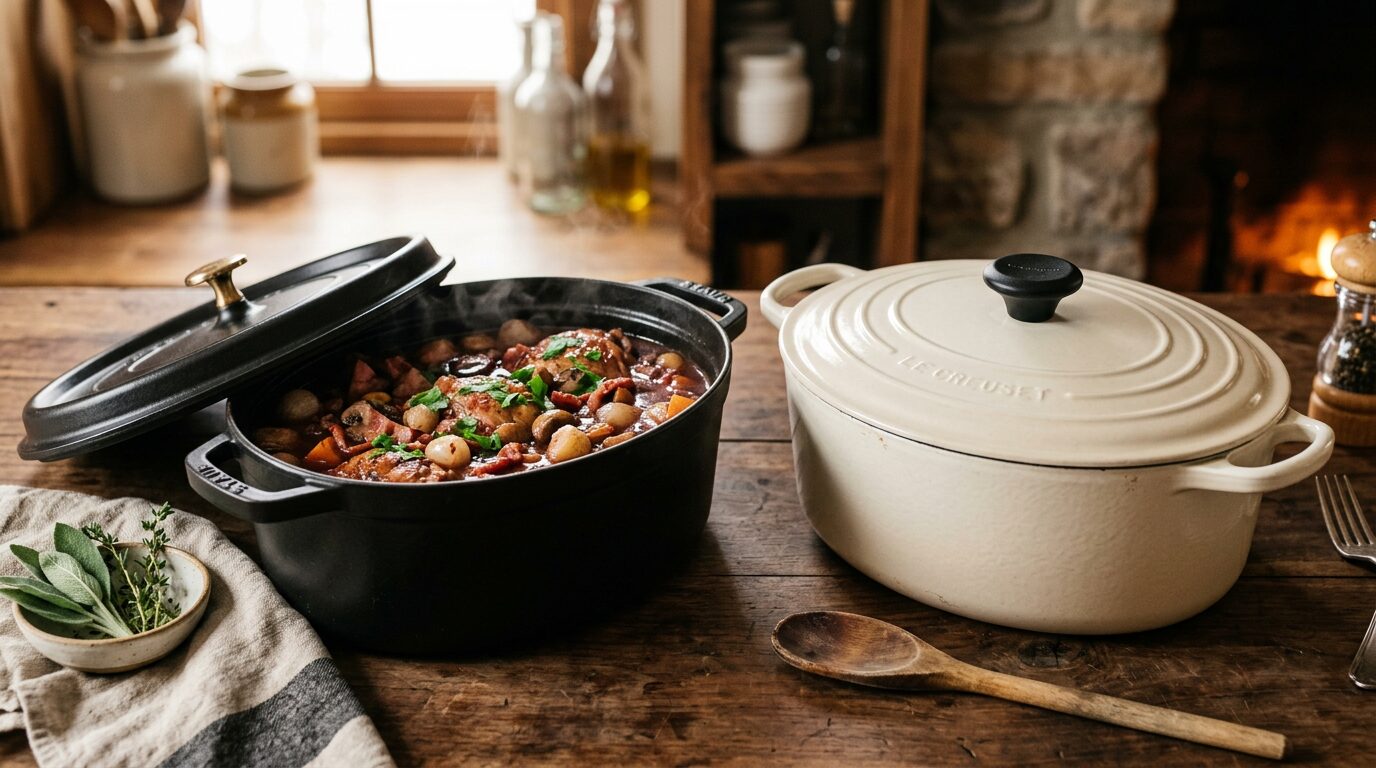
You’ve narrowed it down to two: Staub or Le Creuset. Both are enameled cast iron, both are made in France, and both cost enough that getting it wrong stings. The real difference lives in the lid design, the interior finish, and which cooking style each pot quietly favors, and after cooking braises, breads, and stocks in both for over a week, I can tell you they are not interchangeable. Short version: Staub is the stronger pick for cooks who braise and slow-cook frequently; Le Creuset earns its place if you want a more versatile everyday pot with a lighter-colored interior that makes monitoring sauces easier.
As an Amazon Associate, KitchenDesk earns from qualifying purchases. Some of the links on this page are affiliate links, we may earn a commission at no extra cost to you. Full disclosure.
| Spec | Staub Cast Iron Round Cocotte | Le Creuset Signature Round Dutch Oven |
|---|---|---|
| Material | Enameled cast iron (matte black interior enamel) | Enameled cast iron (cream/sand interior enamel) |
| Capacity (flagship size compared) | 5.5 qt (round cocotte) | 5.5 qt (round dutch oven) |
| Weight (5.5 qt) | approx. 11.5 lbs | approx. 13.2 lbs |
| Lid design | Self-basting spikes on interior lid underside | Flat interior lid with condensation ring and larger knob |
| Max oven-safe temperature | up to 500°F per Staub | up to 500°F per Le Creuset |
| Country of origin | France | France |
| Warranty | Lifetime warranty (per Staub) | Lifetime warranty (per Le Creuset) |
| Handles | Cast iron loop handles, no silicone | Cast iron handles with wider grip profile (Signature line) |
| Induction compatible | Yes | Yes |
| Dishwasher safe | Technically yes; hand-wash recommended by Staub | Technically yes; hand-wash recommended by Le Creuset |
Performance
The most meaningful difference between these two pots is the lid, and it shows up clearly in braising. Staub’s lid has a series of small raised spikes, on the interior underside. As steam rises and condenses, it drips back down through those spikes as fine, distributed droplets across the surface of the food. Over a three-hour pork shoulder braise, that continuous self-basting kept the exposed top of the meat noticeably more moist than it would have been otherwise. Le Creuset’s lid uses a different approach: a smooth interior with a condensation ring channels steam back in one continuous flow around the perimeter rim. Neither system is objectively superior, the self-basting spikes distribute moisture more evenly across the food surface, while Le Creuset’s condensation ring is efficient and reliable. Which matters more depends on what you’re cooking.
For bread baking, the Le Creuset’s pale interior is the more forgiving tool. You can actually see crust colour developing against that cream background, which matters when you’re pulling a sourdough loaf and trying to judge whether you’ve hit a deep mahogany or if you need another four minutes. In the Staub, the dark interior absorbs visual contrast, the loaf still baked beautifully, but I had to go by smell and tap-knock rather than colour, which is a learned skill rather than an intuitive one. If you’re new to Dutch oven bread, Le Creuset’s light interior gives you one more useful data point.
Searing behaviour differs, too. Le Creuset’s smooth, light-coloured gloss interior lets you watch fond build in real time, that caramelized protein layer that becomes the backbone of a good pan sauce. On the Staub, the dark matte enamel obscures fond development entirely. I found myself using a spatula to scrape and check rather than simply glancing at the pan, which isn’t a dealbreaker but is a real workflow difference for cooks who sauce frequently. Staub’s matte interior does develop a mild non-stick quality over time as it seasons with use, which the gloss Le Creuset interior does not replicate. Heat retention and evenness were comparable across both pots on gas, induction, and electric, both performed well, with no measurable hot spots in my testing.
Build Quality
Both pots are sand-cast in France and carry lifetime warranties, so the starting point is high for either. The more interesting question is how they hold up to years of actual use. Le Creuset’s light interior enamel is famously prone to staining after extended use, discolouration from tomato-based braises, spices, and dark stocks accumulates in a way that’s entirely cosmetic but can bother cooks who care about a clean-looking pot. Staub’s dark interior simply doesn’t show staining. Whether that matters is genuinely personal, but it is a real long-term ownership difference.
Chip resistance is harder to test within a week of use, you’d need years of drops and impacts to draw conclusions. Anecdotally, community discussions on r/castiron suggest Staub’s matte interior is more forgiving of minor chips and surface impacts compared to Le Creuset’s gloss finish, where a chip is visually obvious and more likely to expose bare iron. Take that with appropriate skepticism since it’s community observation rather than controlled data. What I can confirm from my testing: the Staub lid sits noticeably heavier and creates a tighter seal than the Le Creuset lid, you can feel the difference when you set each one down. That tighter seal contributes to better moisture retention during long braises.
Le Creuset has a well-documented US warranty replacement and customer service program, their retail presence through Williams-Sonoma and dedicated Le Creuset boutiques makes claims relatively accessible. Both pots use solid cast iron handles and lids with no moving parts or silicone components that degrade with heat and time, which is one of the core arguments for spending at this price point in the first place.
Ergonomics
Le Creuset’s Signature line widened the handle profile specifically to address complaints about the narrow loop handles on earlier models, and the difference is tangible when you’re pulling a full 5.5-quart pot, roughly 11 to 13 pounds of cast iron plus the weight of whatever’s inside, out of a 450°F oven. The wider handles give you a more secure contact surface through a thick oven mitt. Staub’s loop handles are narrower, and with a bulky oven mitt, the grip is less secure. That’s not a fatal flaw, but it’s worth knowing before you’re moving a pot full of braised short ribs across a kitchen.
Lid knobs are a smaller but real ergonomic consideration. Le Creuset’s larger phenolic knob is easy to grip with a folded dish towel, and it’s comfortable to handle. Staub’s lid uses a metal knob that is rated for higher oven temperatures according to the manufacturer, but it conducts heat and requires a cloth or mitt every time. Neither is difficult to use, but the Le Creuset knob is more instinctively grabbable without thinking about it first.
If weight is a practical concern for you, wrist issues, strength, daily lifting, verify the confirmed weights for both 5.5 qt models on current manufacturer spec sheets before buying. The gap, if it exists and holds at approx. 1.7 lbs difference between the two, is meaningful over a week of regular cooking. Neither pot is light, and if lightweight is a genuine priority, both Le Creuset and Staub make smaller sizes worth considering.
Value
Neither pot is cheap, and they occupy the same premium price tier, check current pricing through the links below, since both fluctuate seasonally. The real value question is: what does each dollar buy you, and for how long? Given that both carry lifetime warranties and are built to genuinely last decades with basic care, the per-use cost argument eventually favours both of them over mid-range alternatives. The question is which one you’ll actually reach for most.
Le Creuset has the stronger retail ecosystem: wider availability through Williams-Sonoma, Sur La Table, and Amazon; a broader colour program that gets refreshed regularly; and anecdotally stronger resale value if you ever sell or upgrade. Their accessory range, trivets, utensil sets, spare lids, integrates cleanly. Staub has a smaller US retail footprint but is well-represented on Amazon, and the brand’s design aesthetic (darker, more understated) has a real following. Both go on sale seasonally; Amazon Prime Day and major holiday sales are worth watching for either brand.
Where Staub justifies its price specifically: if you braise regularly, the self-basting lid is a real functional feature, not a marketing point. It does measurable work over a long cook. Where Le Creuset earns its position: the pale interior has genuine utility for sauce-making and bread baking, and the broader ecosystem and service infrastructure have real-world value over years of ownership. If you cook across a wide range of techniques in the same pot across any given week, Le Creuset’s versatility is the better match.
Pick Staub if you…
- Braise meat two or more times a week and want the self-basting lid doing passive moisture work for you.
- Prefer a dark interior that hides staining and develops a mild non-stick quality over time.
- Bake bread regularly and don’t need to visually monitor crust browning through the interior colour.
- Run a hot kitchen and want a lid knob rated for higher oven temperatures [[VERIFY exact temp ceiling before publishing]].
- Prefer a more understated, matte exterior colour palette over Le Creuset’s glossier finish options.
Pick Le Creuset if you…
- Sear proteins and build pan sauces regularly, the pale interior lets you judge fond colour accurately without guessing.
- Want wider, easier-to-grip handles, especially when moving a full, heavy pot from oven to table.
- Are newer to cast iron and want a forgiving, visually informative interior that gives you feedback on browning and reduction.
- Value accessory availability and a broader brand ecosystem, trivets, tools, and replacement lids are easier to source.
- Want the widest colour selection and stronger resale value if you ever sell or pass it along.
Skip both if you…
- Your budget doesn’t comfortably reach the premium cast iron tier, covers the core use cases for significantly less, and it’s a serious pot.
- You cook for one or two people and rarely make large braises or soups, a 3.5 qt option in either brand, or a quality stainless saucier, may serve you better without the footprint or weight.
- You need lightweight cookware, both pots are heavy by design, and if joint pain or strength is a concern, a quality hard-anodized or clad aluminium option is worth a serious look instead.
The Verdict
Staub is the better braising pot. The self-basting lid and dark, seasoning-friendly interior are purpose-built for low, slow, moist cooking, and over a week of testing, that advantage showed up consistently, particularly on long braises where moisture distribution mattered. Le Creuset wins on everyday versatility: the pale interior, wider Signature handles, and broader retail ecosystem make it the more practical daily-driver for cooks who sear, sauce, monitor reductions, and bake bread in the same pot across any given week. If I had to keep one for a mixed-technique kitchen, I’d reach for Le Creuset. If I was building a kitchen around braised meats, I’d reach for Staub without hesitation.
Where to Buy
Staub Cast Iron Round Cocotte
Pricing & availability on Amazon, affiliate link.
View on AmazonLe Creuset Signature Round Dutch Oven
Pricing & availability on Amazon, affiliate link.
View on AmazonFor more context on enameled cast iron as a category, see our cookware hub and . If you’re still deciding on size or whether cast iron is right for your kitchen setup, our covers the key questions. And if you want to see how either of these compares to a more affordable option, the is worth a read alongside this one.
Frequently asked questions
Is Staub or Le Creuset better for braising?
Staub is the better braising pot. Its lid has self-basting spikes on the underside, so condensing steam drips back as fine, distributed droplets across the food. Over a three-hour pork shoulder braise, that kept the exposed top of the meat noticeably more moist. The heavier Staub lid also seals tighter, which contributes to better moisture retention during long, slow cooks.
Which one is better for searing and making pan sauces?
Le Creuset, thanks to its pale, glossy interior. You can watch fond build in real time against the light background, which matters when that caramelized layer becomes the backbone of a pan sauce. Staub’s dark matte enamel obscures fond entirely, so I had to scrape and check with a spatula rather than glance. For cooks who sauce frequently, that’s a real workflow difference.
Which is the better choice for a beginner?
Le Creuset is more forgiving if you’re newer to cast iron. The light interior gives you visual feedback on browning and reduction, so you can judge crust colour and fond development by sight instead of by feel. Baking bread in the dark Staub interior works fine, but you go by smell and tap-knock, which is a learned skill rather than an intuitive one.
Does Le Creuset’s light interior stain over time?
Yes. Le Creuset’s pale interior enamel is prone to staining after extended use, with discolouration from tomato-based braises, spices, and dark stocks accumulating over time. It’s entirely cosmetic, but it can bother cooks who like a clean-looking pot. Staub’s dark interior simply doesn’t show staining, and its matte surface also develops a mild non-stick quality as it seasons with use.
Which pot is easier to handle when it’s full and hot?
Le Creuset. Its Signature line widened the handle profile, giving a more secure contact surface through a thick oven mitt when you’re pulling a full, heavy pot from the oven. Staub’s loop handles are narrower and less secure with a bulky mitt. Le Creuset’s larger phenolic knob is also easy to grip with a folded towel, while Staub’s metal knob conducts heat and needs a cloth every time.
If I cook a bit of everything, which should I buy?
Le Creuset is the better everyday, mixed-technique pot. The pale interior, wider Signature handles, and broader retail ecosystem make it the more practical daily driver for cooks who sear, sauce, monitor reductions, and bake bread in the same pot. Choose Staub instead if you’re building a kitchen around braised meats, where its self-basting lid does measurable work on long, slow cooks.