
On this page
You’re standing between two very different philosophies of what a kitchen knife should be, and the wrong choice means spending real money on a tool that fights you every time you cook. Japanese knives and German knives aren’t just different shapes; they reflect different steels, different geometries, and different assumptions about how you work. By the end of this guide you’ll understand exactly what separates the two traditions, which tasks each style handles better, and how to match a knife to your actual cooking habits, not just what looks good on a magnetic strip.
As an Amazon Associate, KitchenDesk earns from qualifying purchases. Some of the links on this page are affiliate links, we may earn a commission at no extra cost to you. Full disclosure.
Jump to a section
TL;DR
- Japanese knives use harder steel (typically 60+ HRC) ground to a thinner, more acute edge, usually 10–15° per side. German knives run softer (55–58 HRC) with a thicker, more convex edge, typically 17–22° per side.
- Harder steel holds an edge longer but chips more easily under lateral stress; softer steel dulls faster but is far more forgiving of rough use and the occasional bone.
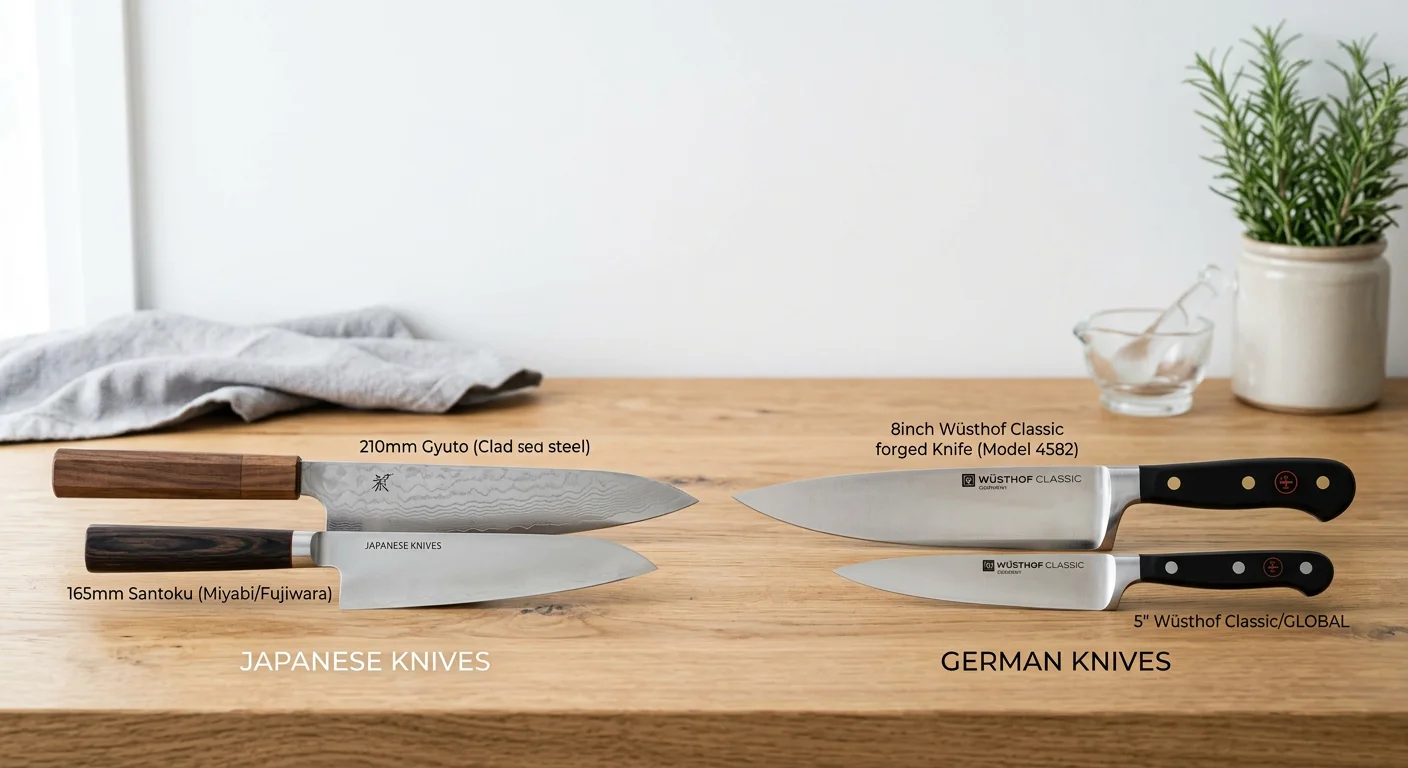
- For a first serious knife, most home cooks are better served by a German 8-inch chef’s knife or a Japanese 210mm gyuto, both are all-purpose workhorses, just with different feels.
- Honing rods are not interchangeable: a ridged steel rod can damage a hard Japanese blade. Use a smooth (polished) honing rod or ceramic rod for Japanese knives.
- The “best steel” debate is mostly settled by how you maintain it. A well-kept $80 knife outperforms a neglected $300 one, every time.
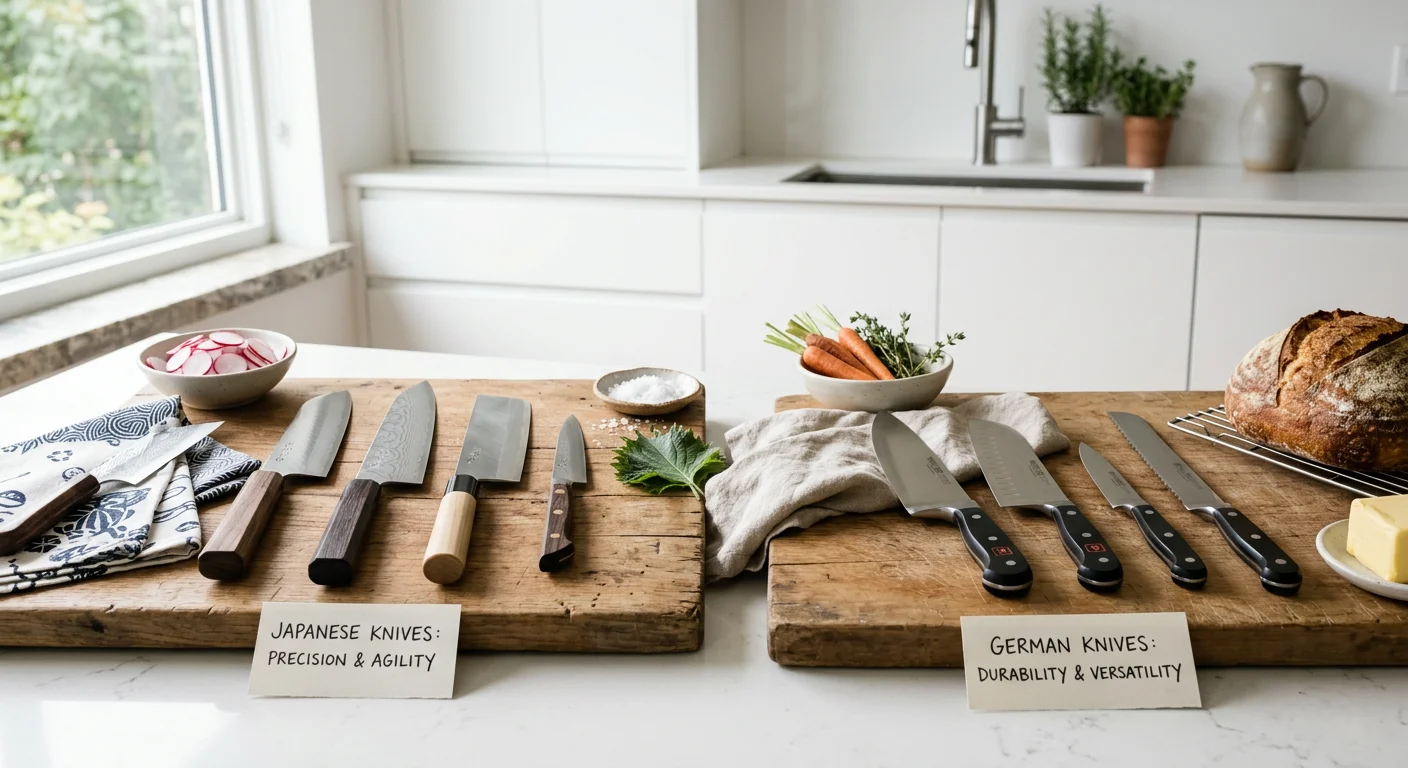
- Thin Japanese blades excel at precision tasks, paper-thin vegetable slices, fish butchery, clean herb cuts. German blades handle high-impact work, breaking down chicken, squash, melons, more confidently.
- If you hand-wash and hone regularly, Japanese is worth considering. If your knives go in the dishwasher or get tossed in a drawer, start with German.
Two Traditions, Two Engineering Philosophies
German knife-making concentrated in Solingen and Thiers during the 19th century, optimising for a robust, mass-producible blade that could handle the varied demands of professional butchery and home cooking alike. The goal was a tool that performed reliably across a wide range of tasks, stayed workable with minimal fuss, and tolerated the kind of rough handling that comes with a busy kitchen. Japan’s blade tradition has different roots, stretching back to samurai sword-smithing and evolving into highly specialized single-bevel kitchen knives like the yanagiba and deba before Western culinary influence produced the gyuto, a Japanese interpretation of the French chef’s knife, in the 20th century.
The two traditions have converged commercially, you can buy a German-profile knife made in Japan, and plenty of Japanese-style knives are manufactured in Europe, but they still represent genuinely distinct engineering trade-offs in steel hardness, blade geometry, and intended maintenance routines. Understanding those trade-offs is what separates a good buying decision from an expensive mistake.
What Actually Matters When Choosing Between Japanese and German Knives
Steel hardness, edge geometry, blade profile, and your maintenance habits are the four variables that actually determine whether a knife works for you. Everything else is secondary. Rockwell hardness (HRC) is the starting point: it determines how acute an edge the steel can hold and how brittle it becomes under shock. Japanese knives typically run 60–67 HRC depending on the steel alloy, VG-10, SG2, white #1 and #2, and blue #1 and #2 are common options you’ll see specified by reputable makers. German knives from established makers like Wüsthof and Zwilling typically rate 56–58 HRC. The practical difference: harder steel can be ground thinner and holds that edge through more cutting cycles, but it reaches a brittleness threshold where lateral flex or impact on hard food, frozen items, bones, hard squash stems, can microchip the edge. Softer steel blunts gradually and predictably, and you can bring it back on a honing rod between uses without much ceremony.
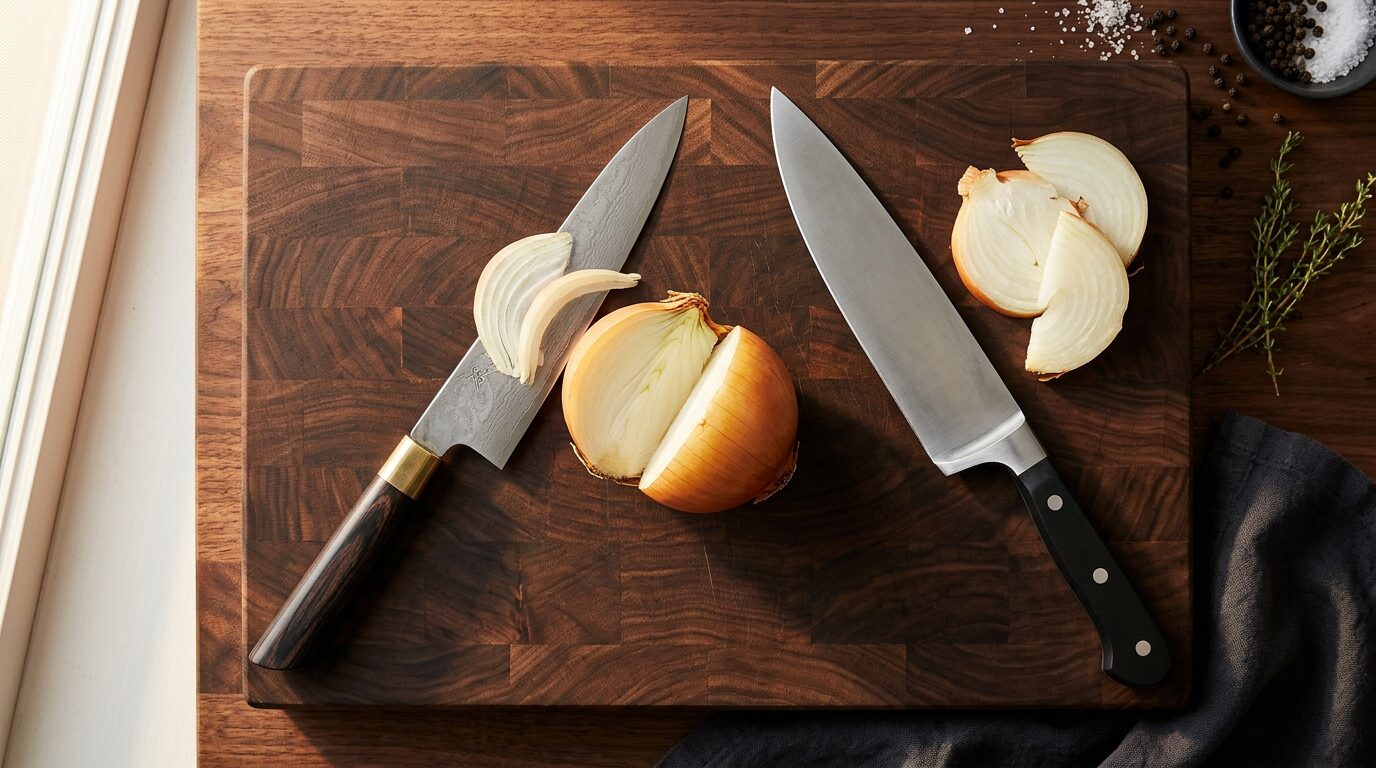
Bevel angle and grind are where the tactile difference lives. Most German knives leave the factory at 17–22° per side and use a convex or flat grind that adds spine thickness for rigidity. Japanese knives, especially gyutos from dedicated cutlery makers, are typically ground to 10–15° per side and often feature a thinner spine and a hollow or flat grind. That extra acuity is what produces the “falls through food” sensation people describe, it’s geometry, not magic. The knife is simply removing less material as it passes through, with less wedging force on either side of the blade.
Blade profile shapes your cutting style in a way that’s easy to underestimate before you’ve used both. German chef’s knives have a pronounced belly curve suited to a rocking chop, if you’re someone who keeps the tip on the board and rocks the heel up and down through herbs or onions, that curve is working with you. Japanese gyutos are flatter toward the heel, encouraging a push-cut or slice-forward motion instead. Neither approach is objectively better, but if you rock-chop by habit, a flat-profile Japanese blade will feel wrong until you consciously adapt, and some cooks never do.
Finally, maintenance reality is the variable most people gloss over when they’re excited about a new knife. According to Serious Eats’ knife-care and sharpening coverage, harder-steel Japanese blades need a whetstone, or at minimum a quality water stone, to re-sharpen properly; a pull-through sharpener removes too much metal and can’t maintain the geometry. German knives tolerate pull-through sharpeners and honing rods more gracefully, making them lower-friction to maintain for someone who doesn’t want to learn whetstoning. Honest question to ask yourself: will you actually learn to use a whetstone? If the answer is probably not, that should influence which category you buy into.
What’s Just Marketing Fluff
Knife marketing is full of impressive-sounding claims that don’t translate to cutting performance in a home kitchen. The “forged vs. stamped” distinction is the oldest one. Forging was historically a mark of quality because it aligned the steel’s grain structure during manufacture. Modern stamped blanks from reputable mills, used by brands like Victorinox, are cut from high-quality sheet steel and heat-treated just as carefully. Cook’s Illustrated has repeatedly ranked stamped knives competitively with forged ones in blind cutting tests. Worth noting: the bolster, that thick collar between blade and handle, is a forging artifact that can actually make sharpening harder once the blade wears down, because it prevents you from reaching the full heel of the edge on a stone.
Layer counts on Damascus-pattern steel are another piece of spec-sheet theater. “67-layer Damascus” sounds impressive and looks genuinely beautiful, but the visible wavy pattern is aesthetic. The cutting edge is determined by the core steel, often VG-10 or similar, not the number of cladding layers around it. Damascus cladding can provide mild corrosion resistance to the softer outer layers, but it does not sharpen better, hold an edge longer, or cut differently than a mono-steel blade of equivalent core hardness. You’re paying for looks, which is a completely legitimate reason to buy something, just go in knowing that’s what you’re paying for.
Handle materials marketed as “premium” deserve similar scrutiny. Pakkawood, G-10, micarta, and stabilised wood are all durable synthetic or stabilised composites. The material matters less than the fit to your hand. An expensive carbon-fibre handle on a knife that doesn’t fit your grip is worse than a POM (polyoxymethylene) handle that does. Test grip in person when possible, or buy from a retailer with a reasonable return window.
Common Mistakes Home Cooks Make When Buying Knives
The mistakes aren’t usually about picking the wrong brand, they’re about mismatching a knife’s requirements to actual kitchen habits, or letting one impressive quality paper over a fundamental fit problem. Here are the ones I see most often.
- Using a ridged honing rod on a hard Japanese blade. Ceramic or smooth (polished) honing rods are safe for hard Japanese blades. A standard German-style ridged steel rod can cause microchipping on blades above roughly 61 HRC. This is one of the most common ways expensive Japanese knives get quietly destroyed, the owner doesn’t even notice until the edge feels consistently “off” and a closer look reveals a line of tiny chips along the bevel.
- Treating a thin Japanese knife like a German workhorse. Thin, hard blades are not built for splitting butternut squash through the stem, cracking lobster shells, or any cutting that involves significant lateral force or impact. Using a gyuto this way causes tip breaks and edge chips. Keep a German chef’s knife or a Chinese cleaver-style blade for high-impact tasks if you’re investing in a Japanese primary blade.
- Skipping the whetstone because sharpening “seems complicated.” A basic 1000/3000 combination water stone costs less than most knife blocks and is straightforward to learn for a double-bevel blade. Letting a knife go dull and then running it through a pull-through sharpener repeatedly is more damaging over a year than quarterly whetstone sessions. There are well-regarded free tutorials from knife specialists and culinary schools that reduce the learning curve significantly.
- Buying a large set instead of two or three right knives. Most home cooks use three knives for 95% of tasks: a chef’s knife or gyuto (8–10 inches / 210–240mm), a paring knife, and a serrated bread knife. Buying a 15-piece block fills a counter and draws budget away from buying one genuinely good chef’s knife. Start with the chef’s knife, use it for six months, then identify the specific gap before buying anything else.
Price Tiers: Where to Set Your Budget
Budget
$30–$80 At this tier, German-style knives from Victorinox (Fibrox Pro line) and similar stamped-blade makers offer real, usable performance. Cook’s Illustrated has named the Victorinox Fibrox Pro 8-inch a top pick against knives costing three times as much, and that result has held up across multiple testing rounds. Japanese-style options at this price typically use softer stainless steel than higher-end Japanese lines, which narrows the performance gap with German knives considerably. This tier makes sense if you’re equipping a first kitchen, buying for a student, or you genuinely don’t know yet how much you care about knives. There’s no shame in starting here, the Victorinox Fibrox is what many professional cooks reach for when they want a knife they don’t have to worry about.
Mid-Range
$80–$180 This is where the category gets genuinely interesting and where most home cooks who cook regularly should land. German options from Wüsthof (Classic line) and Zwilling (Pro line) bring full bolsters, better steel formulations, and longer warranties. On the Japanese side, gyutos from Tojiro (DP series), MAC (Professional series), and similar makers offer genuine harder-steel performance in VG-10 or similar alloys, at prices that don’t require you to treat the knife like a museum piece. The performance jump from budget to mid-range is real and noticeable primarily in edge retention, you’re sharpening less often and honing more efficiently. This tier makes sense for anyone cooking four or more nights a week who’s willing to spend ten minutes with a honing rod after use.
Premium
$180+ At this level you’re paying for better steel (SG2/R2, HAP40, white or blue carbon), hand-finishing, tighter fit tolerances, and in many cases a significantly more refined out-of-box edge. German premium options, Wüsthof Ikon, Messermeister Meridian Elite, improve handle ergonomics and balance more than they improve raw cutting performance; the German formula is already mature. Japanese premium opens the door to single-bevel knives, reactive carbon steels, and artisan workshop blades from the production centres of Sakai or Echizen that are genuinely hand-finished by individual craftspeople. The extra performance at this tier only pays back if you sharpen regularly on a whetstone, handle the knife carefully, and actually notice the difference, which not every home cook does. Buy premium because you know you’ll appreciate it, not because better gear makes you a better cook. It doesn’t, and anyone who tells you otherwise is selling something.
Dig Deeper: Related Guides and Reviews
If you’ve worked out which direction you’re heading, the next step is finding a specific knife. Our covers tested gyutos and specialty Japanese blades across every price tier, with hands-on notes from real cooking sessions. If the German path makes more sense for your habits, breaks down the current field from Wüsthof, Zwilling, Messermeister, and a few challengers worth knowing about. And regardless of which knife you buy, sharpening is what keeps it performing, covers whetstones, honing rods, and pull-through sharpeners honestly, including which pull-throughs are actually worth keeping and which to avoid.
Frequently Asked Questions
Which is better for a beginner, a Japanese or German knife?
German knives are more forgiving for beginners. The softer steel tolerates rough honing and imperfect cutting technique, including occasional tip-rocking on a hard board, without chipping. If you’re building knife skills, start German and consider Japanese once you know how you cook and how you maintain your tools.
Can I use the same honing rod for both styles?
No. A ridged (grooved) steel honing rod is fine for German knives in the 56–58 HRC range but can microchip Japanese blades above roughly 61 HRC. Use a smooth polished steel or a ceramic honing rod for Japanese knives.
Do Japanese knives rust more easily?
It depends on the steel. Most Japanese knives sold to home cooks use stainless or semi-stainless steel (VG-10, SG2) and resist corrosion comparably to German stainless. Traditional Japanese carbon steel knives, white #1 and #2 (Shirogami), blue #1 and #2 (Aogami), will rust if left wet and require a thin coating of food-safe oil or regular use to develop a protective patina. If you buy carbon steel, dry it immediately after every use. That’s non-negotiable.
What’s a gyuto, and how does it compare to a chef’s knife?
A gyuto is the Japanese double-bevel equivalent of a Western chef’s knife, developed in the 20th century to handle butchery and general prep. It shares the same basic role but tends to be thinner behind the edge, flatter in belly profile (favouring push-cuts over rocking), and lighter than a German chef’s knife of equivalent length. Most 210mm gyutos (roughly 8 inches) are direct substitutes for a standard chef’s knife in a home kitchen, the differences are real but not dramatic enough to require a learning curve for most cooks.
Is a $300 Japanese knife worth it over a $100 one?
For most home cooks, no, not in pure cutting-performance terms. The sharpest out-of-box edge, longest edge retention, and finest steel quality do live at the high end, but they only pay back if you’re sharpening regularly on a whetstone and handling the knife carefully. A $100 mid-range knife maintained well will outperform a $300 knife that never gets sharpened. Buy premium when you know you’ve actually outgrown the mid-range.
Can Japanese knives go in the dishwasher?
No. Dishwashers are bad for any quality knife regardless of origin, the heat, alkaline detergent, and vibration degrade handles, dull edges, and can cause pitting or rust on even stainless steel. Hand-wash, dry immediately, store on a magnetic strip or in a blade guard. This rule applies equally to German and Japanese knives.
What length knife should I buy?
An 8-inch (200–210mm) chef’s knife or gyuto is the practical standard for most home cooks, long enough for large produce, manoeuvrable in a typical home kitchen. Go to 10 inches (240–250mm) if you regularly break down large cuts of meat or have bigger hands. Shorter (6 inches / 150mm) works for smaller cooks or tight prep spaces but limits you on larger tasks. When in doubt, 8 inches is the right starting point.
What’s the difference between a single-bevel and double-bevel Japanese knife?
A single-bevel knife, yanagiba, deba, usuba, is sharpened only on one side, producing an extremely acute edge suited to specific professional tasks like pulling cuts through fish or cleanly separating thin vegetable sheets. They require deliberate technique to use well and are not the right starting point for most home cooks. The gyuto, and most knives marketed to home cooks, is double-bevel (sharpened on both sides), the same fundamental geometry as German knives.
How often should I sharpen my knife?
A rough working guide: hone before or after each use (for German knives or soft-stainless Japanese knives), and sharpen on a stone when honing stops restoring the edge. For a home cook this typically means a full sharpening session every three to six months. Hard Japanese blades may need less frequent sharpening but require a whetstone, not a pull-through, when they do. The actual answer depends on how much you cook and what you’re cutting through; acidic foods and hard vegetables accelerate dulling more than soft proteins do.
Is German or Japanese better for cutting meat?
It depends on the task. For slicing boneless proteins, chicken breast, fish fillets, roasts, a thin Japanese gyuto or a yanagiba produces cleaner cuts with less tearing. For tasks involving bones, breaking down a whole chicken, cutting through cartilage, portioning ribs, a German chef’s knife or a dedicated Japanese deba handles the impact better without chipping. Most home cooks doing general meat prep will be well-served by either style; the edge cases (literally) are where the difference shows up.
The honest answer to “Japanese or German?” is: it depends less on which tradition is superior and more on how you actually cook and how much maintenance you’re willing to commit to. If you hand-wash, dry promptly, and will put in the time to learn a whetstone, the Japanese side of the counter opens up genuinely impressive options. If you want a knife that handles rough work, forgives imperfect honing technique, and doesn’t require babying, German is the right call, and there’s no performance penalty for making that choice. Buy the knife that matches your real kitchen habits, not your aspirational ones.
Maya Chen, KitchenDesk. Maya is a Toronto-based home cook and former line cook (Toqué!, 2014–2017). She tests kitchen gear on gas, induction, and electric for a minimum of one week before any recommendation goes to print.