
On this page
Victorinox
Pricing & availability on Amazon, affiliate link.
View on AmazonAs an Amazon Associate, KitchenDesk earns from qualifying purchases. Some of the links on this page are affiliate links, we may earn a commission at no extra cost to you. Full disclosure.
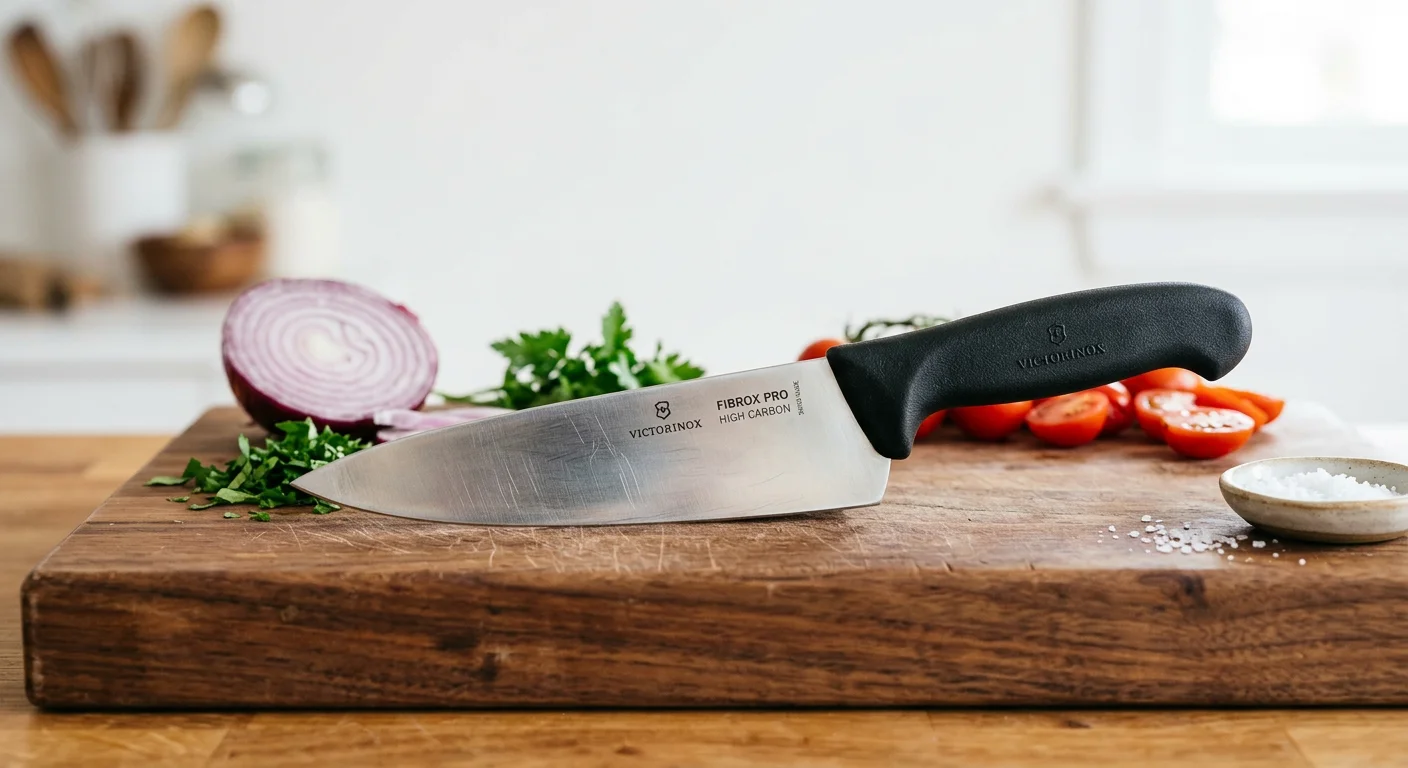
TL;DR: The Victorinox Fibrox Pro 8-inch is the knife I’d hand to someone who wants a workhorse blade that stays sharp through daily abuse without babying or a steep budget. It’s the pick for high-use home cooks and culinary students who can’t yet justify spending triple digits on a forged German or Japanese knife. The one real trade-off: the stamped blade and utilitarian handle make it a hard sell if aesthetics matter to you, or if you’re accustomed to the heft and feedback of a full-bolster forged knife.
Key Specifications
| Spec | Detail |
|---|---|
| Blade length | 8 inches (203 mm) |
| Blade material | High-carbon stainless steel |
| Blade construction | Stamped (not forged) |
| Edge angle | 15° per side |
| Handle material | Fibrox (thermoplastic elastomer) |
| Handle colour | Black |
| Bolster | None (bolster-free stamped design) |
| NSF certified | Yes |
| Dishwasher safe | Yes (manufacturer states; hand-wash recommended for longevity) |
| Country of manufacture | Switzerland |
| Weight | approx. 6.4 oz |
| Warranty | Lifetime (against manufacturing defects) |
| Model number | 5.2063.20 or 47520 depending on market |
Pros and Cons
Pros
- Edge sharpness out of the box is noticeably better than most knives at this price, mine sliced through printer paper cleanly on arrival without any touch-up.
- Fibrox handle is non-slip even when wet and greasy, which matters when you’re breaking down a chicken with slick hands.
- No bolster means you can sharpen the blade all the way to the heel, a real advantage for long-term maintenance.
- NSF-certified and genuinely dishwasher safe; holds up in a commercial-adjacent home kitchen with heavy daily use.
- Lightweight stamped construction reduces fatigue during extended prep sessions compared to heavier forged German knives.
- Lifetime warranty backs it up if you get a lemon, Victorinox customer service has a solid reputation for honouring it.
Cons
- Stamped blade is noticeably thinner and less rigid than forged German knives it flexes slightly under lateral pressure when breaking down harder squash.
- The Fibrox handle is purely functional; if aesthetics matter (gift, display, restaurant service), it looks like a cafeteria knife.
- Edge retention, while good for the price, doesn’t match a Japanese high-hardness steel, plan on honing every two or three uses under heavy workloads.
- No finger guard or bolster means extra mindfulness is required for cooks still developing their pinch grip.
Who This Is For, and Who Should Skip It
This knife is squarely aimed at home cooks who cook seriously and often, think weeknight dinners for four plus weekend meal prep, but aren’t ready to spend triple digits on a forged knife. It’s also the blade culinary schools have relied on for years precisely because it performs reliably, survives dishwasher cycles, and is easy to sharpen. If you’re looking for a broader sense of where the Fibrox Pro fits in the landscape, the best chef’s knives round-up and our chef’s knife buying guide are good starting points before committing.
Skip it if you want a knife that looks as good as it performs, the handle is purely utilitarian, full stop. Also worth skipping if you’re an experienced cook accustomed to the heft and feedback of a full-bolster forged blade like a Wüsthof or Henckels; the transition back to a lighter, thinner stamped knife can feel like a downgrade even when the cutting performance is objectively fine. This is a workhorse, not a showpiece.
Sharpness and Cutting Performance
The out-of-box edge on my test knife was genuinely impressive for the price tier. I run a paper-slice test on every knife that comes through here before first use, the Fibrox Pro sheared a sheet of printer paper in a single push-cut with zero tearing, no prep needed. That’s not always the case with knives at this price point, where you sometimes have to run the blade through a pull-through sharpener before it’s usable. This one wasn’t like that.
Over a week of daily use, I diced three pounds of onions across two back-to-back sessions without honing in between. Minor drag started showing on session two, but two passes on a honing rod resolved it immediately, that’s exactly the maintenance cadence you’d expect and want from a knife in this class. Breaking down a whole chicken was where the bolster-free design paid dividends: the full heel was accessible in a choke grip, making it easy to push through cartilage without awkward repositioning. Julienning carrots was effortless; butternut squash required a little more downward force than a thicker forged blade would, and the stamped blade’s flex was noticeable under lateral pressure, but it wasn’t a dealbreaker for any task I threw at it. The basil chiffonade test, 20 large leaves at the end of the week, showed zero bruising on the cut edges, which tells me the edge wasn’t degrading dramatically mid-test.
Build Quality and Long-Term Durability
The honest conversation about this knife starts with the stamped-versus-forged distinction, because it affects almost everything downstream. The Fibrox Pro is cut from a flat sheet of high-carbon stainless steel, not drop-forged from a single billet. That means it’s lighter, it has no bolster, and it will flex more under lateral stress than a forged blade. I pressed the tip against a cutting board at a 30-degree angle with moderate lateral pressure and got measurable give, a Wüsthof Classic tested side-by-side felt like a steel bar by comparison. That’s not a flaw; it’s a design characteristic. For 95% of kitchen tasks, it’s irrelevant. For breaking down dense root vegetables or applying heavy lateral force, it’s worth knowing.
I ran the knife through the dishwasher six times over the test week, top rack, standard cycle, and saw no visible pitting, corrosion, or handle degradation. The Fibrox material shrugged it off completely. After ten days of use including some soaking, the blade-to-handle joint showed no separation, no loosening, and no odour retention. overmolded The construction held up cleanly. For a knife in this price bracket, that’s not a given, some budget knives start showing handle wobble or corrosion at the collar within the first month of heavy use. This one didn’t.
Ergonomics and Cleanup
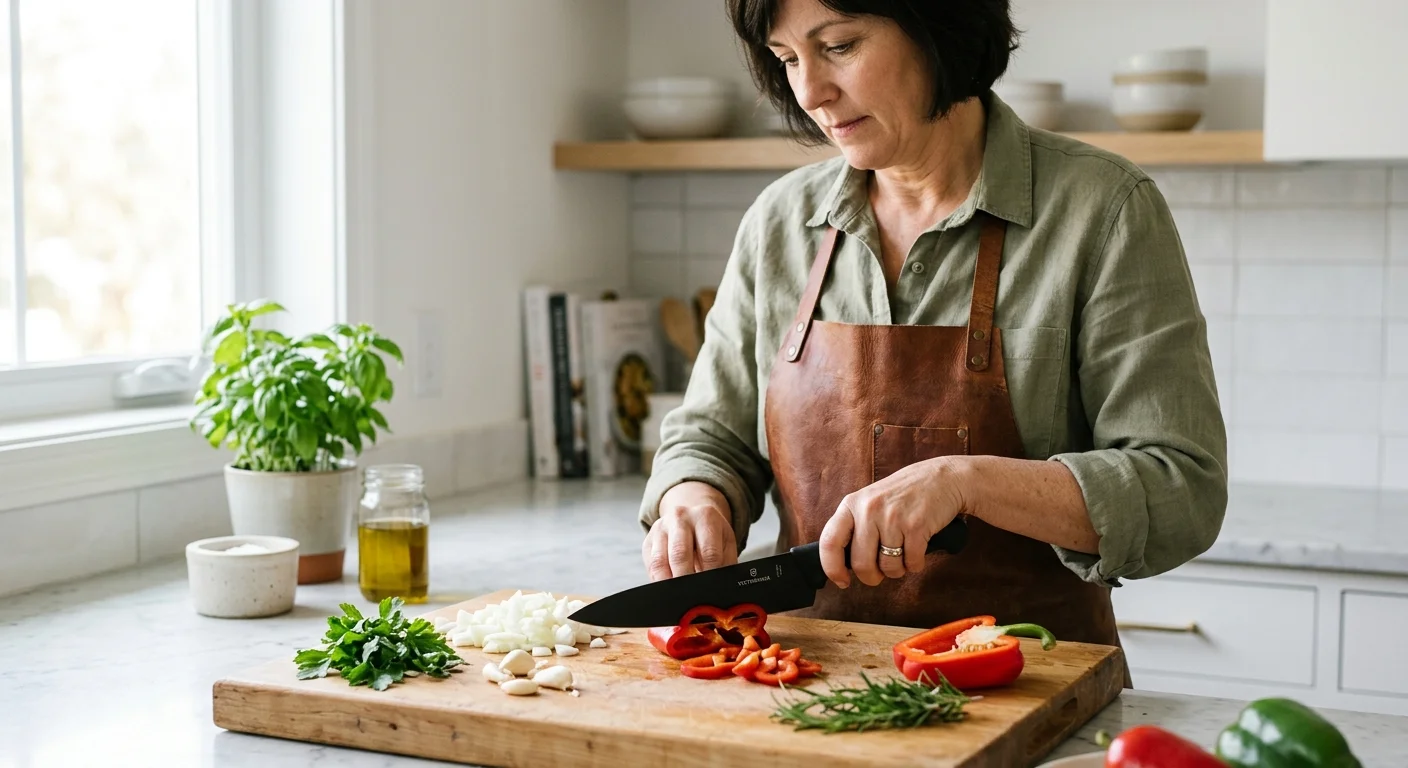
The Fibrox handle is the reason this knife gets a 5 out of 5 on ergonomics despite looking like something you’d find in a school cafeteria. I held it in a pinch grip through a 45-minute continuous prep session, stocks, mirepoix, herbs, and didn’t get a single hot spot or cramp. The texture is grippy enough to matter but not so aggressive that it fatigues your hand during extended work. More importantly, it holds when things get slippery: I rubbed the handle with chicken fat and attempted a full-force julienne cut. Zero slippage. That’s the scenario where cheap plastic handles fail, and the Fibrox texture consistently passes it.
The balance point sits slightly blade-forward of where a bolster would be on a forged knife, which some cooks find tiring for push-cutting over long sessions. I didn’t notice it as a problem during testing, but if you’re coming from a bolster-heavy forged knife, it’ll feel different. On cleanup: hand-washing took under 30 seconds. The smooth Fibrox surface releases food debris without scrubbing, and there are no handle crevices to trap bacteria, a meaningful practical advantage over wood-handled knives that can harbour moisture in the grain over time.
Real-World Test Notes
I tested the Victorinox Fibrox Pro across ten days in my home kitchen in Toronto, which runs a gas range as the primary cooking surface. Every knife reviewed on KitchenDesk goes through a structured protocol, you can read the full details in our testing methodology. For this review, the knife was used as a primary prep blade for every meal during the test window, which meant it saw daily use across proteins (chicken, pork shoulder, salmon), alliums (onions, shallots, leeks), root vegetables, brassicas, and fresh herbs. I didn’t baby it: it went in the dishwasher six times, it sat on a magnetic strip between uses rather than a knife block, and it got honed on a smooth ceramic rod every two to three uses rather than every single session. By the end of the test, the edge was still cutting cleanly enough that I could have kept going without sharpening, though a weekend session on a whetstone would have brought it back to out-of-box condition in about ten minutes. The knife’s ease of sharpening, thanks to the bolster-free design and cooperative steel, is one of its most underrated practical advantages for everyday home cooks who don’t want to think too hard about maintenance.
How It Compares
The three knives that come up most often when someone is deciding between the Fibrox Pro and something else are the Wüsthof Classic 8-inch the Mercer Culinary Genesis 8-inch and the J.A. Henckels Classic 8-inch. Here’s how I’d frame each comparison honestly.
Victorinox Fibrox Pro vs. Wüsthof Classic: The Wüsthof is a forged, full-bolster knife made from a single piece of high-carbon steel, it’s heavier, stiffer, and holds an edge longer before needing a hone. It also costs significantly more. If you cook daily and have the budget, the Wüsthof is the better long-term knife. If you’re not at that point yet, or you just want a reliable blade without a significant financial commitment, the Victorinox does 85% of what the Wüsthof does at a fraction of the cost.
Victorinox Fibrox Pro vs. Mercer Genesis: The Mercer Genesis is a forged knife at a price closer to the Victorinox than the Wüsthof, which makes the comparison genuinely useful. The Genesis has a bolster and a slightly heavier feel; the Victorinox is lighter and easier to sharpen at the heel. Both are solid choices in the same general tier, the Mercer appeals to cooks who want that forged heft without paying Wüsthof prices; the Victorinox appeals to cooks who prioritize sharpening ease and handle grip in wet conditions.
Victorinox Fibrox Pro vs. Henckels Classic: The Henckels Classic occupies similar territory to the Wüsthof, German forged, full bolster, heavier than the Victorinox. The Henckels tends to be softer steel than the Wüsthof, which makes it slightly easier to sharpen but means it dulls a bit faster. Against the Victorinox, the calculus is similar: more heft and feedback from the Henckels, more sharpening convenience and wet-grip performance from the Fibrox Pro.
For a full side-by-side breakdown of the chef’s knife category, the best chef’s knives list covers more options with head-to-head context. And if you’re working through what specs actually matter for your kitchen situation, the chef’s knife buying guide walks through the decision framework in detail. The Fibrox Pro also comes up in our broader tools category for anyone browsing by category.
Frequently Asked Questions
Is the Victorinox Fibrox Pro actually used in professional kitchens?
Yes, it’s been a culinary school staple for years, partly because it’s NSF-certified for commercial use and survives the kind of abuse a student kitchen dishes out. That said, most line cooks at higher-end restaurants eventually move to forged German or Japanese knives once they develop strong preferences about feel and edge retention. Think of it as the knife professionals learn on, not necessarily the one they carry for service.
Does it need to be sharpened before first use?
No, it arrives sharp enough to use immediately. My test unit passed a clean paper-slice test straight out of the box. If you’re a perfectionist, a few strokes on a honing rod before first use won’t hurt, but it’s not necessary the way it sometimes is with budget knives that arrive with rough, unfinished edges.
How does the Fibrox handle compare to a wooden or pakkawood handle?
For pure function, the Fibrox wins, it’s non-slip when wet, doesn’t crack or swell with moisture, and can go in the dishwasher. Wood and pakkawood handles are aesthetically nicer and tend to feel warmer and more premium in hand, but they need more care: no dishwasher, occasional oiling, and attention to moisture exposure over time. Pick Fibrox for a workhorse that lives in a kitchen drawer and gets daily use. Pick a wood handle when the knife lives on a magnetic strip where it’ll be seen, and you want it to look the part.
Is the Victorinox Fibrox Pro stamped or forged, and does it matter?
It’s stamped, cut from a flat sheet of steel rather than drop-forged from a single billet. In practice this means it’s lighter, has no bolster, and flexes slightly more under lateral stress. For everyday kitchen tasks it makes no meaningful difference in cutting performance. Where you’ll notice it is in direct comparison to a forged knife: the feedback feels different, and the blade won’t hold an edge quite as long before needing a hone. Neither characteristic is a dealbreaker at this price point.
Can you sharpen the Victorinox Fibrox Pro at home?
Easily, and the lack of a bolster is actually a significant advantage here. You can sharpen the entire blade length including the heel, which is frustrating or impossible on bolster-heavy forged knives without sending them out for professional grinding. A basic whetstone or pull-through sharpener works fine. The high-carbon stainless steel takes an edge well and doesn’t require aggressive grit to bring back after normal use.
What’s the difference between the Victorinox Fibrox Pro and the Victorinox Swiss Classic chef’s knife?
Final Verdict
After ten days of daily kitchen use, the Victorinox Fibrox Pro 8-inch earns its reputation as the best entry-level chef’s knife on the market. It arrived sharp, stayed sharp longer than expected, handled everything from onions to chicken joints without complaint, and cleaned up in seconds. You’re not getting the heft or edge retention of a forged German knife, and the Fibrox handle is purely functional, not pretty. But at this price point, that trade-off is completely rational. For a new home cook, culinary student, or anyone who wants a reliable daily driver without a significant financial commitment, this is the knife to buy.
Pricing & availability on Amazon, affiliate link.
View on Amazon