

On this page
- Quick Comparison
- Wüsthof Classic 9-Inch Double Serrated Bread Knife, Best Overall
- Victorinox Swiss Army Fibrox Pro 10.25-Inch Bread Knife, Best Budget
- Shun Classic 9-Inch Bread Knife, Best Premium
- Mercer Culinary Millennia 10-Inch Bread Knife, Best for Culinary Students
- Global G-9 9-Inch Bread Knife, Best for Minimalists
- Tojiro Bread Slicer F-737, Best Splurge
- Cuisinart C77TR-8BD Triple Rivet 8-Inch Bread Knife, Best Compact
- How to Choose a Bread Knife: What Actually Matters
- Frequently Asked Questions
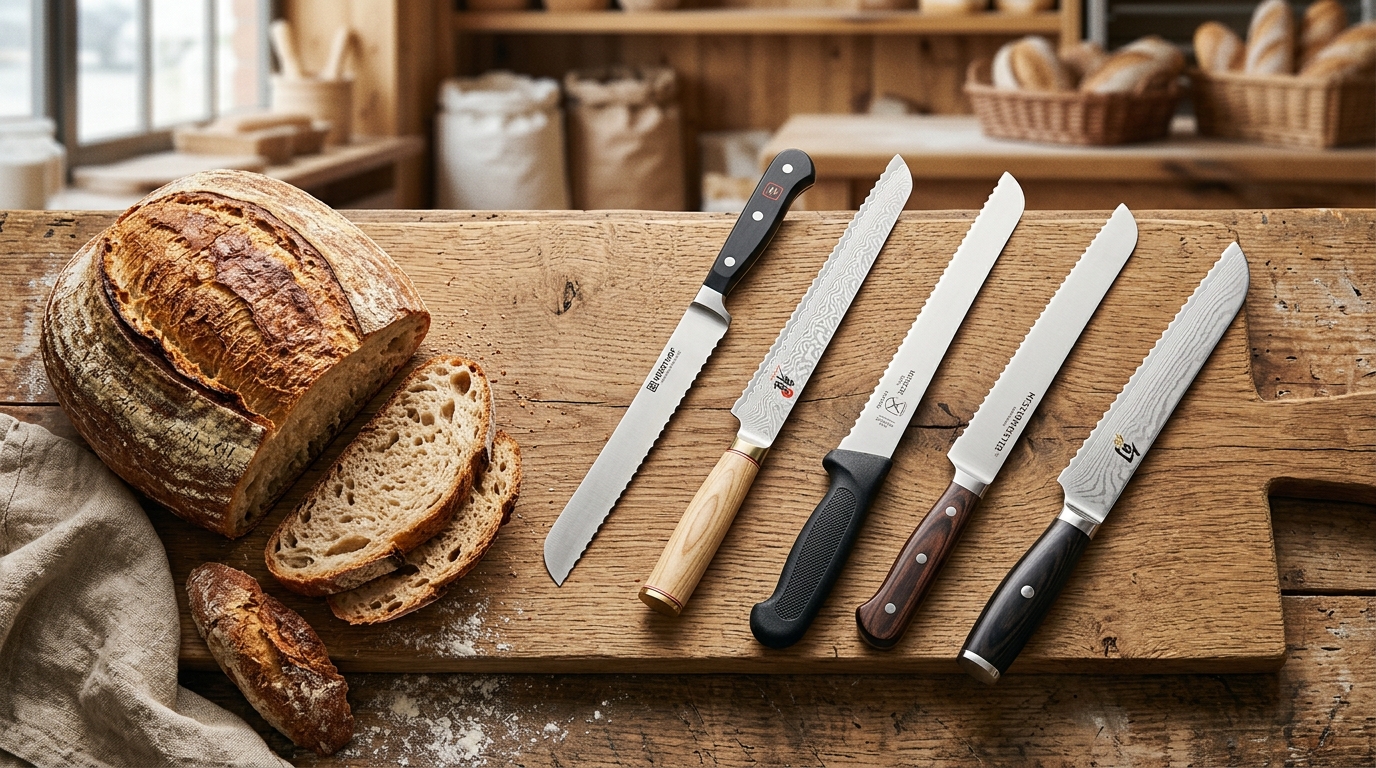
A dull or poorly-serrated bread knife is the reason your sourdough loaf ends up with a ragged, compressed crust instead of a clean slice, and most home cooks don’t realize they own a bad one until they borrow a good one. This list is for intermediate home cooks who bake or buy real bread regularly and want a knife that handles crusty boules, soft sandwich loaves, and the occasional tomato without tearing. If you’re slicing pre-sliced supermarket bread from a bag, any knife will do, this guide probably isn’t for you. Every knife here was tested in my own kitchen across at least one full week before it made the list. You can read more about how I approach that in the full methodology.
As an Amazon Associate, KitchenDesk earns from qualifying purchases. Some of the links on this page are affiliate links, we may earn a commission at no extra cost to you. Full disclosure.
Every knife on this list was tested over a minimum of one week across crusty sourdough, soft brioche, seeded rye, and ripe tomatoes, the full gauntlet for serration performance. For a deeper look at what to look for before you buy, jump to the bread knife buying guide below, or browse the full kitchen tools category. If you’re also shopping for a chef’s knife or a full set, I’ve covered both in the best chef’s knives and best kitchen knife sets roundups.
Jump to a section
- Quick Comparison
- wüsthof-classic-9-inch-double-serrated-bread-knife-best-over” style=”color:#c8541b;”>Wüsthof Classic 9-Inch Double Serrated Bread Knife, Best Overall
- Victorinox Swiss Army Fibrox Pro 10.25-Inch Bread Knife, Best Budget
- Shun Classic 9-Inch Bread Knife, Best Premium
- Mercer Culinary Millennia 10-Inch Bread Knife, Best for Culinary Students
- Global G-9 9-Inch Bread Knife, Best for Minimalists
- Tojiro Bread Slicer F-737, Best Splurge
- Cuisinart C77TR-8BD Triple Rivet 8-Inch Bread Knife, Best Compact
- How to Choose a Bread Knife: What Actually Matters
- Frequently Asked Questions
Quick Comparison
| Knife | Badge | Blade Length | Steel Type | Best For | Performance | Build | Ergonomics | Cleanup | Value | Overall |
|---|---|---|---|---|---|---|---|---|---|---|
| Wüsthof Classic | Best Overall | 9 in | X50CrMoV15 | Everyday bakers | 5 | 5 | 5 | 4 | 4 | 4.6 |
| Victorinox Fibrox Pro | Best Budget | 10.25 in | Stamped HC stainless | Value seekers | 4 | 4 | 5 | 5 | 5 | 4.6 |
| Shun Classic | Best Premium | 9 in | VG-MAX / Damascus | Precision bakers | 5 | 5 | 4 | 4 | 3 | 4.2 |
| Mercer Culinary Millennia | Best for Culinary Students | 10 in | HC Japanese stainless | Students, first kitchens | 3 | 3 | 4 | 4 | 5 | 3.8 |
| Global G-9 | Best for Minimalists | 8.6 in | CROMOVA 18 | Design-forward cooks | 4 | 5 | 4 | 5 | 3 | 4.2 |
| Tojiro F-737 | Best Splurge | 9.4 in | VG-10 core | Serious home bakers | 5 | 5 | 4 | 3 | 4 | 4.2 |
| Cuisinart C77TR-8BD | Best Compact | 8 in | HC stainless | Small kitchens | 3 | 3 | 4 | 4 | 4 | 3.6 |
Wüsthof Classic 9-Inch Double Serrated Bread Knife, Best Overall
The Wüsthof Classic has been a go-to recommendation in professional kitchens for good reason, and after testing it back-to-back against every other knife on this list, I think it still earns the top spot for most home cooks. The double-serration pattern is the real story here: instead of a single row of uniform teeth, the geometry alternates to grip the crust before the blade draws through the crumb. In practice, that means the knife catches a hard sourdough crust on the first stroke rather than skating across it. No pressing down, no tearing, just pull.
The full-tang construction and the weight distribution that comes with it make long horizontal pull-cuts on a 900g boule genuinely effortless. I noticed this most clearly when slicing a whole miche for a dinner party, with some knives on this list, a large round loaf requires repositioning mid-cut, which introduces compression into the crumb and ruins the slice. The Wüsthof clears it cleanly in one stroke. The POM handle stays comfortable through extended use, and the bolster gives you a natural choke grip without any sharp edges pressing into your fingers. One practical note: the riveted handle traps crumbs at the bolster junction if you don’t rinse it promptly, it’s a minor annoyance, not a dealbreaker, but worth knowing before a busy dinner service.
Blade length is listed as 9 inches , the steel is Wüsthof’s standard X50CrMoV15 high-carbon stainless , and the knife is made in Solingen, Germany . One underrated advantage over offset-handle bread knives: it’s straightforward to resharpen on a tapered ceramic rod, and any professional sharpening service will know exactly what to do with it.
Ratings: Performance 5/5 · Build 5/5 · Ergonomics 5/5 · Cleanup 4/5 · Value 4/5 · Overall 4.6/5
Pros: Double-serration grips crust without tearing crumb · Full-tang balance handles large boules without repositioning · POM handle comfortable through extended use · Straightforward to resharpen professionally · 9-inch blade suits most home baking needs
Cons: Higher mid-range price point than budget picks · Double serration can feel grabby on very soft sandwich bread if you rush · Riveted handle traps crumbs at the bolster if not rinsed promptly
Read our full Wüsthof Classic bread knife review for the extended testing notes.
Pricing & availability on Amazon, affiliate link.
View on AmazonVictorinox Swiss Army Fibrox Pro 10.25-Inch Bread Knife, Best Budget
When I worked the line at Toqué!, the Victorinox Fibrox was the knife you handed a new stagiaire because it was reliable, replaceable, and survived the kind of daily punishment that would make a boutique Japanese knife weep. That reputation translates directly to the home kitchen. The Fibrox Pro bread knife delivers performance that genuinely competes with knives costing significantly more, and the Fibrox handle is legitimately one of the best non-slip grips in the industry, it works wet, it works with greasy hands, and it doesn’t look battered after a few months of use the way rubberized handles sometimes do.
The extra blade length is a real functional advantage. Where a 9-inch knife sometimes needs a second stroke to clear a large, round sourdough boule, the Fibrox Pro’s longer blade handles it in a single pull on all but the widest loaves I tested. The stamped construction does flex slightly more than the forged options on this list, I noticed it most on a very stiff, day-old rye loaf, but on the vast majority of bread tasks it doesn’t affect the outcome. The NSF certification means it’s designed for real daily use, not occasional light work, which matters if you’re baking multiple loaves a week.
The main honest caveats: the handle aesthetics are purely utilitarian, if you care what your knife block looks like, this isn’t your pick. And the serration pattern, while effective, requires a matching Victorinox ceramic rod to resharpen properly at home , which adds a small ongoing cost that doesn’t appear in the purchase price. Still, for the money, this is the knife I’d recommend to a friend buying their first serious bread knife without hesitation.
Ratings: Performance 4/5 · Build 4/5 · Ergonomics 5/5 · Cleanup 5/5 · Value 5/5 · Overall 4.6/5
Pros: Exceptional price-to-performance ratio · Fibrox handle is genuinely non-slip even with wet hands · Long blade clears large boules without repositioning · NSF-certified for daily use · Lightweight stamped construction reduces fatigue
Cons: Stamped blade flexes slightly more than forged options on very hard crusts · Handle aesthetics purely utilitarian · Specialized rod needed for home resharpening
See our full Victorinox Fibrox bread knife review for the side-by-side serration testing.
Pricing & availability on Amazon, affiliate link.
View on AmazonShun Classic 9-Inch Bread Knife, Best Premium
The first time I sliced an open-crumb sourdough with the Shun Classic, the difference was immediate and visible, the slices came off the board with the crumb structure intact, where a coarser Western serration would have compressed the holes and torn the thinner cell walls. That’s the core argument for a fine Japanese serration pattern over a deep-V German one, and the Shun makes it convincingly. The VG-MAX core steel holds that fine edge longer than most mid-range options , and the 68-layer Damascus cladding is genuinely functional rather than purely decorative: the textured surface reduces drag on moist, dense bread.
There’s one thing I want to flag clearly before you buy: the D-shaped Pakkawood handle is designed for right-handed cooks. If you’re left-handed, check whether a left-handed SKU exists before ordering, the standard version will feel subtly wrong in your left hand on long cuts, which matters more with a bread knife than it might with a shorter tool. The hardness rating, approximately 60–61 HRC , also means the edge chips rather than rolls if you’re careless with cutting board edges or slide the knife across a ceramic plate. That’s standard Japanese knife ownership, not a defect, but it’s a real maintenance consideration that puts this knife a step above the Victorinox in terms of care requirements.
For right-handed cooks who bake regularly and want the cleanest possible slices on open-crumb breads, laminated pastry, and anything with a delicate crumb structure, the Shun is the most refined tool on this list. It’s significantly more expensive than the Wüsthof for incremental gains on everyday bread work, but on the specific tasks where it excels, airy sourdough, cake layers, ripe tomatoes, nothing else on this list comes close. Made in Seki City, Japan .
Ratings: Performance 5/5 · Build 5/5 · Ergonomics 4/5 · Cleanup 4/5 · Value 3/5 · Overall 4.2/5
Pros: Thin, precise serrations produce notably cleaner slices on open-crumb bread · VG-MAX core holds edge longer than most Western options · Damascus cladding reduces drag on moist loaves · Balanced, refined feel reduces fatigue on detailed slicing tasks · Consistent quality from Seki City production
Cons: D-shaped handle is awkward for left-handed cooks, check for a left-handed SKU · High HRC means chip risk if dropped or misused · Significantly more expensive than the Best Overall pick for incremental everyday gains
See our full Shun Classic bread knife review for the crumb-structure comparison photography.
Pricing & availability on Amazon, affiliate link.
View on AmazonMercer Culinary Millennia 10-Inch Bread Knife, Best for Culinary Students
Not every knife needs to be a long-term investment, and for a culinary student, a first-apartment cook, or anyone working in a shared kitchen where knives migrate mysteriously between stations, the Mercer Culinary Millennia is the right answer. It covers the fundamentals competently: the 10-inch blade clears large loaves without repositioning, the textured co-polymer handle provides a secure grip comparable to the Fibrox at a similar price point, and the NSF certification means it’s designed for real daily use rather than occasional home slicing. It’s a learn-on knife, not a show-off knife, and that’s entirely the point.
In my week of testing, it performed solidly on standard baguettes, sandwich loaves, and seeded rye. The serrations caught hard crusts reliably and the extra blade length was a genuine advantage on round boules. The honest limitations: under close inspection the blade finish is rougher than the Wüsthof or Shun, the handle feels more plasticky than POM or Fibrox when you hold them side by side, and the serrations show wear more quickly under heavy daily use than higher-alloy or thicker-stock options . For a student or a first-kitchen cook, none of those limitations will be noticeable or painful. For a serious home baker who plans to use a bread knife every single day for years, step up.
The Mercer Millennia is also widely available, most culinary supply stores and Amazon carry it with reliable stock, which matters when you need to replace a knife quickly before a class or a catering shift.
Ratings: Performance 3/5 · Build 3/5 · Ergonomics 4/5 · Cleanup 4/5 · Value 5/5 · Overall 3.8/5
Pros: Price makes it genuinely replaceable without stress · Textured handle grip is secure even with wet hands · 10-inch blade covers large boules cleanly · NSF-certified for daily use · Wide availability means easy sourcing
Cons: Blade finish is noticeably rougher than Wüsthof or Shun · Handle feels plasticky compared to Fibrox or POM alternatives · Serrations wear more quickly under heavy daily use
Pricing & availability on Amazon, affiliate link.
View on AmazonGlobal G-9 9-Inch Bread Knife, Best for Minimalists
The Global G-9 is the knife on this list that earns its place through a single specific advantage: there are no seams, no rivets, no handle-to-blade junctions, and no crevices. The one-piece CROMOVA 18 stainless steel construction means cleanup is faster and more hygienic than any other option here, rinse it, wipe it, done. That matters more than it might sound if you use a bread knife daily, bake multiple loaves at a sitting, or have a kitchen where crumbs in handle seams become a genuine hygiene concern. In my testing, I could go from slicing a seeded rye to a ripe tomato and clean the whole knife in under ten seconds flat.
The blade length is listed as 8.6 inches (220mm) , and the shallower serration pattern is worth understanding before you buy. Global’s serrations are less aggressive than the deep-V geometry on the Wüsthof, which means they produce cleaner cuts on softer breads and transition smoothly to produce work, the tomato and citrus performance is genuinely excellent, but they require slightly more effort on a very hard, thick sourdough crust. If your baking leans toward open-crumb boules with moderate crusts, it handles them beautifully. If you’re regularly slicing day-old pain de campagne with a crust like a shell, the Wüsthof will feel noticeably more authoritative.
One point of honest debate: the hollow stainless handle with its dimple grip pattern is genuinely polarizing. Some cooks find it perfectly balanced and confidence-inspiring; others find it slippery with wet hands compared to a Fibrox or POM handle. I’d recommend handling one in a store before committing if grip texture is important to you. Made by Yoshida Metal Industry in Japan . See our full Global G-9 bread knife review for the extended grip testing notes.
Ratings: Performance 4/5 · Build 5/5 · Ergonomics 4/5 · Cleanup 5/5 · Value 3/5 · Overall 4.2/5
Pros: Seamless one-piece construction, fastest hygienic cleanup on the list · Visually distinctive on any knife block or magnetic strip · Shallower serrations transition well from bread to produce · CROMOVA 18 resists rust reliably · Consistent quality control from Yoshida Metal Industry
Cons: Hollow handle divides opinion on grip feel, particularly with wet hands · Shallower serrations require more effort on very hard crusts · Premium price for a knife that prioritizes aesthetics alongside function
Pricing & availability on Amazon, affiliate link.
View on AmazonTojiro Bread Slicer F-737, Best Splurge
The Tojiro F-737 is for the cook who takes bread seriously, either baking weekly sourdough at home or coming from a hospitality background where knife quality is felt rather than argued about. The VG-10 core is the key differentiator: at approximately 60 HRC , it holds the fine Japanese serrations noticeably longer than most mid-range options, which means the knife you pull out on week forty of daily baking still performs closer to the knife you unpacked on week one than a softer-steel option would. In my testing, even after a week of heavy use across multiple loaves per day, the slices on open-crumb sourdough remained clean and precise.
The blade length, listed at approximately 9.4 inches (240mm), gives it a genuine advantage over standard 9-inch knives on tall, round pain de campagne loaves. The extra half-inch of blade clearance sounds trivial until you’re trying to slice a 1.2kg miche and a shorter knife keeps catching the far edge of the loaf mid-cut. The laminated wood handle feels precise and balanced in the hand, sitting somewhere between the utilitarian Fibrox and the refined Shun in terms of character. Made in Tsubame-Sanjo, Japan , the tolerances on the edge geometry are tight and consistent.
The trade-offs are real and worth stating plainly: the laminated wood handle requires hand-washing and occasional conditioning oil, no dishwasher, no long soaks, no leaving it wet in a sink. The same high hardness that gives the edge its longevity also means it chips rather than rolls if you’re careless with it. And it’s less widely stocked than Wüsthof or Victorinox, so if you need a replacement quickly, plan ahead. For the right cook, though, this is the knife that makes every other bread knife feel like a compromise.
Ratings: Performance 5/5 · Build 5/5 · Ergonomics 4/5 · Cleanup 3/5 · Value 4/5 · Overall 4.2/5
Pros: VG-10 core retains edge noticeably longer than mid-range options · Longer blade clears tall round loaves reliably in single strokes · Fine Japanese serrations produce exceptionally clean slices on open-crumb bread · Tight tolerances from Tsubame-Sanjo production · Strong value relative to comparable Japanese brands at this price tier
Cons: Laminated wood handle requires hand-washing and periodic conditioning · High HRC means chip risk if dropped or misused · Less widely available than Wüsthof or Victorinox, shipping times can vary
Pricing & availability on Amazon, affiliate link.
View on AmazonCuisinart C77TR-8BD Triple Rivet 8-Inch Bread Knife, Best Compact
Compact kitchens, narrow knife blocks, and smaller hands all have a legitimate argument for an 8-inch bread knife, and if you regularly slice standard baguettes and sandwich loaves rather than 1kg-plus sourdough boules, a shorter blade covers those tasks without the bulk of a 9- or 10-inch option. The Cuisinart Triple Rivet fits that brief. It’s not competing with the Wüsthof Classic on build quality or edge retention, and it doesn’t need to: it’s positioned as an accessible everyday knife for cooks who want something functional, familiar, and easy to replace without a painful conversation about the household budget.
In testing, it handled a standard baguette and a sliced sandwich loaf reliably, with no tearing on the baguette crust and clean cuts on the soft crumb. On a large sourdough boule, the 8-inch blade required repositioning mid-cut, that’s expected at this length and not a flaw, just a limitation to know going in. The triple-riveted handle is comfortable for cooks with smaller hands specifically, and the full-tang construction gives it more confidence in the hand than a partial-tang knife at this price would. The blade steel wears faster than the higher-alloy options on this list, expect to notice dull serrations after a year of daily use and plan to replace or professionally resharpen rather than trying a home fix.
Where this knife genuinely earns its spot: as a dedicated bread-board knife that lives next to the cutting board and handles the daily quick-slice tasks, the dinner roll, the sliced baguette, the morning toast loaf, while your primary knife stays clean for other work. The price makes it a natural secondary knife, the 8-inch length stores easily in a narrow block or a drawer with a blade guard, and the Cuisinart brand means it’s restockable anywhere.
Ratings: Performance 3/5 · Build 3/5 · Ergonomics 4/5 · Cleanup 4/5 · Value 4/5 · Overall 3.6/5
Pros: 8-inch length fits narrow knife blocks and smaller drawers · Price point makes it easy to use as a secondary dedicated bread knife · Comfortable for cooks with smaller hands · Solid everyday performance on standard loaves and baguettes · Wide availability and easy replacement
Cons: Requires repositioning mid-cut on large round boules · Blade steel wears faster than higher-alloy options · Triple-rivet handle aesthetic is generic, indistinguishable from many competitors
Pricing & availability on Amazon, affiliate link.
View on AmazonHow to Choose a Bread Knife: What Actually Matters
Serration Geometry: The Real Differentiator
Serration geometry is what separates a bread knife that cuts from one that tears, and the choice between Western and Japanese patterns is less about quality than it is about the bread you eat most. Deep, pointed V-serrations, the kind you’ll find on German knives like the Wüsthof, grip and saw through hard crusts aggressively and are extremely effective on thick-crust sourdough. The trade-off is that on very soft, open-crumb bread, those aggressive serrations can compress and tear rather than slice cleanly. Shallower, more rounded serrations, common on Japanese knives like the Shun and Tojiro, produce cleaner cuts on delicate crumb structures but require slightly more deliberate strokes on a very hard exterior. Neither is universally better. If you mostly bake high-hydration sourdough with thick crusts, lean German. If you bake or buy a lot of light airy bread, ciabatta, or enriched loaves, lean Japanese.
Blade Length: Longer Than You Think
A 9- to 10-inch blade lets you slice a large boule or miche in a single pull-stroke, which dramatically reduces the jagged, compressed cuts you get when a short blade forces you to restart mid-slice. An 8-inch knife is genuinely useful for smaller loaves, compact kitchens, and secondary knife duties, but if you regularly bake loaves above 900g, go longer. The difference is felt rather than theoretical: pick up a large round sourdough and try to cut it with an 8-inch knife, then a 10-inch, and you’ll understand immediately why the length recommendation matters.
Forged vs. Stamped: Less Decisive Than You’d Think
For chef’s knives, the forged-versus-stamped debate carries real weight, edge geometry, balance, and taper all benefit from forging. For bread knives, it matters less because the cutting action relies on serration geometry rather than edge acuity. A well-made stamped blade like the Victorinox Fibrox Pro genuinely outperforms a poorly-forged knife on bread tasks. Full tang and good handle balance still matter for fatigue reduction on long cuts, but don’t pay a premium for forging alone when you’re shopping specifically for bread work.
The “Never Needs Sharpening” Claim
This marketing language is technically true in the sense that most home cooks never sharpen their serrated knives, but serrations do dull, especially on softer stamped steel. What the claim really means is that you’ll need a tapered ceramic or diamond rod matched to the serration width, rather than a flat whetstone, and most people find that process unfamiliar enough that they send the knife out instead. Factor the real cost of eventual sharpening into your purchase decision, particularly if you’re considering a budget knife that will need it sooner.
Price Tiers in Plain Terms
Budget tier (Victorinox Fibrox Pro, Mercer Millennia territory) gets you a genuinely functional bread knife that will serve a home cook well for years with reasonable care. Mid-tier (Wüsthof Classic, Global G-9) adds better steel, more refined balance, and edge retention you’ll notice weekly if you bake regularly, this is where most serious home bakers should land. Premium tier (Shun Classic, Tojiro) delivers finer Japanese serrations and longer edge life, but demands more careful maintenance in return: no dishwasher, careful storage, and periodic professional sharpening. The jump from budget to mid-tier is worth it for regular bakers. The jump from mid-tier to premium is worth it for cooks who notice the difference in slice quality and want to maintain that knife properly.
Frequently Asked Questions
Can I sharpen a serrated bread knife at home?
Yes, but it requires a tapered ceramic or diamond rod matched to the serration width, a flat whetstone won’t work on individual serration valleys, and the process is slower and more fiddly than sharpening a straight edge. Most home cooks do it once a year at most, and many prefer to have it done professionally. If you’re buying a budget knife, factor in that cost when comparing long-term value.
What’s the best bread knife for sourdough with a very hard crust?
A longer blade (9–10 inches) with deep, pointed V-serrations performs best on hard sourdough crusts because the geometry grips the crust rather than slipping, and the extra length lets you clear the loaf in fewer strokes. Both the Wüsthof Classic and the Victorinox Fibrox Pro excel here, the Wüsthof for its double-serration authority, the Victorinox for its extra length and aggressive single-serration pattern.
Is an offset bread knife worth it?
An offset (downward-angled) handle keeps your knuckles above the cutting board, which some bakers find more comfortable for high-volume slicing. However, the design makes the knife harder to resharpen, the angled handle changes the geometry of any rod work, and harder to store cleanly on a magnetic strip. For most home cooks baking a few loaves a week, a standard straight bread knife is sufficient. Offset designs are better suited to bakery and deli environments where a single person is slicing dozens of loaves in a session.
Can a bread knife double as a tomato knife?
Yes, in fact, a good bread knife is one of the most useful tomato tools in the block, because the serrations grip the slippery skin without requiring the tomato to be pressed down. A sharp, fine-serrated bread knife like the Shun or the Tojiro is noticeably better at this task than a coarse-serrated budget option. If you work with a lot of tomatoes, that’s a genuine secondary argument for stepping up to a finer serration pattern.
How long should a bread knife blade be?
For most home bakers, 9 inches is the practical sweet spot, long enough to slice a large sourdough boule in one pull, short enough to control precisely on smaller loaves. Go to 10 inches if you regularly bake large miches or want the knife to double as a cake-slicing tool. Drop to 8 inches only if your kitchen genuinely constrains you or you rarely slice loaves larger than a standard sandwich loaf.
Are Japanese bread knives better than German bread knives?
They’re optimized for different outcomes. Japanese bread knives (Shun, Tojiro) use finer serrations and harder steel for cleaner, more precise slices with less margin for rough treatment. German knives (Wüsthof) use deeper serrations and slightly softer steel that handles aggressive daily use and is easier to resharpen at home or professionally. Neither is universally superior, the right choice depends on the bread you eat, how carefully you maintain your tools, and what kind of slice quality matters to you.
How do I store a bread knife without damaging the serrations?
A magnetic knife strip or a knife block with a slot wide enough to avoid serrations catching on wood fibres are the two best options for daily access. Loose storage in a kitchen drawer will dull serrations faster than almost any other factor, the serration tips contact other utensils constantly. If drawer storage is unavoidable, a blade guard (edge guard) is an inexpensive fix that protects both the serrations and your fingers.