

On this page
The first time you use a mandoline, your hand knows exactly how close that blade sits to your fingers. That’s not paranoia. It’s a fixed blade with no bolster to stop your hand if something goes wrong, and it’s part of why so many home cooks buy one, use it twice, and shove it in a drawer for good. If that describes you, or you haven’t bought one yet because the whole category feels like an accident waiting to happen, this guide is for you.
I tested a full lineup of mandolines for KitchenDesk’s mandoline testing roundup, and two of them stand out specifically for people who have never used one before. Neither is the fastest or the most feature-packed model on that list. Both are the ones I’d actually hand to a nervous first-timer without a second thought, and I’ll explain why, plus the safety habits that matter more than which model you buy.
As an Amazon Associate, KitchenDesk earns from qualifying purchases. Some of the links on this page are affiliate links, we may earn a commission at no extra cost to you. Full disclosure.
How I Tested These Picks
Every mandoline in that roundup, including the two below, got at least a week of real use in my kitchen before I wrote a word about it. I ran the same basic test list on each one: julienned carrots, thin potatoes for gratin, cucumber for a quick pickle, and a russet potato held at a slightly awkward angle to see how the guard actually performed under a less-than-perfect grip. Full details on how I score and compare are on my methodology page. For this pair specifically, I paid extra attention to guard fit and how forgiving each one was of a careless hand, since that’s the real failure point for beginners.
Mueller Austria Premium Mandoline Slicer: Best for Beginners
If the mandoline category intimidates you, this is where I’d start. The Mueller Austria Premium Mandoline Slicer is the beginner pick from my full testing roundup, and after a week of daily use in my own kitchen, it’s easy to see why. This isn’t the mandoline for someone chasing paper-thin symmetry for a food styling shot. It’s the one for someone who has never run a vegetable across a blade this sharp and wants to get through a full prep session with all ten fingers intact.
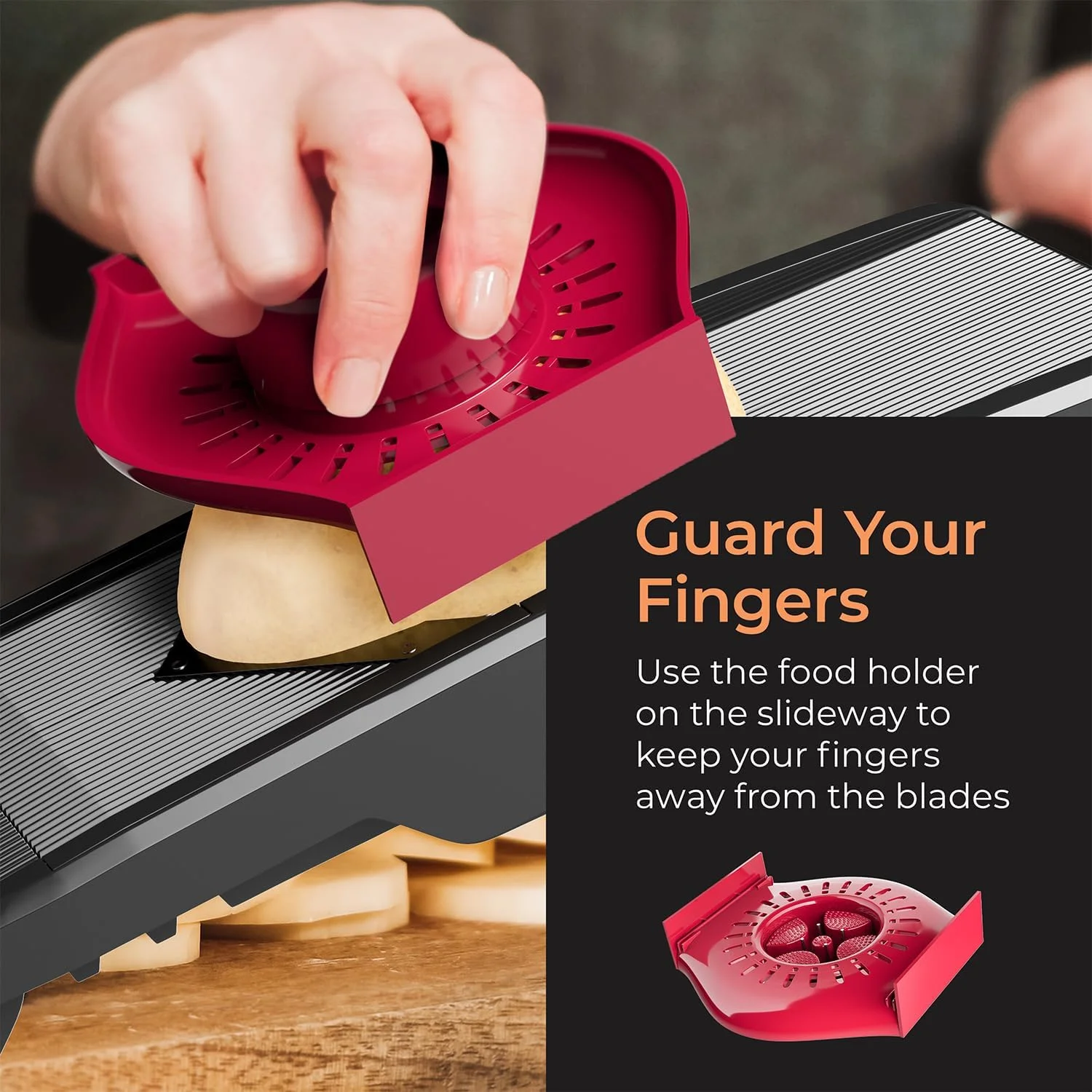
What stood out most in my tests wasn’t a spec on paper, it was the hand guard. It’s one of the largest guards I’ve tested on any mandoline in this price range, and the grip pattern on the underside holds a whole carrot firmly enough that it doesn’t twist mid-pass. That detail matters more than it sounds like it should. The actual injury risk on a mandoline usually isn’t the blade making contact on a clean, straight pass, it’s the vegetable rotating under your palm while your fingers follow it down to correct the angle. A guard that keeps the vegetable oriented removes that failure mode almost entirely.
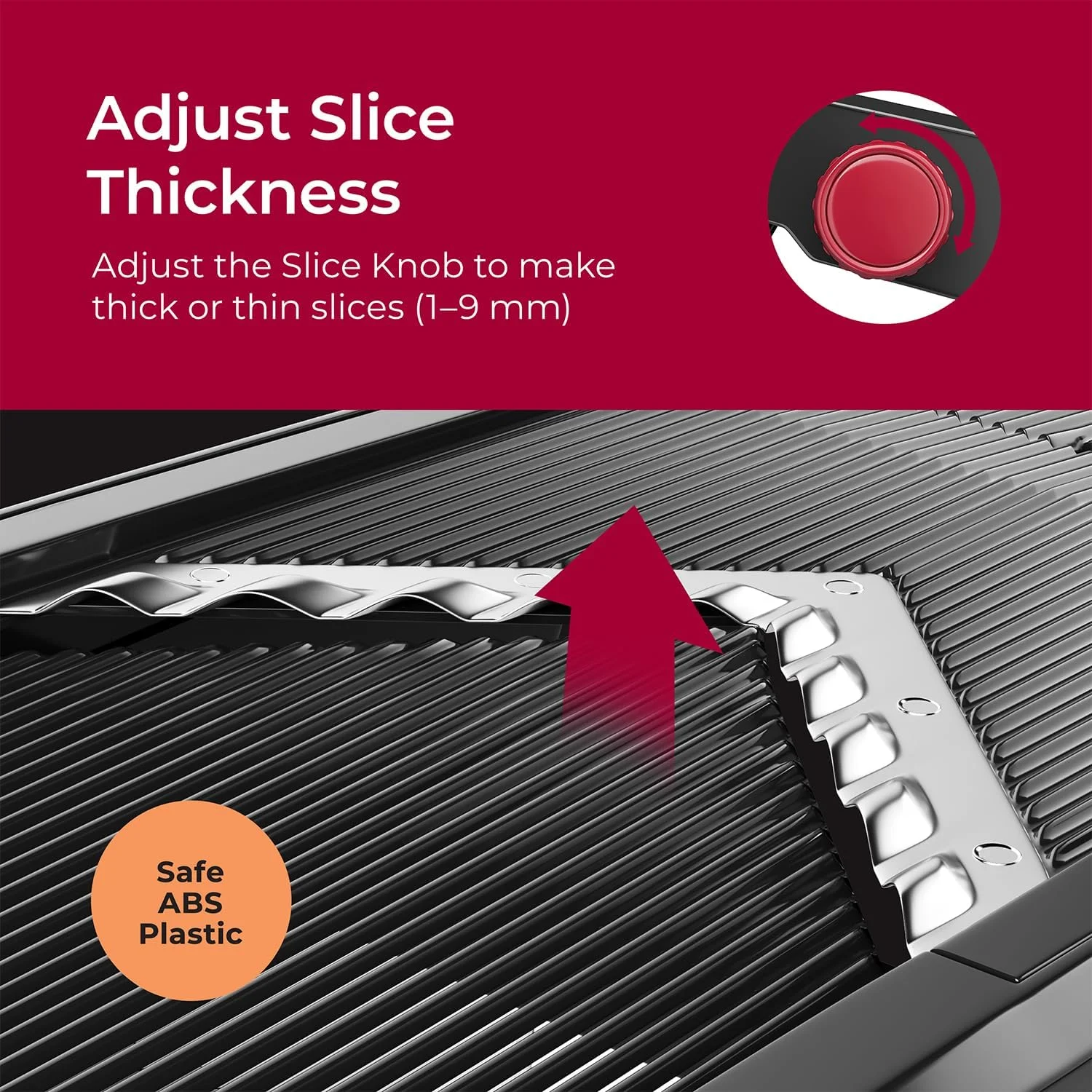
The other thing beginners get wrong is guessing thickness on a dial, then re-guessing halfway through a pile of potatoes when the slices come out inconsistent. The Mueller uses pre-set thickness clicks instead of an ambiguous dial you have to eyeball, so there’s no mid-recipe recalibration and no second-guessing whether you nudged it. Every slice at a given setting matches the one before it, which sounds like a small thing until you’re three potatoes into a gratin and realize you haven’t had to stop and check your work once.
The trade-off: this isn’t the mandoline I’d recommend if you already know your way around one and want fine-tuned control over odd cuts like waffle fries or ultra-thin garnish work. The preset clicks that make it foolproof for a first-timer also mean less granular control than a dial-based model gives an experienced user. For a first mandoline, though, I’d take foolproof over flexible every time.
Pricing & availability on Amazon, affiliate link.
OXO Good Grips Chef’s Mandoline Slicer 2.0: Best Step-Up Pick
If you’d rather spend a little more for what I’d call the single best hand guard in this price tier, the OXO Good Grips Chef’s Mandoline Slicer 2.0 is the step-up option from the Mueller. It’s a slightly different tool for a slightly different beginner: someone who wants the extra reassurance of a wider guard and doesn’t mind a small premium for it.
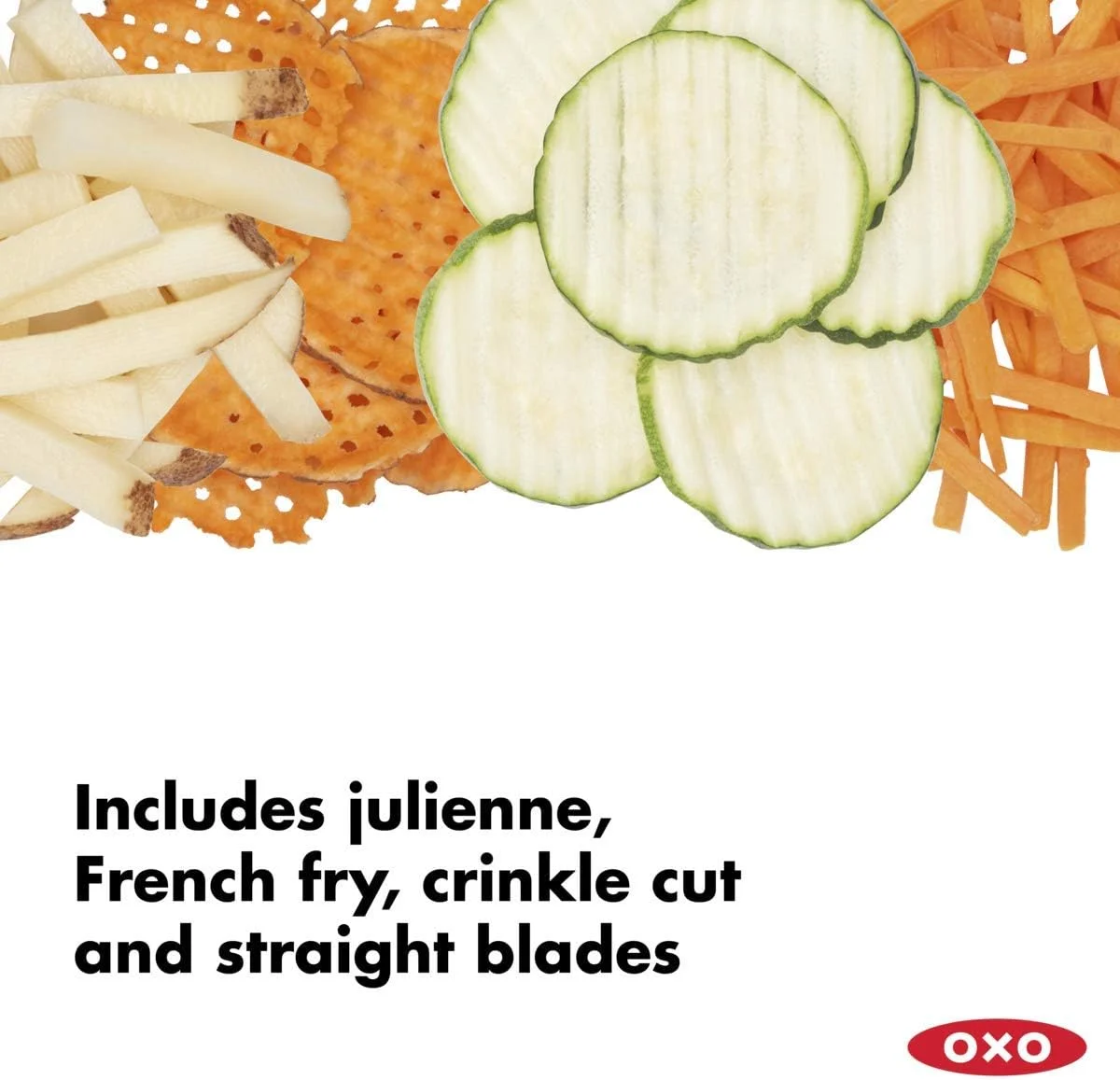
The guard is genuinely the best I’ve tested at this price point. It’s wide enough to grip a whole russet potato without repositioning your hand mid-pass, which is exactly the moment a beginner’s grip tends to slip. Underneath, the food-gripping teeth hold the vegetable in place without crushing anything soft, so a ripe tomato or a zucchini doesn’t turn to mush the way it can on a guard with weaker grip teeth.
Blade tension stays consistent across every thickness setting, so a paper-thin setting doesn’t suddenly feel looser or grabbier than a thick one, which is a common failure point on cheaper mandolines. The non-slip feet also held firm on a wet prep surface in my tests, and that’s not a throwaway detail. A wet counter is one of the most common beginner mistakes, and a mandoline that shifts even slightly mid-slice is its own kind of hazard.
The honest trade-off is size and storage. This is a bulkier unit than the Mueller, and it doesn’t collapse down as flat, so if your kitchen drawers are already full, that’s worth factoring in before you buy. It’s also a step up in price for a guard upgrade that a lot of beginners genuinely won’t need on day one. I’d point a first-timer with limited storage back toward the Mueller and save this one for someone who’s decided they’re sticking with mandolines long-term.
Pricing & availability on Amazon, affiliate link.
What Actually Matters in a First Mandoline
Every mandoline comes with a hand guard, but not all of them are worth trusting. Before you buy, look specifically at two things: how much surface area the guard actually covers, and whether the grip on the underside holds food still or just balances it. A guard that lets a carrot or a potato pivot even slightly under your palm defeats its own purpose. Size matters more than most first-time buyers expect. A small guard forces your fingers closer to the blade on anything round or irregular, which is exactly the food shape that trips people up.
The second thing to check is how the mandoline sets thickness. Dial-based mandolines give you more range, but they ask you to read a small marking and trust it, and it’s easy to misjudge a setting until you’re three slices in. Pre-set click settings remove that guesswork entirely: you hear and feel a click, and every slice at that setting matches the last one. For a first mandoline, I’d take the predictability of clicks over the flexibility of a dial almost every time. You can graduate to finer control once you’ve built some comfort with the tool.
- Guard coverage: does it fully cradle a whole potato or carrot, or just balance one?
- Thickness control: pre-set clicks you can trust, or a dial you have to eyeball?
- Counter setup: bone-dry, stable, and fully seated before your first pass
Here’s the safety point most beginners miss entirely: the blade making contact with your hand on a clean, straight pass is rarely how mandoline injuries actually happen. It’s the vegetable rotating under your palm mid-slice, and your hand following it down to correct the angle, that closes the gap between your fingers and the blade. That’s why guard grip matters more than guard size alone, and why the shape of what you’re slicing changes your risk. A perfectly round cucumber or a lopsided sweet potato end will roll under a weak guard well before you run out of vegetable to hold.
Your counter matters too. Set the mandoline on a completely dry, stable surface, never anything wet or slightly tilted, and check that the feet or the guard’s grip are actually seated before your first pass. If you’re also rethinking your cutting board setup while you’re at it, my guide to wood versus plastic cutting boards covers a related piece of the same prep-safety picture: what you’re slicing onto matters almost as much as what you’re slicing with. And whatever you do, resist the urge to hand-hold the last small nub of a vegetable against the blade. Stop well before the end and finish it with a knife.
Mandoline Safety FAQ for Beginners
Are mandolines dangerous for beginners?
They’re more dangerous than a chef’s knife by feel, mainly because the blade is fixed, exposed, and doesn’t move out of the way the way a knife does in your hand. Most mandoline injuries actually come from a guard that’s too small, a careless hand-hold near the end of a vegetable, or a wet counter, not from the tool itself being unusually unsafe. Used with a proper guard and a bit of attention, a mandoline is no more dangerous than any other sharp kitchen tool. The risk is almost entirely technique, not the object.
Do I need a cut-resistant glove?
It’s not a bad idea, especially for your first few sessions, but I wouldn’t treat it as a substitute for using the hand guard properly. A glove protects against an accidental graze; it won’t necessarily stop a full pass if your guard technique is off. Think of a glove as a backup layer, not your primary safety system. If wearing one makes you calmer and steadier while you build muscle memory, it’s worth the small cost and the slightly awkward grip while you adjust to it.
What’s the easiest mandoline to learn on?
Look for pre-set thickness clicks instead of a dial, and a hand guard large enough to hold a whole potato or carrot without your fingers creeping toward the blade. That combination is exactly why the Mueller Austria is my starting recommendation here: it removes thickness guesswork and keeps your hand further from danger by design. A mandoline with a tiny guard or a fussy dial adds a learning curve on top of a tool that’s already unfamiliar, and that’s the wrong place to add difficulty for a first-timer.
How thin should I slice as a first-timer?
Start thicker than you think you need. A mid-range setting is easier to control, more forgiving if your grip slips slightly, and still gives you a real feel for how the blade behaves before you chase paper-thin gratin slices. You can always run a second pass at a thinner setting once you’re comfortable. Beginners who start on the thinnest setting available tend to rush and get inconsistent results anyway, since thin slices demand the steadiest, most practiced hand-guard technique on the entire click or dial range.
Can a mandoline replace my knife skills?
No, and it’s not really trying to. A mandoline is faster and more consistent for high-volume, uniform slicing, like a big batch of potato chips or a pile of cucumber for pickling. A knife is still what you’ll reach for on odd shapes, small quantities, or anything that needs to be diced rather than sliced. Most home cooks who use a mandoline regularly still use a knife for the majority of their prep work. Treat it as an addition to your knife skills, not a replacement for them.
Final Thoughts
If you take one thing from this, let it be that guard technique matters more than which mandoline you buy, though a bigger, better guard makes good technique easier to maintain when you’re tired or rushing. Start with the Mueller if you want the simplest possible learning curve, or the OXO if you’d rather pay a bit more for the widest guard I’ve tested at this level. Either way, keep the counter dry, keep your fingers back from the last inch of whatever you’re slicing, and let the guard do the job it’s designed for.
Mainly shopping on price? See our guide to the best budget mandoline for picks that don’t skimp on the guard or blade.