

On this page
A good mandoline should not need a splurge budget to be sharp or safe. The common assumption is that the entry-level shelf is where corners get cut on the two things that actually matter: how cleanly the blade slices and how well the guard protects your fingers. My own testing does not back that up. Some budget mandolines cut just as cleanly as tools that cost much more, they just skip the extras, folding stands, swappable blade cartridges, bundled cases, that drive up the price without improving a single slice. This guide is for home cooks who want real value: something that slices consistently, holds an edge, and does not make you nervous every time you reach for a cucumber. It is not a guide to the cheapest mandoline you can find at any cost. It is a guide to genuine value, two picks that earned their spot through actual kitchen use, not just a low number on a price tag. I tested both picks below in my own kitchen over more than a week each, the same process behind our full mandoline testing roundup.
As an Amazon Associate, KitchenDesk earns from qualifying purchases. Some of the links on this page are affiliate links, and we may earn a commission at no extra cost to you. Full disclosure.
How We Tested These Picks
Every product on KitchenDesk goes through the same baseline before it earns a rating: a minimum of one week of real use in an actual kitchen, never a single unboxing session. For mandolines, that means repeated passes on cucumber, carrot, potato, and a softer item like tomato, checked for compression, tearing, and whether the blade still performs the same on day seven as it did on day one. The full test protocol, equipment, and five-axis scoring are on how we test every product. Both mandolines below went through that same process. Nothing here got a pass because of the price tag.
Benriner Japanese Mandoline Slicer: Best Budget Overall
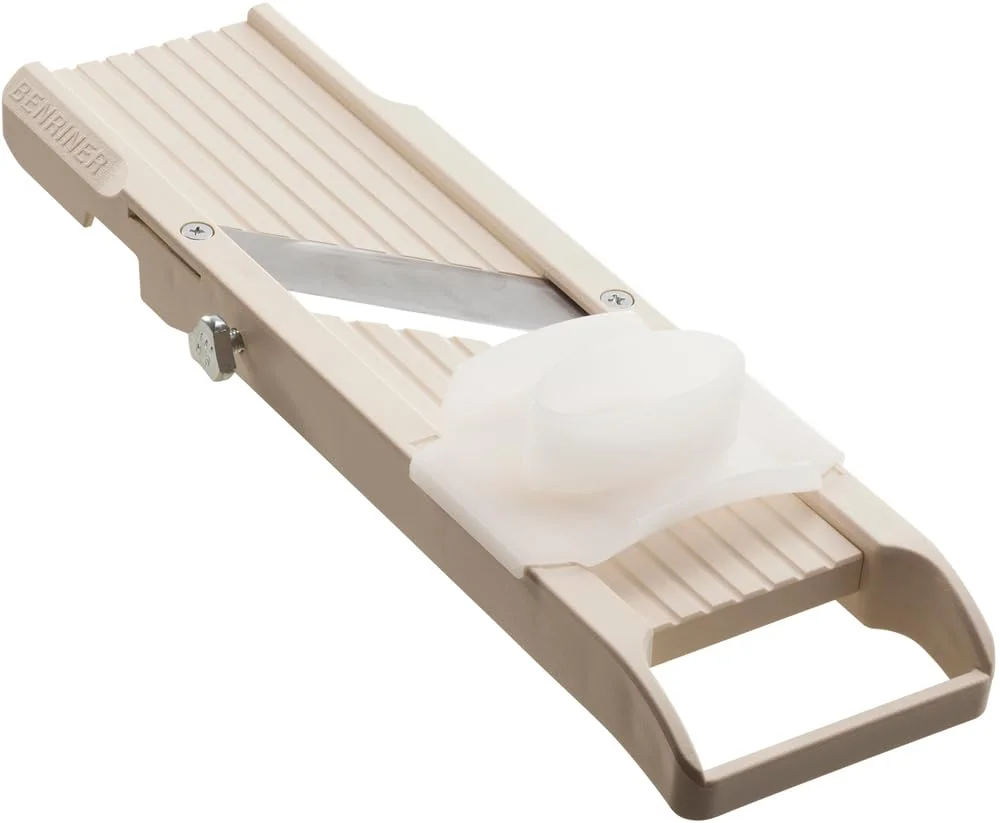
The Benriner is the mandoline I have watched actual line cooks buy for their own kitchens, and testing it myself, I understand why. It suits someone who already has basic knife skills and wants professional-grade slicing without professional-grade spending. The blade is noticeably sharper straight out of the packaging than almost anything else in the accessible, entry-level category. In my cucumber tests it sliced to a clean, near-translucent thickness on the first pass: no compression, no drag, no torn skin. That is the hardest thing for an inexpensive blade to get right, and the Benriner gets it right immediately.
What impressed me more than the first slice was the tenth one. Cheaper stamped blades tend to dull within a handful of uses, and you can feel the difference as slicing turns from effortless to a sawing motion. The Benriner held its edge through a full week of regular prep without that drop-off. The design behind it is deliberately simple: a flat, lightweight body, a single straight blade, and three julienne inserts for fine, medium, and coarse cuts. There is no blade-switching mechanism to fumble with mid-prep or lose track of in a drawer. Cleanup matches that simplicity. It rinses dry in under a minute and stores flat next to a sheet pan instead of taking up a shelf.
The trade-off is the hand guard, and I am not going to soften it: it is small, and it will not hold a whole potato or a large carrot the way a bulkier guard would. On anything past a shallot or a narrow zucchini, you are relying on your own grip discipline, or better, a cut-resistant glove, rather than the guard doing the safety work for you. That is a genuine limitation, not a nitpick, and it is exactly why this pick suits someone who already handles a blade carefully more than a total first-timer.
Pricing & availability on Amazon, affiliate link.
Mueller Austria Premium Mandoline Slicer: Best for Beginners
If the whole idea of a mandoline makes you nervous, or you have never used one and would rather not think hard about thickness settings on your first few tries, start here instead. The Mueller trades some of the Benriner’s outright sharpness for predictability, and for a first mandoline that is usually the right trade. It is also a sensible pick for a household member who cooks less often and just wants the same result every time without fuss.
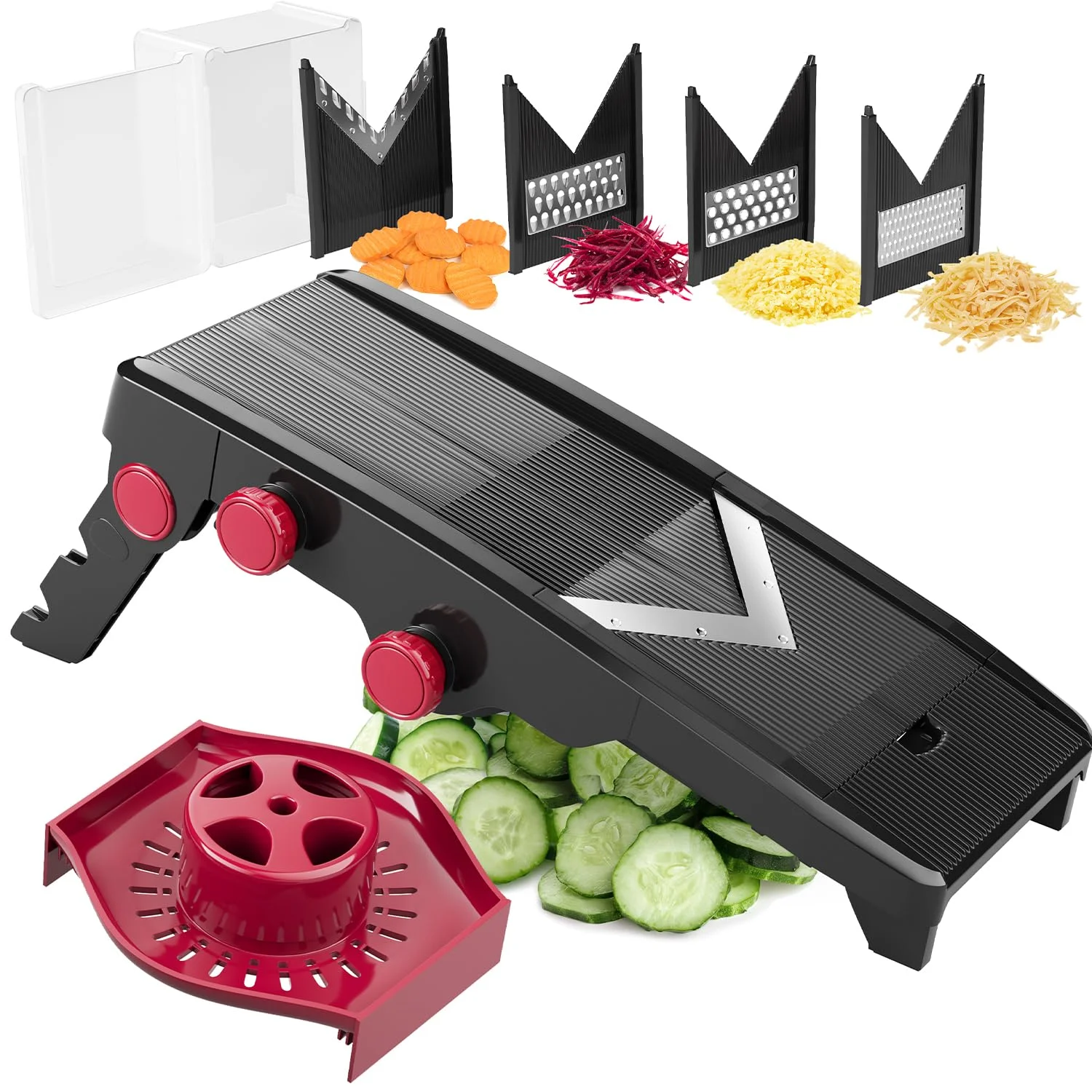
The pre-set thickness clicks are the reason I point beginners toward this one specifically. There is no dial to misjudge and no thumb screw that drifts mid-slice, you click to a setting and every pass comes out the same thickness as the last. The bigger deal is the hand guard. It is one of the largest I tested in this price range, with enough grip surface to hold a whole carrot without the vegetable twisting under your hand. That matters more than people expect: the moment food rotates mid-pass and your hand overcorrects to catch it is a more common way people get hurt on a mandoline than straightforward blade contact. A guard that keeps produce oriented correctly removes that failure point almost entirely.
The trade-off shows up once you outgrow it. Pre-set thicknesses lock you into whatever increments the manufacturer chose, and if you want something between two settings, there is no way to get there. It is also simply not as sharp as the Benriner straight out of the box. Neither of those is a safety issue, they are just the ceiling on what this tool is designed to do. For someone building comfort with a mandoline before moving to a sharper, less forgiving blade, that ceiling is a fair price to pay.
Pricing & availability on Amazon, affiliate link.
What to Actually Look for in a Budget Mandoline
Buying a budget mandoline is not the same as buying a bad one, but it does mean being deliberate about where the savings come from. Two things should never be the corner you cut: blade quality and hand guard quality. Nearly everything else on a mandoline is convenience, not safety.
A dull or poorly ground blade does not just make worse slices, it makes the tool more dangerous. When a blade drags instead of cutting cleanly, you instinctively push harder to force the vegetable through, and more downward force means less control right as your hand gets close to the blade. A sharp blade needs less pressure, which means a steadier pass every time. This shows up most clearly on high-moisture vegetables like tomatoes and cucumbers, where a mediocre blade tends to compress the flesh instead of slicing cleanly through it. This is also why a blade that stays sharp across weeks of regular use, not just on the first cut out of the box, matters more for everyday cooking than anything printed on the packaging.
The hand guard’s job is just as simple: keep your fingers out of the blade’s path while still letting you apply even, steady pressure. A guard that is too small, or shaped wrong for what you are actually slicing, forces an awkward grip that puts your fingers closer to the blade than the tool was designed for. If a budget mandoline skimps here without being upfront about it, that is the one red flag worth walking away from. Pair any mandoline with a minimal guard, budget or not, with a cut-resistant glove. It costs little and removes most of the real risk.
What can you safely trade away to save money? Quite a bit, as long as it is not the blade or the guard:
- Interchangeable blade cartridges instead of one fixed blade
- Folding leg stands instead of a flat, handheld design
- Stainless steel housings instead of molded plastic
- Extra storage cases or bundled accessories
A single fixed blade with a few julienne inserts covers most home cooking, and pre-set thickness clicks instead of a continuous dial are a workflow trade-off, not a safety one. The same pattern shows up outside mandolines, too. Our box grater testing turned up nearly identical results: the cheap models that actually failed were the ones with soft, poorly finished shredding surfaces, not the ones that simply skipped extra attachments.
Frequently Asked Questions
Is a cheap mandoline safe to use?
Yes, as long as the blade is genuinely sharp and the hand guard is well designed, not just present. The real risk with cheap mandolines is not the price, it is a dull, poorly ground blade that needs extra pushing force, combined with a flimsy guard that does not actually protect your fingers. Both picks in this guide passed that bar in my own testing. What is not safe is a mandoline with a vague, undersized guard paired with a blade that dulls within a few uses, no matter what it costs.
What’s the difference between a budget and a premium mandoline?
In my testing, the real gap is mostly in extras rather than core function: folding stands, swappable blade cartridges, stainless bodies instead of plastic, and a wider adjustment range. A well-made budget mandoline like the Benriner can match, or beat, a premium model on raw blade sharpness. What premium mandolines more reliably add is frame rigidity under pressure and more cut styles in one tool, useful if you slice constantly, unnecessary if you reach for a mandoline a few times a month.
Do budget mandolines dull faster?
Some do, which is exactly why blade steel and grind quality matter more than price tag when you are shopping on a budget. Cheap stamped blades can noticeably dull within a few weeks of regular use. The Benriner is the exception in this guide: in my testing, its edge held up through a full week of daily prep without the drag that signals a dulling blade. Do not assume budget automatically means it will dull fast. Assume a poorly made blade will, no matter what it costs.
Do I need a cut-resistant glove with a budget mandoline?
If the hand guard is small, or the mandoline does not include one, yes, treat a cut-resistant glove as part of the tool rather than an optional extra. The Benriner’s compact guard is the clearest example here: it works, but it was not designed to hold larger vegetables safely on its own. A glove is cheap insurance. Mandolines with roomier guards, like the Mueller, still benefit from one, they just need it less for everyday use.
Can a budget mandoline handle everyday vegetables as well as a premium one?
For what most home cooks actually slice, cucumber, potato, carrot, zucchini, fennel, yes. Premium mandolines pull ahead on harder or more awkward produce, like dense root vegetables or large batches, where extra frame rigidity and features like folding legs start to matter. For a weeknight gratin, a salad, or a batch of quick pickles, a well-chosen budget mandoline will not be the reason the dish falls short.
The Bottom Line
A budget mandoline does not have to mean a dull blade or a guard that only exists on paper. The Benriner earns the top spot here because its blade quality genuinely competes with pricier tools, as long as you respect the small guard and treat a cut-resistant glove as standard equipment, not an accessory. The Mueller is the better starting point if you want the guard doing more of the safety work while you build confidence with the category. Either way, save your money on the extras you will not miss. The blade and the guard are the two places a budget mandoline cannot afford to cut corners.
New to mandolines specifically? Our guide to the best mandoline for beginners focuses on the safest way to start.