

On this page
- TL;DR, What to Know Before You Read Further
- A Bit of Background: Two Traditions, One Knife Aisle
- What Actually Matters When Buying a Knife
- What Looks Important But Mostly Isn’t
- Common Mistakes Home Cooks Make When Buying Knives
- Price Tiers: What Your Budget Actually Buys
- Further Reading on KitchenDesk
- Frequently Asked Questions
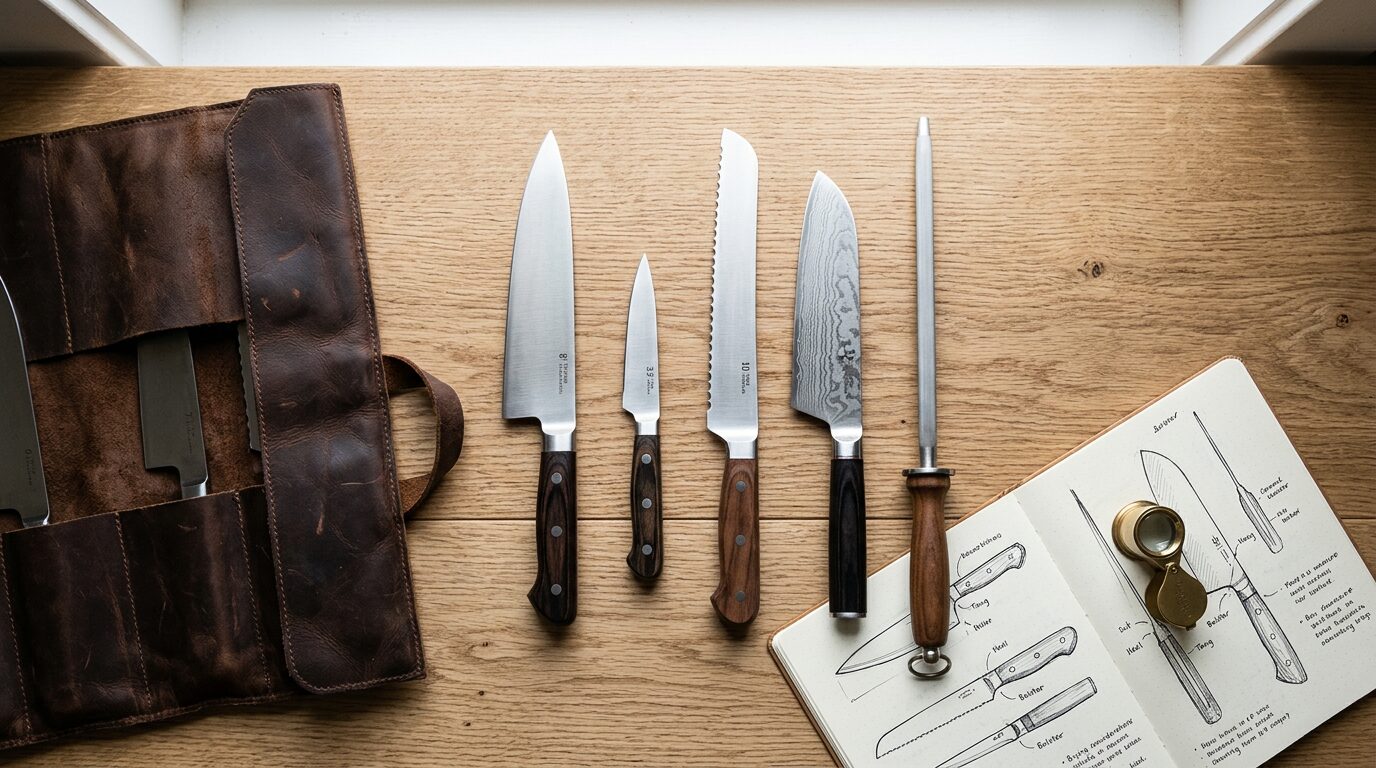
Most home cooks own at least one knife they secretly hate, a blade that slips on tomatoes, a handle that cramps after ten minutes of prep, or a gift-set relic that’s been sitting in a block untouched for years. Buying a knife well means understanding a handful of real variables, not memorizing marketing terms off a box. By the end of this guide you’ll know which blade steel and geometry actually affect your daily cooking, what the price tiers realistically deliver, and how to narrow 200 options down to the two or three knives that will do 90 percent of your kitchen work.
As an Amazon Associate, KitchenDesk earns from qualifying purchases. Some of the links on this page are affiliate links, we may earn a commission at no extra cost to you. Full disclosure.
Jump to a section
- TL;DR, What to Know Before You Read Further
- A Bit of Background: Two Traditions, One Knife Aisle
- What Actually Matters When Buying a Knife
- What Looks Important But Mostly Isn’t
- Common Mistakes Home Cooks Make When Buying Knives
- Price Tiers: What Your Budget Actually Buys
- Further Reading on KitchenDesk
- Frequently Asked Questions
TL;DR, What to Know Before You Read Further
- One good chef’s knife (8-inch is the most versatile) will handle the majority of home-cook prep, build from there, not from a block set.
- Blade steel hardness (measured in HRC on the Rockwell scale) affects edge retention and sharpening difficulty: softer German steels (HRC ~56–58) are forgiving; harder Japanese steels (HRC ~60–67) hold an edge longer but chip more easily.
- Edge geometry matters more than hardness alone, a thinner, lower-angle grind (10–15° per side) cuts more efficiently than a thick blade regardless of what the box says about “premium steel.”
- Full-tang construction is worth paying for; partial-tang and rat-tail tangs are common cost-cut points that affect long-term durability and balance.
- Handle material is personal, wood, polymer, and composite each have real tradeoffs in grip security, hygiene, and longevity; none is universally best.
- Sharpening is the skill most buyers ignore: a knife you can maintain beats an expensive one you can’t. Budget for a whetstone or a pull-through sharpener before upgrading the blade.
- Block sets almost always include knives you won’t use and skip knives you will, a chef’s knife, a paring knife, and a serrated bread knife cover the vast majority of home-cook tasks.
- Country of origin signals manufacturing approach (German vs. Japanese tradition), not a quality ranking, excellent and mediocre knives exist on both sides.
A Bit of Background: Two Traditions, One Knife Aisle
Knife design evolved along two broad tracks. The German and European tradition favored heavier, curved blades with softer steel optimized for a rocking-cut motion, think the classic French chef’s knife with its pronounced belly and thick spine. The Japanese tradition favored lighter, thinner, harder blades suited to a push-pull slicing technique, with a flatter profile that keeps more of the edge in contact with the board on a forward stroke.
Both traditions converged in the 20th century as Western manufacturers adopted Japanese steel science and Japanese makers began producing hybrid “Western-style” gyutos for export markets. That history explains virtually every spec difference you’ll encounter today: steel hardness, bevel angle, blade thickness, and handle construction all trace back to which tradition a given knife is rooted in. Once you understand that fork in the road, a crowded knife aisle starts to make sense.
What Actually Matters When Buying a Knife
Blade Steel and Hardness (HRC)
HRC is the Rockwell hardness scale measurement for steel, and it’s one of the few specs that has direct, daily consequences for how a knife behaves. Harder steels, typically Japanese, HRC 60 and above, hold a finer edge longer but are more brittle and require more careful sharpening technique. Softer steels, typically German, HRC 56–58, dull faster but are easier to hone back and are more tolerant of lateral stress. That last point is relevant if you’re the type to pry a wedge of squash open or twist a blade to break a joint. Neither hardness range is objectively better; your sharpening habits and cooking style determine which is right for you.
Edge Geometry and Grind
A blade’s cross-section, how thick it is behind the edge, how steep the bevel, determines cutting feel more than steel grade alone. A thin, convex hollow grind slices with less resistance through food; a thick flat grind is more durable for heavy work. Serious Eats’ knife equipment coverage consistently identifies edge geometry as the variable most buyers overlook, noting that a well-ground knife in modest steel will outcut a poorly ground knife in expensive steel . When you’re comparing knives online, look for published bevel angle and blade thickness behind the edge, if a brand doesn’t publish those numbers, that’s worth noting.
Balance and Weight
Where a knife’s balance point sits relative to the bolster affects fatigue over a long prep session. Some cooks want a blade-heavy knife for a chopping stroke; others prefer handle-heavy for a pinch grip. There’s no universal right answer, and no spec sheet reliably communicates how a knife will feel in your specific hand. When buying online, check whether the manufacturer publishes the knife’s weight in grams, a knife listed simply as “lightweight” tells you nothing. If you can handle a knife in a store before committing, do it. That test is worth more than any review.
Full Tang vs. Partial Tang
A full tang, where the steel runs the full length of the handle, visible as a steel strip sandwiched between the handle scales on both sides, distributes weight more evenly and gives the handle more surface area to bond to. Partial tangs and rat-tail tangs (a narrow spike of steel buried inside the handle) are cheaper to manufacture and more likely to fail at the handle joint after years of repeated stress. This is a legitimate durability differentiator. You can usually identify a full tang by looking at the handle from the side or butt, if the steel is visible all the way to the end cap, it’s full tang.
Handle Fit and Material
A handle that doesn’t fit your hand, too thick, too short, wrong shape for a pinch vs. hammer grip, causes fatigue and imprecision no matter how good the blade is. Polymer handles (Fibrox, POM, G-10) are dishwasher-safe and grippy when wet; they’re the practical choice for a high-use, low-fuss kitchen. Wood is comfortable and warm in hand, but requires hand-washing and occasional oiling to prevent cracking and warping. Composite materials like Micarta or pakkawood split the difference, more durable than raw wood, more pleasant than basic polymer. The hygiene argument against wood handles is real in professional settings [[CITE: NSF International foodservice equipment standards, likely NSF/ANSI 2 or NSF/ANSI 8, needs fact-check for specific handle material requirements]]; at home, the more practical concern is proper drying after washing to prevent microbial growth in cracks.
What Looks Important But Mostly Isn’t
Knife marketing runs on a handful of levers that sound technical but rarely help you make a better decision. Proprietary steel alloy names are the biggest one. X50CrMoV15, VG-MAX, SG2, these are real alloy designations, but brands deploy them as prestige signals without providing the hardness ratings or geometry specs that would let you actually compare knives. A steel name without a published HRC rating and grind specification tells you almost nothing useful. Ask for those numbers; if a brand doesn’t publish them, move on.
The “forged vs. stamped” debate is another one. Forged knives, shaped from a heated blank, are often heavier and include a bolster. Stamped knives, cut from sheet steel and then heat-treated and ground, are lighter and easier to thin-grind. The old assumption that forged automatically means better doesn’t hold. America’s Test Kitchen’s chef’s knife testing has found that several stamped knives consistently outperform heavier forged competitors in cutting evaluations . What matters is the resulting geometry and steel treatment, not whether the blade started as a blank or a sheet.
Full bolsters are worth thinking about critically, too. A full bolster, the thick metal collar between blade and handle, adds weight and some finger protection, but it also blocks sharpening access to the heel of the blade. Once the edge recedes past the bolster over years of sharpening, that section is permanently unusable. Many professional cooks actively prefer bolster-free or half-bolster designs for exactly this reason. And block sets, despite their apparent value, almost always bundle knives you won’t use, six steak knives, a utility knife that never gets reached for, mediocre shears, while the chef’s knife at the center of the set gets a smaller share of the manufacturing budget than it would if bought individually. Three carefully chosen knives will outperform a same-priced set in most home kitchens.
Common Mistakes Home Cooks Make When Buying Knives
The most consistent mistake I saw during my years on the line, and still see when friends ask me to help them choose a knife, is buying before knowing your grip. The two dominant grips are the pinch grip (thumb and forefinger on the blade just above the bolster, remaining fingers wrapped loosely around the handle) and the hammer grip (all fingers wrapped around the handle). They favor different handle shapes and blade weights. A 300g German chef’s knife that feels natural with a hammer grip may feel back-heavy and clumsy with a pinch grip. Figure out which grip you default to before you spend anything significant.
The second mistake is skipping the maintenance equation. A knife is a system, not a one-time purchase. Buying a hard Japanese blade at HRC 65 without a realistic plan for sharpening it, the right whetstones, the technique to use them, or a professional sharpening service within reach, means you’ll be cooking with a dull hard knife within six months. A dull hard knife is worse than a sharp soft one in every practical sense. Buy for the sharpening skill you have today, not the one you intend to develop. You can always upgrade later.
Two more patterns worth flagging: home cooks consistently underinvest in the paring knife. They’ll spend carefully on a chef’s knife and then use a dull, cheap 3-inch blade for every task requiring precision, coring strawberries, trimming fat, segmenting citrus. A sharp, comfortable paring knife is often the knife that gets reached for most in a home kitchen, and it’s rarely the one that gets the budget. And finally, watch the review context when you’re researching. Most knife reviews, including good ones, test on standard vegetables and proteins. If you regularly break down whole birds, fabricate large roasts, or do high-volume garlic work, look specifically for reviewers who’ve tested those use cases. General prep performance and heavy fabrication stress knives differently.
Price Tiers: What Your Budget Actually Buys
Budget (Under ~$50, Check Current Pricing)
Entry-level knives at this tier are typically stamped from softer steel, with injection-molded polymer handles and a basic factory edge. They make sense as a first knife, a camping or travel knife, or for a household member who won’t commit to hand-washing and careful storage. The Victorinox Fibrox 8-inch chef’s knife is the canonical example here, repeatedly recommended by Cook’s Illustrated and America’s Test Kitchen for its practical working edge and comfortable grip despite its modest construction . Don’t expect the handle rivets to outlast years of dishwasher cycles, or the edge to hold through months without honing, but as a workhorse starter knife it’s genuinely hard to criticize at its price point.
Mid-Range (~$50–$150, Verify Current Pricing)
This is the sweet spot for most home cooks who cook seriously three to five nights a week and are willing to hand-wash and hone regularly. At this tier, fit, finish, and steel quality make a meaningful jump: you’ll find full-tang construction, better handle materials, harder steel with more attention to grind geometry, and noticeably better out-of-box edges. German makers like Wüsthof and Victorinox’s higher lines live here, as do several accessible Japanese makers. A single well-chosen chef’s knife at this tier, paired with a solid paring knife and a serrated bread knife, will outperform a $200 block set for the majority of home kitchens, and you’ll know exactly what you’re getting with each piece.
Premium ($150 and Up, Verify Current Pricing)
Premium knives deliver measurable differences in steel refinement, handle material quality, edge geometry precision, and consistency of fit and finish across production runs. At this tier you’re also paying for hand-finishing steps, tighter tolerances, and in some cases semi-custom or single-smith production. The return on investment is real, for cooks who sharpen regularly, use a pinch grip, work with delicate proteins that reward a thin blade, and will hand-wash and store properly. For cooks who don’t yet have a sharpening habit, or whose knives periodically go in the dishwasher, a premium blade is a poor investment. The harder steel is less forgiving of misuse, and the performance advantage disappears entirely without consistent maintenance.
Further Reading on KitchenDesk
If you’re ready to start comparing specific knives, our Best Chef’s Knives, our tested picks across all budgets page covers the options we’ve put through real-kitchen testing across gas, induction, and electric setups. For the knife that most home cooks underestimate, see our Best Paring Knives, the underrated knife worth buying right roundup. And because the knife is genuinely only half the system, our best-knife-sharpeners“>Best Knife Sharpeners, because the knife is only half the system guide covers everything from entry-level pull-throughs to whetstones worth learning on.
Frequently Asked Questions
How many knives does a home cook actually need?
Three covers almost everything: an 8-inch chef’s knife for general prep, a 3–4 inch paring knife for detail work, and a serrated bread knife for bread and soft-skinned produce. A boning knife is useful if you regularly break down whole birds or fabricate meat; a nakiri is a worthwhile addition if you cook vegetables at high volume. Everything else is situational, buy it when you identify a specific gap, not in advance.
German or Japanese, which tradition is better for home cooks?
Neither is universally better. German-tradition knives (heavier, softer steel, curved belly, ~15–20° bevel) are more forgiving of imprecise sharpening and lateral stress, and suit a rocking-chop style well. Japanese-tradition knives (lighter, harder steel, flatter profile, ~10–15° bevel) reward a deliberate push-pull slicing technique and hold a finer edge longer, but chip under abuse and require more careful sharpening. Match the knife to your technique and maintenance habits. A home cook who mostly chops and hones on a pull-through sharpener will get more daily value from a German-style blade. A cook who slices proteins and maintains a whetstone will appreciate the Japanese edge.
Is it worth buying a knife set or should I buy individually?
Individual knives almost always deliver better value per knife than a set at the same total price. Sets bundle knives you won’t use and often compromise the quality of the flagship chef’s knife to hit a target retail price. The exception: a set that includes exactly the knives you’d buy anyway, from a brand you’ve verified, at a price lower than the sum of parts. That does happen occasionally, especially on sale, but verify what’s in the set before assuming it’s a deal.
What does HRC mean, and what number should I look for?
HRC is the Rockwell hardness scale measurement for steel. Kitchen knives typically range from HRC 52 (very soft, easy to sharpen, dulls quickly) to HRC 67+ (very hard, holds a fine edge, chips more easily). For a home cook new to sharpening, HRC 56–60 is a practical range, hard enough to hold a working edge through a week of cooking, soft enough that a few strokes on a honing steel or pull-through sharpener restores it. Above HRC 62, plan to learn proper whetstone technique or budget for professional sharpening a few times a year.
Can I put my knives in the dishwasher?
Technically, some knives are labeled dishwasher-safe, but repeated dishwasher cycles accelerate handle degradation, corrode softer steel at the edge and spine, and blunt edges through vibration against the rack. Hand-washing and immediate drying is the standard recommendation from virtually every knife manufacturer and culinary authority. The more you paid for the knife, the more this matters, a hard Japanese blade at HRC 64 corrodes faster at the edge than a softer German steel, all else equal.
How do I know when my knife needs sharpening vs. just honing?
Honing realigns an edge that’s already there, it’s maintenance between sharpenings, not a replacement for sharpening. If a few strokes on a honing steel (or ceramic rod for harder Japanese steel) restore your edge, you needed honing. If the knife still slides off a ripe tomato after honing, it needs sharpening, the edge has lost material and needs to be re-ground. Most home cooks should sharpen two to four times a year depending on volume, and hone before or after most cooking sessions.
What’s the best way to store knives?
A magnetic wall strip or an in-drawer knife block protects edges and avoids the loose-drawer problem where blades knock against other utensils and dull between uses. Traditional countertop blocks work fine if properly sized, oversized slots let blades rattle against the walls. Edge guards are a reasonable option for travel or drawer storage. Whatever you use, make sure blades aren’t contacting hard surfaces on the cutting edge itself.
Are ceramic knives worth it?
Ceramic blades (zirconia, not silicate ceramic) hold a very fine edge and don’t react with acidic foods or transfer metallic taste, genuinely useful for slicing soft fruit, cheese, and boneless proteins thinly. The tradeoffs are significant: they’re brittle enough that a lateral stress or a drop onto a hard floor can chip or shatter the blade, they require specialized diamond sharpening equipment, and they can’t handle bones, frozen food, or any task requiring torque. Think of them as a supplemental specialty tool, not a primary knife.
What cutting board material is best for knife longevity?
End-grain wood and edge-grain wood are the most knife-friendly surfaces, softer than the blade steel, allowing the edge to part the grain slightly rather than riding across a hard, abrasive face. Plastic (HDPE or polypropylene) is acceptable and easy to sanitize. Bamboo, glass, ceramic, and marble should all be avoided. Bamboo is harder than most kitchen knife steels [[CITE: Janka hardness or Rockwell comparison of Moso bamboo vs. common knife steel alloys, needs primary source, possibly Cook’s Illustrated cutting board testing or materials science reference]], and glass or stone will destroy an edge in a single session.
How do I test a knife’s sharpness at home?
The paper test is the most reliable quick check: hold a sheet of printer paper by the top edge and draw the knife down through it. A sharp edge cuts cleanly; a dull one tears or deflects sideways. The tomato test is more practically meaningful, a sharp knife skins a ripe tomato with no downward pressure, just a draw stroke. If you’re applying downward force to break the skin, the knife needs attention.
Buying a knife well isn’t complicated, but it does require ignoring a fair amount of noise. Focus on edge geometry and steel hardness as a matched pair, verify tang construction, handle a knife before committing when you can, and build your sharpening habit before you spend at the premium tier. Start with one good chef’s knife and a sharp paring knife. Everything else is optional until you identify a specific gap in your actual cooking.
Maya Chen, KitchenDesk. Maya is a Toronto-based home cook and former line cook (Toqué!, 2014–2017). She tests kitchen products in a real kitchen on gas, induction, and electric for a minimum of one week before any review or guide goes out.