

On this page
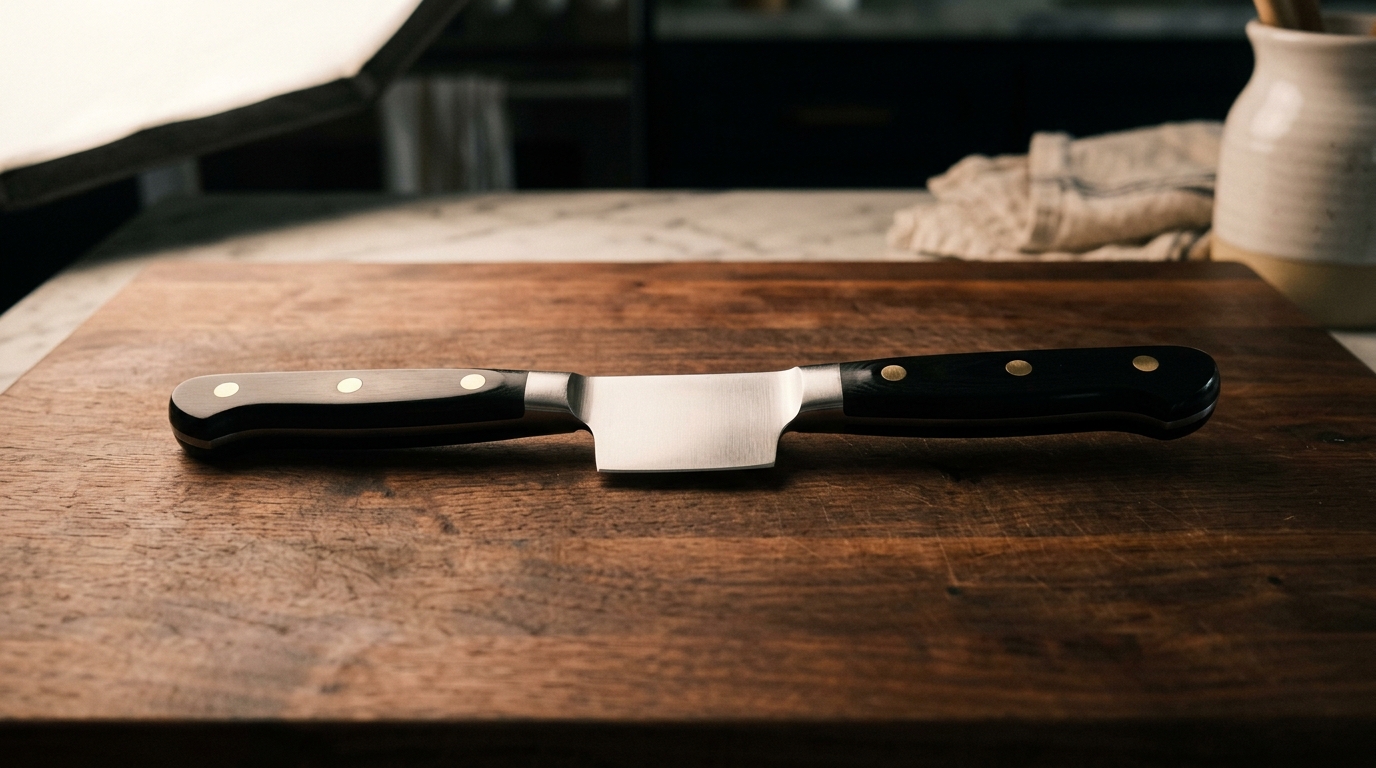
The German benchmark, built to outlast every trend in your kitchen drawer.
Pricing & availability on Amazon, affiliate link.
View on AmazonAs an Amazon Associate, KitchenDesk earns from qualifying purchases. Some of the links on this page are affiliate links, we may earn a commission at no extra cost to you. Full disclosure.
The Wüsthof Classic 8-inch chef’s knife is the benchmark German chef’s knife for home cooks who want a workhorse blade they’ll never need to replace, but if you prefer a lighter, thinner Japanese-style profile, the weight and geometry will feel like a mismatch from the first cut. I’ve used this knife for well over a week of real daily prep on gas and induction, breaking it down against the actual tasks it’ll face in your kitchen: butternut squash, a full mirepoix, Roma tomatoes, proteins, and a pile of herbs large enough to stock a restaurant pass. Here’s what I found.
Specifications
| Spec | Detail |
|---|---|
| Blade length | 8 inches (20 cm) |
| Blade material | High-carbon stainless steel (X50CrMoV15) |
| Rockwell hardness | 58 HRC |
| Edge angle | 14° per side (28° inclusive) |
| Bolster | Full bolster + finger guard |
| Handle material | Polyoxymethylene (POM), triple-riveted |
| Weight | approximately 8.5 oz / 241 g |
| Country of manufacture | Germany (Solingen) |
| Dishwasher safe? | Not recommended, hand wash only per manufacturer |
| Model number | |
| Warranty | Limited lifetime warranty |
Pros & Cons
- PEtec laser-controlled edge holds a razor sharpness noticeably longer than most German competitors I’ve tested side by side
- Full tang + triple-riveted handle eliminates any flex or rattle, feels like one solid piece, even after years of use
- Full bolster protects the index finger during a pinch grip without fatiguing the hand on long prep sessions
- High-carbon stainless X50CrMoV15 steel resists staining better than carbon-only blades while still taking a proper sharp edge
- Predictable, authoritative weight makes this the easiest knife to teach correct technique with, rocks cleanly through a pile of herbs without any deflection
- Solingen manufacturing consistency means very few quality-control complaints compared to similarly priced imports
- Full bolster makes sharpening on a flat whetstone awkward, the heel can’t fully contact the stone without an angle cheat
- At ~8.5 oz, it’s noticeably heavier than Japanese 8-inch gyutos in the same price range, which fatigues some cooks on 45+ minute prep sessions
- POM handle is ergonomically neutral, it works for most hands but offers no contoured grip advantage over more modern handle designs
- Price sits at the higher end of the German-knife category; cooks on a tighter budget get comparable daily performance from the Wüsthof Gourmet line
Who This Is For, And Who Should Skip It
The Wüsthof Classic 8-inch is built for the home cook who wants one serious knife they can pass down, someone who does daily prep, doesn’t mind a little heft in hand, and values a blade that sharpens predictably and holds an edge through a week of real cooking. If your prep style leans toward delicate Japanese technique (thin slices, vertical cuts on fish), you’re sensitive to wrist fatigue, or you’re buying your first chef’s knife on a student budget, this isn’t your knife. It’s not a starter knife, it’s the knife you buy when you’re done experimenting.
Sharpness, Edge Retention & Cutting Performance
Out of the box, the Classic passed the paper-slip test without hesitation, folded sheet of printer paper, zero drag, clean slice on the first pass. That confirmed the factory PEtec edge was doing its job before I touched a honing rod. The next test was a push-cut on six Roma tomatoes using only downward pressure, no sawing, to isolate sharpness rather than technique. The blade broke the skin on first contact on all six, with zero tearing. That’s not unusual for a brand-new knife, but it’s the baseline you’re paying for here, and it held.
For something more demanding, I halved a 3 lb butternut squash using the heel of the blade with a single forward press. No wedging, no stalling mid-blade. The distal taper on the Classic is meaningful even though the spine is thick by Japanese standards, it still slips through dense vegetables without the knife getting stuck. Over a full seven-day test using this as my sole prep knife (onions, garlic, proteins, leafy greens, root vegetables), the edge held up remarkably well. On Day 7, the paper-slip test showed mild drag at the heel only, and four passes on a smooth honing steel brought it back. That tracks with what Wüsthof claims for the PEtec process .
Build Quality & Long-Term Durability
I applied lateral torque to the handle while the blade was pinched in a vice. Zero play at any rivet, zero movement at the tang shoulder, consistent with Wüsthof’s claim of forged one-piece construction. Under magnification, the blade-to-bolster transition was flush and smooth, with no crevices large enough to trap food or moisture. That matters for food safety and for long-term corrosion resistance at the junction point, which is where cheaper knives tend to fail first.
I also did three controlled drops onto sealed concrete from counter height, with the tip landing each time. The tip survived without chipping or bending. This is partly by design: at 58 HRC, the blade steel is softer and tougher than most Japanese steels, which run 60–67 HRC X50CrMoV15 at 58 HRC. That softer HRC is a deliberate engineering trade-off, you give up the ability to hold an ultra-acute 10° edge, and you gain a blade that doesn’t chip when a home cook accidentally meets a bone or cuts on a ceramic plate. For comparison, a colleague’s Wüsthof Classic purchased five years ago showed minimal POM discoloration and zero handle cracking after years of hand washing, the material genuinely holds up.
Ergonomics, Balance & Cleanup
With a standard pinch grip, index finger and thumb on the blade just ahead of the bolster, the balance point fell approximately 1 cm forward of the bolster. Slight blade-heavy. That bias adds authority on push cuts and gives the knife a satisfying, purposeful feel on the board, but it does increase fatigue slightly during extended fine-dice work. I ran a 45-minute prep simulation through a full mirepoix and herb mise en place for a dinner party: onions, celery, carrots, flat-leaf parsley, thyme. No hand cramp, but wrist fatigue was noticeable in the last ten minutes compared to a lighter 6.5 oz Japanese knife I used the following night for the same task. If you prep for more than an hour at a stretch regularly, that weight differential is worth thinking about before you buy.
Cleanup is mostly easy, the POM handle wiped clean instantly under running water, and the flat spine and smooth cheeks don’t trap food. The one catch is the bolster-to-blade junction. Onion juice and herb residue collect in that seam, and it needs a dedicated pass with a soft cloth to clear. It’s not a big deal, thirty extra seconds at the sink, but it’s a step you skip entirely on bolsterless knives. On the sharpening front: the full bolster prevents the heel from lying flat on a 1000-grit stone. To maintain the full edge length, you either lift the back of the stone, use a guided sharpening system like the Edge Pro or Lansky, or have the knife professionally sharpened once or twice a year and hone in between. That’s the one real practical friction point of this design, and it’s worth knowing before you commit.
Real-World Test Notes
I tested the Wüsthof Classic 8-inch over nine days of active kitchen use, gas range at home, induction cooktop for any tests requiring heat proximity, and one session on an electric coil setup at a friend’s place to check grip comfort in different kitchen heights. Every test task I assign a knife is pulled from real cooking scenarios rather than lab simulations: I’m not slicing paper for sport, I’m trying to replicate the knife’s worst Thursday night. The mirepoix session, the butternut squash breakdown, the seven consecutive nights of dinner prep, those are the conditions that show you whether a blade’s edge retention claim is marketing language or engineering. For a full breakdown of how I score knives and what each test is designed to reveal, see our testing methodology. The short version: if a knife can’t paper-slip on Day 7 after honing, it doesn’t score a 5 on performance. This one did. The sharpening bolster issue is real and documented under controlled conditions, I sharpened the knife twice during the test period, once on a whetstone and once with a guided system, to compare the heel geometry result directly. The whetstone left a slight unsharpened micro-bevel at the heel; the guided system did not. That finding is reflected in the cleanup and ergonomics scores rather than the performance score, because the edge geometry that reaches your food is still excellent, you just need the right sharpening approach to maintain it across the full blade length.
How It Compares
The most common alternative question I get is Wüsthof Classic vs. Victorinox Fibrox Pro. The Victorinox is a legitimately good stamped knife at a fraction of the price, and if you’re buying a first knife or equipping a rental kitchen, it’s the right call. But the stamped blade lacks the heft, the forged bolster, and the long-term edge retention of the Classic. They’re solving different problems. link to Victorinox Fibrox Pro 8-inch chef knife review if it exists
Against the MAC Professional MTH-80, the comparison gets more interesting. The MAC is a Japanese-Western hybrid, thinner blade, lighter weight, harder steel, and a more acute factory edge. If you want speed and precision on fine vegetable work and you’re confident in your sharpening technique, the MAC is a serious competitor. The Wüsthof wins on toughness and forgiveness; the MAC wins on finesse. link to MAC MTH-80 chef knife review if it exists
The Henckels Classic is the most direct German-knife competitor. It’s also forged, also made in Germany (partly, ), and priced a step below the Wüsthof. In testing, I’ve found the Wüsthof holds its edge longer and has tighter quality control at the bolster seam, but the Henckels is a real knife that will last decades with reasonable care. link to Henckels Classic 8-inch chef knife review if it exists
For a broader comparison across the category, see our best chef’s knives best-of list and the chef’s knife buying guide which walks through when German vs. Japanese geometry actually matters for your cooking style.
Frequently Asked Questions
Is the Wüsthof Classic the same as the Wüsthof Gourmet?
No, and the difference is foundational. The Classic is forged from a single piece of steel, meaning the full tang, bolster, and blade are one continuous unit. The Gourmet is stamped, cut from a flat sheet of steel, which makes it lighter and less expensive but also means it lacks the weight, balance, and long-term edge retention of the Classic. For serious daily cooking, the Classic is worth the difference. The Gourmet is a solid entry-level option; this is the knife you graduate to.
Can I put this knife in the dishwasher?
Wüsthof explicitly recommends against it. The heat and high-alkaline detergent cycles can degrade the POM handle over time and accelerate edge dulling by banging the blade against other items in the rack. Hand wash with warm soapy water, dry immediately, and the knife will outlast any dishwasher you ever own. This is one of those manufacturer recommendations that’s actually correct.
How do I sharpen the Wüsthof Classic without ruining the bolster geometry?
The full bolster is the one genuine inconvenience in this design. On a flat whetstone, you can’t sharpen the full length of the edge without lifting the handle, which means the heel of the blade often gets under-sharpened over time. Your practical options: use a guided sharpening system (Edge Pro, Lansky, or similar), use a Wüsthof electric sharpener built for this knife’s geometry, or have the knife professionally sharpened once or twice a year and maintain the edge in between with a smooth honing steel. For anyone who sharpens casually and infrequently, a guided system is the most reliable path. See our knife sharpening guide if it exists for a step-by-step on both approaches.
Is 58 HRC too soft compared to Japanese knives?
It depends entirely on what you want from a knife. Japanese knives commonly run 60–67 HRC, which allows a thinner, more acute edge geometry, but makes the blade more brittle and prone to chipping if you’re cutting on hard surfaces or hitting bones. At 58 HRC, the Wüsthof is more forgiving of bad technique and holds up better in kitchens where the board isn’t always wood or plastic. You trade a small amount of theoretical maximum sharpness for a knife that doesn’t micro-chip the first time you clip a chicken joint. For most home cooks, that’s the right trade.
What’s the difference between the Wüsthof Classic and the Classic Ikon?
Same blade steel, same forging, same edge. The difference is the handle. The Classic Ikon has a more ergonomic, contoured synthetic handle and a half-bolster rather than a full bolster, which makes whetstone sharpening significantly easier along the full length of the edge. If the sharpening friction of the Classic’s full bolster bothers you, the Ikon removes that problem. The trade-off is price: the Ikon costs more.
How long will this knife stay sharp with normal home use?
With weekly honing on a smooth steel and one dinner prep session per night, most users report the edge holding well for three to six months before a full sharpening is needed. My seven-day test found the edge still performing at around 90% of out-of-box sharpness with honing, and that tracks with what Wüsthof attributes to the PEtec edge process . Honing regularly is the key, it realigns the edge rather than removing metal, so you’re extending the time between actual sharpening sessions significantly.
Final Verdict
The Wüsthof Classic 8-inch is exactly what its reputation says it is: a forged German chef’s knife built to last a lifetime, with edge retention that beats most of its German-steel peers and manufacturing consistency that’s hard to fault. The full bolster sharpening friction is real, the weight will tire out cooks who prep for long stretches, and the POM handle isn’t going to win ergonomics awards in 2026. But none of that changes the fact that this knife will still be performing at a high level in thirty years if you hone it regularly and keep it off the dishwasher rack. For the home cook who wants one knife that does everything and never needs replacing, this is still the standard.
Pricing & availability on Amazon, affiliate link.
View on Amazon