

On this page
- The two-minute math behind every tripped breaker
- How much your appliances actually pull
- The breaker-trippers worth knowing by heart
- How a kitchen circuit is actually wired
- Can these two run at once? The method
- How to map your own kitchen circuits
- When to call a licensed electrician
- Frequently asked questions
- The bottom line
If your kitchen breaker trips the moment the kettle and the toaster are both going, you are not doing anything wrong. You have simply asked one circuit to deliver more power than it is rated to carry. This guide explains, in plain numbers, how much power your countertop appliances actually pull, how much a kitchen circuit can safely hand out, and how to tell which combinations will run happily side by side.
I am a home cook, not an electrician, and I have tripped my share of breakers mid-recipe. What follows is a practical reference built from appliance nameplate labels and the published circuit ratings in the electrical code, not a bench test. Use it to understand your own kitchen, then read the safety note before you touch anything in your panel.
The two-minute math behind every tripped breaker
Three numbers run the whole show, and the relationship between them is simple:
Watts = Volts × Amps
In North American kitchens the voltage is 120 volts nominal. (Big fixed appliances like ranges and wall ovens use 240 volts, but countertop gear runs on 120, so that is the scope here.) Because watts equal volts times amps, you can turn any appliance’s wattage into the current it draws by dividing by 120:
- A 1500-watt air fryer draws 1500 ÷ 120 = 12.5 amps.
- A 1000-watt coffee maker draws 1000 ÷ 120 = 8.3 amps.
That amp figure is what matters, because the breaker in your panel is rated in amps. A 15-amp breaker trips when the current crossing it stays above 15 amps; a 20-amp breaker trips above 20. The breaker is there to protect the wire in the wall from overheating, not to protect your appliance, which is exactly why you should never swap in a larger breaker to stop nuisance tripping. That turns a safety device into a fire risk and is a job for a licensed electrician.
One honest caveat: for the heating appliances that dominate a kitchen (toasters, kettles, griddles), watts and volt-amps are effectively the same, so dividing watts by 120 gives a clean amp number. Motor-driven gear like a mixer can differ slightly, but for the practical question of whether a breaker will hold, treat the label wattage as the number that counts.
How much your appliances actually pull
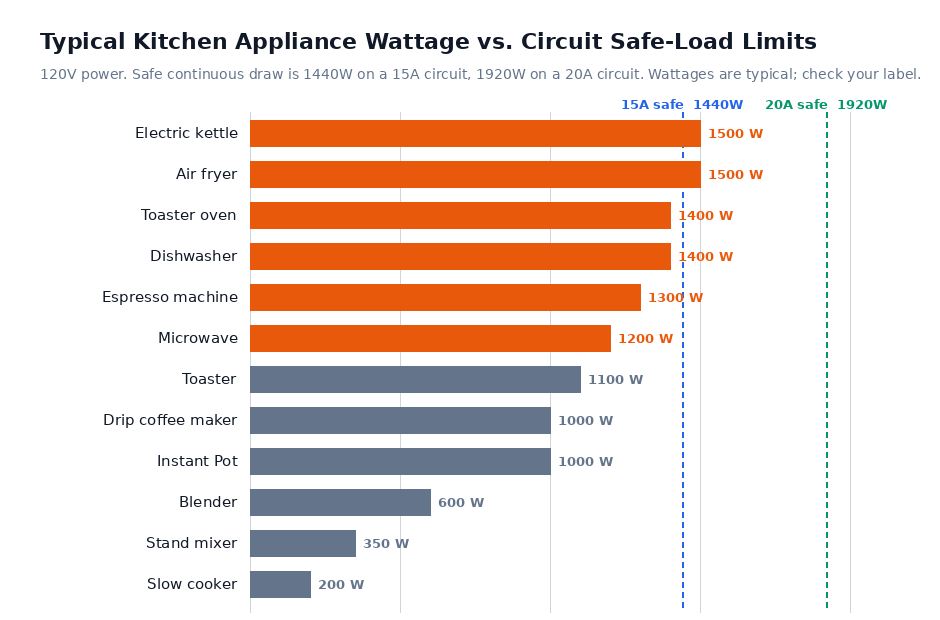
Wattage varies by model, and the only number that is truly yours is printed on the appliance’s nameplate, usually a sticker on the base or back. The table below gives realistic typical ranges so you can see which appliances are the heavy hitters. Treat the amp column as illustrative, calculated from the typical wattage at 120 volts.
| Appliance | Typical range (W) | Typical draw (A @120V) | Load behavior |
|---|---|---|---|
| Slow cooker | 150–300 | ~1.7 | Continuous (hours) |
| Refrigerator (running) | 100–800 | ~1.3 | Cycles on and off |
| Stand mixer | 250–600 | ~2.9 | Short bursts |
| Garbage disposal | 400–900 | ~4.6 | Short bursts |
| Blender | 300–1500 | ~5.0 | Short bursts |
| Rice cooker | 400–800 | ~5.0 | Cook, then warm |
| Food processor | 400–1000 | ~5.8 | Short bursts |
| Drip coffee maker | 750–1200 | ~8.3 | Intermittent |
| Instant Pot / multicooker | 700–1200 | ~8.3 | Heats, then idles |
| Waffle iron | 700–1200 | ~8.3 | Intermittent |
| Microwave (input) | 1000–1500 | ~10.0 | Short |
| Espresso machine | 1000–1500 | ~10.8 | Intermittent |
| Toaster | 800–1500 | ~9.2 | Short |
| Dishwasher | 1200–1500 | ~11.7 | Long cycle |
| Toaster oven | 1200–1800 | ~11.7 | Intermittent |
| Electric kettle | 1000–1500 | ~12.5 | Short, very high draw |
| Air fryer | 1200–1800 | ~12.5 | Can run long |
| Electric griddle / skillet | 1200–1800 | ~12.5 | Intermittent |
| Portable induction burner | 1200–1800 | ~12.5 | Intermittent |
A few of these earn their internal links because they are the ones people most often run together. If you are shopping any of them, our hands-on roundups go deeper on real performance: air fryers compared, electric kettles compared, Instant Pots tested, blenders tested, the KitchenAid stand mixer, and the Breville Barista Express.
The breaker-trippers worth knowing by heart
The appliances that cause almost every kitchen trip are the resistive heaters, because they convert nearly all their power into heat and pull it the whole time they are on. The worst offenders, each routinely landing near 12.5 amps on a 120-volt circuit:
- Electric kettles (often a full 1500 watts, the single most common culprit)
- Air fryers and toaster ovens (1200 to 1800 watts)
- Electric griddles, skillets, and portable induction burners (1200 to 1800 watts)
- Space heaters, which are not kitchen appliances but frequently share a kitchen circuit and quietly eat 1500 watts on their own
Mixers, blenders, slow cookers, and refrigerators are mild by comparison. You can run several of the low-draw items together without trouble. It is stacking two of the 1500-watt heaters on one circuit that brings the breaker down.
How a kitchen circuit is actually wired
A 15-amp circuit can supply 120 × 15 = 1800 watts at its absolute ceiling. A 20-amp circuit can supply 120 × 20 = 2400 watts. But you should not plan to the ceiling, because of the electrical code’s continuous-load rule.
The code says a circuit’s continuous load should stay at or below 80 percent of its rating, where “continuous” means running at full draw for three hours or more. The reason is heat: breakers and wiring warm up under sustained current, and the 80 percent margin keeps a standard breaker from sitting near its thermal trip point for hours. Apply the 80 percent and you get the numbers worth memorizing:
| Circuit | Full capacity | Safe continuous (80%) |
|---|---|---|
| 15-amp | 1800 W | 1440 W |
| 20-amp | 2400 W | 1920 W |
A brief two-minute kettle boil can flirt with the full 1800-watt ceiling and be fine. Something that runs for hours, like an air fryer on a long batch or a slow cooker all afternoon, should fit under the 1440 or 1920 continuous number.
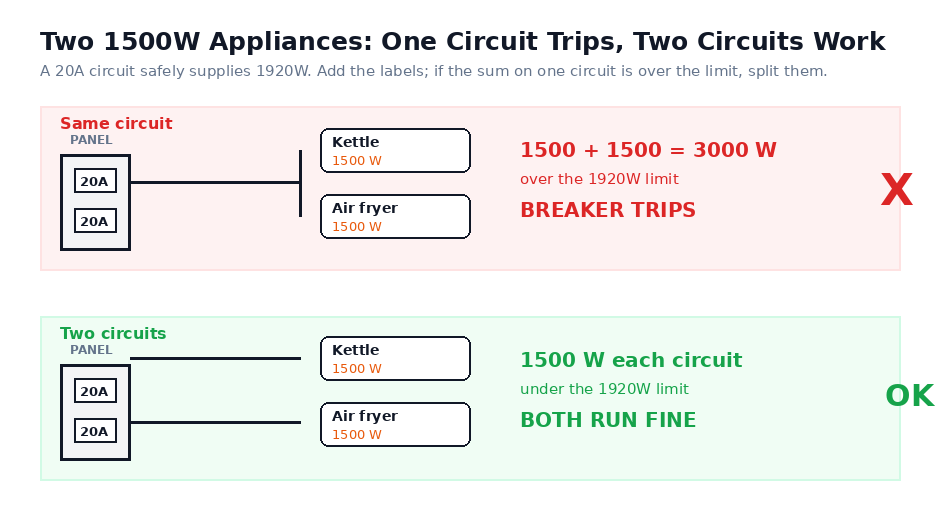
Modern kitchens are wired with this load in mind. Current electrical code requires at least two 20-amp small-appliance circuits serving the countertop outlets, which is the reason you can often run a kettle on one side of the counter and a toaster on the other without a trip. They may be on separate circuits. Code also requires the countertop and near-sink outlets to be GFCI-protected, a device that cuts power instantly on a ground fault to prevent shock near water. None of this is guaranteed in an older home, and the only way to know your layout is to map it.
Can these two run at once? The method
Here is the actual decision procedure:
- Read the wattage off each appliance’s nameplate label.
- Figure out whether the two outlets are on the same circuit or different circuits (mapping steps below).
- If they are on different circuits, each only has to fit under its own limit, and you are usually fine. If they share one circuit, add their watts and compare to that circuit’s safe number.
Worked examples, using typical labels:
- Kettle (1500 W) + toaster (1000 W) = 2500 W. On one 20-amp circuit that is past both the 1920-watt safe number and the 2400-watt ceiling, so it will likely trip. Split them across circuits.
- Coffee maker (900 W) + microwave (1200 W) = 2100 W. On one 20-amp circuit that is over the 1920-watt continuous limit. It may survive a brief overlap but is risky sustained, so separate them.
- Slow cooker (250 W) + stand mixer (400 W) = 650 W. Comfortably under 1440 watts, fine together on a single 15-amp circuit.
- Air fryer (1500 W) alone on a 15-amp circuit draws 12.5 amps, under the breaker but over the 1440-watt continuous margin if it runs three hours or more. Fine for a normal cook, worth watching on a marathon session.
The rule of thumb that covers almost everything: two appliances of 1200 watts or more want different circuits. Add the label watts, compare to 1440 (15-amp) or 1920 (20-amp), and when in doubt plug them into outlets you have confirmed sit on separate breakers.
How to map your own kitchen circuits
You do not need special tools, just a helper or a plug-in lamp:
- Open the breaker panel and note each breaker’s amp number (15 or 20) and any existing labels.
- Plug a lamp or small radio into the outlet you want to identify so you can tell when its power cuts.
- Switch one breaker off and walk the kitchen: every outlet and light that goes dead is on that circuit.
- Write the map down, for example “left counter outlets plus microwave = breaker 12,” and repeat for each breaker.
- Watch for the GFCI catch: one GFCI outlet can protect several outlets downstream of it, so a tripped GFCI can kill outlets even while the breaker stays on. Note those relationships too.
Outlets on the same wall run often share a circuit, but the breaker-flip test is the only real proof. If the panel is unlabeled, confusing, or has two wires under one breaker screw, stop and bring in a professional to map and label it safely.
When to call a licensed electrician
This guide is general reference for typical North American kitchens on 120-volt power. It is not professional electrical advice, electrical codes vary by jurisdiction and edition, and every home is wired differently. Read your own labels and panel, and call a licensed electrician before changing any circuit, adding a dedicated line, or if you notice warm outlets, scorch marks, repeated tripping on a light load, or flickering lights. Those are not problems to reason your way around with a wattage table; they are signs to get a pro on site. Never replace a tripping breaker with a higher-rated one to make the symptom go away.
Frequently asked questions
Why does my breaker trip when I use the kettle and toaster together?
Both are resistive heaters near 1000 to 1500 watts. Run on the same circuit, their combined draw exceeds what a 15 or 20-amp breaker will pass, so it trips to protect the wiring. Put them on different circuits or run them one at a time.
How many watts can a normal kitchen outlet handle?
The outlet follows its circuit. A 15-amp circuit tops out at 1800 watts (1440 sustained) and a 20-amp circuit at 2400 watts (1920 sustained). A single outlet does not have its own separate limit beyond the circuit feeding it.
Is a 20-amp circuit always marked with a special outlet?
No. A 20-amp circuit may use a T-shaped outlet slot, but not always. The reliable indicator is the number on the breaker handle in your panel, not the shape of the outlet.
Can I just install a bigger breaker to stop the tripping?
No, and it is dangerous. The breaker is sized to protect the wire in the wall. A larger breaker lets more current flow than the wire can safely carry, which is a fire risk. The right fix is balancing your load across circuits or having an electrician add a circuit.
Do appliances pull power when they are plugged in but off?
A little, called standby or phantom draw, usually a watt or two for anything with a clock or standby light. It is negligible for breaker math, though it adds up slightly on your energy bill across a whole kitchen.
Does an air fryer really need its own circuit?
Not strictly, but at 1200 to 1800 watts it uses most of a circuit’s safe capacity on its own. Pair it with another heater on the same circuit and you will trip the breaker, so give it a circuit with little else running.
The bottom line
Tripped kitchen breakers are a math problem, not a mystery. Heating appliances pull 1000 to 1800 watts each, a 15-amp circuit safely supplies 1440 watts and a 20-amp circuit 1920 watts, and trouble starts when two big heaters share one circuit. Learn which of your appliances are the heavy hitters, map which outlets share a breaker, and keep the 1200-watt rule of thumb in mind. For anything beyond plugging in smarter, the panel is an electrician’s territory, not a recipe to wing.
Written by Maya Chen, lead reviewer at KitchenDesk. Wattages are typical ranges compiled from appliance nameplate labels; your appliance’s exact figure is on its own label. Circuit figures follow standard North American electrical-code ratings and are provided as general reference, not professional electrical advice.