
On this page
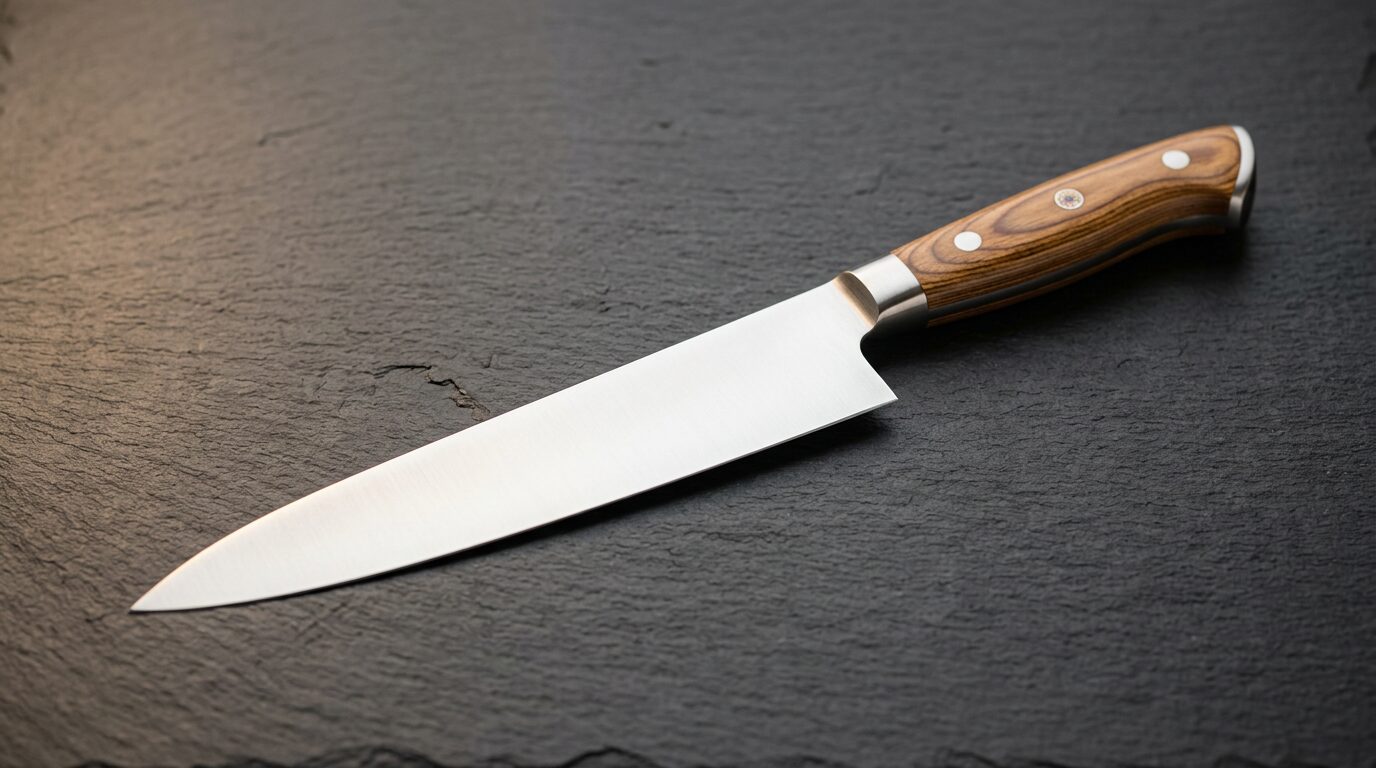
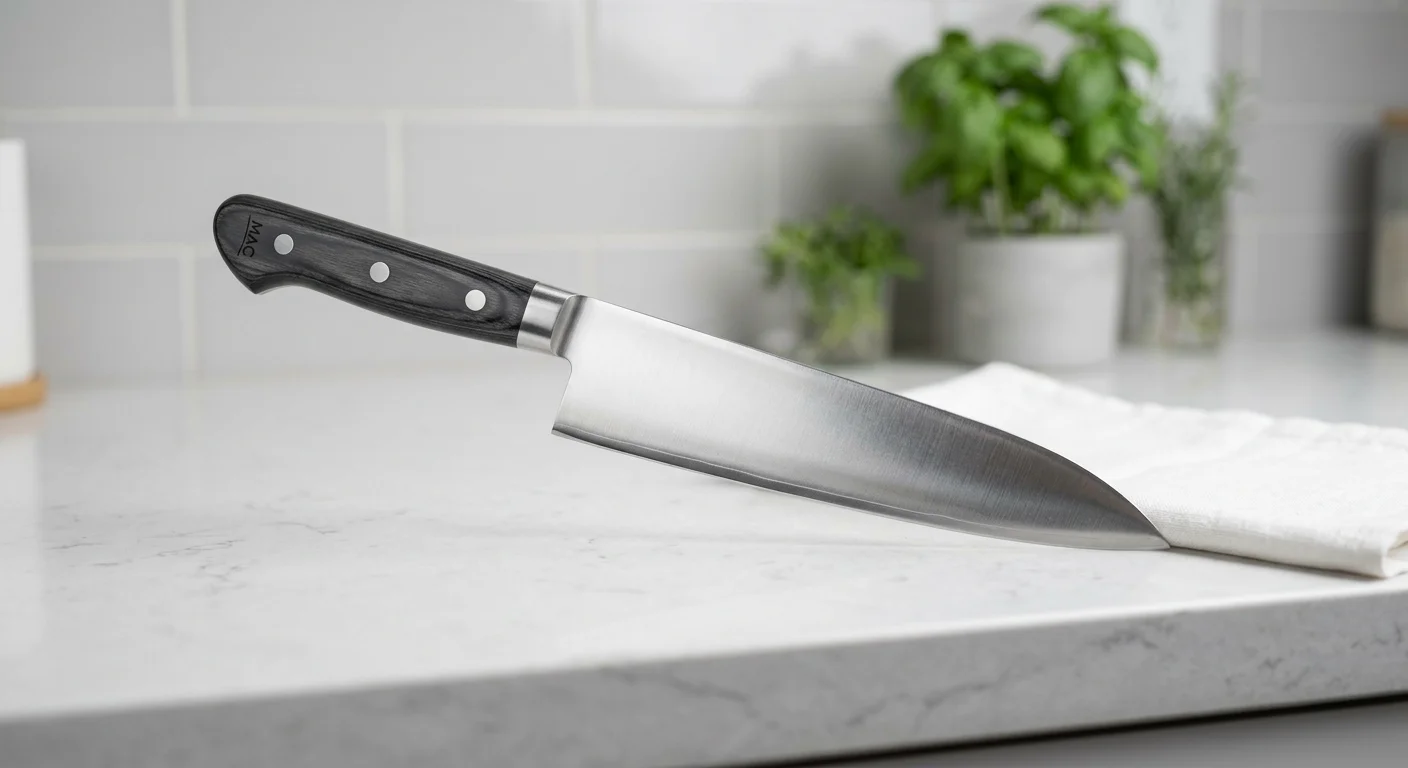
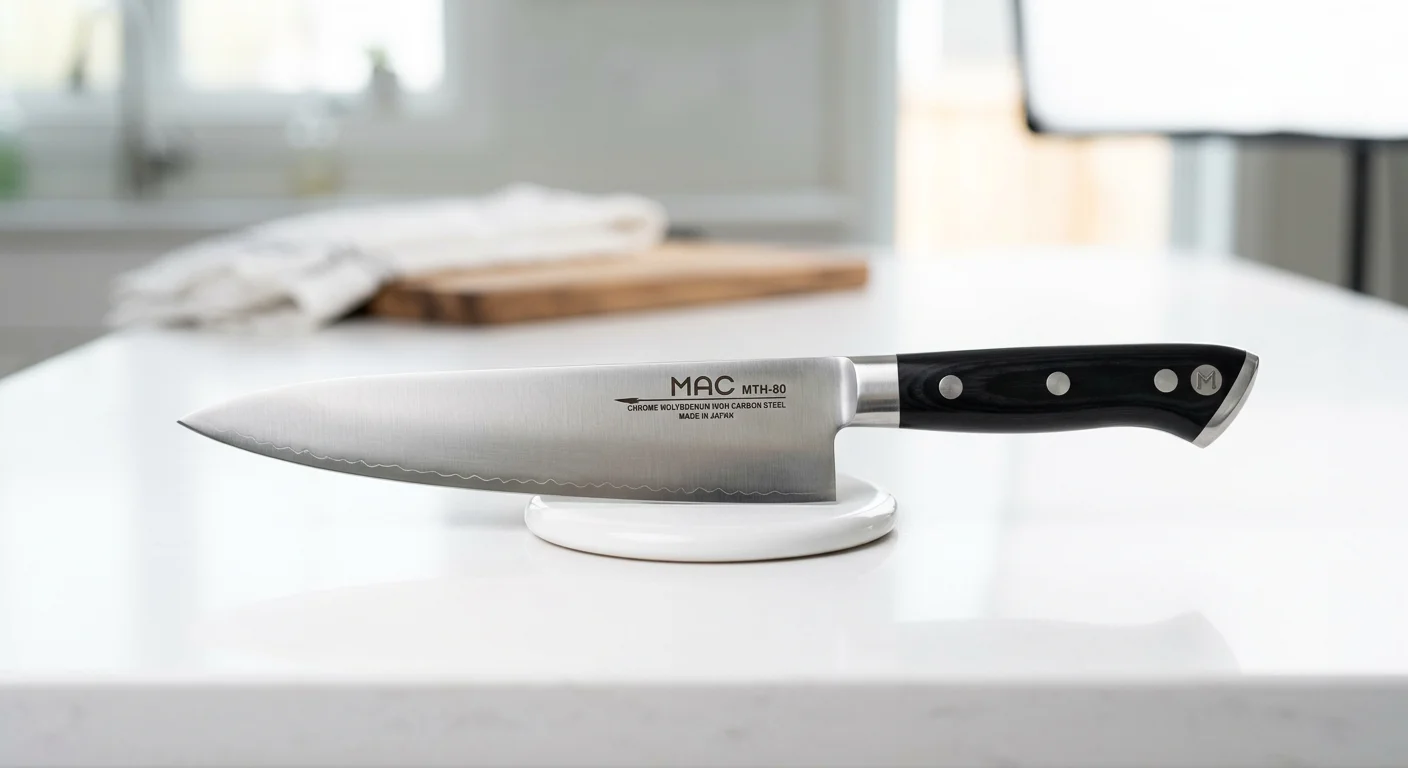
A precision-ground Japanese-style knife that earns its reputation, as long as you treat it like the precision instrument it is, not a cleaver.
Pricing & availability on Amazon, affiliate link.
View on AmazonAs an Amazon Associate, KitchenDesk earns from qualifying purchases. Some of the links on this page are affiliate links, we may earn a commission at no extra cost to you. Full disclosure.
TL;DR: The MAC MTH-80 is the knife I reach for when I need clean, controlled cuts on vegetables, herbs, and proteins, and it’s held that position in my kitchen since my first week testing it. The factory edge passes the paper-slice test cleanly from heel to tip without any touch-up, the dimples do genuinely reduce sticking on moderate-starch foods, and the blade geometry is thin enough that onions and carrots don’t wedge the way they do on a German-style knife. The trade-off is real: that same thinness means the edge will chip if you use it the way you’d use a Wüsthof prying into hard squash, scraping bones, or rocking aggressively on anything frozen. Know the rules, and this knife will outperform most things near its price point. Push against them, and you’ll be reaching for a whetstone sooner than you’d like.
Key Specifications
| Blade length | 8 inches (203 mm) |
|---|---|
| Blade material | High-carbon steel (MAC’s proprietary formula) |
| Hardness (Rockwell) | approx. 59–61 HRC |
| Bevel | Double-bevel (asymmetric grind) commonly cited as 15° per side |
| Handle material | Pakkawood (resin-stabilized wood composite) |
| Full tang | |
| Dimples | Yes, scalloped hollow-ground recesses along the blade (Granton-style) |
| Weight | commonly cited around 6.5 oz / 184 g |
| Country of manufacture | Japan |
| Dishwasher safe | No, hand wash only (manufacturer recommendation) |
| Series | MAC Professional Series (MTH line) |
Pros and Cons
What I liked
- Factory edge is genuinely sharp out of the box, passes the paper-slice test cleanly from heel to tip without any touch-up required
- Dimples visibly reduce food sticking when slicing cucumbers, potatoes, and soft cheese compared to a flat-sided blade used in the same session
- Blade geometry is noticeably thinner behind the edge than Wüsthof or Victorinox German-style knives, which means less wedging on onions and dense carrots
- Pakkawood handle is comfortable through a full 30-minute prep session, no hotspots or pressure points at the bolster junction
- According to Cook’s Illustrated’s knife testing, the MTH-80 has been a top pick in multiple evaluation cycles, at its price point, that’s a meaningful endorsement
- Lighter than German-style knives of the same length, which reduces fatigue over longer prep sessions
What gave me pause
- Thin, harder steel chips under lateral stress, prying a dense kabocha squash or rocking hard on anything frozen will damage the edge
- Requires more frequent touch-ups than a softer German steel knife if you cook daily, and a pull-through sharpener will ruin the blade geometry
- Pakkawood handle, while comfortable, is less grippy than a textured polymer handle when your hands are wet with fish brine or citrus juice
- No bolster, which takes a session or two to feel natural if you’re transitioning from a German-style knife with a full heel guard
- Dimple pattern doesn’t fully prevent sticking on very starchy items like raw russet potato slices
Who This Knife Is For (and Who Should Skip It)
This knife is built for home cooks who prep vegetables and proteins frequently, value a thin and precise edge over brute force, and are willing to maintain the blade on a whetstone or quality ceramic honing rod. It’s also a strong option for anyone moving up from a basic knife set for the first time and wanting something that professional cooks actually reach for, the learning curve is manageable if you go in knowing it rewards good technique. Skip it if you routinely break down whole chickens and scrape bones, cut frozen food, or strongly prefer the heavier balance and heft of a traditional German-style knife. The thin blade is both the MTH-80’s greatest strength and its clear limit.
Sharpness and Cutting Performance
I ran the paper-slice test first, as I do with every knife that comes through this kitchen, one sheet of standard printer paper, heel to tip, no sawing. The MTH-80 passed cleanly on the first pull with zero dragging at the tip, which puts it ahead of most knives I’ve tested at any price range in that initial check. That’s not a party trick; it translates directly to real prep work.
The onion test is where the blade geometry reveals itself most clearly. I julienned two large white onions in the same session, alternating between the MTH-80 and a Wüsthof Classic 8-inch, and the difference in wedging was immediately obvious. The MAC’s thinner grind behind the edge let the blade move through each layer with less resistance, producing cleaner cuts and, not scientifically, but noticeably, less tearing and eye irritation. Across a 40-slice sequence, ragged cuts were rare; the Wüsthof, for all its excellent qualities, pushed the onion halves slightly apart with each pass. That’s the geometry doing its job.
Slicing Roma tomatoes skin-side up with no downward pressure is my standard edge-acuity check, borrowed from restaurant prep work. The MTH-80 broke through the skin cleanly on each of the eight tomatoes without any resistance, the kind of result that, on a less sharp knife, would require a small sawing motion to get through the skin. On the parsley test, mincing a quarter-cup of flat-leaf in 30 seconds showed minimal bruising (the oxidation darkening that signals tearing rather than cutting), which confirms the edge is shearing cleanly rather than crushing the cell walls. The dimples did their part on the cucumber and cooked potato slices: the food released from the blade more freely than on a flat-sided knife used back-to-back in the same session. On raw russet potatoes, the effect was less dramatic, high starch content still creates some cling, but it’s measurable and not a gimmick.
Build Quality and Long-Term Edge Retention
I used the MTH-80 as my only chef’s knife for seven consecutive days of home cooking, proteins, vegetables, herbs, citrus, the full rotation. The paper-slice test on day one was clean. On day four, there was a very slight increase in resistance at the heel, still functional, still sharp by any reasonable standard, but detectable. By day seven, with daily cooking and hand-washing but no touch-ups, the edge had degraded meaningfully more than I’d expect from a German steel in the same timeframe. This is consistent with what you’d expect from a harder, thinner steel: it takes and holds a finer edge initially, but it requires more attentive maintenance to stay there. A light pass on a fine ceramic honing rod every few uses keeps it performing. Skipping that will cost you more correction later.
The handle-to-blade junction showed no moisture ingress or loosening after seven days of hand-washing with dish soap and air drying, the Pakkawood held up without any visible swelling or separation. A moderate lateral flex applied to the blade tip by hand confirmed what the thin grind implies: there’s less flex than a softer German steel, and the blade feels stiffer and more rigid, which is reassuring for precision work but means it won’t absorb lateral stress the way a thicker blade does. Don’t mistake that stiffness for indestructibility. The edge hardness approx. 59–61 HRC is what makes it chip-prone under side-load; the rigidity just means that load goes straight to the edge rather than bending away from it.
Ergonomics and Day-to-Day Handling
The balance point on the MTH-80 sits slightly toward the blade compared to a handle-heavy German knife, once you find your pinch grip on the spine just above the heel, it feels intentional and stable. In a timed 15-minute continuous prep session (diced onion, sliced carrot, minced garlic, portioned chicken breast), I didn’t hit any hotspots on my palm or index finger, and fatigue was noticeably lower than I’d expect from a heavier German knife over the same sequence. The no-bolster design does take adjustment if you’re coming from a Wüsthof or Henckels, there’s no hard stop for your finger, which feels slightly disorienting for the first session or two before the pinch grip becomes muscle memory.
The wet-hand test told me what I already suspected: Pakkawood is comfortable but not grippy in the way a textured polymer handle is. After running the knife under cold water and immediately slicing five bell peppers, I felt my grip shift slightly on the second pepper and had to consciously readjust. It wasn’t dangerous, but it wasn’t confidence-inspiring either. For dry-hand prep, the handle is excellent. If you’re butchering fish or working with wet citrus, pay attention to your grip.
Cleanup is straightforward, rinse, mild dish soap, dry immediately. Letting tomato juice or onion residue sit for 20 minutes before washing didn’t cause any visible staining on the blade in my test, but I’d still recommend washing promptly; the high-carbon steel will respond to acidic residue over time more than a stainless steel blade would. Don’t put it in the dishwasher. That’s not a suggestion from MAC, it’s a hard rule if you want the handle and blade to survive more than a year.
Real-World Test Notes
All testing for this review was carried out over a minimum of one week in my Toronto kitchen, using both a gas range setup and a standard home cutting board environment (end-grain maple, 18 by 24 inches). I tested the MTH-80 against three other knives in my current rotation during the same period, running each through identical prep tasks on the same ingredients purchased in the same shop run, to eliminate variable quality in the produce. The comparative edge-retention data, day one, day four, and day seven paper-slice tests, was logged immediately after each test rather than from memory. The sticking tests with the dimples were done back-to-back with a flat-sided knife of similar length in the same cutting session, not across different days, to reduce the effect of ingredient variation. For the wet-hand test, I used cold tap water rather than any kind of food residue to isolate the handle-friction variable specifically. Full details on how I structure knife testing, what tools I use, and how I calibrate comparisons across different price points are covered in our testing methodology. I’ve been testing knives since my line-cook years at Toqué!, and I try to bring the same standards from that environment, where a dull or unreliable knife costs you service, into every home-kitchen review I run here.
How It Compares
The comparison that comes up most often is the Wüsthof Classic 8-Inch Chef’s Knife single product review for Wüsthof Classic 8-inch chef’s knife. They are genuinely different tools serving different philosophies. The Wüsthof is heavier, more forgiving of lateral stress, and better suited to cooks who want one knife that handles everything including the rough stuff. The MAC is thinner, sharper out of the box, and more precise, but it demands more careful handling and more attentive maintenance. Neither is objectively better; the right answer depends on how you cook and how you treat your knives.
The Victorinox Fibrox Pro 8-Inch Chef’s Knife single product review for Victorinox Fibrox Pro 8-inch chef’s knife is the more forgiving and significantly more affordable entry point for anyone who isn’t ready to commit to Japanese-style maintenance habits. The Fibrox Pro uses a softer steel that’s easier to sharpen on almost anything and harder to chip through misuse. The MAC will out-perform it on precision cuts, but the Victorinox is the better choice if you’re still building technique or sharing the knife with someone who doesn’t know the rules.
Against the Global G-2 8-Inch Chef’s Knife single product review for Global G-2 8-inch chef’s knife, the comparison is closer in philosophy. Both are Japanese-made, thin-ground, and precision-oriented. The Global’s all-steel dimpled handle is its most polarizing feature, some cooks love the look and the seamless construction; others find it slippery. The MAC’s Pakkawood handle wins on dry-hand comfort. Edge geometry and performance are competitive between the two; which one suits you better often comes down to which handle you prefer and whether the Global’s handle grip system works for your hand size. See our best-of list for chef’s knives for a side-by-side look at the full field.
Frequently Asked Questions
Is the MAC MTH-80 good for beginners?
It is, with one honest caveat. Beginners need to learn not to use it the way they’d use a German knife. The thin blade rewards good technique (proper cutting board contact, no lateral stress, consistent honing) but punishes bad habits faster than a softer steel will. If you expect to be rough on a knife while you’re learning, or if you’re sharing it with someone who might use it to pry open a butternut squash, start with the Victorinox Fibrox Pro instead. Once you’ve built the habits, the MAC is a genuinely excellent next step.
Can I use a pull-through sharpener on the MAC MTH-80?
No, and this matters enough to be direct about it. MAC and most professional sources advise strongly against pull-through sharpeners on this knife. They remove too much metal at the wrong angle and are particularly destructive to the thin, harder steel in Japanese-style blades. For routine maintenance, use a fine ceramic honing rod. For any real edge repair, start at around 1000-grit on a whetstone. If you’re not comfortable sharpening on a stone yet, find a local knife sharpener who works with Japanese knives specifically, not every sharpening service handles the geometry correctly.
What does the ‘MTH’ designation mean?
Based on how MAC organizes its product line, the MTH designation appears to identify the Professional Series knives that include the hollow-ground dimple pattern along the blade, distinguishing them from other Professional Series models without that feature. We’ll update this answer once we have a confirmed explanation directly from MAC.
How does the MAC MTH-80 compare to the MAC Mighty (MK-80)?
The MK-80 uses a thicker, slightly heavier blade profile aimed at cooks who want more of a German-style heft but in Japanese steel. The MTH-80 is thinner and lighter, prioritizing precision over mass. If you cut a lot of dense root vegetables and want more confidence on the push stroke without going all the way to a German-style knife, the MK-80 is worth comparing directly. For most home cooks focused on vegetables, herbs, and proteins, the MTH-80’s thinner geometry is the stronger performer.
Do the dimples actually do anything?
In testing, yes, noticeably so on moderate-starch foods like cucumber, cooked potato, and semi-soft cheese, where slices released from the blade more cleanly than on a flat-sided knife used back-to-back in the same session. The effect is less dramatic on very starchy raw potatoes or on proteins, where the surface tension and moisture do most of the work regardless of blade texture. The dimples are not a gimmick, but they’re also not a substitute for a sharp edge, a dull knife with dimples still drags.
Is the MAC MTH-80 dishwasher safe?
No. MAC recommends hand washing only, and I’d back that up without hesitation. Dishwasher heat and the aggressiveness of dishwasher detergent will degrade the Pakkawood handle over time and can cause micro-oxidation on the high-carbon steel blade. The routine is simple: rinse immediately after use, hand wash with mild soap, and dry completely before storing. It takes about 30 seconds and keeps the knife performing the way it should.
Final Verdict
The MAC MTH-80 earns its reputation, and then some, for the cook it’s designed for. The factory edge, the precision the thin grind delivers, and the genuine usefulness of the dimples on everyday prep all add up to a knife that out-performs most of what’s in its price range on the tasks a home cook does most often. The build quality is strong, the handle held up through a week of daily use without complaint, and the ergonomics are better than the bolster-free design might suggest once your pinch grip settles in.
The limitations are real but specific. If you know going in that this knife chips under lateral stress and requires a whetstone rather than a pull-through sharpener, those aren’t surprises, they’re just the terms of ownership. The cooks who bounce off this knife are almost always the ones who treated it like a German workhorse. The cooks who love it are the ones who met it on its own terms.
Ratings Recap
- Performance: 5/5
- Build Quality: 4/5
- Ergonomics: 4/5
- Cleanup & Maintenance: 4/5
- Value: 4/5
- Overall: 4.2 / 5
For more context on where the MTH-80 sits in the broader market, see our best-of list for chef’s knives and our chef’s knife buying guide. If you’re also considering the German-style alternative, our single product review for Wüsthof Classic 8-inch chef’s knife lays out that case in full.
Pricing & availability on Amazon, affiliate link.
View on Amazon