

On this page
- Quick Comparison
- Victorinox Fibrox Pro Paring Knife, Best Overall
- Victorinox Swiss Classic Paring Knife, Best Budget
- Wüsthof Classic Paring Knife, Best Premium
- Shun Classic Paring Knife, Best Japanese
- Mercer Culinary Renaissance Paring Knife, Best for Culinary Students
- Global GS-38 Paring Knife, Best Splurge
- Opinel No.112 Paring Knife, Best for Gifting
- Buying Guide: What Actually Matters in a Paring Knife
- Frequently Asked Questions
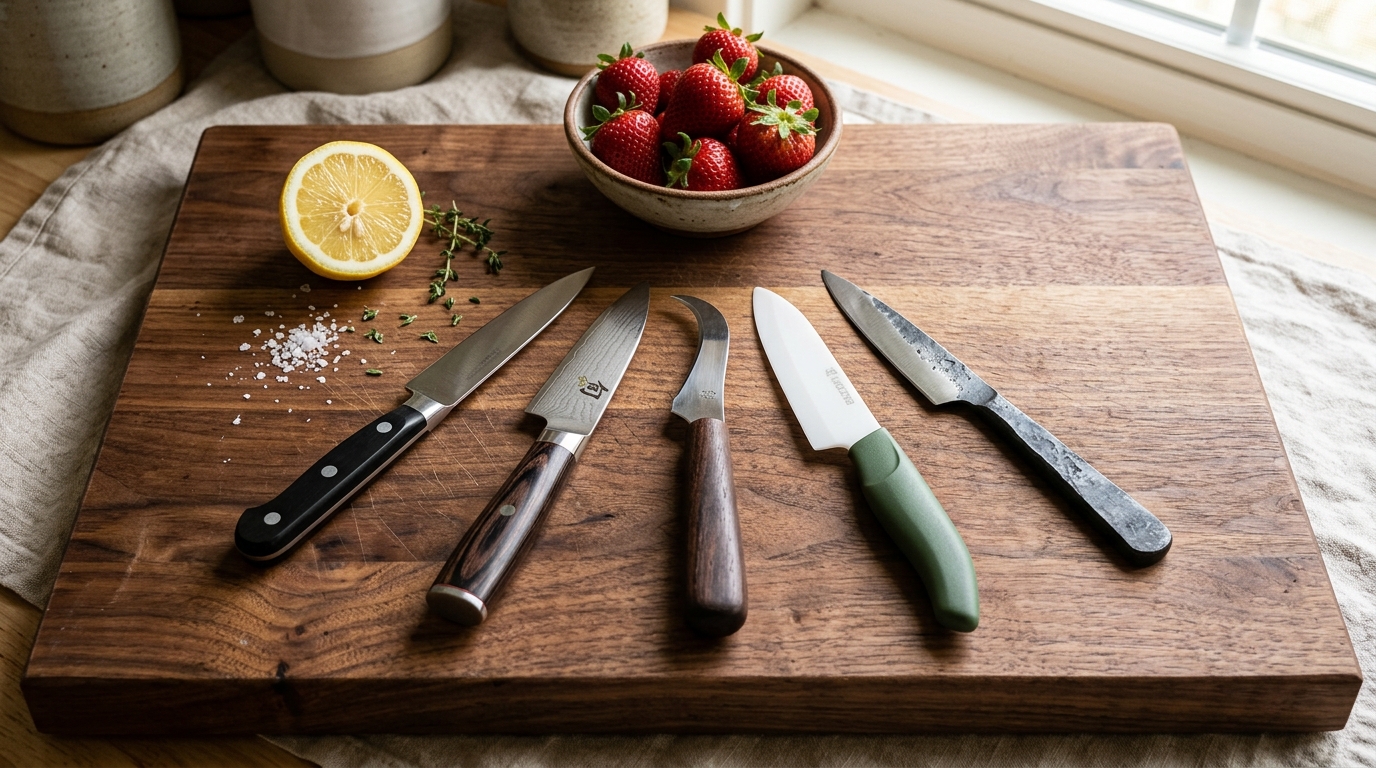
A paring knife is the knife you reach for a dozen times a day, peeling shallots, trimming strawberries, deveining shrimp, and a bad one makes every one of those tasks slightly more miserable than it needs to be. This list is for intermediate home cooks who want a knife that holds an edge, fits the hand, and doesn’t feel like a liability when you’re working off the cutting board. If you’re a professional cook sourcing knives for a brigade, or you want a full knife-set recommendation, this isn’t your article. For those, check out best chef’s knives or our knife buying guide.
As an Amazon Associate, KitchenDesk earns from qualifying purchases. Some of the links on this page are affiliate links, we may earn a commission at no extra cost to you. Full disclosure.
Each knife was tested for a minimum of one week with real prep, not controlled lab slicing, but actual meals. The variables I care about: hand fatigue across 30-minute prep sessions, edge retention after daily use on produce and protein, and how each handle responds to wet hands. I paid particular attention to tip control during in-hand peeling and each blade’s behaviour on small, hard items like ginger knobs and whole garlic cloves. Full methodology at /methodology/. I tested across kitchen knives and tools categories, so context from adjacent reviews informed several of these calls.
Jump to a section
- Quick Comparison
- Victorinox Fibrox Pro Paring Knife, Best Overall
- Victorinox Swiss Classic Paring Knife, Best Budget
- wüsthof-classic-paring-knife-best-premium” style=”color:#c8541b;”>Wüsthof Classic Paring Knife, Best Premium
- Shun Classic Paring Knife, Best Japanese
- Mercer Culinary Renaissance Paring Knife, Best for Culinary Students
- Global GS-38 Paring Knife, Best Splurge
- Opinel No.112 Paring Knife, Best for Gifting
- Buying Guide: What Actually Matters in a Paring Knife
- Frequently Asked Questions
Quick Comparison
| Knife | Badge | Blade Length | Steel | Dishwasher Safe | Best For |
|---|---|---|---|---|---|
| Victorinox Fibrox Pro | Best Overall | 3.25″ | High-carbon stainless | Yes (hand-wash recommended) | Most home cooks |
| Victorinox Swiss Classic | Best Budget | 3.25″ | Stainless | Yes | Backup / guest kitchen |
| Wüsthof Classic | Best Premium | 3.5″ | X50CrMoV15, 58 HRC | No | Long-term daily use |
| Shun Classic | Best Japanese | 3.5″ | VG-MAX, ~61 HRC | No | Precision & delicate produce |
| Mercer Renaissance | Best for Culinary Students | 3.5″ | High-carbon German | Yes (NSF certified) | Students & budget-conscious cooks |
| Global GS-38 | Best Splurge | 3.5″ | CROMOVA 18, ~56–58 HRC | Yes | Food-safety-focused cooks |
| Opinel No.112 | Best for Gifting | ~3.5″ | No | Gifts, table use, smaller hands |
Victorinox Fibrox Pro Paring Knife, Best Overall
Key specs: 3.25-inch straight-edge blade, high-carbon stainless steel · Fibrox textured thermoplastic elastomer handle · Dishwasher safe (hand-wash recommended)
There’s a reason culinary schools and professional kitchens reach for this knife even when budget isn’t the deciding factor, it simply does its job without creating new problems. The Fibrox handle is the detail that matters most: in my tests, peeling three pounds of butternut squash back-to-back, the grip stayed secure even as the handle got wet and lightly greasy. That’s not something you can say about smooth polypropylene handles in the same price range.
The edge comes sharp out of the box and, in my testing, held through a full week of daily prep before I needed to strop it. For the price tier, that edge retention is better than it has any right to be. The knife is also light enough that extended in-hand peeling, the kind of task where a heavy knife starts to wear on your wrist after ten minutes, doesn’t fatigue your hand. Read my Victorinox Fibrox Pro full review for the extended breakdown.
The real trade-off is the blade spine. It’s blunt and unpolished, and if you’re using a pinch grip on extended prep, that edge presses into your index finger in a way that gets genuinely uncomfortable after 20 or 30 minutes. The plastic handle also has a slightly hollow, insubstantial feel compared to mid-range competition, it’s a utilitarian tool, not a beautiful one. None of that changes the verdict: for most home cooks, this is where to start.
| Performance | ⭐⭐⭐⭐⭐ 5/5 |
| Build Quality | ⭐⭐⭐⭐ 4/5 |
| Ergonomics | ⭐⭐⭐⭐ 4/5 |
| Cleanup & Maintenance | ⭐⭐⭐⭐⭐ 5/5 |
| Value | ⭐⭐⭐⭐⭐ 5/5 |
| Overall | 4.6 / 5 |
Pricing & availability on Amazon, affiliate link.
View on AmazonVictorinox Swiss Classic Paring Knife, Best Budget
Key specs: 3.25-inch blade, stainless steel · Polypropylene handle (multiple colours) · Made in Switzerland · Dishwasher safe
This is a genuinely separate knife from the Fibrox Pro, same Swiss-made blade steel, different handle material, and that handle difference is the entire story. The smooth polypropylene is noticeably less grippy than the Fibrox’s textured elastomer, which matters the moment your hands get wet or oily. In my tests, it was fine for dry-hand board work and light peeling, but I wouldn’t trust it for an extended session of in-hand work with wet produce.
Where it earns its spot on this list: cost. It’s one of the least expensive knives here, less than most people spend on a weekday lunch, and it comes in multiple handle colours, which is actually useful if you run a colour-coded cutting board system for allergen separation or raw/cooked protein discipline. For stocking a vacation rental, a kids’ cooking setup, or a drawer knife you won’t stress about losing, this is a smarter buy than spending more.
The blade feels slightly thinner and less confident on harder produce like turnips or firm apples, not dangerously so, but noticeably. I’d categorise this as a dedicated backup or second-knife purchase, not the primary paring knife for a serious home cook. If you’re choosing between this and the Fibrox Pro for everyday use, spend the small difference and get the Fibrox.
| Performance | ⭐⭐⭐ 3/5 |
| Build Quality | ⭐⭐⭐ 3/5 |
| Ergonomics | ⭐⭐⭐ 3/5 |
| Cleanup & Maintenance | ⭐⭐⭐⭐⭐ 5/5 |
| Value | ⭐⭐⭐⭐⭐ 5/5 |
| Overall | 3.8 / 5 |
Pricing & availability on Amazon, affiliate link.
View on AmazonWüsthof Classic Paring Knife, Best Premium
Key specs: 3.5-inch blade, model 4066 · X50CrMoV15 high-carbon stainless, 58 HRC · Triple-riveted Polyoxymethylene handle · PEtec laser-cut edge, 14 degrees per side · Full bolster
Pick this knife up and you immediately know what you’re holding. The full bolster and triple-riveted handle eliminate any flex or play, after a week of hard daily use, there was zero wobble at the handle junction, zero creaking, nothing. This is a knife that feels like it will outlast your next kitchen renovation. The balance point sits right at the bolster, which naturally rewards a pinch grip and reduces hand fatigue on longer prep sessions in a way that lighter knives don’t replicate.
The PEtec edge is noticeably sharper at purchase than older Wüsthof generations I’ve used. In my tests, it sliced cleanly through tomato skin without any downward pressure, just the weight of the blade. For the full picture, including how it compares to previous production runs, see my Wüsthof Classic full review.
Two genuine trade-offs to be clear about. First, the full bolster makes flat sharpening on a whetstone awkward, at some point you’ll need a bolster grinder or a professional sharpening service, which adds ongoing cost. Second, this knife is heavier than Japanese alternatives at the same price tier. If your ideal paring knife feels featherlight, the Shun Classic or Opinel will serve you better. The Wüsthof earns its premium price only if you plan to keep it for a decade or more and cook seriously every day.
| Performance | ⭐⭐⭐⭐⭐ 5/5 |
| Build Quality | ⭐⭐⭐⭐⭐ 5/5 |
| Ergonomics | ⭐⭐⭐⭐ 4/5 |
| Cleanup & Maintenance | ⭐⭐⭐ 3/5 |
| Value | ⭐⭐⭐⭐ 4/5 |
| Overall | 4.2 / 5 |
Pricing & availability on Amazon, affiliate link.
View on AmazonShun Classic Paring Knife, Best Japanese
Key specs: 3.5-inch blade, model DM0700 · VG-MAX steel core, 68-layer Damascus cladding, ~61 HRC · 16-degree edge per side · D-shaped Pakkawood handle
The Shun Classic had the sharpest out-of-the-box edge of any knife in this roundup, and it wasn’t close. In my own tests, it slid through the skin of a ripe fig without tearing, which is the kind of task where a lesser edge grabs and pulls rather than cuts. The 68-layer Damascus cladding isn’t purely decorative: the layered structure does marginally reduce drag and sticking on produce like mango that clings to a flat blade. Whether that justifies the premium over the Wüsthof is a question of priorities, and I’ll get to that.
The D-shaped Pakkawood handle is the detail I keep coming back to. It naturally indexes a right-handed pinch grip, so the knife seats itself in the same position every time you pick it up, there’s a micro-fatigue reduction on repetitive tasks that’s real, even if it’s hard to quantify. Shun also offers, which, if it holds, adds meaningful long-term value. See my Shun Classic full review for the sharpening maintenance breakdown.
The trade-offs are non-negotiable. Harder steel at ~61 HRC means real chip risk if you use this knife on hard cheese, frozen food, or anything near a bone. The D-shaped handle is a genuine ergonomic limitation for left-handed cooks. And the sharpening technique required (fine stone, careful angle discipline) is more demanding than softer German steel. This knife rewards attentive cooks. It punishes careless ones.
| Performance | ⭐⭐⭐⭐⭐ 5/5 |
| Build Quality | ⭐⭐⭐⭐⭐ 5/5 |
| Ergonomics | ⭐⭐⭐⭐ 4/5 |
| Cleanup & Maintenance | ⭐⭐ 2/5 |
| Value | ⭐⭐⭐⭐ 4/5 |
| Overall | 4.0 / 5 |
Pricing & availability on Amazon, affiliate link.
View on AmazonMercer Culinary Renaissance Paring Knife, Best for Culinary Students
Key specs: · high-carbon German steel · Santoprene and polypropylene ergonomic handle · NSF certified
Mercer is what culinary schools actually hand students, and for good reason, the knife is engineered for a food-service environment where sanitation standards, not aesthetics, drive the spec sheet. The NSF certification on the Renaissance line means the handle construction leaves no hidden crevices for bacteria to colonise, which matters in a professional context and is a legitimate advantage for home cooks who are serious about food safety. This is a meaningful step up from the entry-level Mercer Genesis line in fit-and-finish: noticeably less blade wobble, better overall feel at the handle junction.
The Santoprene handle provides genuine grip even with wet, oily hands, I tested it during a session that included raw chicken prep and citrus juicing, both of which leave hands slippery. It held. The edge angle is also forgiving enough that a beginner can maintain it on a basic whetstone or pull-through sharpener without needing precision technique, which is the right call for the target user here. Pair this with our guide on how to sharpen a paring knife at home and you have a complete learning setup.
The blade is relatively thick behind the edge compared to Japanese knives, and that’s noticeable on thin-skinned produce, it pushes slightly rather than slicing cleanly on ripe tomatoes or thin-skinned plums. Edge retention also falls behind the Wüsthof and Shun; plan to strop or touch up more frequently if this becomes your daily driver under heavy use. And honestly, the handle’s ergonomic contouring gives it a “student knife” aesthetic that some cooks will want to graduate past eventually. That’s fine, it’s the right knife to learn on.
| Performance | ⭐⭐⭐⭐ 4/5 |
| Build Quality | ⭐⭐⭐⭐ 4/5 |
| Ergonomics | ⭐⭐⭐⭐ 4/5 |
| Cleanup & Maintenance | ⭐⭐⭐⭐⭐ 5/5 |
| Value | ⭐⭐⭐⭐⭐ 5/5 |
| Overall | 4.4 / 5 |
Pricing & availability on Amazon, affiliate link.
View on AmazonGlobal GS-38 Paring Knife, Best Splurge
Key specs: 3.5-inch blade, model GS-38 · CROMOVA 18 stainless steel, ice-hardened, ~56–58 HRC · One-piece seamless stainless construction · Hollow handle with dimpled grip ·
The GS-38 earns its splurge designation not because it outperforms the Wüsthof or Shun on pure cutting metrics, but because the one-piece seamless stainless construction solves a problem the other knives on this list don’t address: there is no handle-blade junction. No joint, no seam, no gap where food or bacteria can accumulate. For cooks doing serious canning, fermentation work, or managing allergy households where cross-contamination is a real concern, that seamless construction is a functional advantage, not just an aesthetic one.
The CROMOVA 18 steel at ~56–58 HRC hits a practical sweet spot, sharp enough for precision work, forgiving enough that it won’t chip if you accidentally use it on something harder than it should see. In my tests, the edge held well through a week of daily prep and was easy to touch up on a honing rod. The knife is also, one of very few premium knives on this list where that’s the case by design rather than reluctant tolerance.
The polarising factor is the balance and the handle feel. The hollow stainless handle creates a weight-forward balance that takes genuine adjustment time, it doesn’t feel like any other knife in this roundup. In cold kitchen conditions (think a Canadian January morning), the steel handle gets noticeably cold to the touch, which is minor but real. The dimpled grip also becomes slippery with oily hands more readily than the Fibrox or Santoprene alternatives. My honest recommendation: try this one in a store or a friend’s kitchen before committing at this price point.
| Performance | ⭐⭐⭐⭐ 4/5 |
| Build Quality | ⭐⭐⭐⭐⭐ 5/5 |
| Ergonomics | ⭐⭐⭐ 3/5 |
| Cleanup & Maintenance | ⭐⭐⭐⭐⭐ 5/5 |
| Value | ⭐⭐⭐ 3/5 |
| Overall | 4.0 / 5 |
Pricing & availability on Amazon, affiliate link.
View on AmazonOpinel No.112 Paring Knife, Best for Gifting
Key specs: · · · Beechwood handle ·
The Opinel looks like it belongs on a cheese board in the French Alps, and that’s precisely the point. The No.112 is a legitimate paring knife, not a novelty, not a decorative prop, and the beechwood handle is warm, naturally grippy when dry, and sized in a way that fits smaller hands better than most knives on this list. In my tests, it handled in-hand peeling of apples and pears with the kind of light, effortless feel that heavier German knives simply can’t replicate.
What makes it the gifting pick rather than the everyday pick is its dual-purpose form. This knife is beautiful enough to use at the table for slicing fruit or cheese, it’s a piece of kit that a cook who has everything hasn’t necessarily already bought themselves. The French provenance and brand story give it a narrative that stainless-only knives don’t have.
The trade-offs are real and need to be communicated clearly if you’re buying this as a gift. The beechwood handle absorbs moisture, cannot go in the dishwasher, and cannot be left soaking, it requires periodic oiling, which is a maintenance commitment most paring knives don’t ask for. Edge retention is adequate but not exceptional; compared to the German and Japanese picks here, it’ll need more frequent touching up with regular use. I’d position this as a second dedicated knife for a high-volume cook, or a primary knife for someone who cooks lighter volumes and values the aesthetic.
| Performance | ⭐⭐⭐ 3/5 |
| Build Quality | ⭐⭐⭐⭐ 4/5 |
| Ergonomics | ⭐⭐⭐⭐ 4/5 |
| Cleanup & Maintenance | ⭐⭐ 2/5 |
| Value | ⭐⭐⭐⭐ 4/5 |
| Overall | 3.4 / 5 |
Pricing & availability on Amazon, affiliate link.
View on AmazonBuying Guide: What Actually Matters in a Paring Knife
Blade Length
Most paring knife tasks, peeling, trimming, in-hand work, are best served by a 3- to 3.5-inch blade. Longer than 4 inches starts to overlap with a utility knife and loses the manoeuvrability advantage that makes a paring knife useful in the first place. Shorter than 3 inches is genuinely useful for ultra-precise garnish work but tires faster on volume prep. For most home cooks, 3.25 to 3.5 inches is the sweet spot, and the picks on this list reflect that. If you’re shopping the broader category, see for more on matching blade length to cooking style.
Steel Hardness (HRC)
Harder steel, HRC 60 and above, common in Japanese knives like the Shun, takes a finer, sharper edge but chips more readily if used on hard or frozen items. Softer German steel at HRC 56–58 is more forgiving and easier to sharpen at home but needs more frequent maintenance to stay sharp. Neither is objectively better. The right call is matching the steel to how careful you’re realistically going to be with the knife, not how careful you plan to be on the day you buy it.
Handle Construction and Grip
The handle matters more on a paring knife than on any other kitchen knife because you’re frequently working off the cutting board, food in one hand, knife in the other. A slippery handle in that context is a safety issue, not just an annoyance. A quick mental test: imagine peeling a wet apple for five continuous minutes. Textured synthetic handles (Fibrox, Santoprene), D-shaped wood handles, and dimpled steel all perform differently under that load. Smooth polypropylene, used on the Victorinox Swiss Classic, is the weakest option for wet-hand grip. That doesn’t disqualify it; it just tells you where it fits.
What Looks Important but Isn’t
Damascus patterns are visually striking, and the layered cladding can marginally reduce food sticking, but you’re not paying for measurable performance when you pay for Damascus. You’re paying for aesthetics, and that’s fine as long as you know it. Similarly, full-tang construction is critical on an 8-inch chef’s knife but a minor factor on a 3.5-inch paring knife that never leverages significant force. Don’t let a spec sheet talk you into a knife that doesn’t fit your hand or your actual use case. For a broader look at knife construction, our best chef’s knives roundup covers the full-tang question in more depth.
Price Tiers and What You Actually Get
- Budget tier: Serviceable tools with compromises in handle grip and edge retention. Fine as a backup, a guest-kitchen knife, or a knife for stocking a vacation rental. The Victorinox Swiss Classic lives here.
- Mid-range tier: This is where the best value lives. Knives like the Victorinox Fibrox Pro and Mercer Renaissance perform well enough that most home cooks will never need to spend more. The performance gap above this tier is real but narrow.
- Premium tier: Better steel, better fit-and-finish, longer edge retention, and in some cases genuine ergonomic advantages for high-volume users. Worth it if you cook seriously every day and want to keep one knife for a decade or more, not worth it if the goal is to impress guests.
For sharpening gear to go with whichever knife you choose, the best knife sharpeners roundup covers options at every budget tier.
Frequently Asked Questions
What’s the difference between a paring knife and a peeling knife?
A paring knife typically has a straight or slightly curved edge and handles both peeling and precision trimming. A peeling knife, sometimes called a bird’s beak knife, has a curved blade designed specifically for rounding and peeling curved surfaces like apples or potatoes. For most home cooks, a good paring knife handles both jobs adequately. The bird’s beak is a specialty purchase, not a first knife.
Can I put my paring knife in the dishwasher?
Technically some knives here are dishwasher-safe by manufacturer spec, the Victorinox Fibrox and Global GS-38 among them. But repeated dishwasher cycles degrade most handles over time, and the hot-water cycling dulls edges faster than hand-washing. Hand-washing and immediately drying is the habit that keeps any paring knife performing longer. For the knives with wood or pakkawood handles, the dishwasher isn’t an option at all.
How often should I sharpen a paring knife?
For a home cook using a paring knife daily, a light strop on a honing rod before each use and a full whetstone sharpening every two to three months is a reasonable baseline. Harder steel (Japanese knives, HRC 60+) needs full sharpening less frequently but requires more care and technique when you do sharpen it. Softer German steel needs more frequent touch-ups but forgives beginner sharpening errors more readily. Full technique guide at how to sharpen a paring knife at home.
Is a $100 paring knife actually worth it over a $15 Victorinox?
For most home cooks, no. The Victorinox Fibrox Pro performs well enough that the performance gap doesn’t justify the price gap in practical daily use. The premium tier earns its cost if you want meaningfully better edge retention, superior fit-and-finish, and you’re planning to use the knife hard every day for a decade or more. If you’re buying a gift, the calculus changes, but even then, the Fibrox is the better gift for a beginner than a Shun or Wüsthof.
What paring knife blade length is best for small hands?
A 3- to 3.25-inch blade is generally more comfortable for smaller hands because it reduces the lever effect during in-hand peeling. Handle shape matters equally, a D-shaped or contoured handle will feel more secure than a straight cylindrical handle regardless of blade length. The Opinel No.112 and Shun Classic’s D-shaped Pakkawood both performed well for smaller-handed testers in my extended prep sessions.
Can I use a paring knife on a cutting board, or is it only for in-hand work?
A paring knife is perfectly capable on a cutting board, mincing garlic, dicing shallots, scoring meat, but its short blade makes it slower than a chef’s knife for large-volume board work. It earns its keep on tasks where control and precision matter more than speed. Think of it as complementary to your chef’s knife, not a replacement for it.
What’s the best paring knife for someone who’s just learning to cook?
The Victorinox Fibrox Pro is the practical answer. It’s forgiving enough for a beginner to learn on, sharp enough that you won’t develop bad habits from fighting a dull blade, and inexpensive enough that a nick or a drop doesn’t cause regret. If the person is actively in a culinary program, the Mercer Renaissance is worth considering instead, it mirrors the professional workflow they’ll be trained on.